Caffeine pouches are one of the fastest-growing ways to get energy without drinking anything, but most of them tell you almost nothing about what is inside. You get a milligram number on the front of the tin, maybe a flavor name, and that is about it. The differences that actually matter, like how long a pouch lasts, whether anything smooths the caffeine, and what you are truly paying per dose, are buried or missing entirely.
This guide breaks down the criteria you should check before buying any caffeine pouch. Not brand rankings. Not a "top five" list. Just the specific things that separate a good product from a marketing wrapper around raw caffeine.
A disclosure, up front: Roon makes a caffeine pouch, and the Roon team wrote this guide. We will be fair anyway. Where our own product has a genuine trade-off, like offering only one flavor or being built for a long, steady window rather than a short burst, we will say so plainly. If you want the brand-by-brand ranking instead, we have that too: Best Caffeine Pouches Ranked (2026).
Key takeaways
- Dose per pouch, not per tin, is the number that matters. Some brands print total caffeine per tin or per "serving" of two pouches. If the label does not show you the milligrams in a single pouch, that is a red flag.
- Caffeine alone is fast in, fast out. A pouch that pairs caffeine with L-theanine and a duration-extending compound like Dynamine® will feel different from one that is just caffeine and flavoring.
- Cost per pouch is more honest than cost per tin. A $6 tin with 10 pouches costs $0.60 each. A tin with 15 pouches at $1.00 per pouch (from a one-time 4-tin bundle) looks pricier, but which is "cheaper" depends on how many hours of focus each one actually delivers.
- Nicotine-free is a product fact, not a health claim. If you want zero nicotine, confirm it on the label. Not every energy pouch is nicotine-free by default.
Why most caffeine pouches feel the same (and wear off too fast)
The majority of caffeine pouches on the market use the same basic formula: caffeine, a sweetener, a flavoring agent, and filler material to give the pouch its shape. That is not inherently bad. Caffeine works. The problem is that caffeine alone, delivered through the oral mucosa, gives you a spike that peaks quickly and fades within a few hours.
Here is why. When you swallow caffeine in coffee or an energy drink, it has to pass through the stomach and small intestine before it reaches your bloodstream. Peak plasma concentration typically arrives 30 to 60 minutes after ingestion. An oral pouch, held against the gum or under the lip, lets caffeine absorb through the buccal mucosa and bypass the gut entirely. That is why pouches hit faster, often within 5 to 10 minutes.
But faster onset does not mean longer effect. Caffeine's half-life in a healthy adult averages about 5 hours, which means the felt energy window from a single moderate dose is typically 3 to 4 hours. After that, you are either reaching for another pouch, another coffee, or just riding the fade.
So the question is not really "which pouch has the most caffeine." It is: what else is in the pouch, and does it extend or refine what the caffeine does?
Most pouches do not even try to answer that question. They compete on milligrams and flavors. That is fine if you just want a quick hit. But if you are choosing a caffeine pouch as your primary daily energy source, the formula matters more than the dose.
The criteria that actually separate caffeine pouches
Here is the buying framework, criterion by criterion. Use it on any brand.
| Criterion | Why it matters | What good looks like |
|---|---|---|
| Caffeine dose per pouch | Your body responds to mg, not branding. Too low and you feel nothing; too high and you get jittery. | 50 to 150 mg per pouch, clearly printed per unit. 80 mg is roughly one small cup of coffee. |
| Companion ingredients | Caffeine alone gives you alertness plus jitters plus a fast fade. Pairing it with L-theanine or other compounds changes the quality of the effect. | At minimum, L-theanine in a meaningful dose. Better: a full stack designed for duration and smoothness. |
| Duration mechanism | A pouch that lasts 2 hours sends you back to the tin twice as often as one that lasts 6. | Look for Dynamine® or similar compounds with published PK data showing extended caffeine half-life. |
| Pouch count per tin | Brands use different counts (10, 15, 20) to make price comparisons harder. | Do the math yourself: price ÷ pouches = true cost per dose. |
| Cost per pouch | The honest unit of comparison. | Varies by formula complexity. A plain caffeine pouch will cost less than a multi-ingredient stack. Both can be good value depending on what you need. |
| Sweetener and flavor | You will have this in your mouth for 15 to 30 minutes. Ingredients should be disclosed. | Named sweetener on the label. If it uses sucralose, it should say so. If it uses sugar, you should know that too. |
| Nicotine content | Some "energy" pouches still contain nicotine. If you want none, verify it. | Explicitly labeled nicotine-free and tobacco-free. |
| Third-party testing | An oral pouch goes directly against your mucosa. You want to know what is in it. | A Certificate of Analysis (COA) from an independent lab, ideally accessible on the brand's site. |
Caffeine dose: the number that matters most (and how brands hide it)
The right caffeine dose depends on your tolerance and your goals. For reference, a small cup of brewed coffee contains roughly 80 to 100 mg. Most caffeine pouches land between 50 mg and 200 mg per pouch.
The issue is disclosure. Some brands list caffeine per "serving," and a serving might be two pouches. Others list the total per tin. A few list a proprietary blend weight without breaking out the caffeine separately. If you cannot find the milligrams per single pouch on the label or the product page, move on.
Higher is not better. A 200 mg pouch will hit hard, but it also brings more jitters, a steeper crash, and a narrower window before you are either wired or fading. If the formula includes ingredients that extend caffeine's effect, a lower dose can deliver more total productive hours.
Companion ingredients: the difference between caffeine and a formula
The most studied caffeine companion is L-theanine, an amino acid found naturally in tea leaves. A 2010 study by Giesbrecht et al. published in Nutritional Neuroscience found that the combination of L-theanine and caffeine improved cognitive performance and increased subjective alertness compared to placebo. L-theanine does not cancel the caffeine. It refines it: you keep the alertness, but the jittery, scattered edge softens.
Research ratios vary. Many prominent studies use a 1:2 caffeine-to-L-theanine ratio (for example, the Giesbrecht study used 40 mg caffeine with 97 mg L-theanine). A pouch with 80 mg caffeine and 10 mg L-theanine is not the same as one with 80 mg caffeine and 60 mg L-theanine. Check the actual milligrams.
Beyond L-theanine, some pouches include Dynamine® or TeaCrine®, two methylurate compounds related to caffeine. These have different roles, and they are worth understanding.
Duration: why some pouches last 2 hours and others last 6 to 8
This is the criterion most buyers overlook, and it changes the entire value equation.
Caffeine alone has a half-life of about 5 hours, but the felt alertness from a moderate dose fades well before that. Most people get 3 to 4 useful hours from a cup of coffee or a plain caffeine pouch.
Dynamine® changes this. A randomized, double-blind, crossover pharmacokinetic study (n=12) found that when 100 mg of Dynamine® was co-administered with 150 mg of caffeine, caffeine's oral clearance dropped from 41.9 to 17.1 L/hr and its half-life extended from 7.2 to 15 hours, with no increase in peak concentration. Same peak, longer tail. That study used doses considerably higher than what most pouches contain (for example, Roon uses 25 mg Dynamine® with 80 mg caffeine, roughly four times less Dynamine® and about half the caffeine). The mechanism is the same, but the magnitude of the PK shift at lower doses has not been independently measured. Roon's claimed 6 to 8 hour felt window is based on the company's own user-experience data, not on this study's specific doses.
To be precise: a 15-hour half-life does not mean 15 hours of felt energy. Half-life is a clearance metric, not a subjective experience metric. The practical outcome, based on user reports and Roon's own testing, is 6 to 8 hours of steady alertness from a single pouch.
The trade-off is real. A longer duration means you should not take it late in the day. If you use a Dynamine®-containing pouch, stop at least 8 hours before bed.
TeaCrine® plays a different role. It does not extend caffeine's pharmacokinetics the way Dynamine® does. Its primary advantage is that, unlike caffeine itself, TeaCrine® has not shown habituation effects over 8 weeks of daily use at doses up to 300 mg/day (Taylor et al., 2016, Journal of the International Society of Sports Nutrition). That does not mean a product containing TeaCrine® is "tolerance-free," because it still contains caffeine. But the TeaCrine® component does not lose its edge the way caffeine alone tends to.
Cost per pouch: the number most brands want you to ignore
A tin of caffeine pouches might cost anywhere from $5 to $25. That number is almost meaningless without knowing how many pouches are inside and how long each one works.
Here is how to compare honestly. Divide the price by the pouch count. A $6 tin with 10 pouches costs $0.60 per pouch. A 15-pouch tin at $1.00 per pouch (the one-time 4-tin bundle price for Roon) looks more expensive per unit.
But if the $0.60 pouch lasts 2 hours and the $1.00 pouch lasts 6 to 8, the cost per hour of useful energy flips. The "expensive" pouch costs roughly $0.13 to $0.17 per hour. The "cheap" one costs $0.30 per hour, and you need three of them to cover the same window.
This is not an argument that expensive is always better. A plain caffeine pouch is a perfectly good product for someone who wants a quick 2-hour boost. The point is that price per tin is a bad comparison metric. Price per hour of effect is a better one.
Sweetener, flavor, and what is in your mouth
You will hold a caffeine pouch against your gum for 15 to 30 minutes. What it tastes like matters, and what it is sweetened with matters more.
Most caffeine pouches use either sucralose (a zero-calorie artificial sweetener) or sugar alcohols like xylitol. A few use sugar. The Roon pouch, for full transparency, uses sucralose and artificial flavoring in its Cool Mint formula. It is zero sugar, but it is not "all natural" or unsweetened.
If a brand does not disclose its sweetener on the product page, that is worth questioning. You are absorbing whatever is in the pouch directly through your mouth tissue.
Nicotine-free status and third-party testing
If you specifically want a nicotine-free pouch, verify it. The energy pouch and nicotine pouch markets overlap, and some brands sell both under the same name. "Energy" on the label does not guarantee zero nicotine.
Third-party testing means an independent lab has verified that the pouch contains what the label says, at the amounts the label says, and nothing it should not. Look for a Certificate of Analysis (COA). Brands that test will usually say so prominently; brands that do not will usually say nothing.
What Roon actually puts in the pouch
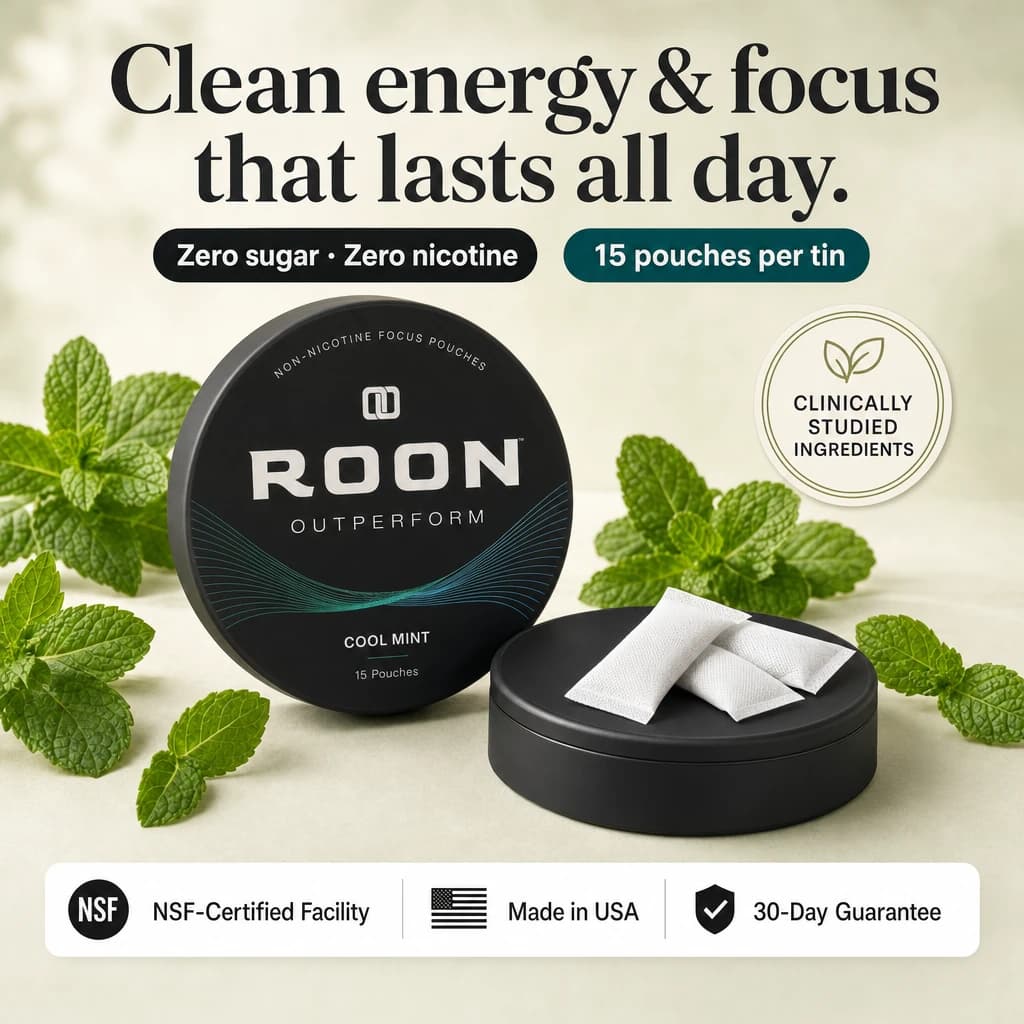
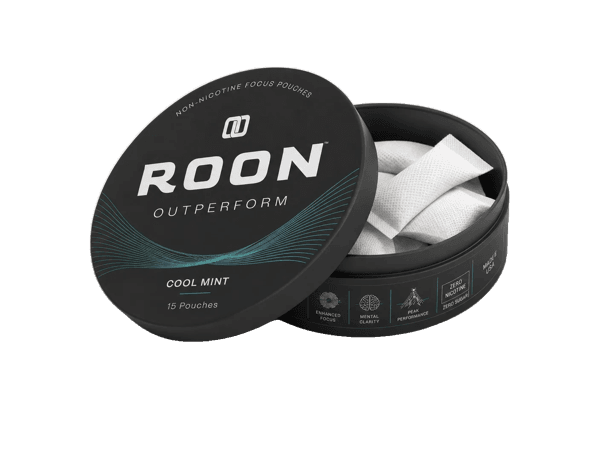
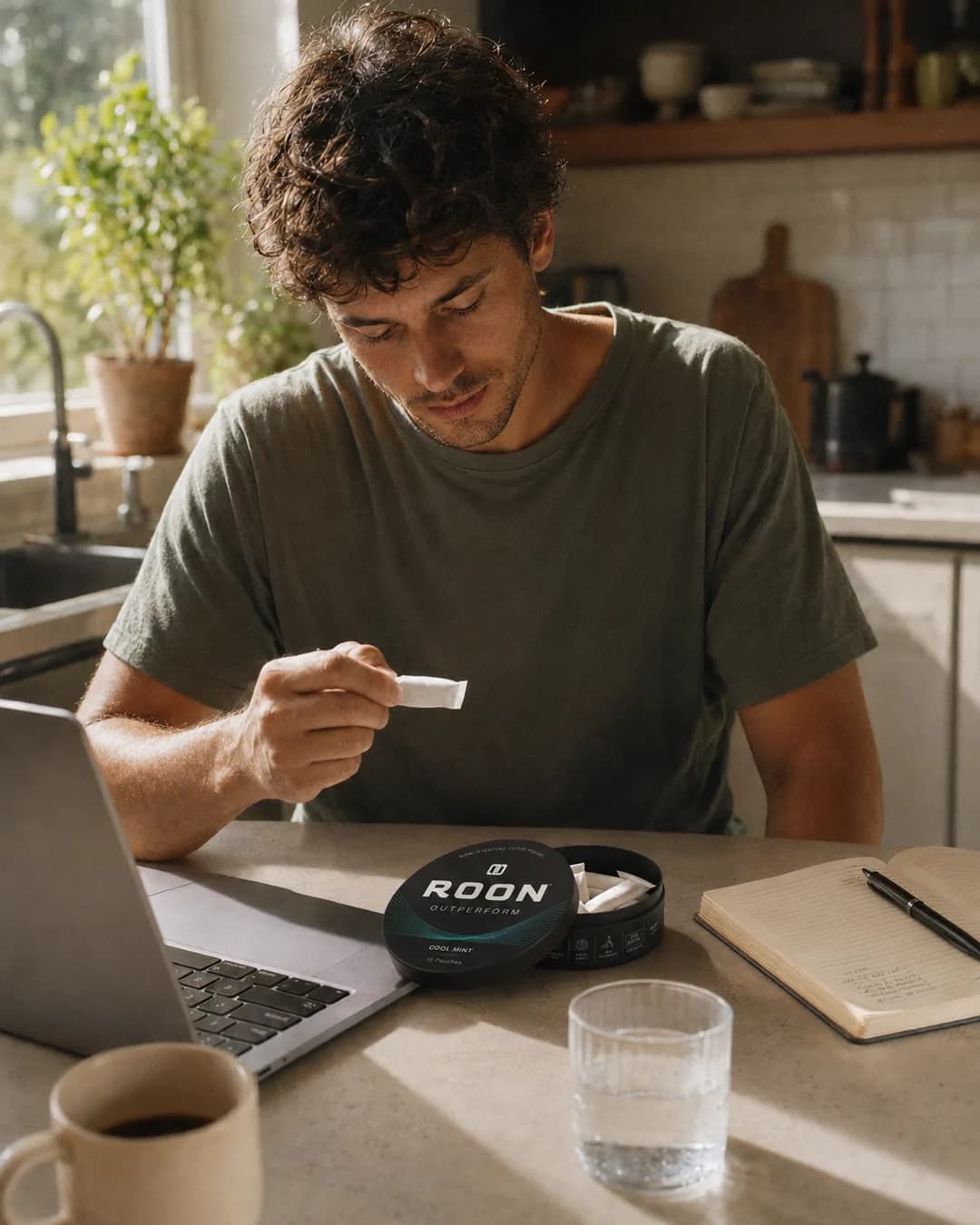
Roon is a zero-nicotine, zero-tobacco oral pouch built around a four-ingredient nootropic stack. Here is the full formula per pouch:
- 80 mg caffeine (roughly one small cup of coffee)
- 60 mg L-theanine (a 4:3 caffeine-to-theanine ratio; research ratios vary, with many studies using 1:2, so Roon's formula has relatively more caffeine than most study designs)
- 25 mg Dynamine® (the compound that extends caffeine's duration without increasing peak stimulation)
- 5 mg TeaCrine®, from material standardized to 40%
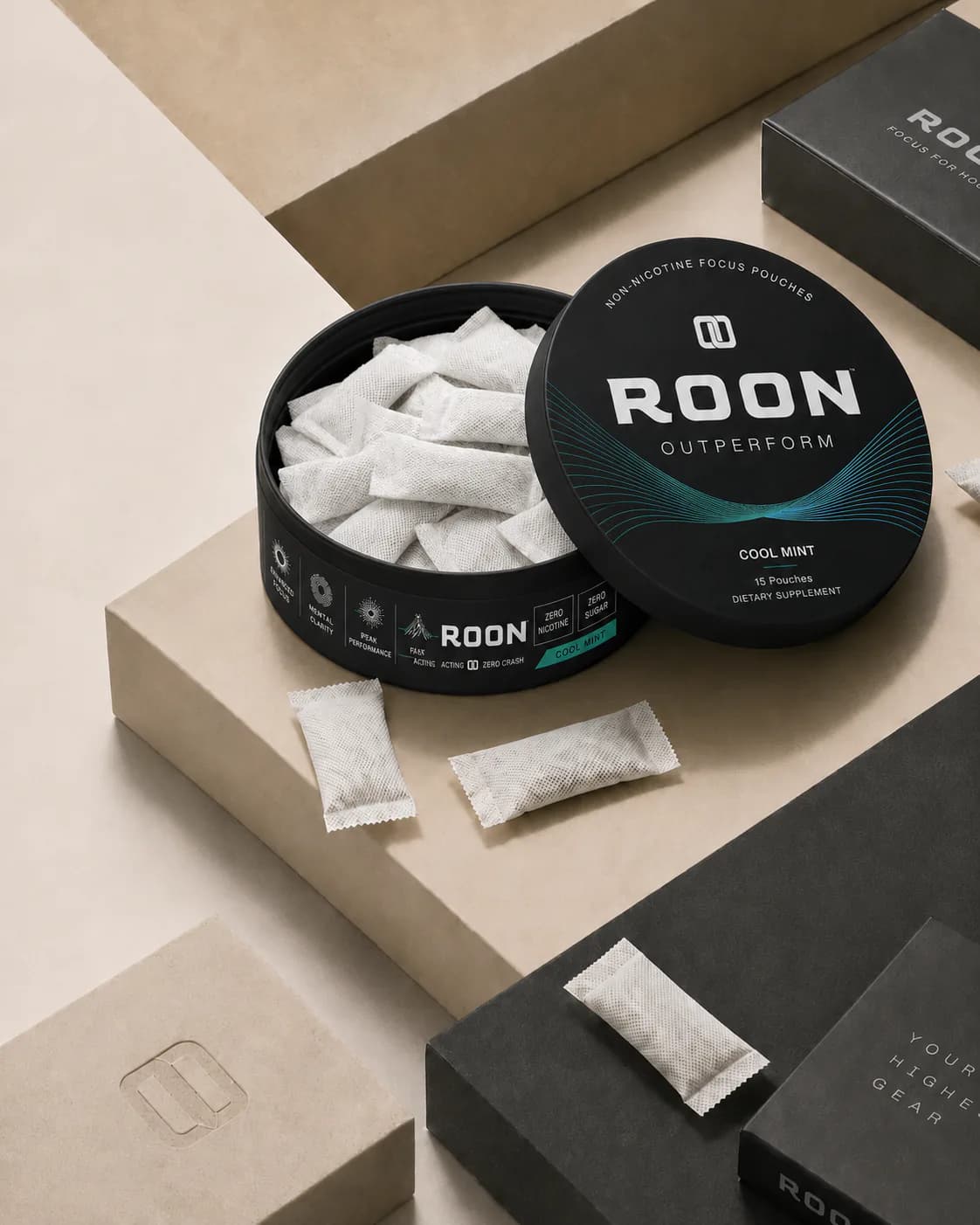
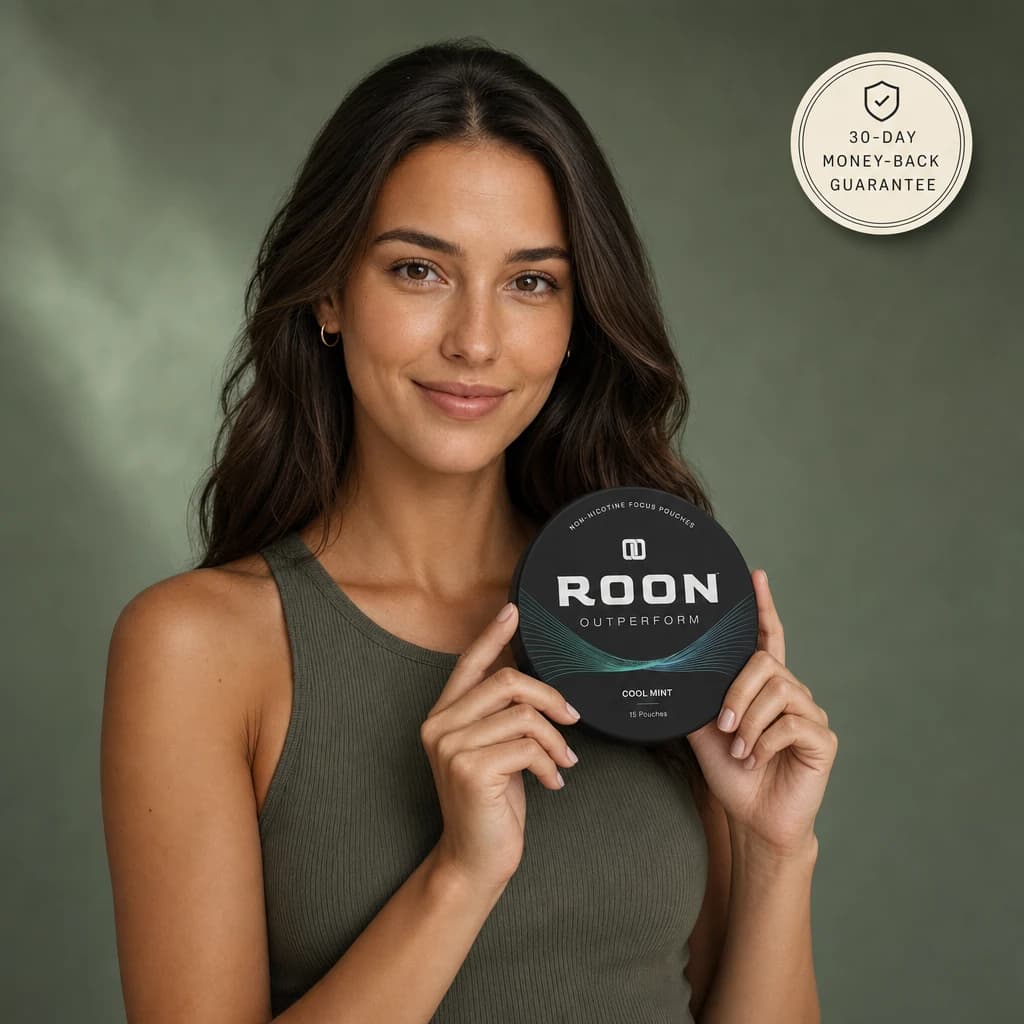
Each tin contains 15 pouches in Cool Mint, the only flavor available. Roon is sold as a single tin ($19.99) or in multi-tin bundles. The one-time price is $15.00 per tin ($1.00 per pouch). Subscriptions bring the price as low as $9.16 per tin ($0.61 per pouch). The product is sweetened with sucralose, not sugar.
The functional profile: onset in 5 to 10 minutes, peak effect at 30 to 60 minutes, felt duration of 6 to 8 hours. No liquid, no brewing, no sugar, no nicotine. Roon calls its combined stack a "2.5x caffeine effect," which is the brand's own characterization of how the four ingredients work together, not an independent clinical finding about the finished product.
The design trade-offs are deliberate. One flavor means one formula to optimize rather than a line of variants. A long duration window means this is not the pouch for a 30-minute energy bump before a short meeting. And the multi-ingredient stack costs more per pouch than a plain caffeine pouch, because the ingredients cost more to source. If all you need is cheap, fast caffeine, a simpler product may be the right call.
What Roon is not: it is not a substitute for sleep, food, or medical care. It is a way to get steady, focused energy from a small caffeine dose that lasts longer than it normally would. About 6,000 people have switched to Roon across all sales channels. For the full ingredient breakdown, clinical citations, and reviews, the Roon product page is directly below. For brand-by-brand comparisons with specific competitors, see Best Caffeine Pouches for Focus and Deep Work.