Who Makes Rogue Nicotine Pouches
Who Makes Rogue Nicotine Pouches: The Full Story Behind the Brand
You've seen the cans at gas stations, convenience stores, and all over Reddit threads. If you've ever asked who makes Rogue nicotine pouches, you're not alone. Rogue nicotine pouches have carved out a real following in the tobacco-free nicotine space, but the answer is more layered than a single company name on a label. The brand sits at the intersection of Big Tobacco money and pharmaceutical manufacturing, and understanding who makes Rogue nicotine pouches tells you a lot about where the nicotine pouch market is heading.
Here's what you need to know about the companies behind Rogue, how their pouches are made, and what alternatives exist if nicotine isn't what you're after.
Key Takeaways
- Rogue is owned by Rogue Holdings, LLC, a wholly owned subsidiary of Swisher International, one of the largest cigar companies in the world.
- The pouches are manufactured by Avema Pharma Solutions, a pharmaceutical company that also supplies private-label healthcare products to major U.S. drugstore chains.
- Rogue launched in 2018 and uses tobacco-free nicotine (nicotine polacrilex) in a dry-fill pouch format.
- The U.S. nicotine pouch market hit an estimated $4.09 billion in 2024, growing at roughly 30% per year, according to Grand View Research.
The Short Answer to Who Makes Rogue Nicotine Pouches: Swisher International
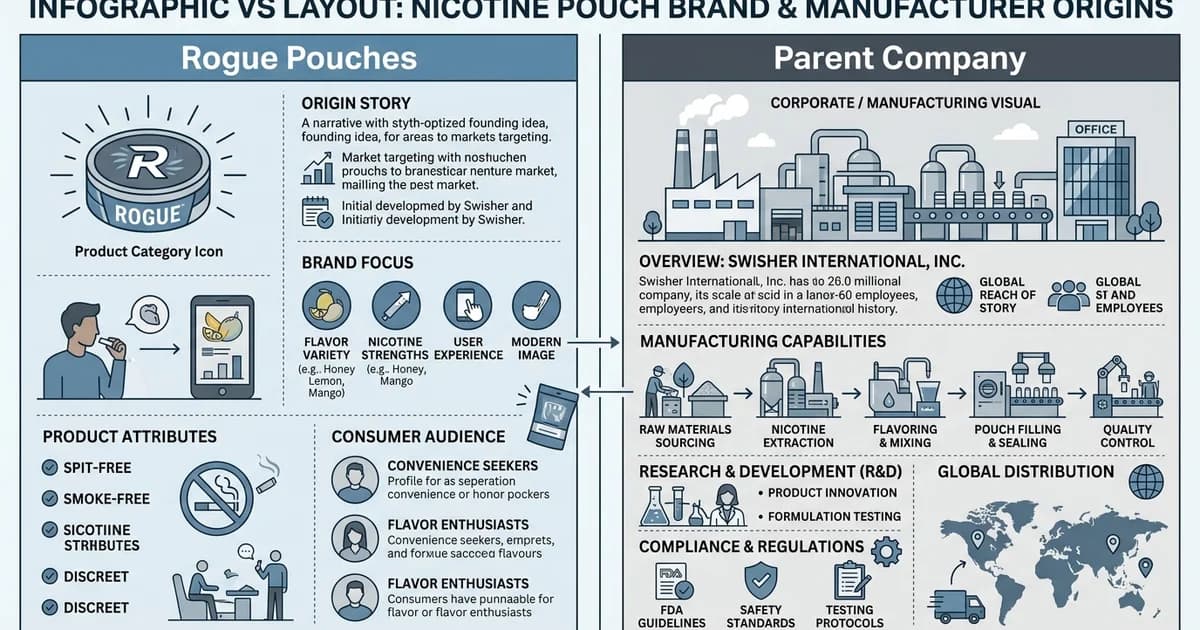
According to Rogue's own support page, Rogue Holdings, LLC is a wholly owned subsidiary of Swisher International, Inc. If you know Swisher, you know cigars. The company sells more than two billion cigars and cigarillos annually to over 70 countries.
Swisher has been around since 1861. Its headquarters sit in Jacksonville, Florida, with manufacturing operations stretching to the Dominican Republic and West Virginia. This isn't a scrappy startup. It's one of the oldest and largest tobacco companies in America, and Rogue is its bet on the fast-growing tobacco-free nicotine category. So when people ask who makes Rogue nicotine pouches, the short answer is Swisher, but the full picture involves another company entirely.
Swisher saw the writing on the wall years ago. Cigarette sales have been declining for decades. Cigar sales are steady but not explosive. The real growth in nicotine is happening in the pouch category, and Swisher positioned Rogue to capture a share of that market.
Who Actually Manufactures the Pouches?
Knowing who makes Rogue nicotine pouches requires separating ownership from manufacturing. According to Rogue's official support documentation, Rogue Holdings is a joint venture between Swisher International and Avema Pharma Solutions, an affiliate of PL Developments. PL Developments is a pharmaceutical and healthcare company best known for supplying private-label products to drugstore chains like Walgreen's, Rite-Aid, and CVS.
So the corporate structure breaks down like this:
| Role | Company |
|---|---|
| Brand Owner | Rogue Holdings, LLC |
| Parent Company | Swisher International, Inc. |
| Manufacturer | Avema Pharma Solutions (PL Developments) |
| Distribution | Swisher International |
Avema handles the actual production of the pouches. The fact that the manufacturer is a pharmaceutical company, not a tobacco processor, matters. The pouches are produced in FDA-registered facilities in the United States, which gives Rogue a quality-control story that purely tobacco-origin brands can't match. This pharmaceutical angle is a key detail for anyone researching who makes Rogue nicotine pouches.
How Rogue Got Started
Rogue first appeared on the market in 2018, and there is a lot to know about Rogue pouches before you buy. According to CStore Decisions, the original manufacturer was NicoGen Pharma Solutions. The brand was positioned as an alternative to combustible tobacco products, not as a quitting aid.
By 2019, the company restructured under Rogue Holdings, LLC, and Swisher International took over distribution. The brand has since expanded from pouches into lozenges, gum, and tablets, though the pouches remain the flagship product. This restructuring changed the answer to who makes Rogue nicotine pouches from a small pharma startup to a Big Tobacco subsidiary.
The timing was deliberate. Rogue entered the market just as ZYN (made by Swedish Match, now owned by Philip Morris International) was proving that Americans would buy tobacco-free nicotine pouches by the millions. Swisher saw the opportunity and invested heavily.
What's Inside a Rogue Pouch?
Understanding what's inside a Rogue pouch starts with nicotine polacrilex, a pharmaceutical-grade form of nicotine bound to a resin. This is the same type of nicotine found in nicotine gum. It's tobacco-free, meaning no actual tobacco leaf touches the product.
According to Nicokick, Rogue pouches are made from plant-based fibers, nicotine polacrilex, flavoring agents, moisture regulators, and sugar-free sweeteners like acesulfame K.
Here's a breakdown of the key components:
- Nicotine polacrilex: The active ingredient. Delivers nicotine without tobacco leaf.
- Plant-based fibers: Form the pouch material itself.
- Gum arabic and hydroxypropyl cellulose: Stabilizers that control how the pouch releases nicotine.
- Sodium carbonate and sodium bicarbonate: pH adjusters that affect absorption speed through your gum tissue.
- Acesulfame K: A zero-calorie sweetener (the same one in diet sodas).
- Natural and artificial flavors: Responsible for the taste profile.
Rogue comes in two nicotine strengths: 3mg and 6mg per pouch. Each can holds 20 pouches. The Rogue flavor lineup currently spans 13 options on roguenicotine.com: Apple, Berry, Blue Raspberry, Bold, Cinnamon, Citrus, Honey Lemon, Mango, Original, Peppermint, Smooth, Spearmint, and Wintergreen.
The dry-fill format means slower nicotine release compared to moist pouches like ZYN. Some users prefer this because it extends the experience to around an hour per pouch. Others find it takes longer to "kick in" and produces a milder sensation overall. Understanding these ingredients helps explain why who makes Rogue nicotine pouches matters: the pharmaceutical manufacturing process shapes the product itself.
Who Makes Rogue Nicotine Pouches Compared to Other Brands?
Rogue isn't the only player. Here's how the major nicotine pouch brands stack up by manufacturer:
| Brand | Manufacturer / Parent Company | Country of Origin |
|---|---|---|
| Rogue | Swisher International / Avema Pharma Solutions | USA |
| ZYN | Swedish Match (Philip Morris International) | Sweden / USA |
| On! | Altria Group | Sweden / USA |
| Velo | British American Tobacco (BAT) | UK / Global |
| Lucy | Lucy Goods (independent) | USA |
Notice a pattern? Almost every major nicotine pouch brand is backed by a legacy tobacco company. ZYN belongs to Philip Morris. On! is Altria (the company behind Marlboro). Velo is British American Tobacco. Knowing who makes Rogue nicotine pouches puts the brand in context: Swisher is following the same playbook as every other Big Tobacco company entering this space.
The nicotine pouch market is growing fast. According to Grand View Research, the U.S. nicotine pouch industry was estimated at $4.09 billion in 2024 and is expected to grow at a CAGR of 29.6% from 2025 to 2030. The CDC reported in September 2024 that about 2.9% of U.S. adults now use nicotine pouches. That kind of growth attracts serious capital, which is exactly why Big Tobacco has moved in so aggressively.
What Sets Rogue Apart from ZYN and Others?
Now that you know who makes Rogue nicotine pouches, the next question is what makes them different. Rogue differentiates itself in a few specific ways. First, it's manufactured entirely in the United States by a pharmaceutical company, not imported from Scandinavia. Second, the dry-fill format gives it a different mouthfeel and release profile than ZYN's moist pouches. Third, Rogue tends to price lower than ZYN at most retailers, making it an accessible entry point for people trying pouches for the first time.
On flavor range, Rogue holds its own. The brand's 13 flavors cover the expected territory (mints, fruits, citrus) alongside plainer options like Original and Smooth. Nicotine strengths top out at 6mg, which is moderate compared to some brands that push 8mg or higher.
The trade-off? Some users report that Rogue's dry format produces less flavor intensity upfront. It's a slower burn. Whether that's a pro or a con depends entirely on what you're looking for.
The Nicotine Question Worth Asking
All of these brands, Rogue included, deliver nicotine. That's the point. And nicotine is effective at what it does: it sharpens attention, improves reaction time, and provides a short-term cognitive lift. Knowing who makes Rogue nicotine pouches doesn't change the fundamental pharmacology of the product inside the can.
But nicotine also builds tolerance. The 6mg pouch that gave you a buzz last month will feel like nothing next month. That's how the molecule works. It binds to acetylcholine receptors in your brain, and your brain adapts by upregulating those receptors, demanding more nicotine to achieve baseline function.
Then there's the dependency cycle. Miss a pouch and you get irritability, brain fog, difficulty concentrating. The very problems nicotine "solves" are the ones it creates through withdrawal.
This is the trade-off that most nicotine pouch marketing skips over. Tobacco-free doesn't mean consequence-free. The delivery mechanism is cleaner than a cigarette, absolutely. But the underlying pharmacology hasn't changed.
What If You Want the Focus Without the Nicotine?
This is where the conversation shifts. A growing number of people reach for pouches not because they crave nicotine, but because they want a cognitive edge. They want focus, alertness, and sustained mental energy without the jitters of a double espresso or the crash of an energy drink. For these users, knowing who makes Rogue nicotine pouches is less important than finding an alternative that delivers focus without dependency.
If that sounds like you, nicotine is an expensive solution, both financially and physiologically.
Roon takes the sublingual pouch format and removes nicotine entirely. Instead, it uses a stack of four active compounds: Caffeine (80 mg), L-Theanine (60 mg), Theacrine (5 mg), and Methylliberine (25 mg). The combination is designed to promote sustained focus for six to eight hours without the tolerance buildup, jitters, or crash that come with nicotine or high-dose caffeine.
L-Theanine smooths out caffeine's rough edges. Theacrine and Methylliberine extend the duration of the effect without stacking stimulant load. The result is a pouch that works like a cognitive tool rather than a habit you have to feed.
No tobacco. No nicotine. Caffeine is the main stimulant.
If you've been using nicotine pouches for focus rather than craving, it's worth asking whether the nicotine is actually the part you need. Now that you know who makes Rogue nicotine pouches and what's inside them, you can make a more informed choice about what you put in your body. See how Roon compares.