Study Breakdown: Tyrosine Improves Working Memory When You Multitask (Thomas, 1999)
Roon Team
Study Breakdown: Tyrosine Improves Working Memory When You Multitask (Thomas, 1999)
Most supplement research tests a single task in a quiet room. Real cognitive work rarely looks like that. You answer an email while a meeting plays in another tab, track three open loops, and try to hold a number in your head long enough to type it.
That gap is exactly what the tyrosine working memory study by Thomas and colleagues set out to close. Published in 1999, it asked a sharper question than most: does the amino acid tyrosine help when your brain is juggling several demands at once, not just one?
The answer it produced still gets cited in nearly every modern tyrosine review. Here is what the study actually did, what it found, and where the science has landed since.
Key Takeaways
- The Thomas 1999 tyrosine study found that a single dose improved working memory during a demanding multitasking battery in healthy adults.
- It was unusual because it tested cognition without a physical stressor like cold or sleep loss present.
- Tyrosine is a precursor to dopamine and noradrenaline, the chemicals your brain leans on hardest when attention is stretched.
- Later reviews confirm the effect is real but conditional: tyrosine helps most when demand is high and your neurotransmitters are getting depleted.
What the Thomas 1999 Tyrosine Study Tested
The study examined whether tyrosine could support working memory while people performed several tasks simultaneously. The full citation is Thomas, Lockwood, Singh, and Deuster (1999), "Tyrosine improves working memory in a multitasking environment," published in Pharmacology Biochemistry and Behavior.
Healthy volunteers took either tyrosine or a placebo, then ran through a multitasking battery that loaded several cognitive channels at the same time. Working memory was the headline measure. That is the mental scratchpad you use to hold and manipulate information over short windows, and it degrades fast under load.
The design mattered as much as the result. Researchers wanted to see performance under genuine cognitive pressure, not in a sterile single-task setup.
The Result: Better Working Memory Under Load
Tyrosine improved working memory performance during the multitasking battery compared to placebo. That single finding is why the paper became a reference point for tyrosine multitasking research.
The improvement showed up where it counts. Not in a trivial reaction-time tweak, but in the kind of memory work that breaks down first when you split your attention across competing demands.
What makes the paper distinctive is the context. As later researchers noted, this was one of the few experiments to show a tyrosine benefit on a complex task without exposing subjects to a stressor first. A 2013 paper in Frontiers in Behavioral Neuroscience singled out the Thomas study on exactly those grounds, pointing out that most earlier work used stress like cold or noise to deplete the brain first.
In plain terms: the cognitive load of multitasking may be enough on its own to make tyrosine useful.
Why Tyrosine Affects Working Memory at All
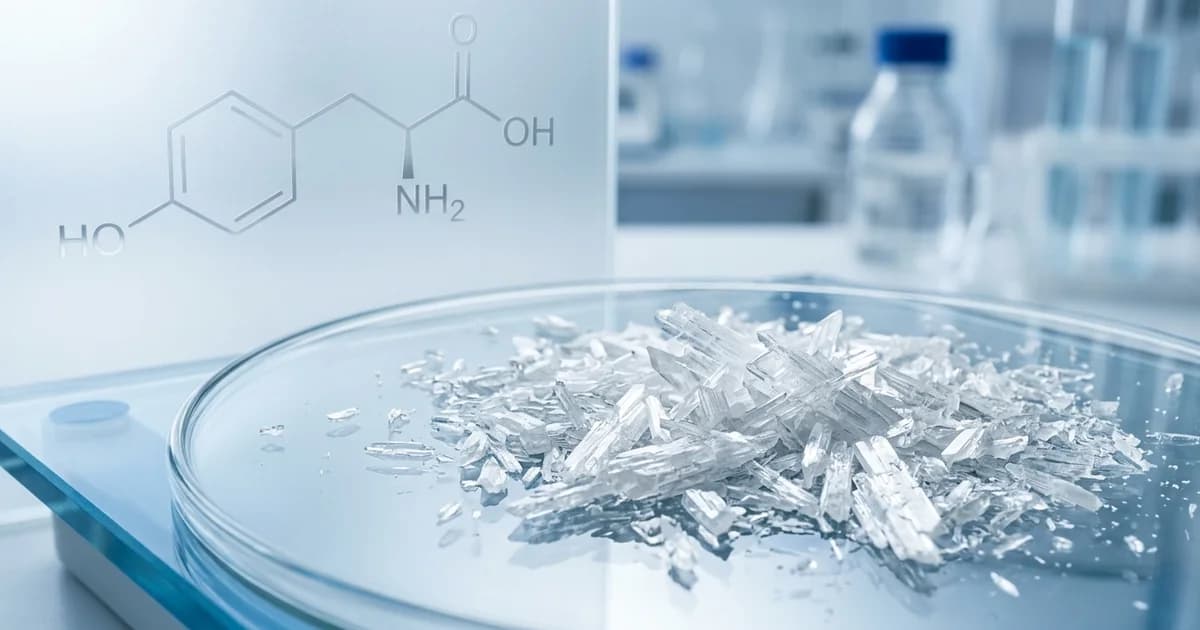
Tyrosine is the raw material your brain converts into dopamine and noradrenaline. Working memory and focused attention both run on these two chemicals, especially in the prefrontal cortex.
Here is the mechanism in sequence:
- You consume tyrosine, an amino acid found in protein.
- It crosses the blood-brain barrier and gets taken up by neurons.
- Inside the cell, it converts to L-DOPA, then to dopamine, and onward to noradrenaline.
- When demand spikes, your brain burns through these transmitters faster, and extra tyrosine helps refill the tank.
According to the 2015 review by Jongkees and colleagues in the Journal of Psychiatric Research, tyrosine levels in the blood peak roughly one to two hours after intake and can stay raised for several hours. That timing lines up with the windows used in the cognitive testing literature.
This is why the l-tyrosine attention effect is conditional, not automatic. If your transmitter levels are already comfortable, topping them up does little. When you are taxing them, the extra supply has somewhere to go.
How Thomas 1999 Fits the Wider Evidence
The Thomas study reads better when you place it against the studies that came after it. The pattern across two decades is consistent: tyrosine supports cognition under demand, and does little when demand is low.
| Study | Population | Condition | Working Memory / Cognitive Outcome |
|---|---|---|---|
| Thomas et al., 1999 | Healthy adults | Multitasking battery, no stressor | Improved working memory |
| Jongkees et al., 2015 (review) | Healthy and clinical groups | Stress or high cognitive demand | Consistent benefit when demand is high |
| Colzato et al., 2013 | Healthy adults | N-back updating task | Improved working memory updating |
| Jongkees et al., 2020 | Healthy adults | Working memory gating vs. updating | Effect depended on baseline dopamine function |
The throughline is dose-of-demand, not just dose-of-tyrosine. The harder your brain is working, the more a precursor like tyrosine has a job to do.
One caveat the 2015 review is honest about: results across the broader literature are mixed, and individual differences in dopamine function shape who responds. Tyrosine is not a universal switch. It is a conditional support that depends on what your brain is doing and where your baseline sits.
What This Means for Real Cognitive Work
The practical read is simple. Tyrosine looks most useful in the exact scenario Thomas tested: holding information steady while several tasks pull at your attention.
That describes a normal workday for a lot of people. Deep work sessions, dense study blocks, high-stakes problem solving, and the kind of context-switching that drains your mental scratchpad by mid-afternoon.
It does not mean tyrosine is a focus guarantee. The science points to a tool that helps your brain hold its line under load, which is a more modest and more believable claim than most supplement marketing makes. If you want a broader view of single ingredients, our guide to nootropic ingredients backed by research sets the same evidence-first bar.
Conclusion
The Thomas 1999 study earned its place in the literature by testing tyrosine the way real cognition actually happens: under simultaneous demand, not in isolation. It found that a single dose supported working memory during multitasking in healthy adults, and it did so without leaning on an external stressor to prove the point.
Two decades of follow-up research have refined rather than overturned that finding. Tyrosine is a precursor, not a stimulant, and its value scales with how hard your brain is working. When you are running multiple cognitive tracks at once, supporting the supply of dopamine and noradrenaline is a reasonable, evidence-aligned move. When you are coasting, the effect fades. That nuance is the whole story.
Frequently Asked Questions
What did the Thomas 1999 tyrosine study actually find?
It found that a single dose of tyrosine improved working memory performance in healthy adults during a multitasking battery, compared to placebo. The result was notable because the task created enough cognitive load to show a benefit without using a physical stressor like cold or sleep deprivation, which earlier tyrosine studies usually relied on.
Does tyrosine improve multitasking specifically?
The Thomas study suggests tyrosine supports working memory under multitasking conditions, where you hold and update information while attention is split. Later work, including N-back updating studies, points the same direction. The effect appears strongest when cognitive demand is genuinely high, rather than during simple or low-load tasks.
How does tyrosine affect working memory?
Tyrosine is converted in the brain into L-DOPA, then dopamine, then noradrenaline. These transmitters power prefrontal working memory and attention. Under heavy demand, your brain uses them faster, and supplemental tyrosine helps maintain supply. When your baseline is already sufficient, adding more tends to produce little measurable change.
How long does tyrosine take to work?
Blood tyrosine levels peak roughly one to two hours after intake and can stay raised for several hours, according to the Jongkees 2015 review. Cognitive testing studies generally dose participants inside that window, which is why timing matters if you are using it ahead of a demanding mental task.
Is the tyrosine working memory effect reliable for everyone?
No. The broader literature is mixed, and reviews note that individual differences in dopamine function influence who responds. Tyrosine is a conditional support, not a guaranteed boost. It helps most when transmitter demand is high and your baseline dopamine activity leaves room for benefit.
Is tyrosine a stimulant like caffeine?
No. Caffeine blocks adenosine to reduce the feeling of fatigue. Tyrosine is an amino acid precursor that supplies the building blocks for dopamine and noradrenaline. It does not create alertness on its own the way a stimulant does. The two work through entirely different mechanisms and are sometimes studied alongside each other.
Where Sustained Focus Actually Comes From
The lesson from Thomas 1999 is that the brain needs support most when you are running several mental tracks at once. That is precisely the moment focus tends to collapse, somewhere in the long middle of a deep-work block or a multitasking-heavy afternoon.
Roon was built for that window. Each sublingual pouch pairs 80 mg of caffeine with 60 mg of L-theanine, 25 mg of methylliberine (Dynamine), and 5 mg of theacrine (TeaCrine), absorbed under the lip for a 5 to 10 minute onset and designed for 6 to 8 hours of steady focus with no jitters, no crash, and no tolerance buildup.
To be clear, Roon does not contain tyrosine, and it is not a replacement for sleep, protein, or the deep-work habits that drive real output. It is the fast, clean focus layer for the hours when your attention is stretched thinnest. If multitasking is wearing you down by mid-afternoon, try Roon on your next demanding block and judge it by the work you get done.
Written by Roon Team