The Best Study Drink Isn't a Drink: Energy Drinks vs Coffee vs a Focus Pouch
Roon Team
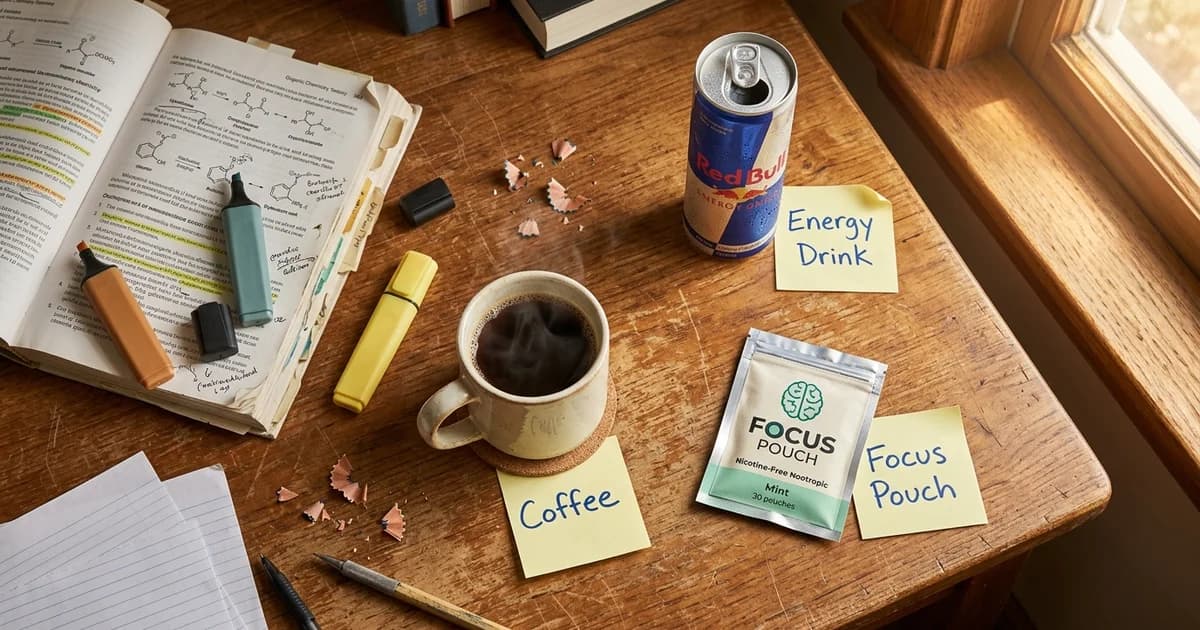
The Best Study Drink Isn't a Drink: Energy Drinks vs Coffee vs a Focus Pouch
You have a 9 p.m. deadline, three unread chapters, and a brain that quit two hours ago. So you reach for the thing every student reaches for: a can, a mug, or a bottle. The search for the best energy drink for studying usually ends with a sugar crash at 11 p.m. and a heartbeat you can feel in your teeth.
The problem isn't your willpower. It's the delivery system. Most study drinks dump caffeine fast, spike your blood sugar, and leave nothing behind for the second half of a long session.
This guide compares your real options, energy drinks, coffee, tea, and a newer category, the sublingual focus pouch, on the metrics that actually matter when you're studying: onset speed, how long the focus lasts, and whether you crash.
Key Takeaways
- The best drink for studying is the one that gives you steady focus for hours, not a 45-minute spike followed by a crash.
- Energy drinks win on convenience and lose on sugar, which sets up the classic mid-session blood-sugar dip.
- Caffeine plus L-theanine is the most evidence-backed pairing for calm, focused attention, and most energy drinks don't contain L-theanine.
- The FDA puts the safe daily caffeine ceiling at about 400 mg for most adults, which two large energy drinks can blow past fast.
- A sublingual focus pouch skips the sugar and the liquid entirely, which is why "the best study drink" might not be a drink at all.
What Actually Makes a Good Study Aid
The best study fuel does three things: it kicks in fast, it lasts through a full session, and it doesn't drop you off a cliff when it wears off.
Caffeine handles the first part. It's the most studied cognitive stimulant on earth, and at the right dose it sharpens alertness and reaction time. The issue is everything that gets bundled with it.
Sugar is the usual culprit. When a drink delivers caffeine alongside a load of fast sugar, you get a quick lift followed by a blood-sugar dip that feels like exhaustion. That's the "crash" students complain about, and it tends to land right in the middle of your study block.
Then there's the jitter problem. High-dose caffeine on its own can make you wired and anxious, which is the opposite of what you want when you're trying to hold a complex idea in your head. The fix isn't less caffeine. It's pairing it with something that smooths the edges.
The L-theanine factor
This is where most study drinks fall short. L-theanine is an amino acid found in tea, and paired with caffeine it produces calm, directed focus instead of a buzzy rush.
The research here is solid. A 2010 study in Nutritional Neuroscience found that L-theanine combined with caffeine improved accuracy during attention-switching tasks and reduced how easily people got distracted. In other words, the pairing helped people focus during exactly the kind of demanding mental work studying requires.
Most energy drinks don't include L-theanine. Coffee doesn't either. That gap is the whole reason the category needs rethinking.
Energy Drinks for Studying: Fast, Convenient, Sugary
Energy drinks are the most convenient option and the worst on crash risk. They're built for a quick hit, not a four-hour study marathon.
A typical large energy drink carries 150 to 300 mg of caffeine, which is real firepower. The catch is what rides along with it. Many cans pack 30 to 50 grams of sugar, and that sugar is the engine behind the mid-session slump.
There's also a ceiling problem. Two big cans can push you past the FDA's 400 mg daily caffeine guideline, and during finals week, two cans in a day is nothing. Sugar-free versions fix the calories but not the rollercoaster, since the caffeine still arrives all at once and leaves the same way.
If you're hunting for the best energy drink for studying, the honest answer is that the format itself works against you. You're buying speed at the cost of stability.
Coffee for Studying: Reliable but Blunt
Coffee is the steadiest cheap option, but it's a blunt instrument. It gives you caffeine and little else, which means you get the alertness and the jitters in one package.
A standard 12-ounce cup runs about 120 to 200 mg of caffeine. That's a sensible study dose, and black coffee has no sugar, so you skip the blood-sugar crash that sinks energy drinks.
The downside is the lack of anything to balance the caffeine. No L-theanine, no smoothing agent, so the higher you push your intake across a long night, the more likely you are to feel anxious and scattered rather than locked in.
Coffee also forces a tradeoff students know well. Drink enough to stay sharp past midnight, and you may not sleep when you finally close the laptop. Caffeine has a long tail in the body, and that tail can wreck the recovery your brain needs to actually consolidate what you studied.
Tea and Matcha: The Original Calm-Focus Drink
Green tea and matcha are the only common drinks that naturally pair caffeine with L-theanine. That's why a cup of tea feels like a gentler lift than coffee.
The tradeoff is dose. A cup of green tea has only 25 to 50 mg of caffeine, which often isn't enough to power a serious study session. You'd need to drink several cups, and that means several trips to the bathroom and a sloshing stomach.
Matcha concentrates things a bit more, and it's a reasonable choice for lighter review work. For a high-stakes all-nighter, though, the caffeine ceiling is just too low to lean on alone.
The Focus Pouch: When the Best Study Drink Isn't a Drink
A sublingual focus pouch delivers the caffeine-plus-L-theanine combination without sugar or liquid, which solves the problems all three drinks share. You tuck it under your lip, the ingredients absorb through the tissue in your mouth, and focus arrives in minutes.
This is the newer category, and it exists because the drink format has built-in limits. A pouch carries no sugar, so there's no blood-sugar crash. It carries no liquid, so you're not pacing the library bathroom. And because the dose is fixed, you know exactly how much caffeine you're taking.
The better pouches also add ingredients energy drinks skip. Beyond caffeine and L-theanine, some include methylliberine and theacrine, two compounds studied for smooth, longer-lasting energy. A 2022 study in adult egamers found that a combination of caffeine, theacrine, and methylliberine improved cognitive performance and reaction time without hurting mood, which is the exact profile you want for sustained mental work.
That's the case for rethinking what to drink while studying. Sometimes the best tool isn't a beverage at all.
Energy Drinks vs Coffee vs Pouches: The Comparison Table
Here's how the main options stack up for a long study or exam session. This covers the energy drinks vs coffee for studying debate plus the newer pouch category.
| Option | Caffeine | Onset | Focus Duration | Sugar | Crash Risk | Best For |
|---|---|---|---|---|---|---|
| Energy drink | 150–300 mg | 15–45 min | 2–3 hrs | Often 30–50 g | High | A quick, short burst |
| Coffee | 120–200 mg/cup | 20–40 min | 3–4 hrs | None (black) | Moderate | Steady, no-frills focus |
| Green tea / matcha | 25–50 mg/cup | 30–45 min | 2–3 hrs | None | Low | Light review, calm focus |
| Roon focus pouch | 80 mg + 60 mg L-theanine | 5–10 min | 6–8 hrs | None | Low | Long sessions, exams |
Roon sits in the table because it's the option built specifically for the long-session problem the drinks can't solve. Its pouch carries 80 mg caffeine, 60 mg L-theanine, 25 mg methylliberine (Dynamine), and 5 mg theacrine (TeaCrine), and it's designed for a 6 to 8 hour focus window with no sugar and no crash.
How to Choose What to Drink While Studying
Match the tool to the task. A 30-minute flashcard review and a six-hour exam cram are not the same problem.
For short bursts, a single coffee or a small energy drink is fine. The crash won't matter much if you're done before it hits.
For long sessions, prioritize duration and stability over raw kick. You want something that holds a steady line for hours and pairs caffeine with L-theanine so you stay calm instead of frantic. Watch your total caffeine across the day, and stop early enough that you can still sleep, because sleep is when your brain files away what you studied.
Conclusion
The best study fuel isn't the one with the most caffeine or the flashiest can. It's the one that turns on fast, holds steady through a full session, and lets you off gently instead of dropping you mid-chapter.
Energy drinks win on speed and convenience but lose on sugar and crash. Coffee is reliable and cheap but blunt, with no L-theanine to balance the jitters. Tea has the right chemistry but too little caffeine to carry a serious session.
Once you judge these options by how long the focus lasts rather than how hard it hits, the conclusion writes itself. The format you've always reached for may not be the format that actually serves a long night of studying.
Frequently Asked Questions
What is the best energy drink for studying?
There's no single winner, because the energy drink format works against long study sessions. The caffeine arrives fast and leaves fast, and the sugar in many cans sets up a mid-session crash. If you want a steadier option, look for something that pairs caffeine with L-theanine and skips the sugar, like green tea, matcha, or a focus pouch designed for sustained attention rather than a quick spike.
Is coffee or energy drinks better for studying?
Coffee is usually the better choice for studying. Black coffee delivers a sensible caffeine dose without the heavy sugar load that causes energy-drink crashes. Energy drinks are more convenient and hit harder up front, but the combination of high caffeine and sugar tends to produce a sharper slump later. For long sessions, the stability of coffee beats the quick burst of a typical energy drink.
How much caffeine is safe while studying?
The FDA cites about 400 mg of caffeine a day as an amount not generally linked to negative effects for most healthy adults. That's roughly two to three cups of coffee. People vary widely in sensitivity, so during exam season, track your total across coffee, tea, and energy drinks, and stop early enough in the day that caffeine doesn't ruin your sleep.
Does L-theanine actually help with focus?
Yes, when paired with caffeine. A 2010 study in Nutritional Neuroscience found that L-theanine combined with caffeine improved accuracy during attention-switching tasks and reduced distractibility. The combination tends to deliver calm, directed focus rather than the jittery buzz caffeine can cause on its own. That's why tea, which contains both compounds naturally, feels smoother than coffee.
What can I drink to study without crashing?
To avoid a crash, skip the sugar and choose something that releases steadily. Black coffee, green tea, and matcha all avoid the sugar spike that sinks most energy drinks. A focus pouch with caffeine and L-theanine also sidesteps the crash, since it carries no sugar and the L-theanine smooths out the caffeine. The key is pairing your caffeine with stability, not piling on more of it.
Are focus pouches better than energy drinks for studying?
For long sessions, often yes. A sublingual focus pouch absorbs in minutes, carries no sugar, and avoids the liquid bloat of drinking several cans or cups. The better pouches pair caffeine with L-theanine and add longer-lasting compounds like methylliberine and theacrine. The result is a longer focus window with less crash risk than a sugary energy drink, though a basic coffee still works fine for short tasks.
The Long-Session Tool, Without the Can
If the takeaway here is that long study nights need duration over kick, that's the exact gap Roon was built to fill. It's a zero-nicotine, zero-sugar sublingual pouch that absorbs in 5 to 10 minutes and holds a focus window of 6 to 8 hours, which lines up with a real exam session instead of a 45-minute energy-drink spike.
Each pouch pairs 80 mg of caffeine with 60 mg of L-theanine, the combination research links to calm, focused attention, plus 25 mg of methylliberine (Dynamine) and 5 mg of theacrine (TeaCrine) for steady energy without the jitters or crash. No can, no sugar, no trips to the bathroom.
Roon isn't a substitute for sleep, real food, or a study plan that starts before midnight. It's the focus layer for the hours you do put in. If you're tired of the energy-drink rollercoaster, try Roon for your next long session and judge it by how the second half feels.
Written by Roon Team