Taurine Deficiency and Aging: What the 2023 Science Study Actually Found
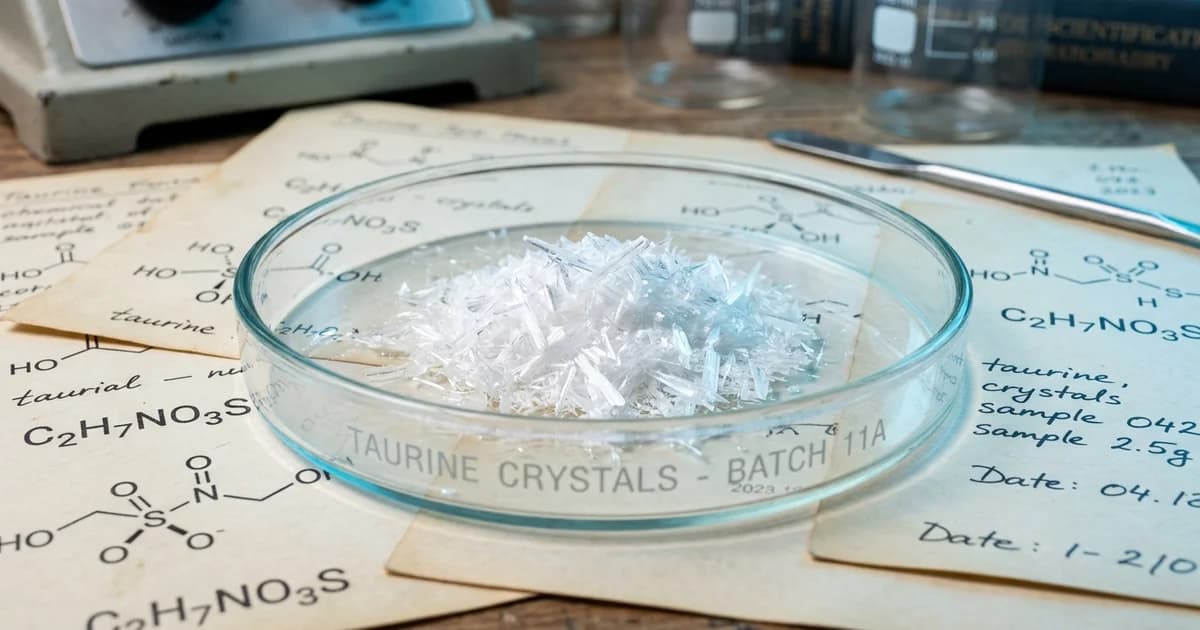
In 2023, a single amino acid jumped from gym supplement to longevity headline. The reason was the taurine and aging study published in the journal Science, which reported that taurine levels drop as animals get older, and that topping them back up extended healthy lifespan across several species.
That is a big claim. It is also a more complicated one than the headlines suggested.
Here is the careful version. The animal data is genuinely strong. The human evidence is thin. And a follow-up paper in 2025 pushed back hard on one of the study's central assumptions. If you want to know whether taurine slows aging, you need both halves of the story.
Key Takeaways
- The 2023 study found that taurine levels declined with age in mice, monkeys, and humans, and that supplementing taurine extended median lifespan in mice by roughly 10 to 12 percent.
- Supplemented animals also showed better markers of health: stronger muscle, denser bone, improved metabolism, and younger-looking immune systems.
- The human portion was correlational, not a trial. Nobody proved that taking taurine makes people live longer.
- A 2025 NIH-led paper concluded taurine is unlikely to be a reliable biomarker of aging, complicating the original premise.
- Animal longevity wins rarely translate cleanly to humans. Read the result with interest, not certainty.
What the 2023 Taurine and Aging Study Reported
The paper, titled "Taurine deficiency as a driver of aging," was led by Vijay Yadav's team and published in Science. Its core argument was simple: taurine is not just something you consume, it is something your body loses over time, and that loss may be part of why you age.
The researchers measured taurine in blood and found that concentrations fell substantially with age across mice, monkeys, and people. In their reading, declining taurine looked less like a side effect of aging and more like a possible cause.
So they tested it. They gave middle-aged mice daily taurine and tracked what happened.
The headline result: longer life in mice
The supplemented mice lived longer. As summarized by ScienceDaily, taurine increased median lifespan by about 10 to 12 percent in mice (12 percent in females, 10 percent in males), which works out to several extra months of life for an animal that normally lives around two years.
This is the number that drove the taurine lifespan study coverage everywhere. A double-digit lifespan bump from a cheap, widely available amino acid is the kind of finding that travels fast.
But lifespan was not the only thing they measured.
Healthspan, not just lifespan
The more interesting data was about how the animals aged, not just how long they lasted. The taurine-fed mice were healthier on nearly every axis the team checked.
- Greater muscle strength and endurance
- Denser bones
- Better glucose handling and metabolic markers
- Reduced markers of cellular senescence (worn-out, inflammatory cells)
- Immune systems that looked biologically younger
As Medical News Today reported in its coverage, the effects spanned multiple tissues rather than one isolated system. That breadth is part of why the result drew attention. It suggested taurine was touching something upstream in the aging process.
The Multi-Species Angle
The reason this taurine longevity research landed harder than a typical mouse study is that the team did not stop at mice. They looked across the biological ladder.
Work in worms (C. elegans) and yeast pointed in a similar direction, and the team also studied middle-aged rhesus monkeys, a far closer stand-in for human biology. In the monkeys, six months of taurine supplementation was associated with improvements in body weight, bone density, and several blood markers tied to metabolic and immune health, as summarized by ColumbiaDoctors.
When a signal shows up in worms, mice, and primates, scientists pay closer attention. Consistency across species is one of the better hints that you are looking at a real biological mechanism rather than a quirk of one animal.
The monkeys, though, were not tracked to the end of their lives. The primate data is about health markers, not lifespan. That distinction matters and got flattened in a lot of the reporting.
The Human Evidence Is the Weak Link
Here is the part that got lost. The 2023 study did not show that taurine makes humans live longer.
What it showed in people was a correlation: lower taurine levels tended to track with markers of worse health, like higher body weight, inflammation, and type 2 diabetes risk. The team also noted that exercise seemed to raise taurine levels in human participants.
Correlation is not causation, and the researchers said so. There was no randomized human trial showing that taurine supplements extend life or slow aging in people. So when you ask "does taurine slow aging" in humans, the honest 2023 answer was: unknown, and worth testing.
This is the line between an exciting hypothesis and a proven intervention. The taurine study sat firmly on the hypothesis side of it.
The 2025 Pushback: Taurine as an Aging Biomarker
The story did not end in 2023. In 2025, a research team led by scientists at the National Institute on Aging tested one of the original study's load-bearing assumptions: that taurine reliably falls as you age.
Their conclusion was the opposite. According to the NIH, blood taurine levels did not consistently decline with age across humans, monkeys, and mice. In many people, taurine actually stayed stable or rose over time.
The NIH team concluded that taurine is unlikely to be a good biomarker of aging, with their findings published in the journal Science. As NutraIngredients noted in its reporting, the variation between individuals was large enough that there was no clean downward trend to build a theory on.
This does not erase the mouse lifespan data. Taurine could still benefit health even if it is not a tidy aging clock. But it does undercut the original framing, which leaned on the idea that falling taurine drives aging in the first place.
So, Does Taurine Slow Aging?
The honest answer: in mice, the evidence for taurine deficiency aging effects is strong. In humans, it remains unproven.
Here is how the two key papers stack up.
| Question | 2023 Science study (Yadav et al.) | 2025 NIH-led follow-up |
|---|---|---|
| Does taurine fall with age? | Yes, across species | Not reliably; often stable or rising |
| Lifespan effect in mice | +10 to 12% median | Not addressed |
| Health markers improved? | Yes, in mice and monkeys | Not the focus |
| Proven in humans? | No, correlational only | Challenges the aging-biomarker premise |
| Bottom line | Promising hypothesis | Cautions against over-reading it |
Taurine is cheap, it is found in foods like meat and shellfish, and it has a long safety record at common doses. None of that is in dispute. What is in dispute is whether swallowing extra taurine does anything meaningful to human aging, and right now the answer is that we do not have the trial to say.
Frequently Asked Questions
What did the 2023 taurine and aging study actually prove?
It proved that taurine supplementation extended median lifespan in mice by roughly 10 to 12 percent and improved health markers in mice and monkeys. It also found that taurine levels appeared to fall with age across species. What it did not prove was any lifespan or anti-aging benefit in humans, where the data was only correlational.
Does taurine slow aging in humans?
There is no human trial showing that taurine slows aging. The 2023 study found correlations between higher taurine and better health markers in people, but correlation does not establish cause. A 2025 NIH-led paper further questioned whether taurine even declines reliably with human age, so the question remains open.
How much did taurine extend lifespan in the study?
In middle-aged mice, daily taurine raised median lifespan by about 10 to 12 percent according to the 2023 Science study and its press coverage. That translates to several additional months for an animal that typically lives around two years. The effect was measured in mice, not humans or monkeys.
Why did the 2025 NIH study contradict the original?
The NIH-led team measured taurine over time and found it did not consistently fall with age. In many individuals, levels stayed flat or increased. Because the 2023 theory rested partly on taurine declining with age, the newer data suggests taurine is unlikely to work as a clean aging biomarker, even if it has other benefits.
Is taurine safe to take?
Taurine has a long safety record at the doses found in food and common supplements, and it occurs naturally in meat, fish, and shellfish. As with any supplement, the safe path is to talk to your doctor before starting, especially if you take medication or have a health condition. Safety is not the same as proven benefit.
Should I take taurine for longevity based on this study?
The science does not yet support taking taurine specifically to extend human lifespan. The animal data is genuinely interesting and worth following, but it has not been confirmed in people, and the aging-biomarker premise has been challenged. Treat it as a hypothesis under investigation, not a settled recommendation.
Reading Hyped Science Without Getting Burned
The taurine saga is a clean lesson in how to read a headline. A real result in mice became "the fountain of youth" in the press, then ran into a sober follow-up two years later. Both the excitement and the correction were part of normal science working as intended.
The skill worth keeping is the one the researchers themselves modeled: strong animal data is a reason to investigate, not a reason to conclude. Hold the finding lightly, watch for the replication, and notice when the human evidence is missing.
How We Think About Ingredients at Roon
We spend a lot of time reading studies exactly like this one, because the gap between "worked in mice" and "works in you" is where most supplement marketing falls apart. The taurine story is a useful reminder that an exciting mechanism and a proven human benefit are not the same thing.
That standard is how we build Roon. Our sublingual cognitive pouch uses four ingredients with real human evidence behind them: 80 mg caffeine, 60 mg L-theanine, 25 mg methylliberine (Dynamine), and 5 mg theacrine (TeaCrine), tuned for 6 to 8 hours of focus with no jitters and no crash. We are not selling you a longevity claim or a miracle molecule, and taurine is not part of the formula.
If you want the deeper read on this particular amino acid, our taurine benefits guide breaks down what the evidence does and does not support. Read the science first, then decide. That is the whole idea behind Roon.
Written by Roon Team