Study Schedule for MCAT: What Actually Works
Roon Team
Study Schedule for MCAT: What Actually Works (And What's a Waste of Time)
Most MCAT study schedules fail before week three. You download a color-coded 12-week plan from Reddit, print it out, tape it to your wall, and abandon it after nine days because it was designed for someone else's life. The problem isn't discipline. It's that the study schedule for MCAT prep you're following was built on vibes, not evidence.
The average total MCAT score in 2024 was 506.3, while the average score for students who actually matriculated into medical school through AMCAS was 511.8. That five-point gap represents thousands of rejected applicants. What separates those two groups isn't raw intelligence. It's how they structured their preparation.
Here's what the research and the data say about building a study schedule for MCAT prep that you can actually stick to, and actually score well on.
Key Takeaways:
- Plan for 300 to 350+ total study hours, spread across 3 to 6 months
- Prioritize active recall and spaced repetition over passive review
- Schedule full-length practice exams every 1 to 2 weeks starting in month two
- Protect your cognitive stamina. Six focused hours beat twelve exhausted ones
How Many Hours Does Your Study Schedule for MCAT Prep Really Need?
The AAMC, the organization that writes the MCAT, has historically recommended around 300 to 350 hours of total preparation. That number is backed by prep companies and student forums alike. But raw hours don't tell the full story of a good study schedule MCAT students can rely on.
A former admissions dean quoted by the AAMC recommends six to eight hours per day for a minimum of six weeks, noting that your brain needs time to absorb information and build new neural pathways. Twelve hours a day for three weeks produces worse results than six hours a day for six weeks, even though the total hours are similar.
This matters because most students get the ratio wrong. They cram too many hours into too few weeks, burn out, and watch their practice scores plateau or drop. A well-designed study schedule for MCAT prep accounts for this by spreading the load over a realistic timeline.
The Three Common Timelines
| Timeline | Daily Hours | Total Hours | Best For |
|---|---|---|---|
| 3 months | 3-5 hrs/day | 270-450 | Students with strong science backgrounds |
| 4 months | 3-4 hrs/day | 360-480 | Most students (recommended sweet spot) |
| 6 months | 2-3 hrs/day | 360-540 | Students working or taking classes simultaneously |
Most MCAT study schedules run 12 to 20 weeks. The three-month study schedule for MCAT is the most popular, but it's also the most demanding. If you're balancing coursework, a job, or clinical volunteering, give yourself four to six months and lower the daily intensity. Consistency over time beats heroic daily efforts every single time, a principle that holds for study hour planning for high-stakes exams across the board.
The Two Study Methods That Actually Move Your Score
Any study schedule for MCAT success needs to be built around the right methods. There's a reason Anki flashcard decks are practically a religion in pre-med circles. The science behind them is solid.
Active Recall
Passive review, reading your notes, highlighting textbooks, watching lecture videos, feels productive, but active recall over passive review is what the science consistently supports. It isn't. The research is clear: actively testing yourself on material produces far stronger long-term retention than re-reading it.
A 2022 systematic review published in Cureus found that the combination of active recall strategies with compounds like caffeine and L-theanine improved attention and general cognition in study participants. But even without any supplements, active recall alone outperforms passive study methods by a wide margin.
For your study schedule for MCAT prep, this means:
- Use Anki or a similar flashcard app for content review (biochemistry pathways, amino acids, psychology terms)
- Do practice passages daily, especially for CARS, which cannot be memorized and only improves through consistent timed practice
- Write out explanations from memory before checking your notes
Spaced Repetition
Cramming works for a quiz tomorrow. It fails for an exam that tests 15 courses worth of material. Spaced repetition, reviewing material at increasing intervals over time, is one of the most well-documented learning strategies in cognitive science, and it should be the backbone of any study schedule MCAT students build.
A 2024 study in Academic Medicine tested spaced repetition against standard study methods in a large cohort and found that spaced repetition produced a learning score of 58.03% vs. 43.20% at the six-month mark. That's not a marginal improvement. That's a different tier of retention.
Your study schedule for MCAT prep should build spaced repetition into its structure. Review biochemistry on Monday, test yourself on it Wednesday, revisit it the following Monday, then again two weeks later. The intervals grow as the material solidifies.
How to Structure Your Week (A Real Template)
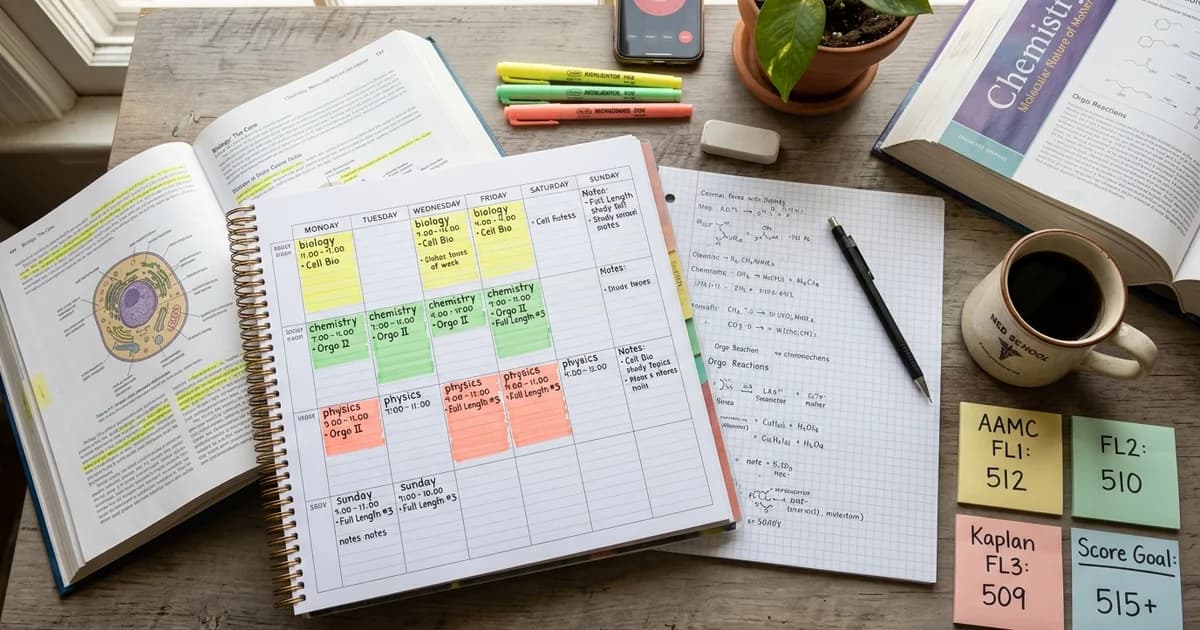
Forget the overly specific hour-by-hour plans. They collapse the moment something unexpected happens. Instead, build your study schedule for MCAT prep around blocks and priorities.
Phase 1: Content Review (Weeks 1-6)
- 4-5 days/week: Content study blocks (biology, biochemistry, physics, psychology/sociology, organic chemistry, general chemistry)
- Daily: 30 minutes of Anki reviews (spaced repetition)
- Daily: 1-2 CARS passages (timed)
- 1 day/week: Light review or catch-up day
- 1 day/week: Full rest. No studying. Your brain consolidates memory during downtime
Cover one major subject per day or per two-day block. Don't try to study everything every day. A good study schedule for MCAT content review keeps subjects separated so you can go deep without context-switching.
Phase 2: Practice and Integration (Weeks 7-10)
- 3 days/week: Mixed practice problems across all sections
- 1 day/week: Full-length practice exam (under real conditions)
- 1 day/week: Full-length exam review (this is where the real learning happens)
- Daily: Anki reviews continue
- Daily: CARS practice continues
A study in BMC Medical Education found that students improved gradually over time with more practice exams, and that full-length practice exam performance predicted actual MCAT scores independently of other factors. The review day after each practice test matters as much as the test itself. Spend it analyzing every wrong answer, identifying patterns in your mistakes, and adjusting your study schedule MCAT content priorities accordingly.
Phase 3: Refinement (Weeks 11-12)
- Focus on weak areas identified by practice exam data
- 2 full-length exams in the final two weeks (use AAMC official exams here)
- Taper study hours in the final 3-4 days. Light review only. No new material
- Prioritize sleep, nutrition, and stress management
This final phase is where a disciplined study schedule for MCAT prep pays off. If you've followed the structure, you'll enter test week confident rather than panicked.
The Cognitive Stamina Problem Nobody Talks About
The MCAT is a 7.5-hour exam. That's not a test of knowledge alone. It's a test of sustained cognitive performance under pressure.
Research from BMC Neuroscience describes mental fatigue from prolonged cognitive activity as causing drowsiness, difficulty concentrating, disordered thinking, and increased errors. Sound familiar? That's what happens in hour five of a full-length practice test.
Your study schedule for MCAT prep needs to train for this. Here's how:
- Simulate real test conditions during practice exams. No phone. No extra breaks. Full timing
- Build up your daily study duration gradually. Start with 3-4 hours and work up to 6-8 over several weeks
- Take real breaks. A 10-minute walk between study blocks does more for your focus than scrolling your phone for 30 minutes
- Protect your sleep. Seven to eight hours, minimum. Memory consolidation happens during sleep. Cutting it short to study more is a net negative
What Doesn't Work (Stop Doing These)
Studying 12+ hours a day for weeks on end. You'll burn out, your retention will crater, and you'll associate studying with misery. The AAMC's own guidance warns against this approach. No study schedule for MCAT prep should demand this of you.
Skipping CARS practice because "you can't study for it." You can. You just can't memorize your way through it. Daily timed passage practice is the only reliable way to improve. SDN's study guide calls daily CARS practice essential because it improves only through consistent effort.
Relying on passive video lectures as your primary study method. Watch the video once to learn the concept. Then close it and test yourself. The testing is the studying.
Never reviewing your practice exams. Taking a full-length without spending equal time reviewing it is like running a diagnostic and ignoring the results.
The Stimulant Question
Here's the uncomfortable truth about MCAT prep culture. A systematic review in Cureus found that nonprescription stimulant use among medical students ranged from 5.2% to as high as 47.4% depending on the country and institution. The reasons are predictable: students want more focus, more hours, more output.
But prescription stimulants carry real risks. They're Schedule II controlled substances, in the same legal category as oxycodone. Using them without a prescription is a federal offense, and for someone applying to medical school, the professional consequences of that choice are severe.
The smarter approach is to optimize what you can control. Sleep, exercise, nutrition, and study structure account for the vast majority of cognitive performance variation. And if you want a legal, evidence-based edge on focus while following your study schedule for MCAT prep, there are better options than risking your medical career before it starts.
Build the Study Schedule for MCAT Success. Protect the Focus.
A good study schedule for MCAT success isn't complicated. It's 300+ hours of deliberate practice, spread across three to six months, built on active recall and spaced repetition, with weekly full-length exams in the final stretch. The students who score well aren't smarter. They're more structured and more consistent.
But even the best study schedule for MCAT prep only works if your brain can actually show up for each session. That's where cognitive stamina becomes the real variable.
Roon was designed for exactly this kind of sustained mental work. Roon's zero-nicotine focus pouches deliver 80 mg of caffeine, L-theanine, theacrine, and methylliberine, a stack that supports 6-8 hours of clean focus without jitters, crashes, or tolerance buildup. No prescription. No legal risk. Just a sharper version of the study session you already planned.
Study smarter without a prescription. Try Roon →