Attention Span Games: What the Science Actually Says
Roon Team
Attention Span Games: What the Science Actually Says (and What It Doesn't)
You downloaded the app. You played the matching game for ten minutes a day. You felt sharper, maybe. Then you put your phone down, opened your laptop, and still couldn't focus on a single email for more than forty seconds. If that sounds familiar, attention span games might not be delivering what they promised.
You're not alone. Attention span games have become a billion-dollar category, promising everything from better memory to protection against cognitive decline. Lumosity alone has attracted over 70 million subscribers across 182 countries. But the gap between what these games promise and what they deliver is worth examining closely, especially if you're spending real time (and sometimes real money) chasing better focus.
Here's what the research actually supports, where the hype around attention span games falls apart, and what else you should be doing if you want attention that lasts.
Key Takeaways
- Attention span games can improve your performance on the specific tasks they train. Transferring those gains to real-world focus is a different story.
- The FTC fined Lumosity $2 million in 2016 for making claims their science couldn't back up.
- A 2023 second-order meta-analysis found that far transfer (gains beyond the trained task) remains weak and inconsistent.
- Real attention improvement comes from stacking the right habits: sleep, exercise, strategic neurochemical support, and yes, the right kind of cognitive challenge.
What Are Attention Span Games, Exactly?
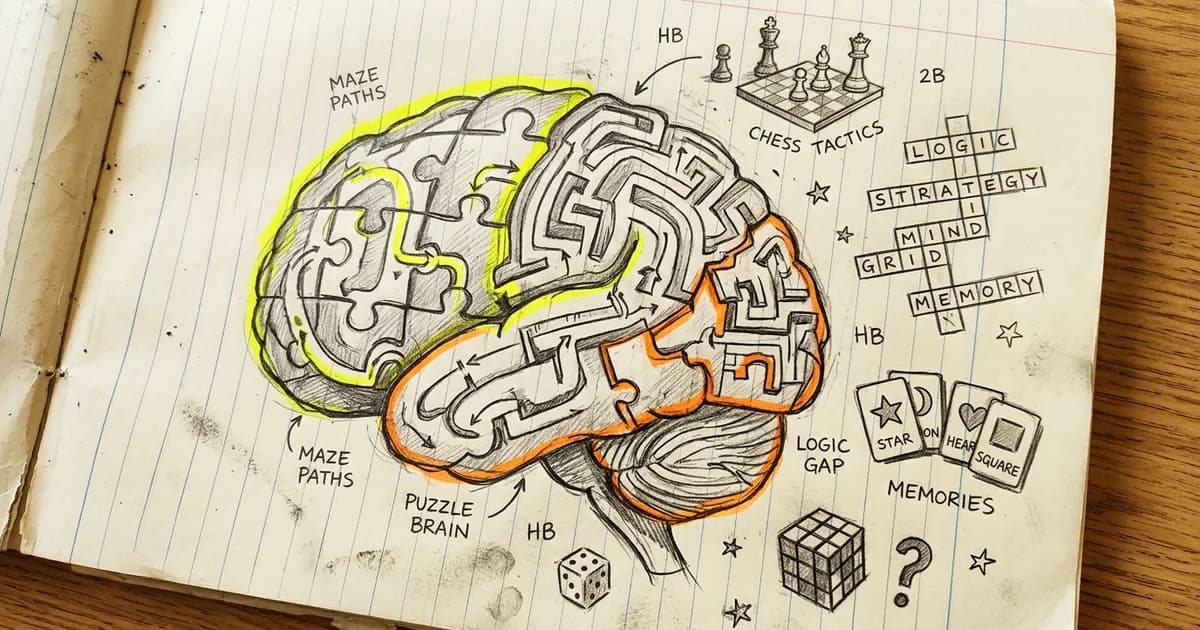
The term covers a wide range of digital and analog activities designed to train sustained focus, though what attention span means at a neurological level is worth understanding first. On the digital side, you'll find apps like Lumosity, BrainHQ, Elevate, and Peak. These attention span games typically offer short sessions (10 to 20 minutes) built around tasks like pattern matching, rapid visual search, working memory challenges, and task-switching drills.
On the analog side, classic games also qualify as attention span games. Chess demands deep sustained attention. Sudoku trains working memory. Even a jigsaw puzzle forces your brain to hold a visual template while scanning for matches.
There are also action video games, which occupy an interesting middle ground. A study on ResearchGate found that participants who played action games for more than 11 hours per week performed better on attention and working memory tasks than those who played less. Whether that's the games talking or the type of person who plays 11 hours of action games per week is a fair question.
The core premise behind all attention span games is simple: if you repeatedly challenge a cognitive function, that function gets stronger. It's the mental equivalent of progressive overload in the gym.
The question is whether the strength you build in the game carries over to the rest of your life.
The Transfer Problem: Near vs. Far
This is where the science behind attention span games gets honest.
Cognitive scientists split training benefits into two categories. Near transfer means you get better at tasks that closely resemble what you trained on. Far transfer means those gains extend to unrelated real-world tasks, like staying focused during a two-hour meeting after training on a pattern-matching game.
A second-order meta-analysis published in Collabra: Psychology (a meta-analysis of meta-analyses) found that near transfer is real but modest. Far transfer? The benefits "hardly go beyond the trained task and similar tasks." A 2023 review in PMC reinforced this, concluding that while near transfer is genuine, observed far transfer tends to be driven by nonspecific factors like motivation and expectation rather than actual cognitive restructuring.
Translation: attention span games will make you better at the game. They might not make you better at your job.
A 2025 study published in ScienceDirect ran a preregistered, double-blind, randomized controlled trial on working memory training and found "no evidence of near or far transfer effects." That's about as clean a null result as you'll find in cognitive science.
Where Attention Span Games Do Work
This isn't all bad news. The evidence for attention span games isn't zero. It's just more specific than the marketing suggests.
A meta-analysis published in ScienceDirect on game-based brain training for older adults found small but real improvements in processing speed (effect size g = 0.23), selective attention (g = 0.40), and short-term memory (g = 0.35) compared to control groups. Those aren't huge numbers, but they're statistically meaningful.
A study indexed in PMC found that brain training games improved attention and memory functions in healthy subjects compared to baseline. The caveat: the improvements were measured on tasks similar to the training itself.
A 2025 study in Frontiers in Education found that a gamified educational app improved attention in children with ADHD over an eight-week randomized controlled trial, though this was used alongside other interventions.
And a 2025 review published in PMC on computerized brain training in healthy aging noted that while there is evidence for "small but significant improvement in skills such as working memory, processing speed, and visuospatial skills," the practical benefits of attention span games for everyday life remain limited.
So the honest summary looks like this:
| Claim | Evidence Level |
|---|---|
| Attention span games improve performance on similar tasks | Strong |
| These games improve selective attention in older adults | Moderate |
| Games improve general real-world focus | Weak |
| Games prevent cognitive decline or dementia | Unsupported (per FTC) |
The Lumosity Lesson
In 2016, the Federal Trade Commission fined Lumosity's parent company $2 million for deceptive advertising. The FTC's complaint stated that Lumosity "simply did not have the science to back up its ads." The company had marketed its attention span games as tools to delay memory decline, protect against dementia, and improve performance at work and school.
The settlement didn't prove brain training is useless. It proved that the claims had outpaced the evidence. That distinction matters.
Lumosity still exists. It still publishes research. Some of that research is legitimate. But the episode is a useful reminder: when a company tells you their attention span games will sharpen your brain, ask to see the specific study, the sample size, the control group, and whether the measured outcome was near transfer or far.
What Actually Improves Your Attention Span
If attention span games alone won't fix your focus, evidence-based ways to increase attention point toward a broader set of habits. The answer is less exciting than an app download, but it's backed by stronger evidence.
1. Sleep
This one isn't optional. Sleep deprivation degrades attention faster than almost anything else. Even partial sleep loss (six hours instead of eight) impairs sustained attention, working memory, and executive function. Your prefrontal cortex, the region that keeps you locked onto a task, is one of the first areas to suffer when you cut sleep short. No attention span games will compensate for a 1 AM bedtime.
2. Physical Exercise
Aerobic exercise has a stronger evidence base for cognitive improvement than any brain training app. It promotes neurogenesis in the hippocampus, increases BDNF (brain-derived neurotrophic factor), and improves prefrontal cortex function, which is the brain region most responsible for sustained attention.
3. Strategic Cognitive Challenge
Attention span games aren't worthless. They're just insufficient on their own. The best approach is to combine them with real-world cognitive demands that force sustained, effortful attention over long periods, not just ten-minute bursts.
Learn a new language. Pick up an instrument. Read a book that requires you to hold complex arguments in your head across chapters. These activities demand the kind of deep focus that short-burst attention span games rarely touch. They also build what researchers call "cognitive reserve," a buffer of neural capacity that protects against decline over time.
4. Neurochemical Support
Your ability to focus isn't just a matter of willpower or practice. It's biochemistry. Attention depends on the interplay between several neurotransmitter systems:
- Adenosine builds up throughout the day, creating the pressure that makes you feel mentally fatigued. Caffeine blocks adenosine receptors, which is why coffee helps, temporarily.
- GABA is the brain's primary inhibitory neurotransmitter. It calms neural noise so you can focus on one thing instead of everything.
- Dopamine drives motivation and reward. Without adequate dopamine signaling, even interesting tasks feel like a grind.
The problem with caffeine alone is that it only addresses one pathway (adenosine) while often creating jitters and a crash as it wears off. A more complete approach targets multiple pathways simultaneously.
Attention Span Games as Part of a Bigger Strategy
Think of attention span games the way you'd think of stretching before a workout. Useful? Sure. Sufficient on their own? Not even close.
The people who actually maintain sharp focus across a full workday aren't relying on a single intervention, and increasing focus without burnout means stacking several complementary habits. They're stacking: consistent sleep, regular exercise, the right kind of mental stimulation, and neurochemical support that matches how the brain actually works.
The research is clear that training your brain is possible. It's also clear that attention span games on your phone aren't going to replace the biological foundations of attention.
Here's a useful framework: attention span games are a supplement to your focus strategy, not the strategy itself. Use them to warm up your focus, challenge specific cognitive skills, or just enjoy the process. But don't expect them to do the heavy lifting that sleep, movement, and neurochemistry are responsible for.
Build the Foundation First
If you've been playing attention span games and still feel like your focus dissolves halfway through the afternoon, you may need to fix your attention span at the foundation before your training regimen matters. It's your neurochemistry.
Roon was designed around this idea. Its sublingual pouch combines Caffeine (80 mg), L-Theanine, Theacrine, and Methylliberine to target the adenosine, GABA, and dopamine pathways that govern sustained attention. The result is 6 to 8 hours of clean, sustained focus without jitters, crashes, or tolerance buildup. No nicotine. No guesswork.
Play the attention span games if you enjoy them. But give your brain the chemistry it needs to actually perform. Cut through the fog.