Spermidine-Rich Foods: Eating for Autophagy and Longevity
Roon Team
Spermidine-Rich Foods: Eating for Autophagy and Longevity
Your cells run a recycling program. When it works, old and damaged proteins get broken down and reused. When it slows with age, the junk piles up, and that buildup tracks with most of the diseases we associate with getting older. Spermidine foods feed that recycling program, which is why a compound named after semen (where it was first found) keeps showing up in serious longevity research.
The molecule is called spermidine, a polyamine your body makes, your gut bacteria produce, and your diet supplies. Its main trick is triggering autophagy, the cellular cleanup process that won a Nobel Prize in 2016.
Here is what the science actually says, which foods carry the most of it, and how to eat for it without buying a single supplement.
Key Takeaways
- Spermidine triggers autophagy, the cell-cleaning process that declines with age.
- In a study of nearly 24,000 U.S. adults, the highest spermidine intake was linked to a 30% lower risk of all-cause death and a 32% lower risk of cardiovascular death.
- Wheat germ is the densest common source, followed by soybeans (natto), aged cheese, mushrooms, and legumes.
- You can build meaningful intake through food alone, no pills required.
What Spermidine Actually Does in Your Body
Spermidine works mainly by switching on autophagy. Think of autophagy as your cells eating their own trash: misfolded proteins, worn-out mitochondria, cellular debris. Clear the trash and the cell runs cleaner and longer.
This matters because autophagy drops off as you age, and that decline is tied to heart disease, metabolic problems, and cognitive decline. Spermidine is one of the few dietary compounds shown to restart the process in aging cells.
The animal lifespan data is hard to ignore. In the foundational work published in Nature Cell Biology, spermidine supplementation extended lifespan in yeast, worms, and flies, and later research reported similar effects in mice. Those are not human results, but they point to a consistent mechanism across very different species.
The Human Data on Spermidine and Longevity
The most cited human evidence comes from a large U.S. nutrition survey. Researchers analyzed dietary intake in nearly 24,000 people and tracked who died over the following years.
The result was clear. Higher intake of dietary spermidine is associated with decreased risk of CVD and all-cause mortality, and among specific food origin spermidine, that derived from vegetables, cereals, legumes, nuts, and cheese was associated with reduced CVD and all-cause mortality, per the Frontiers in Public Health analysis of NHANES data.
The size of the effect is what got attention. An observational study of nearly 24,000 people enrolled in NHANES from 2003 to 2014 found that those who consumed the most dietary spermidine had a 30% lower risk of all-cause mortality and a 32% lower risk of cardiovascular death compared to those who consumed the least.
One caveat worth keeping. This is observational data, so it shows a strong association, not proof that spermidine alone caused the lower death rates. People who eat more spermidine tend to eat more whole grains, legumes, and vegetables in general. Still, the signal lines up neatly with the lab mechanism, which is rare.
Spermidine and the Aging Brain
Spermidine may support the brain through the same autophagy pathway it uses everywhere else. In animal models of aging, the effect on memory has been measurable.
Research published in Aging-US reported that spermidine and spermine delay brain aging by inducing autophagy in SAMP8 mice, a strain bred to age rapidly. A separate line of work found that the compound protects synapses, the connection points between neurons that tend to degrade with age.
Early human work is promising but modest. Researchers have run small trials giving spermidine-rich supplements to older adults with memory complaints over a few months. By promoting autophagy, spermidine may also support cognitive resilience, and preclinical studies suggest it can help clear beta-amyloid, the abnormal protein buildup seen in the brains of people with Alzheimer's disease.
To be precise: none of this means spermidine treats or prevents any brain disease. It means the food compound supports a maintenance process the brain relies on.
Spermidine Rich Foods: Where to Get It
Wheat germ is the heavyweight. Gram for gram, it carries far more spermidine than nearly any other common food, which is why wheat germ spermidine shows up in most longevity diets and in many supplement extracts.
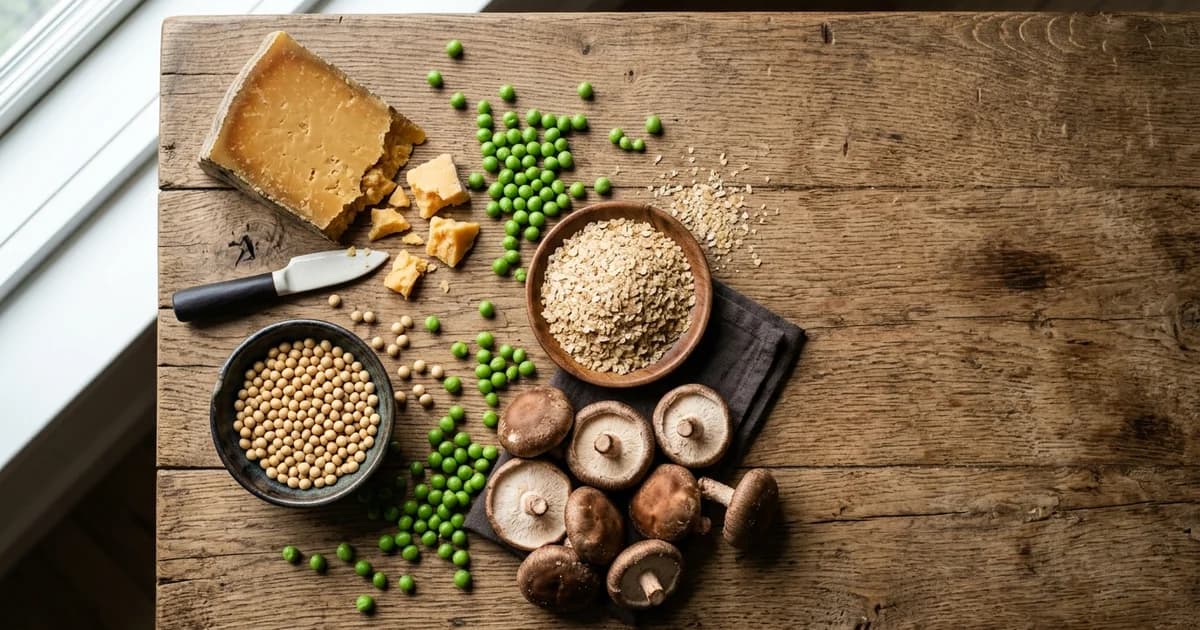
After that, fermented soy is the standout. Natto spermidine content is high because fermentation by Bacillus subtilis drives up polyamine levels, making natto one of the richest whole-food sources you can buy. Aged cheeses, mushrooms, and legumes round out the list.
Here are the most reliable spermidine rich foods, ranked roughly by density:
| Food | Spermidine density | Easy way to eat it |
|---|---|---|
| Wheat germ | Highest of common foods | Stir into oatmeal, yogurt, or smoothies |
| Natto (fermented soy) | Very high | Eat over rice for breakfast |
| Soybeans / edamame | High | Snack, salad, or stir-fry |
| Aged cheese (cheddar, parmesan) | High | Grate over vegetables or pasta |
| Mushrooms | Moderate to high | Saute as a side or fold into eggs |
| Green peas, legumes, lentils | Moderate | Soups, dals, and bowls |
| Whole grains | Moderate | Swap in for refined grains |
A practical note on foods for autophagy: spermidine survives normal cooking reasonably well, and fermented foods often gain spermidine during their processing. So natto, aged cheese, and miso punch above their weight.
How to Build a Spermidine Diet for Longevity
You do not need to count milligrams. A spermidine diet for longevity is mostly the same Mediterranean-plus-fermented-food pattern that performs well in nearly every long-term health study, with a couple of deliberate additions.
A simple daily template:
- Breakfast: A spoonful of wheat germ in oatmeal or yogurt. This single habit moves the needle more than anything else.
- Lunch: A legume base (lentils, chickpeas, edamame) plus mushrooms.
- Dinner: Whole grains and a fermented element, whether that is natto, aged cheese, or miso.
Two factors stack on top of diet. Fasting and exercise both independently raise autophagy, so spermidine-rich eating works alongside them rather than competing with them. The NHANES data also suggests the source matters: spermidine from vegetables, cereals, legumes, nuts, and cheese carried the clearest benefit.
Conclusion
Spermidine is one of the cleaner stories in longevity science. A compound in everyday food triggers a cellular cleanup process that fades with age, the mechanism holds up across species, and large human data links higher intake to lower mortality.
You do not need a pill to act on it. Wheat germ, natto, aged cheese, mushrooms, and legumes deliver real amounts, and they happen to be the same foods that show up in every diet associated with a long, healthy life. Eat for autophagy by eating well, then let fasting and movement do the rest.
Frequently Asked Questions
What food has the most spermidine?
Wheat germ is the densest common source of spermidine by a wide margin, which is why it appears in most longevity diets and forms the base of many spermidine supplement extracts. A single spoonful stirred into oatmeal, yogurt, or a smoothie is the easiest way to raise your daily intake. Fermented soy products like natto come next, followed by aged cheeses, mushrooms, and legumes.
How much spermidine should I eat per day?
There is no official recommended intake, and most research describes intake in ranges rather than targets. In the large NHANES analysis, people in the highest intake group, who showed the lowest mortality risk, were simply eating more whole grains, legumes, vegetables, nuts, and cheese. A practical goal is to include at least one or two spermidine-rich foods at every meal rather than chasing a specific milligram number.
Does cooking destroy spermidine in food?
Spermidine holds up reasonably well to normal cooking, so sauteed mushrooms and cooked legumes still contribute. Fermentation actually increases spermidine, which is why natto, aged cheese, and miso are such strong sources. The main thing to avoid is assuming you have to eat everything raw, because you do not.
Is spermidine from food as good as a supplement?
Food-derived spermidine comes packaged with fiber, protein, and other nutrients, and the strongest human mortality data is built on dietary intake, not pills. The NHANES study tied benefits specifically to spermidine from vegetables, cereals, legumes, nuts, and cheese. Supplements can be useful for convenience or for people who cannot eat enough source foods, but food first is the better-supported approach.
Can spermidine help with memory or brain aging?
In animal models, spermidine has delayed brain aging and protected synapses by inducing autophagy, and early human work in older adults is encouraging but small. It is best understood as support for a maintenance process the brain relies on, not as a treatment for any cognitive condition. If you have concerns about memory, talk to a clinician rather than self-treating with any single compound.
Does spermidine work like fasting?
Both spermidine and fasting raise autophagy, which is why spermidine is sometimes called a caloric-restriction mimetic. They are not interchangeable, but they push the same lever from different directions. Eating spermidine-rich foods and practicing time-restricted eating or regular exercise can reinforce each other rather than cancel out.
Food First, Focus Second: Two Different Jobs
Spermidine is a foundation play. It works slowly and quietly, supporting cellular maintenance over months and years through the food you eat every day. That is a different job from sharpening your focus for the next four hours.
Both matter, and they do not compete. A spermidine-rich diet builds the long-term base. When you need precise, acute focus for deep work, that calls for a different tool. Roon is a zero-nicotine sublingual pouch built for exactly that second job, combining 80 mg caffeine, 60 mg L-theanine, 25 mg methylliberine (Dynamine), and 5 mg theacrine (TeaCrine) for a 5 to 10 minute onset and 6 to 8 hours of steady focus without the jitters, crash, or tolerance buildup.
Roon is not a longevity supplement and it will not replace good food. Think of it as the focus layer on top of a well-fed foundation. Eat for autophagy, then try Roon when you need your attention to show up on command.
Written by Roon Team