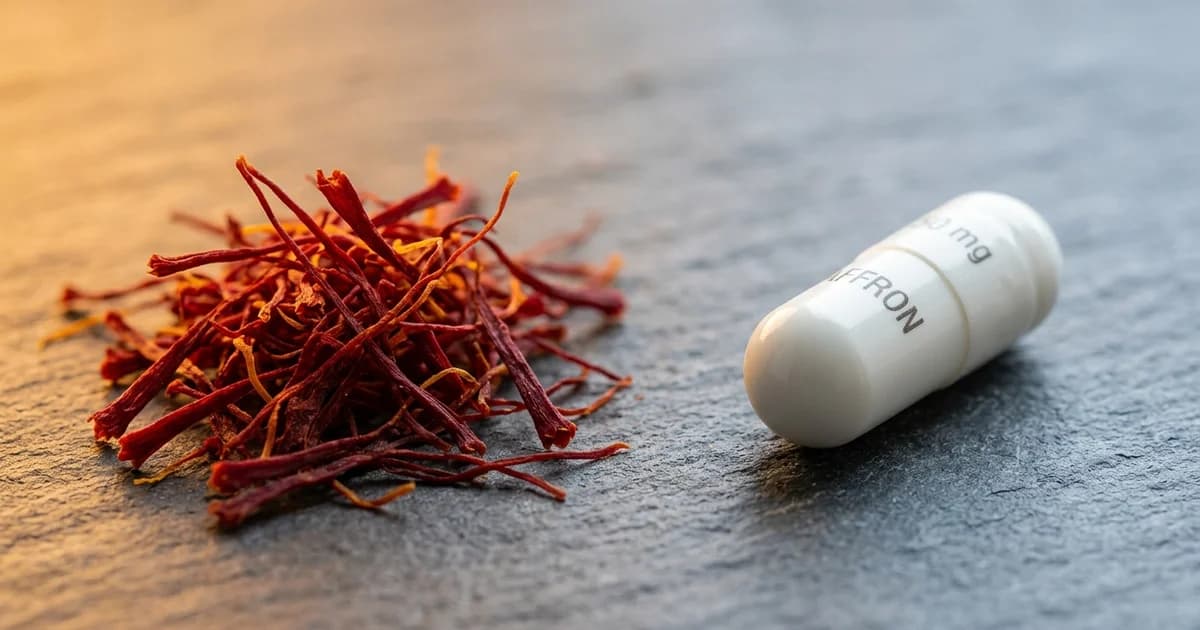
Saffron vs Fluoxetine: Inside the Landmark Trial That Made a Spice a Contender
In 2004, a small team of Iranian psychiatrists ran an experiment that sounds almost too simple to take seriously. They gave one group of depressed patients Prozac. They gave the other group a daily capsule of saffron, the red threads people usually associate with paella and overpriced rice. Then they watched what happened.
The saffron vs fluoxetine comparison that followed has been replicated, scrutinized, and folded into multiple meta-analyses over the past two decades. The headline finding keeps surviving: in mild to moderate depression, a measured dose of saffron performed about as well as a standard antidepressant.
This is the story of how a kitchen spice became a legitimate research subject, what the data actually shows, and where the limits sit.
Key Takeaways
- In head-to-head trials, saffron matched fluoxetine (Prozac) for reducing symptoms of mild to moderate depression, with no statistically significant gap between the two.
- The original work came from Tehran University of Medical Sciences, led by psychiatrist Shahin Akhondzadeh, using small, double-blind, randomized designs.
- Saffron's two key compounds, crocin and safranal, appear to influence serotonin activity, which is the same broad pathway that SSRIs target.
- The trials were small and short, so saffron is a promising research candidate, not a proven replacement for prescribed medication.
The Problem That Made Researchers Look at a Spice
Depression is not a niche condition. The World Health Organization estimates that around 280 million people live with depression worldwide, and the agency calls it a leading cause of disability on the planet.
Standard antidepressants help millions of people. They also come with friction. Sexual side effects, weight changes, sleep disruption, and a slow onset push a meaningful share of patients to quit early.
That gap is why researchers started testing plant compounds with a long history of folk use. Saffron, the dried stigma of the Crocus sativus flower, had been used for low mood in Persian traditional medicine for centuries. The question was whether that tradition would hold up under a placebo control and a rating scale.
The Landmark Saffron vs Fluoxetine Trial, Explained
The trial that put this question on the map was a six-week, double-blind, randomized study published in 2005 by Noorbala, Akhondzadeh, and colleagues. The design was clean for its size.
Forty adult outpatients met the DSM-IV criteria for major depression. Researchers randomly assigned them to one of two arms. Our objective was to compare the efficacy of hydro-alcoholic extract of Crocus sativus (stigma) with fluoxetine in the treatment of mild to moderate depression in a 6-week double-blind, randomized trial.
One group took 30 mg of saffron per day. The other took 20 mg of fluoxetine per day, a common clinical dose of Prozac. Neither the patients nor the assessors knew who got which.
What the Numbers Showed
Both groups got better, and they got better by roughly the same amount. The Hamilton Depression Rating Scale (HAM-D) was used as the primary outcome measure and both groups exhibited marked improvement from baseline, with no statistically significant difference between them (mean HAM-D reduction: saffron=12.0±5.1; fluoxetine=11.0±4.5; p>0.05).
In plain terms, the spice and the drug landed in the same place. That is the finding that turned a single saffron antidepressant study into an entire research line.
This was not a one-off. The same Tehran group also ran a crocus sativus vs Prozac comparison using saffron petals instead of stigma, and a separate trial pitting saffron against the older tricyclic antidepressant imipramine. The pattern repeated.
Saffron vs Prozac: The Head-to-Head Snapshot
Here is how the two compare on the points patients tend to care about. This reflects trial findings, not a recommendation to swap one for the other.
| Factor | Saffron (Crocus sativus) | Fluoxetine (Prozac) |
|---|---|---|
| Typical study dose | 30 mg/day | 20 mg/day |
| Symptom reduction (mild–moderate) | Comparable to fluoxetine | Comparable to saffron |
| Trial duration tested | Mostly 6 weeks | Mostly 6 weeks |
| Evidence base | Small RCTs plus meta-analyses | Decades of large-scale trials |
| Regulatory status | Dietary supplement / food | FDA-approved prescription drug |
| Reported side effects in trials | Few, similar to fluoxetine | Standard SSRI profile |
The honest reading: saffron held its own on efficacy in these specific studies, but fluoxetine sits on a far deeper and longer evidence base.
Why a Spice Would Affect Mood at All
Saffron is not a single chemical. Its color, smell, and bioactivity come mostly from two compounds: crocin, which gives the threads their deep red, and safranal, which carries the aroma.
These compounds appear to act on the same neurotransmitter systems that prescription antidepressants do. According to a comparative review in PMC, it has an impact by altering brain chemicals such as serotonin, which is responsible for boosting mood. However, the exact mechanism through which Saffron increases serotonin levels in the brain is still unclear.
The leading theory is reuptake inhibition. Research summarized by MDPI notes that studies on mice have attributed anti-depressant properties to safranal and crocin via the mechanism of inhibiting dopamine, serotonin, and norepinephrine reuptake. That is, broadly, what an SSRI does, which helps explain why the trial outcomes looked so similar.
What the Bigger Picture Says
A single 40-person trial proves very little on its own. The interesting part is what happened when researchers pooled the studies.
A 2019 systematic review and meta-analysis gathered the available data on saffron and mood. Twenty-three studies were included. Saffron had a large positive effect size when compared with placebo for depressive symptoms (g = 0.99, P < 0.001) and anxiety symptoms (g = 0.95, P < 0.006).
A larger effect-size estimate appears in a 2024 systematic review of clinical evidence, which reported that saffron was more effective than placebo in improving cognition, depression with an overall effect size of -4.26 (95% CI: -5.76, -2.77), anxiety of -3.75 (95% CI: -5.83, -1.67), and sleep disorders of -1.91 (95% CI: -2.88, -0.93).
The trials have also moved beyond textbook depression. The Tehran group and others have tested saffron against fluoxetine in postpartum depression and in patients recovering from heart procedures, repeatedly finding similar results between the two.
The Caveats You Should Not Skip
The evidence is genuinely interesting, and it is also genuinely limited. Both things are true.
Most of the head-to-head trials were small, often 30 to 60 people. They ran for about six weeks, which is short for a condition that often lasts years. A large share of the foundational work came from a single research center, which raises the standard question about independent replication.
There is also the matter of severity. These studies tested mild to moderate depression. None of this speaks to severe or treatment-resistant cases, where prescription medication and clinical supervision are the standard of care.
Saffron is also concentrated and expensive, and supplement quality varies widely. A spice rack jar is not a clinical dose, and self-treating a mood disorder is a poor idea regardless of how good the data on an ingredient looks.
Conclusion
The saffron depression trial record is one of the more credible stories in herbal psychiatry. A cheap, blinded, randomized design showed a food-grade spice matching a widely prescribed antidepressant for mild to moderate symptoms, and later meta-analyses backed the direction of that finding.
What the data supports is modest and specific. Saffron is a serious research candidate with a plausible mechanism, not a proven stand-in for medical treatment. The right move with any mood condition is a conversation with a clinician, using studies like these as context rather than as a prescription.
Frequently Asked Questions
Did saffron actually beat Prozac in the studies?
No. Saffron did not beat fluoxetine, and that is the point. In the landmark six-week trial, both groups improved by a similar amount on the Hamilton Depression Rating Scale, with no statistically significant difference between them. The headline is equivalence in mild to moderate depression, not superiority. Saffron performed about as well as the drug, which is notable for a food-grade compound but is not the same as outperforming it.
How much saffron was used in the trials?
The core comparison trials used about 30 mg of standardized saffron extract per day, usually split into two doses. This is a controlled, measured dose of a concentrated extract, not a pinch of the spice from your kitchen. The fluoxetine arm typically received 20 mg per day, a standard clinical dose. Dosing consistency is one reason researchers used capsules rather than culinary saffron.
Which compounds in saffron affect mood?
The two most studied are crocin and safranal. Crocin gives saffron its red color, and safranal produces its distinctive aroma. Animal and lab research suggests these compounds influence serotonin, norepinephrine, and dopamine activity, partly through reuptake inhibition. That overlaps with how SSRIs like fluoxetine work, which offers a plausible biological reason for the similar trial outcomes, though the exact mechanism in humans is still being worked out.
Is saffron safe to take with antidepressants?
This is a question for a doctor, not an article. Because saffron appears to act on serotonin pathways, combining it with prescription antidepressants raises theoretical interaction concerns. Self-combining mood-active compounds without medical guidance is risky. If you take or are considering antidepressants, talk to your prescriber before adding saffron or any supplement to the mix.
Can saffron replace prescription antidepressants?
The research does not support that conclusion. The trials tested mild to moderate depression over short windows in small samples, mostly from one research group. They say nothing about severe or treatment-resistant depression, where medication and clinical care are standard. Saffron is best understood as a promising research subject, not a swap for prescribed treatment.
Why did researchers study a spice for depression in the first place?
Saffron has a long history of use for low mood in Persian traditional medicine. That history, combined with rising interest in tolerable alternatives to standard antidepressants, made it a logical candidate for formal testing. The Tehran University group designed blinded, randomized trials specifically to see whether the traditional use would survive modern scientific scrutiny. It largely did, at least for milder cases.
A Note on Reading the Science Behind What You Take
The saffron story is a useful template for thinking about any compound that claims to affect your brain. Look for blinded, randomized trials. Check the dose used in the study against the dose in the bottle. Ask whether the finding has been replicated by someone other than the original lab.
That same skepticism is how we build Roon. Roon is a zero-nicotine sublingual pouch for sustained focus, built on a four-ingredient formula: 80 mg caffeine, 60 mg L-theanine, 25 mg methylliberine (Dynamine), and 5 mg theacrine (TeaCrine). It is designed for 6 to 8 hours of clean focus with no jitters, no crash, and no tolerance buildup.
To be clear about scope: Roon is a cognitive performance product, not an antidepressant and not a treatment for any mood condition. Saffron and depression sit firmly in clinical territory. If you want more breakdowns like this one, sober reads on the ingredients people actually put in their bodies, follow along with Roon.
Written by Roon Team