Saffron vs 5-HTP: Two Different Roads to Better Serotonin Tone
Roon Team
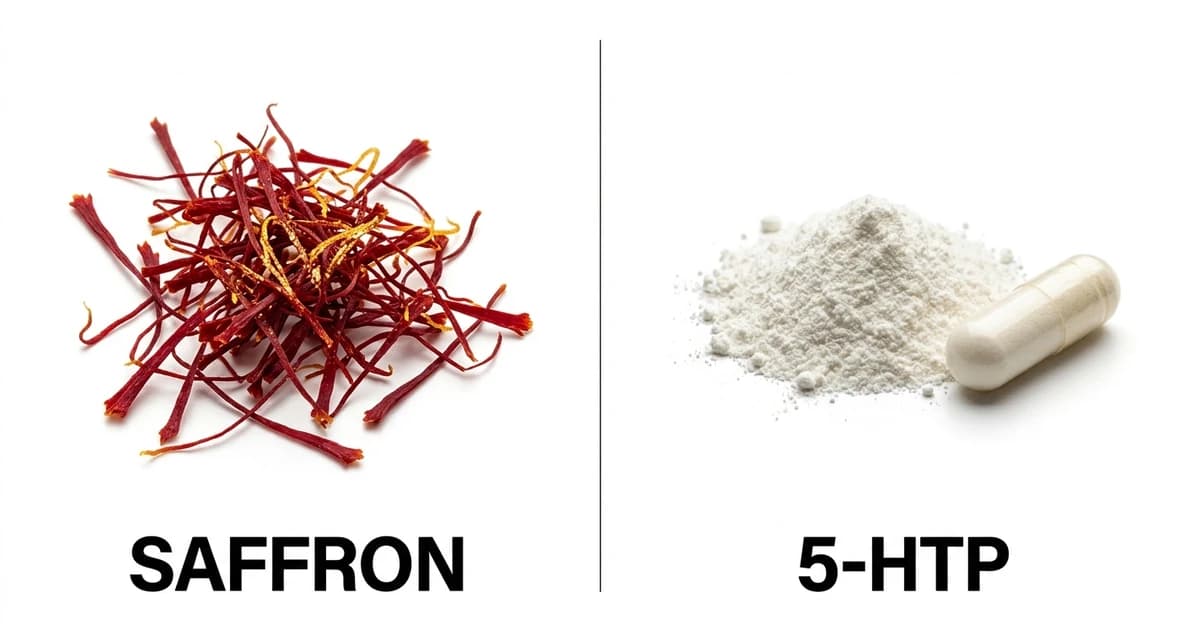
Saffron vs 5-HTP: Two Different Roads to Better Serotonin Tone
Most people shopping for a mood supplement assume one ingredient must be better than the other. The saffron vs 5-HTP question doesn't work that way. These two compounds support serotonin through almost opposite mechanisms, and that difference decides which one fits your goals, your medication situation, and your tolerance for side effects.
5-HTP pushes more raw material into the serotonin assembly line. Saffron works upstream of that, nudging how your brain uses the serotonin it already has. Same destination, very different roads.
Here's the honest breakdown of what each one does, what the trials actually show, and how to choose.
Key Takeaways
- 5-HTP is a direct serotonin precursor. Your body converts it into serotonin in one step, which is fast but blunt and harder to titrate.
- Saffron acts more like a gentle reuptake modulator. Clinical trials compare its mood effects to low-dose SSRIs, with fewer side effects.
- 5-HTP carries real interaction risk with antidepressants and a higher chance of nausea.
- Saffron has the cleaner human safety record at standard doses of 28 to 30 mg per day.
- Neither is a focus tool. Both sit in the evening and mood category, not the daytime performance category.
Saffron vs 5-HTP: The Core Difference in One Table
The fastest way to understand the saffron 5htp difference is to look at mechanism, dosing, and evidence side by side.
| Factor | Saffron (Crocus sativus) | 5-HTP |
|---|---|---|
| How it works | Modulates serotonin and dopamine signaling; behaves like a mild reuptake inhibitor | Direct precursor; converts into serotonin in one enzymatic step |
| Typical dose | 28 to 30 mg/day standardized extract | 50 to 300 mg/day, usually split |
| Onset | Builds over 1 to 4 weeks | Builds over days to weeks |
| Main side effect | Mild, rare at standard doses | Dose-dependent nausea, GI upset |
| Antidepressant interaction | Lower, but still consult a doctor | High risk of serotonin syndrome |
| Best-studied use | Low mood, mild to moderate depression | Mood, appetite, sleep onset |
| Evidence quality | Multiple RCTs, head-to-head vs SSRIs | Older, smaller trials |
How 5-HTP Actually Works
5-HTP is the molecule your body makes right before it makes serotonin. Take it as a supplement, and you hand your brain a near-finished ingredient that skips the slowest step in serotonin production.
That directness is the appeal and the problem. 5-HTP is a naturally occurring chemical substance and a metabolic intermediate in the biosynthesis of serotonin in the human body, and it is available over the counter in the United States, United Kingdom, and Canada as a dietary supplement. Because conversion happens both in the brain and throughout the body, a lot of the serotonin gets made in places you didn't intend, like your gut.
That peripheral conversion is why nausea tops the complaint list. Nausea is the most common complaint and is dose-dependent, beginning around 50 mg reduces it, and splitting the dose across the day is gentler on the stomach. Taking it with food helps too.
At higher intakes the tolerability picture is still workable. Oral doses of 200 to 300 mg per day of 5-HTP have generally been well tolerated, and gastrointestinal effects are usually moderate and often abate or disappear once a steady dosage is achieved.
The 5-HTP Safety Footnote People Forget
5-HTP shares a family history with L-tryptophan, and that history matters. Tryptophan supplements were banned in 1989 when they were found to contain a contaminant called Peak X, after an outbreak of eosinophilia-myalgia syndrome (EMS) was potentially linked to the contaminated products. 5-HTP itself was never banned, but the EMS concern has trailed the precursor category ever since, which is why product quality and sourcing genuinely matter here.
If you want a deeper look at the precursor question specifically, our 5-HTP vs L-tryptophan comparison walks through which serotonin precursor makes more sense and why.
How Saffron Works (And Why It Reads Like a Mild SSRI)
Saffron doesn't flood the system with precursor. It adjusts how serotonin moves and signals. Saffron works by blocking serotonin reuptake similar to SSRIs, while also providing anti-inflammatory and antioxidant effects through active compounds like crocin, crocetin, and safranal.
This is the cleanest way to frame the natural serotonin support comparison. 5-HTP adds fuel. Saffron changes how efficiently the existing fuel is used, plus it brings antioxidant activity that the precursor doesn't.
The active compounds do the heavy lifting. Animal work shows that saffron extracts and their constituents, such as safranal and crocin, can reduce immobility time and increase swimming time in the forced swimming test, similar to the effects of fluoxetine, a commonly prescribed SSRI.
What the Clinical Trials Show
Saffron has the stronger human evidence base for mood, and the head-to-head data against prescription antidepressants is what makes it stand out.
A meta-analysis comparing the two found near-equivalence. The findings showed that saffron administration was well comparable with both fluoxetine and placebo in treating depression. A separate review reinforced this. In a randomized controlled trial, saffron at 30 mg/day and fluoxetine at 20 mg/day were equally effective in reducing depressive symptoms, and saffron demonstrated fewer side effects.
The safety edge is consistent across the literature. A meta-analysis of 8 randomized controlled trials found no marked difference in symptom reduction between saffron and SSRIs, while saffron demonstrated superior safety, producing roughly 6% fewer adverse events.
Saffron also helps people who aren't clinically depressed. In a trial of healthy adults with self-reported low mood, a group of 128 healthy adults who self-reported low mood but were not diagnosed with depression were given either 28 mg of affron per day or a placebo. The result favored saffron. After 4 weeks, the affron group markedly improved in mood versus the placebo group, reporting reduced tension, depression and fatigue, as well as decreased stress and slightly improved sleep.
5-HTP has supportive trials too, but they tend to be older and smaller, which is why most clinicians lean on saffron when they want reproducible data. If you want the full ingredient profile, our saffron deep dive covers dosing, standardization, and what to look for on a label.
Saffron or 5-HTP for Mood: How to Actually Choose
Here is the practical answer to the saffron or 5-HTP for mood question.
Choose saffron if you want the cleaner safety profile, you're sensitive to nausea, or you want an ingredient with head-to-head antidepressant data behind it. It's the more sensible default for general low mood and the easier one to take long term.
Consider 5-HTP if you specifically want a direct precursor approach, you tolerate it well, and you've cleared it with a clinician. The faster mechanism appeals to some people, but the trade-off is GI side effects and tighter interaction limits.
Pick neither, on your own, if you take an SSRI, SNRI, MAOI, tramadol, or any serotonergic medication. Stacking a serotonin precursor on top of those drugs is the classic recipe for serotonin syndrome, and even saffron's mild reuptake activity warrants a conversation with your doctor first.
The Best Natural Mood Supplement Depends on Your Constraints
There is no universal "best natural mood supplement." There is only the best fit for your medication list, your gut tolerance, and how much human data you want behind the choice. For most people with no contraindications, saffron wins on evidence and tolerability. For a narrow precursor-focused goal under supervision, 5-HTP has a role.
The Bottom Line on Two Serotonin Strategies
Saffron and 5-HTP both aim at serotonin tone, but they get there differently. 5-HTP adds raw precursor and works fast, with more nausea and more interaction risk. Saffron modulates the system you already have, carries a cleaner safety record, and has reproducible trials showing mood benefits comparable to low-dose SSRIs.
If you have no contraindications and want the better-studied, gentler option, saffron is the stronger starting point. If you're drawn to the precursor route, do it carefully and with medical input. Either way, treat these as mood and evening tools, not stimulants. Neither one will sharpen your focus during a workday.
Frequently Asked Questions
Is saffron or 5-HTP better for mood?
For most people, saffron is the better-supported choice. It has multiple randomized trials showing mood benefits comparable to low-dose SSRIs, plus a cleaner side effect profile. 5-HTP works through a more direct precursor mechanism and can help some people, but it carries higher nausea risk and a tighter interaction window. The right pick depends on your tolerance, your goals, and any medications you take.
Can I take saffron and 5-HTP together?
You should not combine them on your own. Both influence serotonin through different routes, and stacking serotonergic compounds raises the risk of serotonin syndrome. If you're considering a combination, talk to a doctor or pharmacist first, especially if you take any prescription medication. There is little quality human research on combining the two, so the safer default is to use one at a time.
Does saffron really work like an antidepressant?
Saffron behaves like a mild serotonin reuptake modulator and adds antioxidant and anti-inflammatory activity. Several trials found it comparable to fluoxetine at standard doses, with fewer side effects. That said, saffron is a dietary supplement, not a treatment for any diagnosed condition. If you have clinical depression, work with a healthcare provider rather than self-treating with a supplement.
Why does 5-HTP cause nausea?
5-HTP converts into serotonin not just in your brain but throughout your body, including the gut. That peripheral serotonin production is the main driver of nausea, which is dose-dependent. Starting around 50 mg, splitting the dose across the day, and taking it with food all reduce stomach upset. The effect often eases once your body adjusts to a steady dose.
How long does each one take to work?
Both build gradually rather than hitting instantly. Saffron trials typically show mood improvements over one to four weeks of daily use. 5-HTP effects can begin within days but also strengthen over a few weeks. Neither is an acute, take-it-and-feel-it-in-minutes compound, so consistency over several weeks matters more than any single dose.
Are saffron and 5-HTP safe with antidepressants?
This is the most important caution. 5-HTP has a high interaction risk with SSRIs, SNRIs, MAOIs, and other serotonergic drugs, and can contribute to serotonin syndrome. Saffron's reuptake activity is milder but still warrants a doctor's review before combining. If you take any antidepressant, do not add either supplement without medical clearance.
Where These Two Fit, and Where They Don't
This whole comparison points to one quiet conclusion: saffron and 5-HTP are evening and mood tools, not daytime performance tools. They nudge serotonin tone over weeks. They do nothing for the kind of sharp, sustained focus you need to get through deep work, a study block, or a long afternoon.
That gap is the one Roon was built to fill. Roon is a zero-nicotine sublingual pouch with a four-ingredient stack: 80 mg caffeine, 60 mg L-theanine, 25 mg methylliberine (Dynamine), and 5 mg theacrine (TeaCrine). It hits in 5 to 10 minutes and holds a 6 to 8 hour focus window with no jitters, no crash, and no tolerance buildup.
To be clear about what it isn't: Roon is not a serotonin supplement and not a substitute for saffron, 5-HTP, or anything you'd use for mood support. Think of it as the daytime counterpart. Use a mood tool in the evening, and try Roon when you actually need to lock in and perform.
Written by Roon Team