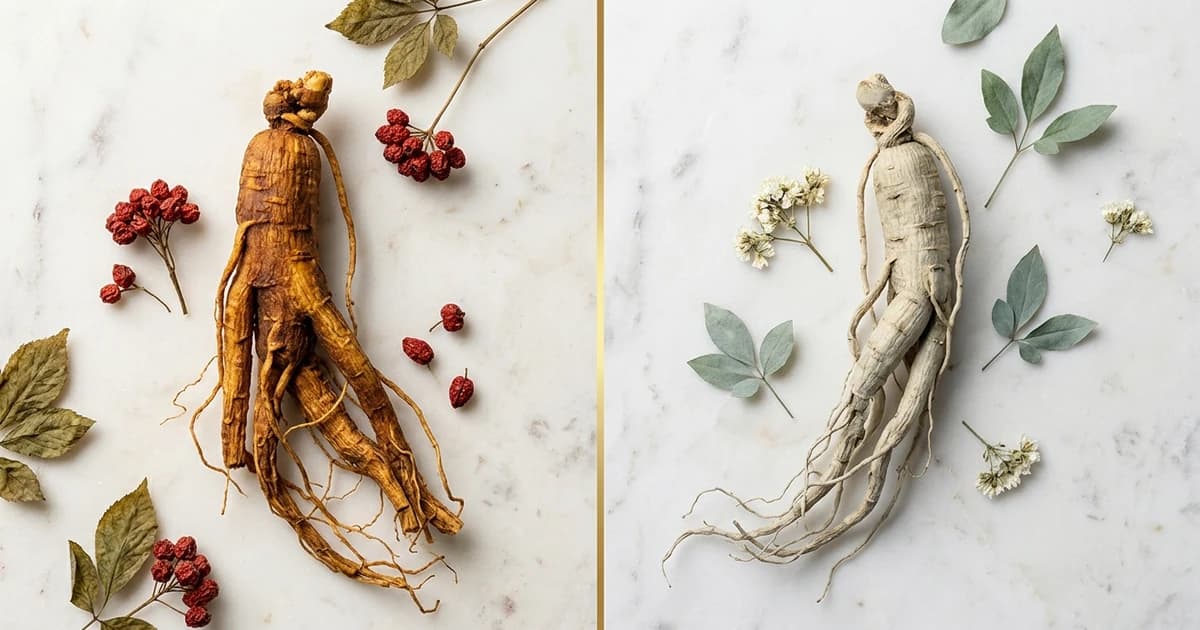
Panax Ginseng vs American Ginseng: Why the Same Plant Gives You Opposite Effects
Two roots. One plant genus. Completely different effects on your brain.
The panax ginseng vs american ginseng question trips up almost everyone who shops for an adaptogen, because the labels lie by omission. Both are "ginseng." Both belong to the Panax genus. Yet one tends to rev you up and the other tends to settle you down. The reason is not marketing. It is chemistry.
The split comes down to two molecules with names that sound like robot serial numbers: Rg1 and Rb1. Get the ratio right for your goal and ginseng works with you. Get it wrong and you wonder why a "calming" root left you wired at midnight.
Key Takeaways
- Panax ginseng (Asian or Korean ginseng) skews stimulating, driven by a higher proportion of the ginsenoside Rg1.
- American ginseng (Panax quinquefolius) skews calming and is unusually rich in Rb1, a ginsenoside that supports GABA activity.
- The species share a genus but carry different ginsenoside fingerprints, which is why their effects diverge.
- For daytime focus without overstimulation, the Rg1-to-Rb1 balance matters more than the word "ginseng" on the label.
The Core Difference: Rg1 vs Rb1 Ginsenosides
If you only remember one thing about panax ginseng vs american ginseng, make it this: the active compounds are not interchangeable, and the ratio between two of them sets the tone.
Ginsenosides are the steroid-like saponins that give ginseng its activity. Researchers sort them into structural families. Ginsenosides can be classified into three groups on the basis of their chemical structure: the Panaxadiol group (Rb1, Rb2, Rb3, Rc), the Panaxatriol group (Re, Rf, Rg1, Rg2, Rh1), and the oleanolic acid group.
Two of these do most of the heavy lifting in the brain. Rg1 sits in the panaxatriol camp. Rb1 sits in the panaxadiol camp. They pull in different directions.
Rg1: the accelerator
Rg1 is the compound most associated with Asian ginseng's lift. Asian ginseng appears to have particularly high concentrations of the Rg1 ginsenoside, which acts as a central nervous system stimulant.
That stimulant character is not hand-waving. Ginsenoside Rg1 is one of the most abundant active chemical constituents of Panax ginseng, with known neuroprotective, anxiolytic, and cognition-improving effects, and it modulates medial prefrontal cortical firing. In plain terms, Rg1 changes how the front of your brain fires. That is the part doing your planning, your focus, your working memory.
Rb1: the brake
Rb1 is the signature of American ginseng, and it leans the other way. The clearest evidence sits in the GABA system, your brain's main calming circuit.
Research in mice demonstrated that Rb1 can promote prefrontal cortical GABA levels and GABAergic transmission, and that Rb1 may exert dual effects on GABA-A and GABA-B receptors to enhance inhibitory transmission. GABA is the neurotransmitter that quiets neural chatter. More GABA tone usually means less jitter and a steadier baseline.
Rb1 also carries a wide protective profile. Reviews summarize the neuroprotective roles of ginsenoside Rb1 across central nervous system diseases, including neurodegenerative disease, cerebral ischemia, depression, and spinal cord injury, through its inhibition of oxidative stress, apoptosis, and neuroinflammation.
The interesting wrinkle: both compounds can touch excitatory signaling too. Ginsenosides Rb1 and Rg1 have both been reported to increase the release of the excitatory neurotransmitter glutamate in cell models. So neither is purely "up" or "down." But the net felt effect tracks with which ginsenoside dominates, and that is where the two species part ways.
Korean vs American Ginseng: A Side-by-Side
The korean vs american ginseng debate is really a debate about ginsenoside fingerprints. Korean ginseng is simply a premium cultivar of Asian Panax ginseng, so it carries the same Rg1-forward profile.
American ginseng is a different species with its own chemistry. Although members of the Panax genus share many saponins, Panax quinquefolius has its own characteristic profile, in this case with high expression of the ginsenoside Rb1. One studied American ginseng extract bears this out clearly. That extract contained 11.65% ginsenosides, of which Rb1 made up 5.69% and Rg1 only 0.28%.
Read that ratio again. Rb1 outweighed Rg1 by roughly twentyfold in American ginseng. That single number explains most of the felt difference.
| Feature | Panax Ginseng (Asian / Korean) | American Ginseng (P. quinquefolius) |
|---|---|---|
| Species | Panax ginseng | Panax quinquefolius |
| Dominant ginsenoside | Rg1 (panaxatriol) | Rb1 (panaxadiol) |
| Net felt effect | Stimulating, energizing | Calming, grounding |
| Brain target emphasis | Prefrontal firing, alertness | GABAergic inhibitory tone |
| Best fit | Low-energy days, fatigue, drive | Stress load, overstimulation, steady focus |
| Common nickname | Asian ginseng, Korean ginseng | Western ginseng |
This is the asian ginseng vs american ginseng split in one table. Same genus, opposite center of gravity.
Which Ginseng for Focus?
For most people chasing clean daytime focus, American ginseng is the safer starting point, because it supports cognition without leaning hard on stimulation.
The strongest human evidence comes from a controlled trial in healthy young adults. American ginseng markedly improved working-memory performance in a double-blind, placebo-controlled crossover study of healthy young adults, and the effects were distinct from those of Asian ginseng. The researchers were direct about the headline result. "The most striking finding was a marked improvement of working-memory performance," the lead researcher reported, with all doses improving performance versus placebo.
That distinction matters for the "which ginseng for focus" question. The study found, for the first time, cognitive and mood enhancements after American ginseng, with cognition-enhancing effects observed across a range of cognitive parameters and doses.
So when do you reach for Asian ginseng instead? When the problem is low drive, not scattered attention. Rg1's stimulating profile suits sluggish, fatigued days where you need a push, not a settle. The trade-off is that an Rg1-heavy root is more likely to feel "too much" if you are already running hot on stress or caffeine.
The practical rule:
- Wired, anxious, overcaffeinated? American ginseng (Rb1) tends to smooth the edges.
- Flat, foggy, low-energy? Panax ginseng (Rg1) tends to lift you.
- Want focus you can sustain through a workday? Start with the calmer Rb1-forward option and add stimulation separately if needed.
Why "Ginseng Types Compared" Articles Usually Mislead You
Most ginseng types compared roundups stop at country of origin. That is the wrong variable. Origin is a proxy. The real driver is the Rg1-to-Rb1 ratio, and that ratio shifts with species, growing conditions, age of the root, and processing.
Red ginseng, for example, is Asian ginseng that has been steamed and dried, a process that converts some ginsenosides into different forms entirely. A "ginseng" supplement with no ginsenoside breakdown on the label tells you almost nothing about how it will feel.
If you care about the effect, ask for the standardization. A product that lists total ginsenoside percentage and the Rb1 or Rg1 emphasis is giving you the information that actually predicts your experience.
The Bigger Lesson: One Genus, Two Directions
Here is the takeaway worth carrying past this article. The same plant genus, grown on two continents, produces molecules that nudge your brain in opposite directions. Stimulating from one. Calming from the other. Both technically "ginseng."
That is a useful reminder for anyone building a focus routine. Botanical names and category labels are blunt instruments. The compounds inside, and the ratios between them, are what your nervous system actually responds to. Match the molecule to the goal, not the marketing word to the shelf.
Frequently Asked Questions
Is Panax ginseng the same as Korean ginseng?
Mostly, yes. Korean ginseng is a prized cultivar of Panax ginseng, the Asian species. It shares the same Rg1-forward ginsenoside profile that gives Asian ginseng its stimulating reputation. The "Korean" label usually signals growing region and grade rather than a different plant. So in the korean vs american ginseng comparison, Korean ginseng sits firmly on the Asian, more stimulating side.
Which ginseng is better for anxiety or overstimulation?
American ginseng is generally the better fit when you already feel wired. Its dominant ginsenoside, Rb1, supports GABAergic transmission, the brain's main calming system. That tends to smooth jitter rather than add to it. Asian ginseng, with its higher Rg1 content and stimulating character, can feel like too much when stress or caffeine already has you running hot.
What is the difference between Rg1 and Rb1 ginsenosides?
Rg1 belongs to the panaxatriol family and acts as a central nervous system stimulant, dominating Asian ginseng. Rb1 belongs to the panaxadiol family, concentrates in American ginseng, and enhances calming GABA activity in the prefrontal cortex. The rg1 vs rb1 ginsenosides balance is the single best predictor of whether a given ginseng will lift you or settle you.
Which ginseng is best for focus and working memory?
For working memory specifically, American ginseng has the strongest direct human evidence. A double-blind, placebo-controlled crossover trial in healthy young adults found meaningful working-memory improvements across multiple doses. That makes it a sensible default for the "which ginseng for focus" question, especially if you want sharper attention without piling on stimulation.
Can I take both Asian and American ginseng together?
You can, but think about why. Stacking an Rg1-heavy stimulating root with an Rb1-heavy calming one can balance out, much like pairing caffeine with a calming amino acid. Just be clear about your goal first. If you only need focus, one well-chosen species usually does the job better than a muddy blend. Talk to a clinician if you take medication or have a health condition.
Does the country of origin tell me how ginseng will feel?
Not reliably. Origin is a rough proxy for species and growing style, but the ginsenoside ratio is what your brain responds to. Two products from the same country can differ widely depending on root age, processing, and standardization. Read the ginsenoside breakdown on the label rather than trusting "ginseng" as a single category.
When the Molecule Matters More Than the Label
The lesson from the panax ginseng vs american ginseng split applies far beyond ginseng: the compound and its ratio decide the effect, not the category name on the front of the tin.
That is the same thinking behind Roon. Roon is not a ginseng product, and it is not a substitute for sleep, training, or a real routine. It is a sublingual cognitive performance pouch built around four named, dosed ingredients: 80 mg caffeine, 60 mg L-theanine, 25 mg methylliberine (Dynamine), and 5 mg theacrine (TeaCrine). The pairing follows the same stimulating-plus-calming logic you just read about, where one molecule provides drive and another keeps the edges smooth.
The point is precision. You feel onset in 5 to 10 minutes and a focus window of 6 to 8 hours, designed to avoid the jitters, crash, and tolerance buildup that come from blunt-instrument stimulants. If you would rather know exactly what is in your focus tool, see what Roon put in the pouch.
Written by Roon Team