Nutrient Deficiencies That Cause Brain Fog: The Big Five
Roon Team
Nutrient Deficiencies That Cause Brain Fog: The Big Five
You can do everything right and still feel like your brain is running through wet sand. Eight hours of sleep, a clean diet, a coffee that should be working. And yet the words won't come, the focus won't hold, and by 2 p.m. you're reading the same sentence four times.
Before you blame stress or your screen time, check the floor your brain is standing on. Nutrient deficiency brain fog is one of the most common and most fixable causes of dull thinking, and most people never get tested for it.
Five deficiencies do the bulk of the damage. Here's what they are, what the science says, and how to tell which one is dragging you down.
Key Takeaways
- Most brain fog blamed on lifestyle is actually a vitamin deficiency or mineral deficiency affecting cognition.
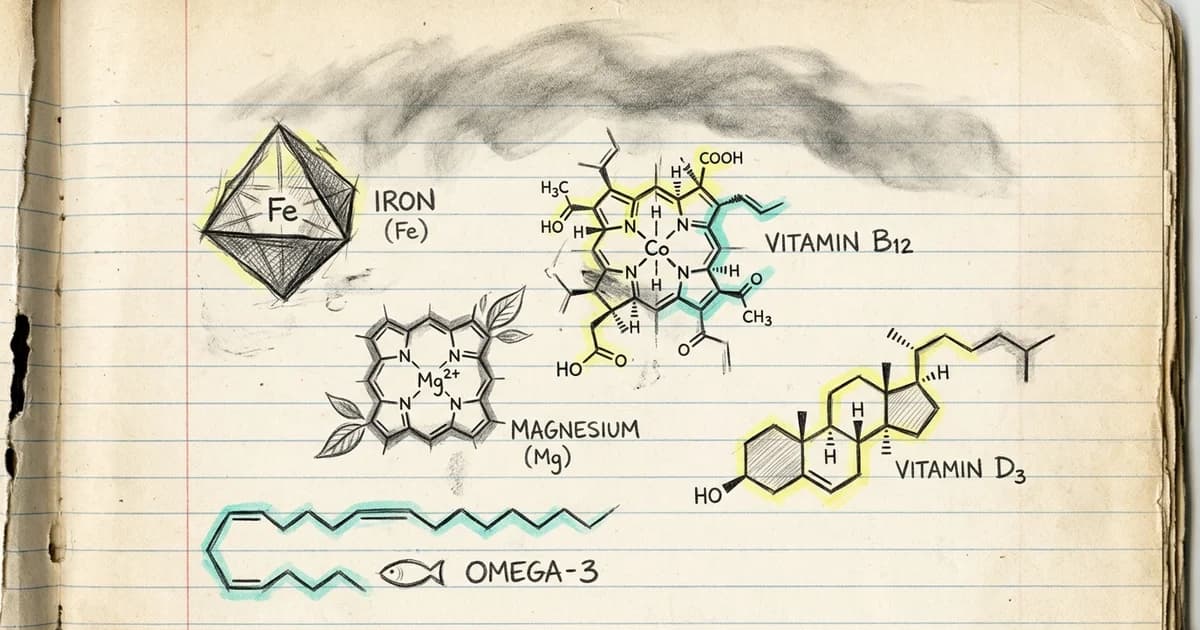
- The big five culprits are vitamin B12, iron, vitamin D, magnesium, and omega-3 fatty acids.
- Many of these are common even in people who eat well, and standard blood panels often miss the early stages.
- Correcting a deficiency fixes the cause. Stimulants and nootropics only mask it.
What Nutrient Deficiency Brain Fog Actually Is
Brain fog is not a medical diagnosis. It's a cluster of symptoms: slow processing, poor recall, trouble holding attention, and a sense that your thinking is muffled.
When a specific nutrient runs low, the brain loses raw material it needs to make energy, build neurotransmitters, or protect neurons. The fog is the symptom. The deficiency is the cause.
This is why what vitamins help brain fog is the wrong first question. The better question is which one you're actually short on, because supplementing the wrong nutrient does nothing. Below are the five deficiencies that cause fog more often than any others.
The Big Five: Deficiencies That Cause Fog
1. Vitamin B12
Low B12 is one of the most reliable causes of mental fatigue, and it hides in plain sight. Your body uses B12 to maintain the myelin sheath around nerves and to produce red blood cells that carry oxygen to your brain.
The unsettling part is how early the symptoms start. A 2025 study covered by Medical News Today found that lower active levels of B12 were linked to cognitive issues, even in people whose total B12 sat within the "normal" lab range. Translation: your bloodwork can say you're fine while your brain disagrees.
Prevalence is higher than most people assume. According to the NIH Office of Dietary Supplements, approximately 3.6% of all adults age 19 and older have vitamin B12 deficiency, and the rate is 3.7% in those age 60 and older. Insufficiency, the gray zone below optimal, runs far higher. Vegans, vegetarians, older adults, and anyone on long-term acid reducers are most at risk.
2. Iron
If you're a woman of reproductive age and your thinking feels chronically slow, iron is the first thing to rule out. Iron carries oxygen and supports the enzymes that build dopamine and other neurotransmitters. Run low, and both energy and attention drop.
The scale here is enormous. The American Journal of Clinical Nutrition reports that the World Health Organization estimates that, worldwide, 2 billion people are anemic and twice as many are iron deficient. Among women specifically, WHO data cited in the literature notes that anemia, the most severe form of iron deficiency, affects 30% of nonpregnant women of reproductive age.
The encouraging news is that this one responds to treatment. Research in the same journal found that iron treatment normalizes cognitive functioning in young women. Fix the iron, and the fog often lifts with it.
3. Vitamin D
Vitamin D deficiency is one of the most widespread vitamin deficiency brain fog triggers in the developed world, mostly because so few people get enough sun or dietary intake. Vitamin D receptors sit throughout the brain, including regions tied to memory and mood.
How common is it? A study of US adults published in ScienceDirect found the overall prevalence rate of vitamin D deficiency was 41.6%, with the highest rate seen in blacks at 82.1%, followed by Hispanics at 69.2%.
The cognitive link is real and recent. A 2024 cohort study in Scientific Reports examined vitamin D deficiency and its role in cognitive functioning, adding to a growing body of work tying low D to slower thinking. People who work indoors, live at higher latitudes, or have darker skin are most likely to be running low without knowing it.
4. Magnesium
Magnesium runs more than 300 enzyme reactions in your body, including the ones that regulate nerve signaling and the brain's stress response. When it drops, you often feel it as a wired, scattered, can't-settle kind of fog.
Most people don't get enough. Diets heavy in processed food strip magnesium out, and stress burns through your stores faster. Research published in Frontiers in Aging Neuroscience has examined the relationship between serum magnesium and cognitive function in adults, reinforcing that this mineral deficiency cognition link deserves attention.
Magnesium is also the quiet partner behind better sleep, and poor sleep is its own fog machine. If your recovery is shot, low magnesium may be part of the chain. Our guide to sleep and cognitive recovery breaks down how the two feed each other.
5. Omega-3 Fatty Acids
Your brain is roughly 60% fat, and a large share of that is the omega-3 fatty acid DHA. It sits in the membranes of your neurons and keeps signaling fast and clean. Run low on omega-3s for long enough, and the hardware itself gets sluggish.
Most Western diets are heavily skewed toward omega-6 fats from seed oils and short on the omega-3s found in fatty fish. That imbalance is linked to poorer cognitive performance and is one reason DHA shows up in so many discussions of mental clarity. If you rarely eat salmon, sardines, or take a quality fish oil, this is worth checking.
The Big Five at a Glance
Here's how the five stack up, plus where an acute focus aid fits once your nutrient floor is solid.
| Factor | Primary role in the brain | Who's most at risk | Typical fix |
|---|---|---|---|
| Vitamin B12 | Nerve myelin, oxygen transport | Vegans, older adults, acid-reducer users | Diet, B12 supplement or injection |
| Iron | Oxygen delivery, dopamine synthesis | Menstruating women, vegetarians | Iron-rich food, supplement (with testing) |
| Vitamin D | Memory and mood regulation | Indoor workers, higher latitudes, darker skin | Sun, diet, vitamin D3 supplement |
| Magnesium | Nerve signaling, stress, sleep | Processed-food diets, high stress | Magnesium-rich food or supplement |
| Omega-3 (DHA) | Neuron membrane structure | Low fish intake, seed-oil-heavy diets | Fatty fish, fish oil or algae oil |
| Acute focus aid (e.g. Roon) | On-demand attention and alertness | Anyone needing focus after the floor is fixed | Caffeine + L-theanine + Dynamine + TeaCrine |
The first five fix the cause. The last row handles a different job: producing sharp focus on demand once the deficiencies are no longer in the way.
How to Figure Out Which One Is Yours
Start with a blood panel, not a supplement haul. Ask your doctor for B12 (ideally active B12, not just total), ferritin for iron stores, 25-hydroxyvitamin D, and a magnesium level. An omega-3 index test exists too, though it's less standard.
Pay attention to the pattern of your symptoms. Cold hands, hair shedding, and breathlessness point toward iron. Tingling in the hands and feet leans B12. Low mood through dark months suggests vitamin D. Poor sleep and muscle twitches hint at magnesium.
Then correct one thing at a time and give it weeks, not days. The b12 iron vitamin d brain fog cluster usually responds within a month or two of consistent correction. If you fix the deficiency and the fog clears, you found your answer.
The Bottom Line on Fog and Nutrients
Most brain fog has a cause, and a large share of the time that cause is a single nutrient your brain has been quietly short on. B12, iron, vitamin D, magnesium, and omega-3s account for the bulk of it.
The move is simple and unglamorous. Test, correct the deficiency, and give your body time to rebuild. No supplement stack and no amount of caffeine can outrun a brain that's missing its raw materials, so fix the floor before you try to build on it.
Frequently Asked Questions
Can a vitamin deficiency really cause brain fog?
Yes. When the brain runs short on a specific nutrient, it loses raw material it needs to make energy, carry oxygen, or build neurotransmitters. B12, iron, and vitamin D are among the most documented vitamin deficiency brain fog triggers. The fog is a symptom, and correcting the underlying deficiency often resolves it within weeks.
What vitamins help brain fog the most?
There is no universal answer, because the right vitamin depends on which one you're actually low on. Supplementing a nutrient you already have plenty of does nothing for your thinking. The smartest approach is a blood panel covering B12, ferritin, and vitamin D, then correcting only what's genuinely low.
How long does it take to fix nutrient deficiency brain fog?
It depends on the nutrient and how depleted you are. Iron stores and vitamin D can take one to three months of consistent correction to rebuild. B12 may improve faster, especially with injections. The key is patience and retesting, since the brain needs time to restock what it lost.
Can my bloodwork be "normal" and I still have a deficiency?
Yes, and this is common. A 2025 study found that lower active levels of B12 were linked to cognitive issues even when total B12 sat in the normal range. Standard panels measure totals, not always the active fraction your cells can use. If symptoms persist, ask about more sensitive testing.
Does iron deficiency affect women more than men?
Far more often, yes. Menstruation, pregnancy, and higher physiologic demand leave women much more likely to run low. WHO data indicates anemia affects roughly 30% of nonpregnant women of reproductive age, and iron deficiency without anemia is even more widespread. It's the first thing to test if a younger woman reports chronic fog.
Will a supplement fix brain fog if I'm not actually deficient?
Probably not. If your nutrient levels are already adequate, adding more rarely sharpens thinking and can occasionally cause harm, as with excess iron. Deficiency correction works because it restores something missing. Once your floor is solid, persistent fog usually points to other causes like sleep, stress, or a need for acute focus support.
Once the Floor Is Solid, You Still Have to Focus
Fixing a deficiency removes the brake. It doesn't press the accelerator. Even with perfect B12, iron, and vitamin D, you can sit down at 9 a.m. and still need help locking into deep work, and that's a different problem with a different tool.
This is where Roon fits, and only here. It is not a substitute for testing, a doctor, or correcting a real deficiency, and no pouch will fix low iron or B12. What it does is deliver acute, on-demand focus once your nutrient floor is in place. Each sublingual pouch pairs 80 mg caffeine with 60 mg L-theanine, 25 mg methylliberine (Dynamine), and 5 mg theacrine (TeaCrine), built for a clean 6 to 8 hour focus window with no jitters and no crash.
Think of it as the layer that comes after the fundamentals, not instead of them. Get your bloodwork right first. Then, on the days you need to perform, try Roon for the focus vitamins were never designed to provide.
Written by Roon Team