N-Acetyl-L-Tyrosine (NALT) vs L-Tyrosine
Roon Team
N-Acetyl-L-Tyrosine (NALT) vs L-Tyrosine: Does the "More Soluble" Form Reach Your Brain?
The label says NALT dissolves better, so it must work better. That logic feels airtight until you read the pharmacokinetics.
The nalt vs l-tyrosine debate hinges on one question that solubility alone cannot answer: how much usable tyrosine actually ends up in your blood, and from there your brain? A form can be easier to mix into a powder and still hand off less of the amino acid your neurons need. That gap between "dissolves well" and "delivers well" is the whole story here.
This is a head-to-head on absorption, not marketing. Let's look at what happens after you swallow each one.
Key Takeaways
- L-tyrosine has the stronger human evidence for raising plasma tyrosine and supporting cognition under stress.
- NALT dissolves far better in water, which is why it shows up in liquids and pre-mixed formulas.
- A meaningful fraction of NALT is excreted unchanged in urine before your body can strip the acetyl group, which weakens its real-world bioavailability.
- The "best form of tyrosine" depends on your goal: solubility and shelf life favor NALT, while raw cognitive payload favors plain L-tyrosine.
What NALT and L-Tyrosine Actually Are
L-tyrosine is a standard amino acid your body uses to build dopamine, norepinephrine, and adrenaline. You get it from protein in food, and you can supplement it directly. It is the raw material your brain converts into the catecholamines that drive focus and drive itself.
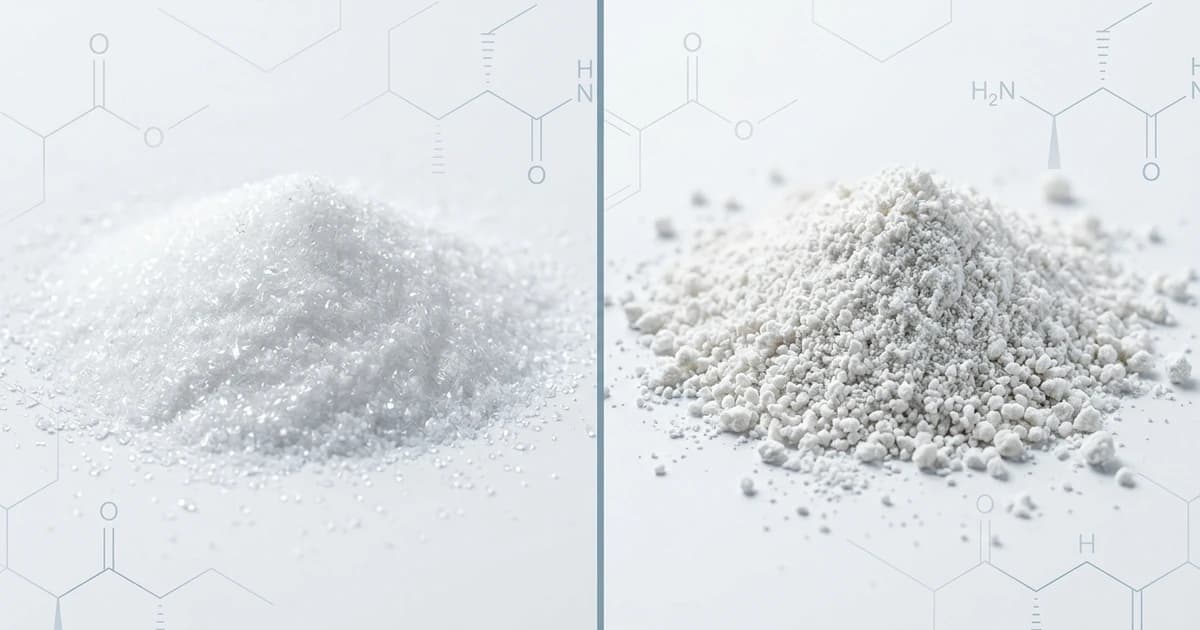
NALT is L-tyrosine with an acetyl group bolted on. That small chemical change makes it much more water-soluble than plain tyrosine, which is why formulators like it for drinks and liquid stacks. N-Acetyl L-Tyrosine (NALT) is the amino acid L-Tyrosine with an acetyl group added, and when you take NALT as a supplement, it breaks down in your kidneys back into L-Tyrosine, so in theory the two supplements offer the same benefits, though NALT is a more soluble form of L-Tyrosine so it should be more bioavailable to your body.
That last clause, "should be more bioavailable," is exactly where theory and data part ways.
NALT vs L-Tyrosine: The Bioavailability Problem
On paper NALT looks superior because it dissolves better, but your body has to remove the acetyl group before any of it counts as tyrosine, and it does that job poorly. This is the core of the n-acetyl-l-tyrosine bioavailability question.
The conversion happens mainly in the kidneys through enzymes called acylases. The catch is speed. Acetylated tyrosine clears through your kidneys faster than the enzymes can deacetylate it, so a large slice gets flushed out before it ever becomes usable.
The most cited human data comes from a 1989 infusion study by Magnusson and colleagues, published in the journal Metabolism. Following intravenous infusions, one study noted that 35% of the administered NALT was excreted in the urine as NALT, two other studies documented as much as 56% and 60% of NALT administered was excreted in the urine unchanged, which basically means that up to 60% of N-Acetyl L-Tyrosine is never converted to tyrosine. You can read the study abstract on Semantic Scholar.
Pour two parts in, get less than one part out. That is a steep tax for a more attractive solubility profile.
Even sources that personally favor NALT acknowledge the leak. Some studies report that in some cases a sizeable percentage of supplemental NALT is excreted in urine before it's converted into L-Tyrosine, which is why some users switch to L-Tyrosine at a slightly higher dose.
Why "more soluble" got mistaken for "more bioavailable"
Solubility describes how well a compound dissolves in liquid. Bioavailability describes how much of the active form reaches your bloodstream intact. Those are different measurements, and a supplement can ace the first while failing the second.
NALT genuinely wins on solubility, which is useful for manufacturing and for liquid products that would otherwise turn cloudy. The marketing leap was treating that physical convenience as proof of better nalt absorption in the body. The infusion data does not support that leap.
What the Human Evidence Says About Plain L-Tyrosine
L-tyrosine has the deeper bench of human trials, and most of them used the plain form, not the acetylated one. When researchers wanted to test whether tyrosine protects cognition under pressure, they reached for L-tyrosine.
In a military study, cadets on a demanding combat course were given tyrosine during a week of psychological and physical stress. Twenty-one cadets took part, with ten receiving five daily doses of a drink containing 2 g tyrosine, and the group supplied with the tyrosine-rich drink performed better on a memory and a tracking task than the group supplied with the carbohydrate-rich drink, while tyrosine also decreased systolic blood pressure. You can find it on PubMed.
The dosing in cognition research is also worth noting, because it explains why capsule counts get high. For healthy adults, doses of 100-150 mg/kg body weight appear most beneficial for cognitive performance without adverse effects, which for a 70 kg adult equals roughly 7 to 10.5 grams per day.
That is a lot of grams. It also reframes the NALT pitch: if you need several grams of tyrosine and over half your NALT washes out, the acetylated form has to work harder to break even.
NALT vs L-Tyrosine: Side-by-Side Comparison
| Factor | L-Tyrosine | NALT (N-Acetyl-L-Tyrosine) |
|---|---|---|
| Water solubility | Low | High |
| Human evidence for cognition | Strong, multiple trials | Limited, mostly extrapolated |
| Bioavailability of usable tyrosine | High | Reduced; large fraction excreted unchanged |
| Typical study dose | ~2 g and up (100-150 mg/kg) | 300-350 mg (much lower, by convention) |
| Best use case | Maximum cognitive payload | Liquids, mixability, shelf stability |
| Cost per usable gram | Lower | Higher |
Sources for dosing ranges: the cadet trial via PubMed and clinical dose summaries via DrOracle.
So, Is NALT Better Than L-Tyrosine?
For raw cognitive value per dose, plain L-tyrosine is the better-supported choice, and the answer to "is nalt better than l-tyrosine" is mostly no. NALT earns its place in liquids and in formulas where solubility and stability matter more than squeezing out every milligram of tyrosine.
If your only metric is how much usable tyrosine reaches your blood per gram, L-tyrosine wins on the current evidence. If you are building a clear drink that needs to stay clear, NALT is the practical pick, with the understanding that you are paying a bioavailability premium for that convenience.
There is no perfect answer to the best form of tyrosine because the two forms optimize for different things. Pick the one that matches your priority: payload or solubility.
The Conclusion: Form Decides What Reaches You
The lesson from tyrosine is bigger than tyrosine. A more soluble molecule is not automatically a more usable one, and the path a compound takes through your body often matters more than how it looks in the tin.
NALT teaches that lesson cleanly. It dissolves beautifully and then loses a large share of its cargo to your kidneys before the active form can do anything. L-tyrosine is less elegant in water and more honest in the bloodstream.
So when any supplement promises a "better" or "enhanced" form, ask the only question that counts: better at what, and does that benefit survive contact with your physiology? Delivery is not a detail. Delivery is the product.
Frequently Asked Questions
Is NALT or L-tyrosine more bioavailable?
L-tyrosine delivers more usable tyrosine per gram. NALT is more water-soluble, but a large fraction of it is excreted in urine unchanged before your kidneys can convert it back to tyrosine. Human infusion data has shown anywhere from roughly a third to about 60% of administered NALT leaving the body unconverted, which undercuts the assumption that better solubility means better real-world absorption.
Why do supplement companies use NALT if L-tyrosine is better?
Solubility and stability. NALT dissolves far better in water, so it suits liquid products, ready-to-mix drinks, and formulas that need to stay clear and stable on a shelf. Plain L-tyrosine is gritty and resists dissolving. For dry capsules where payload is the priority, L-tyrosine usually makes more sense.
How much L-tyrosine do studies actually use?
Cognition research typically uses 100 to 150 mg per kg of body weight, which works out to roughly 7 to 10.5 grams per day for a 70 kg adult. Some trials used around 2 grams per dose during high-stress tasks. These are large amounts compared with the 300 to 350 mg commonly listed for NALT, which is one reason the two are hard to compare directly.
Does tyrosine actually improve focus?
Tyrosine appears most useful under stress, fatigue, or sleep loss rather than as a general stimulant. In a study of cadets during a hard military course, those given tyrosine performed better on memory and tracking tasks than the control group. It works by supplying raw material for dopamine and norepinephrine, the neurotransmitters tied to alertness and working memory.
Can I just take a higher dose of NALT to make up for the loss?
In principle you could increase the dose to offset what your body excretes, and some users do exactly that. The problem is that you are paying more for the same usable tyrosine, and the conversion rate is variable between people. If your goal is reliable delivery of tyrosine, starting with the form that converts more efficiently is the simpler approach.
Is NALT or L-tyrosine safer?
Both are generally well tolerated in healthy adults at common doses. Tyrosine competes with other amino acids for absorption, so it is usually taken on an empty stomach. Anyone with thyroid conditions, melanoma history, or who takes MAOIs or thyroid medication should talk to a clinician first, since tyrosine is a precursor to thyroid hormones and catecholamines.
When Delivery, Not the Label, Decides the Outcome
The tyrosine story makes one point land hard: the form of an ingredient changes how much of it actually reaches you. A compound can dissolve perfectly and still lose most of its payload on the way in. That is a delivery problem, not an ingredient problem, and it is the exact problem we obsess over at Roon.
Roon is a zero-nicotine sublingual pouch built around absorption-first design. The formula is four ingredients: 80 mg caffeine, 60 mg L-theanine, 25 mg methylliberine (Dynamine), and 5 mg theacrine (TeaCrine). Sublingual delivery lets compounds enter through the tissue under your lip rather than running the full first-pass gauntlet of the gut, which is why Roon is engineered for a 5 to 10 minute onset and a 6 to 8 hour window of focus with no jitters, no crash, and no tolerance buildup.
To be clear, Roon is not a tyrosine product and makes no tyrosine claim. It is a focus tool, not a replacement for sleep, food, or a real training routine. If you care about what actually reaches you rather than what sounds good on a label, try Roon and judge it by how it lands.
Written by Roon Team