Inside the Mori Trial: The Study That Put Lion's Mane on the Map
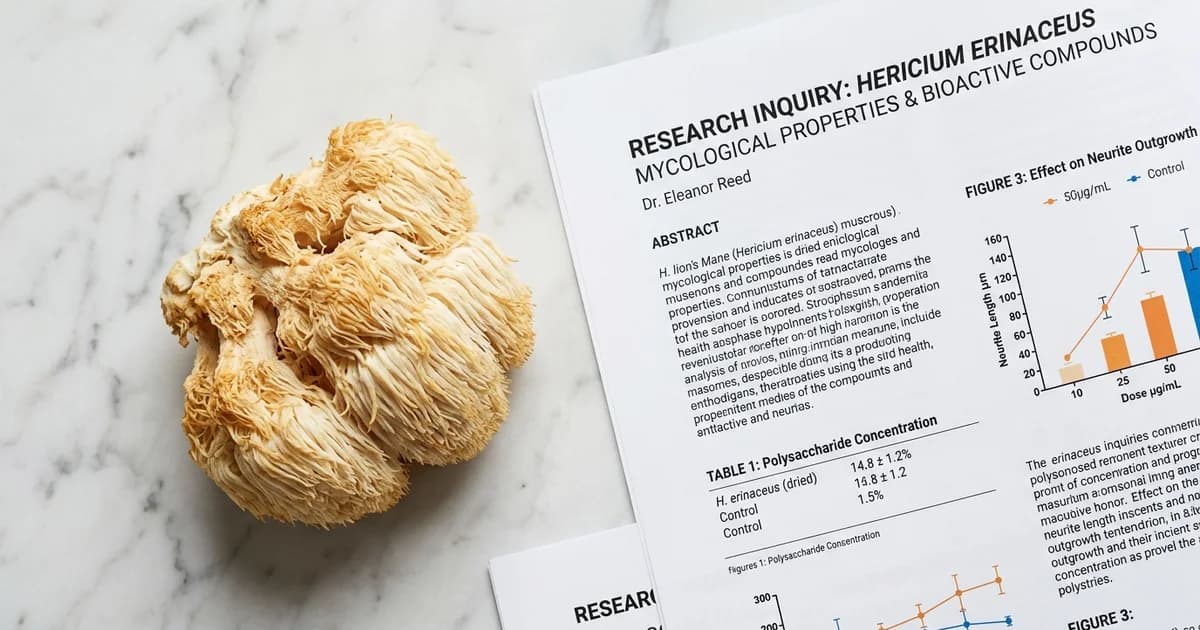
Almost every claim you read about lion's mane and memory traces back to one paper. It is a small Japanese lion's mane study published in 2009, run by Koichiro Mori and his team, and it remains the single most cited piece of human evidence for the mushroom's effect on the aging brain.
Here is what people get wrong about it. They treat 30 older adults over four months as proof that a daily capsule sharpens any brain. The trial is more specific, more careful, and more interesting than that.
Let's look at what the researchers actually did, what they found, and where the result stops.
Key Takeaways
- The Mori 2009 lion's mane trial tested 30 Japanese adults aged 50 to 80 with mild cognitive impairment over 16 weeks.
- The dose was about 3 grams a day of dried lion's mane powder, taken as twelve tablets, split across three doses.
- Cognitive scores rose at weeks 8, 12, and 16, then fell back four weeks after participants stopped taking it.
- The result is about chronic intake in an at-risk older population, not same-day focus in healthy adults.
What the Mori 2009 Lion's Mane Study Actually Tested
The trial was a double-blind, parallel-group, placebo-controlled design, which is the format you want for this kind of question. A double-blind, parallel-group, placebo-controlled trial was performed on 50- to 80-year-old Japanese men and women diagnosed with mild cognitive impairment in order to examine the efficacy of oral administration of Yamabushitake (Hericium erinaceus), an edible mushroom, for improving cognitive impairment, using a cognitive function scale based on the Revised Hasegawa Dementia Scale (HDS-R).
Yamabushitake is just the Japanese name for the same mushroom, so any yamabushitake study you find from this group is lion's mane research under a different label.
The sample was deliberately narrow. In a double-blind placebo-controlled study of 50-80-year-old Japanese men and women (n=30) diagnosed with mild cognitive impairment, oral intake of 250 mg tablets containing 96% of Lion's mane dry powder three times a day for 16 weeks was associated with marked improvement in cognitive function, as measured by the revised Hasegawa Dementia Scale (HDS-R), when compared with controls. A dose of 250 mg of 96% Lion's mane dry powder three times a day for 16 weeks was associated with marked improvement on a dementia rating scale in subjects with mild cognitive impairment.
These were not healthy volunteers. The researchers chose thirty 50-80 year old Japanese men and women diagnosed with mild cognitive impairment (dementia). Each of the study group qualified for the following criteria: They scored a 22 to 25 out of 30 points on a cognitive function scale based on the Revised Hasegawa Dementia Scale in a preliminary examination.
That detail matters. Recruiting people who already show early decline gives the trial more room to detect a change than a room full of sharp 30-year-olds would.
The Dose and the Timeline
The dosing was heavy, and worth spelling out before you compare it to any product on a shelf today. After 2 weeks of preliminary examination, 30 subjects were randomized into two 15-person groups, one of which was given Yamabushitake and the other given a placebo.
From there, the regimen was consistent. Participants took 3,000 mg per day of lion's mane dry powder (four 250 mg tablets, three times daily) for 16 weeks. Results: The lion's mane group showed markedly improved cognitive function scores on the Revised Hasegawa Dementia Scale compared to placebo.
So twelve tablets a day, every day, for four months. This is not a quick-acting protocol, and it was never meant to be.
The structure ran in three phases, which tells you how the researchers thought about timing. Phase 2: Next 16 weeks – the study participants took either the placebo or lion's mane mushroom powder · Phase 3: Last 4 weeks – the researchers performed follow-up observations.
What the Lion's Mane Clinical Trial Found
The benefit built up slowly and then reversed once the supplement stopped. That single finding is the most important takeaway from the entire lion's mane clinical trial, and it is the part most blog summaries skip.
Cognitive gains increased at weeks 8, 12, and 16, which points to a cumulative effect. scores declined again 4 weeks after stopping supplementation. The takeaway is plain: 3,000 mg/day of whole mushroom powder improved cognition in older adults, but benefits required sustained daily use.
Read that twice. The effect was not a switch you flip and forget. It accumulated week over week, and it faded when the daily dose went away.
The authors framed their own conclusion modestly. The results obtained in this study suggest that Yamabushitake is effective in improving mild cognitive impaired men and women diagnosed with mild cognitive impairment.
The word "suggest" is doing honest work there.
How Lion's Mane Is Thought to Work
The leading mechanism for lion's mane cognitive function sits with two families of compounds. Through clinical trials, pharmacological activities and medical evidence of H. erinaceus have been demonstrated, showing its effectiveness in improving average cognitive impairment.
Researchers point to hericenones and erinacines, compounds in the mushroom that appear to prompt the body to make more Nerve Growth Factor, a protein that helps neurons survive and stay connected. This is a slow, structural process, not a stimulant hit. It is the biological reason the Mori timeline stretched across months rather than minutes.
How the Mori Trial Stacks Up Against Other Cognitive Tools
No single supplement does everything. The honest way to read the Mori trial is to place it next to other approaches and match each to the job it actually does.
| Approach | Primary goal | Typical timescale | Best-fit user | Evidence base |
|---|---|---|---|---|
| Lion's mane (Mori 2009) | Support cognitive function over time | Weeks to months of daily intake | Older adults with early cognitive complaints | Small RCT, n=30, plus animal data |
| Erinacine A-enriched lion's mane | Support cognition in mild Alzheimer's | ~49 weeks daily | Clinically diagnosed populations | Small clinical trials |
| Caffeine + L-theanine | Acute, same-session focus | 5 to 30 minutes, lasts hours | Anyone needing focus now | Many human trials |
| Roon sublingual pouch | Acute, sustained same-session focus | 5 to 10 min onset, 6 to 8 hr window | Adults wanting clean focus without jitters | Formulated from ingredient research |
The table makes the split obvious. Lion's mane in the Mori model is a long-game tool for an older, at-risk group. The caffeine and L-theanine family, including Roon's pouch, targets focus inside a single working session.
The Limits You Should Hold Onto
Thirty people is a small sample. One trial in one country, in one specific population, is a starting point, not a verdict.
The Mori result is genuinely useful for what it studied: chronic, daily intake in older adults with lion's mane mild cognitive impairment. It says far less about a healthy 28-year-old hoping for a sharper Tuesday afternoon. Stretching the finding to cover that person is the most common mistake in lion's mane marketing.
The mushroom's strongest human evidence still clusters in aging and early decline. If you want a deeper read on the difference between long-term brain support and acute focus, our guides on caffeine and L-theanine for clean focus and how nootropic onset times actually work cover the contrast in plain terms.
Conclusion
The Mori 2009 trial earned its reputation honestly. It was a well-designed, double-blind study showing that roughly 3 grams of daily lion's mane powder improved cognitive scores in older adults with mild cognitive impairment, with gains that built across 16 weeks and faded a month after stopping.
That is a strong, specific finding. It is also a narrow one. The trial speaks to chronic intake in an at-risk older population, measured over months, not to instant clarity in a healthy brain.
Treat it as the foundation it is. Lion's mane is a slow, cumulative tool with promising but still limited human data, best understood for the exact question this landmark lion's mane study set out to answer.
Frequently Asked Questions
What did the Mori 2009 lion's mane study find?
The trial found that older adults with mild cognitive impairment who took about 3 grams of dried lion's mane powder daily for 16 weeks improved on a cognitive function scale compared with placebo. Cognitive gains increased at weeks 8, 12, and 16, then scores declined again 4 weeks after stopping supplementation. The benefit depended on continued daily use.
How many people were in the trial?
It was a small study. After 2 weeks of preliminary examination, 30 subjects were randomized into two 15-person groups, one of which was given Yamabushitake and the other given a placebo. Thirty participants is a modest sample, which is the main reason the result is treated as promising rather than conclusive.
What dose of lion's mane did the study use?
Participants took a high daily dose split across the day. Participants took 3,000 mg per day of lion's mane dry powder (four 250 mg tablets, three times daily) for 16 weeks. That works out to twelve 250 mg tablets every day, which is far more than most casual users take.
Is yamabushitake the same thing as lion's mane?
Yes. Yamabushitake is the Japanese name for Hericium erinaceus, the same mushroom sold in English-speaking markets as lion's mane. Any yamabushitake study from this research group is lion's mane research under a regional name, so the terms are interchangeable in the scientific literature.
How does lion's mane affect cognitive function?
The leading explanation involves compounds called hericenones and erinacines, which appear to prompt the body to produce more Nerve Growth Factor, a protein that supports neuron survival and connections. This is a slow, structural process. It helps explain why the Mori trial measured changes over months of daily intake rather than within a single dose.
Does lion's mane work for healthy young adults?
The Mori trial does not answer that. The researchers chose thirty 50-80 year old Japanese men and women diagnosed with mild cognitive impairment (dementia). The strongest human evidence for lion's mane sits in older, at-risk groups, so applying it to healthy young adults goes beyond what this study showed.
Are the benefits permanent?
No. The data points to a reversible effect tied to ongoing use. Scores in the lion's mane group declined again within four weeks of stopping the supplement, which suggests the cognitive support depends on sustained daily intake rather than a one-time change.
Where Lion's Mane Ends and Same-Session Focus Begins
The Mori trial answers a question about months, not minutes. It looked at chronic, daily intake in older adults with cognitive complaints, and it found a slow, cumulative, reversible benefit. That is a different goal and a different timescale from wanting to lock in for the next few hours of work.
Roon is built for that second job. It is a sublingual pouch with 80 mg caffeine, 60 mg L-theanine, 25 mg methylliberine (Dynamine), and 5 mg theacrine (TeaCrine), designed for a 5 to 10 minute onset and a 6 to 8 hour window of focus without the jitters or the crash. The point is acute, same-session clarity, not long-term cognitive maintenance.
To be clear about the line: Roon is not a lion's mane supplement and not a substitute for the slow, structural support that mushroom research is studying. If you want sharp focus inside a single working block, try Roon for that. If your goal is long-horizon brain support, that is a separate decision, and the science there is still being written.
Written by Roon Team