Hunter Focus Review
Roon Team
Hunter Focus Review: Is This Premium Nootropic Worth $90 a Month?
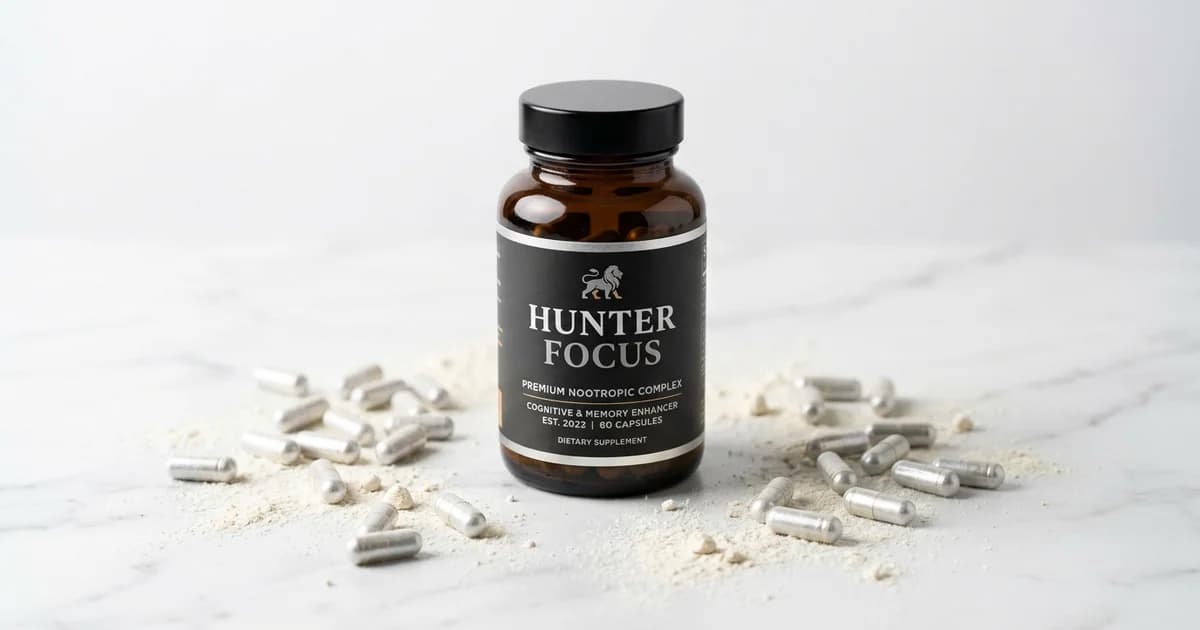
Hunter Focus has become one of the most talked-about nootropics on the market, and this Hunter Focus review will help you decide if the price tag justifies the hype, much like reviews of other talked-about nootropic supplements such as Avantera Elevate. At $90 per bottle, this isn't a casual impulse buy. It's a bet that a 20-ingredient capsule formula can sharpen your focus, lift your mood, and keep your memory intact through long, demanding days. This Hunter Focus review breaks down the ingredients, the real-world experience, and whether the cost actually matches the results.
The short answer: Hunter Focus is a solid nootropic with some genuinely well-dosed ingredients. But it also comes with trade-offs that most reviews gloss over.
Key Takeaways
- Hunter Focus ingredients include 20 compounds spanning nootropics, adaptogens, and vitamins, with a fully transparent label.
- The formula requires 6 capsules per day, which is a real commitment.
- It contains 100mg of caffeine, so timing and caffeine sensitivity matter.
- At $90/month (or ~$2.25 per daily dose in bulk), it's one of the pricier nootropics available.
- As this Hunter Focus review will show, the formula is strong on long-term brain health but has clear gaps in delivery method and sustained energy.
What Is Hunter Focus?
Hunter Focus is a nootropic supplement made by Roar Ambition, a UK-based supplement company. It's part of the broader "Hunter" line, which also includes products for testosterone support and fat loss. The Hunter Focus nootropic positions itself as a premium, no-proprietary-blend alternative to the dozens of underdosed nootropic capsules flooding the market, a category that also includes premium nootropic capsule formulas like Qualia Mind.
The pitch is straightforward: better focus, better memory, better mood. And to Roar Ambition's credit, they put every ingredient and dosage on the label. That transparency alone puts the Hunter Focus nootropic ahead of a lot of competitors.
Hunter Focus Ingredients: The Full Breakdown
Here's where things get interesting in any Hunter Focus review. The Hunter Focus ingredients list packs 20 compounds into a 6-capsule daily serving. That's a lot of compounds, and the dosages are generally respectable.
The Core Nootropic Stack
| Ingredient | Dosage (per serving) | Primary Role |
|---|---|---|
| Citicoline | 250mg | Neuroplasticity, focus |
| Acetyl-L-Carnitine | 800mg | Brain energy metabolism |
| L-Tyrosine | 500mg | Neurotransmitter production |
| Organic Lion's Mane Mushroom | 500mg | Nerve growth factor support |
| Bacopa Monnieri | 300mg | Memory, long-term cognition |
| Ashwagandha Root | 300mg | Stress reduction |
| L-Theanine | 200mg | Calm focus, anxiety reduction |
| Ginkgo Biloba | 120mg | Blood flow, cognitive function |
| Caffeine Anhydrous | 100mg | Alertness, energy |
| Phosphatidylserine | 100mg | Cell membrane integrity |
| Maritime Pine Bark Extract | 75mg | Antioxidant, blood flow |
| Rhodiola Rosea | 50mg | Fatigue resistance |
| Panax Ginseng (10:1 extract) | 40mg | Anti-fatigue, cognition |
| Spanish Sage (4:1 extract) | 25mg | Memory, mood |
The Hunter Focus ingredients also include a B-vitamin complex, Vitamin C, Vitamin D3, and Vitamin K2.
What's Dosed Well
L-Tyrosine at 500mg is a strong dose. It supports dopamine and norepinephrine production, especially under stress. Bacopa at 300mg hits the range where clinical studies have shown memory benefits, though Bacopa typically needs 8-12 weeks of consistent use before you notice anything.
Lion's Mane at 500mg is solid. Research on Lion's Mane has focused on its ability to support nerve growth factor and potentially improve mild cognitive function, particularly in older adults. This is one of the standout Hunter Focus ingredients.
Ashwagandha at 300mg is a reasonable dose for stress management, and L-Theanine at 200mg pairs well with the caffeine to smooth out the stimulant edge.
What's Less Impressive
Citicoline at 250mg is on the lower end. Many nootropic formulas dose citicoline at 500mg, which is closer to what clinical trials have used. At 250mg, you're getting some benefit, but likely not the full effect. Any honest Hunter Focus review should flag this.
Rhodiola Rosea at 50mg is underdosed by most standards. Studies typically use 200-600mg for measurable effects on fatigue and stress. At 50mg, it's hard to argue this is doing much heavy lifting.
Caffeine at 100mg is a double-edged sword. It's enough to feel alert, but it also means you need to be careful about when you take it and what else you're drinking. If you already have a morning coffee, you're stacking stimulants, and the formula gives you no control over that.
The Real-World Experience
Most user reviews follow a consistent pattern. People notice improved focus and attention within the first week, largely driven by the caffeine-L-theanine combination. The focus feels cleaner than coffee alone, with less jitteriness.
The mood and memory benefits take longer, usually 4-8 weeks, which is expected given Hunter Focus ingredients like Bacopa and Lion's Mane.
But the complaints across every Hunter Focus review are consistent too:
- Six capsules every morning is a lot. Multiple reviewers flag this as a real friction point. If you struggle with pills, this is a non-starter.
- The caffeine limits flexibility. You can't take the Hunter Focus nootropic in the afternoon without risking sleep disruption. And you can't easily adjust the caffeine dose without cutting the entire formula in half.
- The price is steep. At $90 per bottle for a 30-day supply, you're paying roughly $3 per day at the single-bottle price. Bulk discounts bring it closer to $2.25/day, but that's still premium territory.
According to one detailed Hunter Focus review on Lift Big Eat Big, after six weeks of testing, the cognitive benefits were real but the reviewer ultimately preferred a non-stimulant option for its versatility.
Hunter Focus Review: Who Is It Actually For?
Hunter Focus works best for a specific type of user: someone who wants a single, all-in-one nootropic capsule, doesn't mind swallowing six pills every morning, and wants long-term brain health support alongside short-term focus, rather than the personalized nootropic blends that services like Thesis offer.
The Hunter Focus nootropic is less ideal if you:
- Already consume caffeine from other sources
- Need cognitive support in the afternoon or evening
- Want a fast-acting, on-demand focus tool
- Prefer not to commit to a large daily pill regimen
The formula is designed for daily, consistent use over months. That's how Hunter Focus ingredients like Bacopa, Lion's Mane, and Ashwagandha deliver their best results. But it also means you're paying $90/month whether or not you need full cognitive support on a given day.
What's Missing From Hunter Focus
After spending time with the formula, the ingredients research, user feedback, and nootropic stack comparisons for this Hunter Focus review, a few gaps stand out.
No sustained-energy compounds beyond caffeine. The formula relies on 100mg of caffeine as its only direct energy driver. Caffeine works, but it comes with tolerance buildup. Take it daily for a few weeks, and you'll need more to feel the same effect. Hunter Focus doesn't include any ingredients that address this tolerance curve.
No sublingual or fast-absorption delivery. Capsules have to pass through your digestive system, which means a 30-45 minute delay before you feel anything. For professionals who need to lock in quickly before a meeting, a presentation, or a deep work block, that lag time is a real limitation.
The caffeine dose is fixed. You can't separate the stimulant from the nootropic stack. If you want the Lion's Mane and Bacopa without the caffeine, you're out of luck. And if you want more energy, you can't increase just the stimulant without doubling your entire intake.
No theacrine or methylliberine. These are two compounds that have shown real promise for sustained energy without tolerance buildup. A study published in Cureus found that a combination of caffeine, theacrine, and methylliberine improved reaction time and cognitive performance in a randomized crossover trial, without negatively affecting mood. A separate trial in tactical personnel found that the caffeine-theacrine-methylliberine combination delivered similar vigilance benefits to double the dose of caffeine alone, with better hemodynamic outcomes. This Hunter Focus review finds it notable that these ingredients are left out entirely.
A Different Approach: Roon
If the gaps above sound familiar, they're exactly the problems that Roon was built to solve.
Roon's zero-nicotine focus pouches are a sublingual format containing 80mg of caffeine, L-Theanine, Theacrine, and Methylliberine. The delivery is sublingual, meaning the active ingredients absorb through the tissue under your lip and hit your system in minutes, not the 30-45 minutes you'd wait with a capsule. With 80mg of caffeine, comparable to a cup of coffee, the advantage is the stack and the curve: L-Theanine smooths the caffeine, while Theacrine and Methylliberine extend it to 6-8 hours of sustained focus with no jitters, no crash, and no tolerance buildup.
Here's how the two compare on the specific gaps identified in this Hunter Focus review:
| Factor | Hunter Focus | Roon |
|---|---|---|
| Delivery method | 6 capsules (oral) | Sublingual pouch |
| Time to effect | 30-45 minutes | Minutes |
| Caffeine | 100mg (fixed) | 80mg |
| Tolerance mitigation | None | Theacrine + Methylliberine |
| Duration | Varies | 6-8 hours sustained |
| Daily cost | ~$2.25-$3.00 | Lower per use |
| Use flexibility | Morning only (caffeine) | On-demand, any time |
The theacrine and methylliberine in Roon's formula are the key differentiators. Research on these compounds suggests they provide energy and focus support without the tolerance curve that pure caffeine creates over time. Combined with L-Theanine, the stack promotes a clean, sustained focus window of 6-8 hours.
Roon isn't trying to be a long-term brain health supplement. It doesn't contain Bacopa, Lion's Mane, or Ashwagandha. It's designed for a different use case: on-demand cognitive performance when you need to be sharp right now.
The bottom line of this Hunter Focus review: for professionals who want both long-term brain health and immediate performance, the most practical approach might be a daily nootropic stack for baseline support, paired with something like Roon for the moments when you need to perform at your best, on your schedule, without swallowing six capsules and waiting half an hour.