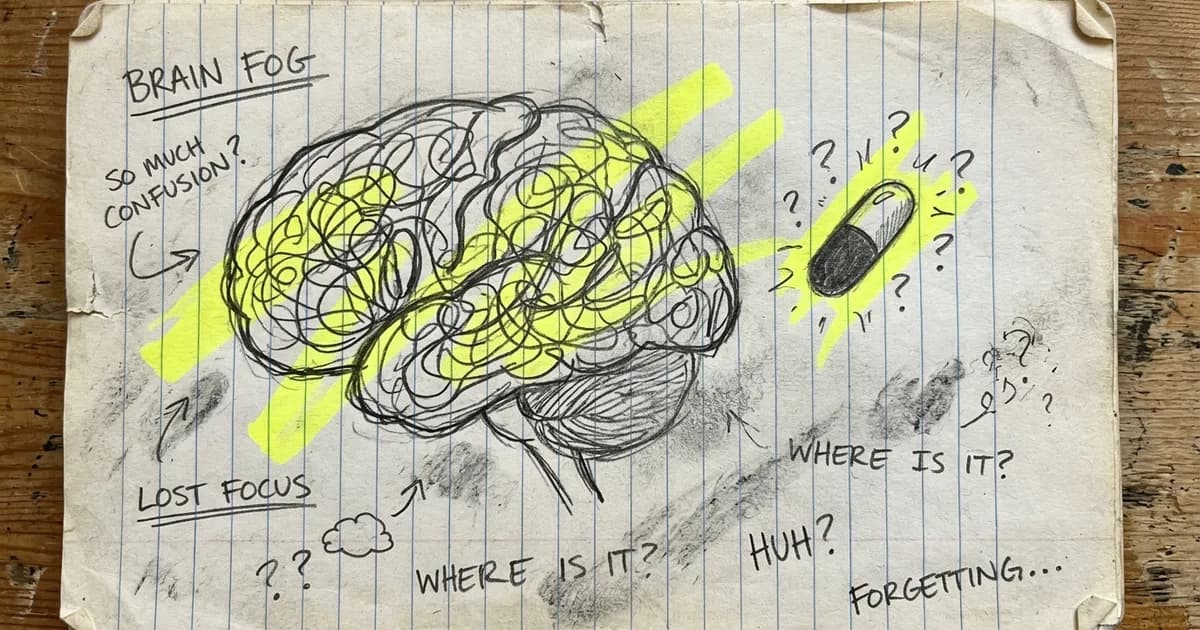
Mental Fatigue: What It Is, Why It Hits Mid-Day, and How to Bounce Back
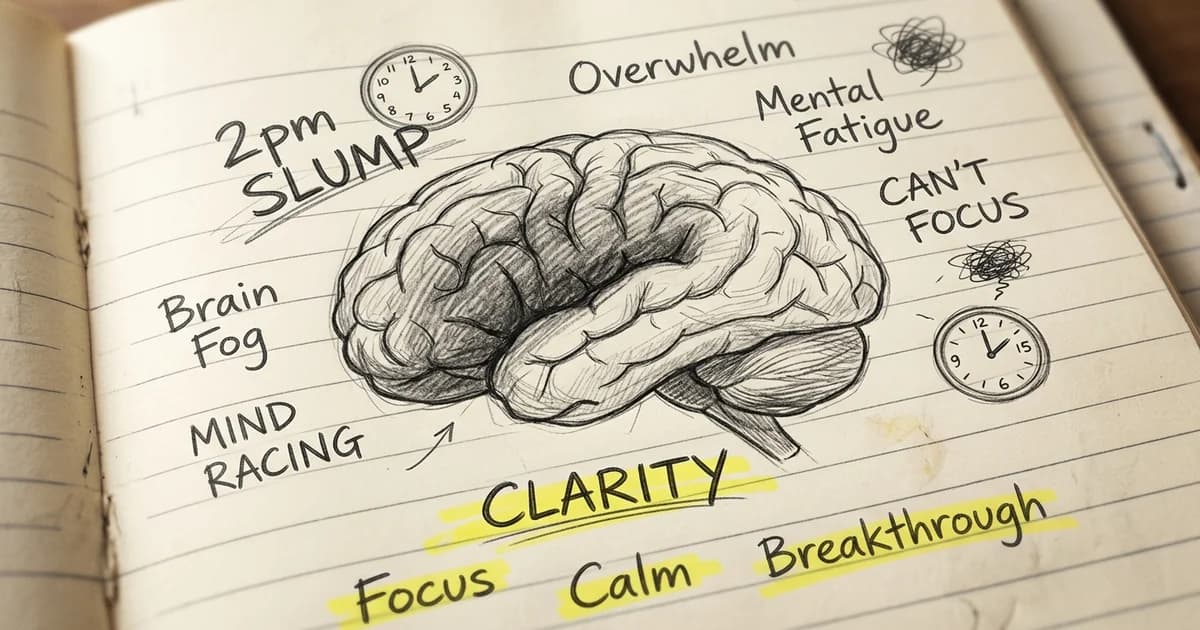
Mental Fatigue: What It Is, Why It Hits Mid-Day, and How to Bounce Back
Around 2 p.m., your brain stops cooperating. The email you started reading three times still hasn't registered. You read the same sentence again. Nothing.
That fog isn't laziness, and it isn't a character flaw. It's mental fatigue, and there's now hard neuroscience explaining exactly what happens inside your head when thinking gets harder as the day wears on. The good news: once you understand the mechanism, you can work with it instead of fighting it.
This guide breaks down what mental fatigue actually is, why it tends to spike in the early afternoon, how it differs from being physically tired, and the specific moves that help you recover.
Key Takeaways
- Mental fatigue is a measurable brain state, not just a mood. Hard cognitive work appears to build up a byproduct in the prefrontal cortex that makes further focus more costly.
- It peaks in the early afternoon for most people, driven partly by your circadian rhythm and partly by accumulated cognitive load.
- Mental exhaustion and physical fatigue feel similar but come from different systems, so they need different fixes.
- You can recover with targeted rest, light, movement, hydration, and a smarter approach to caffeine.
What Is Mental Fatigue?
Mental fatigue is the drop in cognitive performance and motivation that follows extended mental effort. You feel it as fog, slower thinking, and a strong pull to do anything except the task in front of you.
For years, scientists debated whether this feeling was "real" or just a perception. Recent imaging work suggests it's physical. A 2022 study from the Paris Brain Institute, published in Current Biology, found that the accumulation of glutamate in the lateral prefrontal cortex increases over the course of the day, but only during attentionally demanding work. (parisbraininstitute.org)
Glutamate is a normal neurotransmitter. The problem is buildup. As coverage of the research explained, glutamate accumulation makes further activation of the prefrontal cortex more costly, such that cognitive control is more difficult after a mentally tough workday. (scitechdaily.com)
In plain terms: your brain throttles your effort to protect itself. The fog is a feature, not a bug.
This is also an active research front. A 2025 piece in Nature noted that scientists are still working out the roots of mental fatigue, and a 2025 meta-analysis of brain-imaging studies confirmed that mental fatigue causes significant activation of the prefrontal cortex. The region that does your hardest thinking is the same region that tires first.
Mental Fatigue Symptoms: How to Spot It
The clearest mental fatigue symptoms show up in your attention, mood, and decision-making, not your muscles. If you're scanning for them, here's what to watch for.
- Trouble concentrating on tasks you'd normally handle without effort
- Slower reaction times and more careless errors
- Brain fog, where thoughts feel sluggish or out of reach
- Irritability and a short fuse over small things
- Indecision and procrastination, even on easy choices
- Low motivation, where starting feels harder than the task itself
One useful tell: the work itself didn't get harder, but your capacity to do it dropped. Fatigue resources describe it as a state where difficulty concentrating, memory lapses, poor decision-making, irritability, and lack of motivation characterize mental fatigue. When several of these hit at once, you're not unmotivated. You're depleted. (walkinlab.com)
Mental Exhaustion vs Physical Fatigue
Mental exhaustion vs physical fatigue comes down to which system ran out of road. Physical fatigue is your body asking for rest after exertion. Mental fatigue is your brain's processing capacity getting overwhelmed by sustained focus, stress, or cognitive overload.
They feel alike, which is why people confuse them. The fix is different for each, so telling them apart matters.
| Mental Fatigue | Physical Fatigue | |
|---|---|---|
| Main trigger | Sustained focus, decision-making, stress | Exertion, lack of sleep, illness |
| Where you feel it | Attention, mood, motivation | Muscles, limbs, whole body |
| Hallmark signs | Brain fog, irritability, poor focus | Heavy limbs, soreness, low stamina |
| What helps | Mental rest, light, novelty, breaks | Sleep, food, recovery, hydration |
| Sleep test | A nap helps, but you can feel "wired-tired" | Sleep reliably restores it |
Here's the catch. You can be physically rested and mentally wiped, or the reverse. A weekend of sleep won't fix a brain that's been grinding through back-to-back meetings without a single real break.
Why Mental Fatigue Hits Mid-Day
The early-afternoon slump is real, and it's partly hardwired. Researchers call it the post-lunch dip, and it shows up even when people skip lunch entirely, which tells you food isn't the whole story.
A review of circadian studies concluded that the average timing of post-lunch dip in performance falls between 14.00 and 16.00. It tracks a natural dip in your circadian alertness signal during that window. (researchgate.net)
Three things stack up at once in the early afternoon.
- Circadian timing. Your internal clock has a built-in alertness trough in the early-to-mid afternoon. Research on the dip notes that a reduction in alertness during this period may lead to poor judgment and increased human error. (pmc.ncbi.nlm.nih.gov)
- Accumulated cognitive load. By 2 p.m., you've already spent hours making decisions and holding focus. The glutamate buildup mentioned earlier compounds the clock.
- The morning caffeine cliff. That 7 a.m. coffee is wearing off right as the dip arrives.
That last point deserves attention, because most people make it worse.
The Caffeine Crash Problem
Caffeine works by blocking adenosine, the molecule that makes you feel sleepy. But your brain keeps producing adenosine in the background. Caffeine has a half-life of roughly five to six hours, and as it clears, all that accumulated adenosine rushes in at once. That's the crash. (nectr.energy)
So the giant morning coffee that felt great at 8 a.m. is part of why 2 p.m. feels like a wall. You didn't just lose the lift. You got hit with a backlog.
How to Recover From Mental Fatigue
The fastest way to recover from mental fatigue is to give the prefrontal cortex a genuine break, not a different kind of screen. Scrolling your phone during a "break" keeps the same system working. Real recovery changes the input.
Here's a practical sequence, roughly in order of what to try first.
1. Take a real break (not a fake one)
Step away from focused work entirely. Look out a window, close your eyes, or let your mind wander for ten minutes. The goal is to stop demanding output from the brain region that's tired.
2. Get bright light
Light is a strong alertness signal. Studies on the afternoon dip found that bright light and short naps both help counteract it. If you can, step outside. Daylight beats any lamp.
3. Move your body
A brisk five-minute walk raises heart rate, blood flow, and alertness. Movement is one of the cleaner ways to reset attention without adding more stimulants.
4. Hydrate and check your last meal
Mild dehydration drags on focus. A heavy, carb-loaded lunch can deepen the dip. Lighter protein-forward meals tend to leave you sharper into the afternoon.
5. Nap, if you can swing it
A short nap of 10 to 20 minutes can restore alertness without leaving you groggy. The research on the post-lunch dip repeatedly flags napping as a practical fix.
6. Use caffeine with strategy, not desperation
Smaller, earlier, paired doses beat one giant afternoon hit. This is where the combination of caffeine and L-theanine earns its reputation. A double-blind crossover study found that a high-dose L-theanine and caffeine combination improved measures of selective attention, even after sleep loss. Earlier work showed the same pairing improves cognitive performance and increases subjective alertness, with theanine taking the edge off the caffeine.
For more on the brain-fog side of this, see our deeper guide on clearing afternoon fog and protecting focus.
How to Prevent Mid-Day Mental Fatigue
Recovery is reactive. Prevention is better. A few habits keep the afternoon wall from showing up in the first place.
- Front-load hard thinking. Schedule your most demanding work in the morning, before the glutamate and the clock conspire against you.
- Batch decisions. Decision-making drains the same system that handles focus. Standardize small daily choices so you spend less on them.
- Break before you're empty. Short breaks every 60 to 90 minutes prevent the deep dip rather than chasing it.
- Protect sleep. Mental fatigue and poor sleep feed each other. Fix the foundation first.
- Time your caffeine. A moderate dose that holds steady beats a spike followed by a crash.
The Bottom Line on Mental Fatigue
Mental fatigue is a real, measurable brain state, not a willpower problem. Hard cognitive work builds up a byproduct in your prefrontal cortex, and your circadian rhythm adds a predictable afternoon dip on top of it. That's why the wall shows up around 2 p.m. for so many people.
You can't think your way out of it, but you can manage it. Real breaks, daylight, movement, hydration, smart sleep, and a strategic approach to caffeine all help your brain reset. Build those into your day and the mid-afternoon fog stops running the show.
Frequently Asked Questions
Is mental fatigue the same as being tired?
Not exactly. General tiredness usually means your body wants sleep. Mental fatigue is specific to your cognitive system, the part of your brain that handles focus, decisions, and self-control. You can be mentally wiped while still feeling physically restless, the classic "wired but tired" state. That's why a nap helps but doesn't always fully fix it, and why changing your mental input matters as much as resting.
Why do I get mental fatigue every afternoon?
Three forces line up in the early afternoon. Your circadian rhythm has a natural alertness dip between roughly 2 and 4 p.m., you've already spent hours making decisions and focusing, and your morning caffeine is wearing off right around then. Research places the average post-lunch performance dip between 14:00 and 16:00, so if your wall hits at 2 p.m., you're on schedule, not broken.
How long does it take to recover from mental fatigue?
A short reset, a real break, daylight, movement, or a 10-to-20-minute nap, can restore usable focus in 15 to 30 minutes. Deeper, accumulated mental exhaustion from weeks of overload takes longer and usually requires fixing sleep, workload, and recovery habits, not just a single afternoon break.
What's the difference between mental exhaustion and physical fatigue?
Mental exhaustion comes from sustained focus, stress, and decision-making, and shows up as fog, irritability, and low motivation. Physical fatigue comes from exertion or lack of sleep and shows up in your muscles and stamina. The simplest test: if your body feels fine but your brain won't engage, you're dealing with mental fatigue, and rest for the mind matters more than rest for the body.
Does caffeine fix mental fatigue?
Caffeine can sharpen focus temporarily, but a large single dose often backfires. As it clears, backed-up adenosine floods in and triggers a crash. A steadier, moderate dose works better, and pairing caffeine with L-theanine has been shown to improve attention while smoothing out the jittery edge. Strategy beats volume.
Can mental fatigue be a sign of something serious?
Occasional afternoon fog is normal. Persistent, severe, or worsening mental fatigue that interferes with daily life can signal sleep disorders, nutritional gaps, or other medical issues. If rest and lifestyle changes don't help, talk to a healthcare professional rather than trying to push through indefinitely.
Clear-Headed Energy for the 2 p.m. Wall
If your mental fatigue is the ordinary kind, the afternoon dip described above, the goal isn't more stimulation. It's clean, steady focus without the spike-and-crash cycle that makes the wall worse.
That's the gap Roon was built for. Each sublingual pouch pairs 80 mg of caffeine with 60 mg of L-theanine, the same combination shown to support focus while smoothing the jittery edge, plus 25 mg of methylliberine (Dynamine) and 5 mg of theacrine (TeaCrine) for energy that holds. It absorbs in 5 to 10 minutes and is designed to support 6 to 8 hours of clear-headed focus with no jitters, no crash, and no tolerance buildup.
To be clear about what it isn't: Roon supports focus and steady energy, but it doesn't replace sleep, breaks, or daylight, and it isn't a treatment for any condition. If your fatigue is the everyday afternoon kind, it's worth keeping in your kit. Try Roon when the 2 p.m. fog rolls in and see how the rest of your day holds up.
Written by Roon Team