L-Tyrosine vs Caffeine for Alertness
Roon Team
L-Tyrosine vs Caffeine for Alertness: Two Very Different Routes to Wakefulness
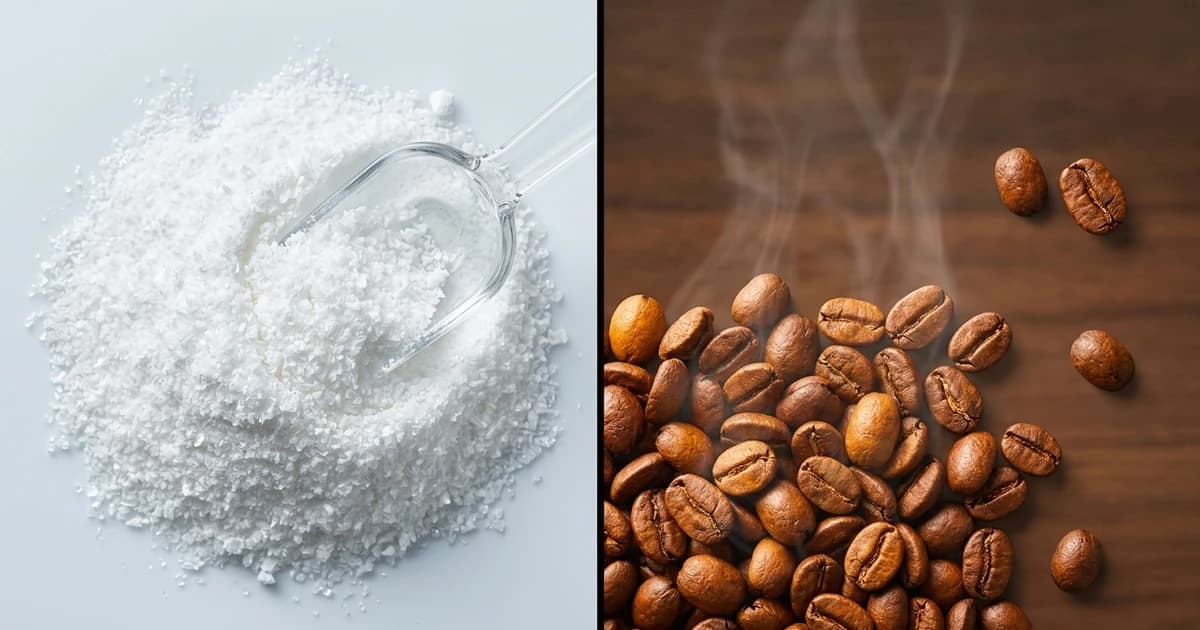
Most people reach for caffeine when they need to stay sharp, and most people have never heard of the other option. That gap matters. The l-tyrosine vs caffeine question isn't about which one is "better," because the two work on completely separate parts of your brain chemistry.
Caffeine fights the signal that tells you to sleep. L-tyrosine restocks the raw material your brain burns through under stress. One is a stimulant. The other is a building block.
Knowing which job you actually need done is the difference between a sharper afternoon and a wasted one.
Key Takeaways
- Caffeine blocks adenosine, the chemical that builds up and makes you sleepy. It masks fatigue rather than replacing what fatigue depletes.
- L-tyrosine is an amino acid your brain converts into dopamine and norepinephrine, the neurotransmitters that drain during stress and sleep loss.
- For everyday alertness, caffeine wins on speed and reliability. For high-stress, sleep-deprived conditions, tyrosine alertness benefits show up where caffeine alone falls short.
- They are not competitors. Many of the best protocols use both.
How Caffeine Actually Works
Caffeine creates alertness by blocking a brain chemical that wants you asleep. As you stay awake, a molecule called adenosine accumulates and binds to receptors that slow your neurons down. Caffeine slides into those same receptors and sits there, so the "you're tired" message never lands.
This is why the effect feels so immediate. Caffeine reaches a peak level in your blood within 30 to 60 minutes. You don't feel more energy because caffeine adds nothing. It just hides the fatigue.
The catch is the half-life. Caffeine has a half-life of about 5–7 hours, meaning that half of what you drink at 2 PM is still active in your system at bedtime. Take it too late and you borrow alertness from tonight's sleep, which deepens the adenosine debt you were trying to cover.
That makes caffeine a masking agent. Useful, fast, and proven, but it doesn't touch the underlying chemistry that fatigue erodes.
How L-Tyrosine Works (And Why It's a Different Tool)
L-tyrosine is a precursor, not a stimulant. Your body uses it to build the catecholamines that power focus and drive. In addition to increasing noradrenaline levels in the brain, the amino acid L-tyrosine acts as a precursor of dopamine.
Here is the part that matters for the dopamine precursor vs stimulant comparison. Under heavy stress, cold, or sleep loss, your brain fires off those neurotransmitters faster than it can rebuild them. When the supply runs low, performance drops. Supplying extra tyrosine gives the production line more raw material exactly when it's running short.
This is why tyrosine does almost nothing when you're rested and calm. There's no shortage to refill. Its value appears specifically under load, which is the opposite of how caffeine behaves.
So a stimulant overrides the brake. A precursor refuels the engine. Same destination, different mechanics.
L-Tyrosine vs Caffeine: The Head-to-Head
The honest answer to tyrosine vs caffeine focus depends entirely on your state. Here's how they stack up.
| Factor | Caffeine | L-Tyrosine |
|---|---|---|
| Mechanism | Blocks adenosine (masks fatigue) | Precursor to dopamine and norepinephrine (refuels) |
| Type | Stimulant | Non-stimulant amino acid |
| Onset | 30–60 min (faster sublingually) | Roughly 30–60 min, dose-dependent |
| Best for | Everyday alertness, low energy | High stress, cold, sleep deprivation |
| Effect when rested | Strong | Minimal |
| Sleep impact | Can disrupt sleep for hours | Does not degrade later sleep |
| Jitters / crash | Possible at higher doses | Rare |
| Typical study dose | 80–200 mg | 150 mg/kg or ~2,000 mg |
Notice the row about sleep. In sleep-deprivation research that compared tyrosine against stimulants, tyrosine offset some of the cognitive decline, and unlike the stimulants tested, it didn't wreck the participants' later sleep. That's a meaningful edge for anyone working overnight who still needs to recover afterward.
What the Research Says About Tyrosine and Sleep Deprivation
The strongest evidence for tyrosine sleep deprivation benefits comes from military and aviation labs, where staying functional through a sleepless night is a real operational problem.
In a classic study on extended wakefulness, subjects worked through a night without sleep and received either tyrosine or a placebo. Tyrosine administration was associated with a marked amelioration of the usual performance decline on a psychomotor task and a marked reduction in lapse probability on a high-event-rate vigilance task. The researchers noted that the improvements lasted on the order of 3 h, and the results suggest that tyrosine is a relatively benign treatment at this dose.
A separate review framed the comparison plainly. L-tyrosine shows modest benefit for cognitive performance during sleep deprivation, while there is no evidence supporting alpha-GPC for this indication. Its effects are real but weaker than traditional stimulants. Specifically, L-tyrosine improved performance on running memory, logical reasoning, mathematical processing, tracking, and visual vigilance tasks following overnight sleep deprivation.
The military interest is telling. One analysis noted that when military scientists completed a systematic review of supplements to maintain performance during sleep deprivation, they concluded that caffeine and L-tyrosine are the best of the bunch. Both made the list. Not one or the other.
Tyrosine's benefits also extend beyond sleep loss to other stressors. In one study, eight male volunteers performed a memory task at 4°C cold or 22°C after ingesting 150 mg/kg of L-tyrosine or placebo, and tyrosine reversed the cold-induced memory deficit. The pattern holds: tyrosine earns its keep when the brain is taxed.
One limit worth stating directly. Tyrosine does not pay down sleep debt. It helps you perform while depleted; it does not replace rest.
When to Choose a Non-Stimulant Instead
A non-stimulant alertness approach makes sense in a few clear situations.
- You're already over-caffeinated. If you've hit your tolerance ceiling for the day, more caffeine just adds jitters. Tyrosine works on a different pathway.
- It's late and you still need to function. Caffeine at 9 p.m. sabotages your sleep. Tyrosine doesn't carry that penalty.
- You're under acute stress. Cold, pressure, or a sleepless stretch depletes catecholamines, which is exactly the deficit tyrosine addresses.
- Caffeine makes you anxious. Some people are fast-wired and react poorly to stimulants. A precursor is gentler.
For ordinary daytime focus when you're reasonably rested, though, caffeine is the more reliable lever. It acts faster and the effect is far more noticeable.
The Smartest Move: Stop Treating It as Either/Or
Caffeine and tyrosine target different problems, so pitting them against each other misses the point. The real upgrade comes from caffeine plus the right support ingredient.
The best-studied partner for caffeine isn't tyrosine, it's L-theanine. L-theanine can help sharpen caffeine's attention and alertness benefits without dulling its mental edge. Pairing the two has been shown to improve simple reaction time, rapid visual information processing, and working-memory-related reaction time, while raising alertness and lowering tiredness.
In sleep-deprived subjects specifically, the L-theanine–caffeine combination enhances attentional focus by suppressing mind wandering and the deviation of attention to distracters.
If you want to go deeper on that pairing, our breakdown of how L-theanine smooths out caffeine and our guide to building a focus stack without the crash cover the ratios that work.
The Bottom Line on Two Routes to Wakefulness
Caffeine and l-tyrosine reach alertness from opposite directions. Caffeine blocks the fatigue signal for fast, dependable energy you can feel within the hour. L-tyrosine refills the dopamine and norepinephrine your brain burns through under stress, which is why its payoff shows up during sleep loss, cold, and pressure rather than on an ordinary Tuesday.
Pick caffeine when you need speed and your day still has room for sleep. Reach for tyrosine when you're depleted, stressed, or already maxed out on stimulants. And for most people chasing steady, all-day focus, the answer isn't choosing a side at all. It's caffeine, dosed well and paired with the right partner.
Frequently Asked Questions
Is L-tyrosine a stimulant?
No. L-tyrosine is an amino acid found in protein-rich foods, and it works as a precursor your body converts into dopamine and norepinephrine. It doesn't block adenosine or force a wakefulness response the way caffeine does. Because it refills neurotransmitters rather than masking fatigue, it produces little noticeable effect when you're rested and calm, and its benefits appear mainly under stress or sleep deprivation.
Can you take L-tyrosine and caffeine together?
Yes, and they target different mechanisms, so there's no inherent conflict. Caffeine masks fatigue by blocking adenosine, while tyrosine supplies raw material for catecholamines depleted by stress. People who want sharper focus often combine a stimulant with supporting ingredients. That said, the best-validated partner for caffeine in the research is L-theanine, which improves attention-switching accuracy while keeping the alertness benefits intact.
Does L-tyrosine help with sleep deprivation?
It helps you perform while sleep-deprived, but it does not pay down sleep debt. Studies on overnight wakefulness found tyrosine reduced the usual decline in psychomotor and vigilance tasks, with effects lasting around three hours. Improvements have shown up in running memory, logical reasoning, and tracking tasks. The benefit is real but modest, and it cannot replace actual rest. Treat it as a temporary bridge, not a sleep substitute.
Which is better for everyday focus, tyrosine or caffeine?
For ordinary daytime focus when you're reasonably rested, caffeine is the more reliable choice. It acts within 30 to 60 minutes and the lift is clearly noticeable. Tyrosine does very little when there's no neurotransmitter deficit to refill, so its everyday effect is subtle at best. Save tyrosine for high-stress or sleep-deprived stretches where caffeine alone leaves a gap.
Why does L-tyrosine only seem to work under stress?
Because stress, cold, and sleep loss make your brain release dopamine and norepinephrine faster than it can rebuild them. When supply runs low, performance drops. Extra tyrosine gives the production line more raw material exactly when it's short. When you're calm and rested, there's no shortage to fix, so supplementing adds little. This state-dependent effect is the core difference between a precursor and a stimulant.
Does L-tyrosine cause jitters or a crash?
Jitters and crashes are rare with tyrosine because it isn't a stimulant. It doesn't spike your nervous system or override adenosine, so there's no sudden surge to come down from. Research has described tyrosine as a relatively benign treatment at the doses studied. Caffeine, by contrast, can produce jitters at higher doses and a noticeable dip as it clears, especially without a buffering ingredient.
Where Caffeine, Done Right, Still Wins the Day
If your problem is a sleepless overnight shift or acute stress, a non-stimulant like tyrosine has a real, evidence-backed place, and it would be dishonest to pretend otherwise. But for the everyday goal of sharp, sustained focus, caffeine remains the faster, more dependable route. The trick is dosing it well and buffering it so you skip the jitters and the crash.
That's the logic behind Roon. Each sublingual pouch pairs 80 mg of caffeine with 60 mg of L-theanine, the most studied combination for calm, focused alertness, plus 25 mg of methylliberine (Dynamine) and 5 mg of theacrine (TeaCrine) to extend the runway. The sublingual format means onset in about 5 to 10 minutes, with 6 to 8 hours of steady focus and no tolerance buildup.
Roon is built for the stimulant side of this comparison, done cleanly. It isn't a fix for chronic sleep loss, and it won't replace the rest your brain actually needs. When you want reliable daytime focus without the rough edges, try Roon.
Written by Roon Team