L-Theanine for Weight Loss
Roon Team
L-Theanine for Weight Loss: What the Cortisol Connection Actually Means
You didn't gain the weight because you ate too many carbs at dinner. You gained it because you've been running on stress fumes for six months, sleeping five hours a night, and your body responded the only way it knows how: by storing fat and begging you to eat more.
L theanine weight loss isn't about a fat-burning pill. It's about fixing the hormonal environment that makes losing fat so difficult in the first place. And the hormone at the center of that environment is cortisol.
Here's what the research actually says, why cortisol is the missing variable in most weight loss conversations, and how a single amino acid found in green tea might change the equation.
Key Takeaways
- Chronic stress raises cortisol, which drives visceral fat storage, increases appetite, and disrupts sleep.
- L-theanine lowers cortisol after acute stress and promotes alpha brain wave activity linked to calm focus.
- Animal studies show l theanine weight loss effects in mice on high-fat diets by improving lipid metabolism and gut microbiota.
- No human clinical trial has directly proven l theanine weight loss in isolation, but the indirect pathways (stress, sleep, cravings) are well-supported.
The Cortisol Problem Nobody Talks About
Most weight loss advice focuses on calories in, calories out. That model isn't wrong, but it's incomplete. It ignores the hormonal machinery running underneath every food decision you make.
Cortisol is the body's primary stress hormone. In short bursts, it's useful. It wakes you up in the morning, helps you react to danger, and mobilizes energy. But when cortisol stays elevated for weeks or months, it does three things that directly sabotage fat loss.
First, it redirects fat storage to your midsection. Cortisol affects fat distribution by causing fat to be stored centrally, around the organs. Research from Yale found that even non-overweight women with high stress reactivity carried more abdominal fat than their calmer counterparts. A study published in Domestic Animal Endocrinology confirmed that patients with abdominal obesity have elevated cortisol levels, and that glucocorticoids increase consumption of calorie-dense foods.
Second, it makes you hungrier. Cortisol doesn't just store fat. It actively drives you toward high-calorie food. This isn't a willpower failure. It's a biochemical signal telling your brain that you need energy because something is "wrong."
Third, it wrecks your sleep. And poor sleep makes everything worse. Research from Stanford Lifestyle Medicine explains that sleep deprivation increases ghrelin (the hunger hormone) and decreases leptin (the satiety hormone), leaving you in a state of constant hunger. A lab study published in Obesity confirmed that acute sleep deprivation reduces blood concentrations of leptin.
So the cycle looks like this: stress raises cortisol, cortisol disrupts sleep, poor sleep increases hunger hormones, increased hunger leads to overeating, and overeating leads to more visceral fat. Repeat.
Breaking that cycle at the cortisol level is where l theanine weight loss science enters the picture.
How L-Theanine Actually Works in Your Brain
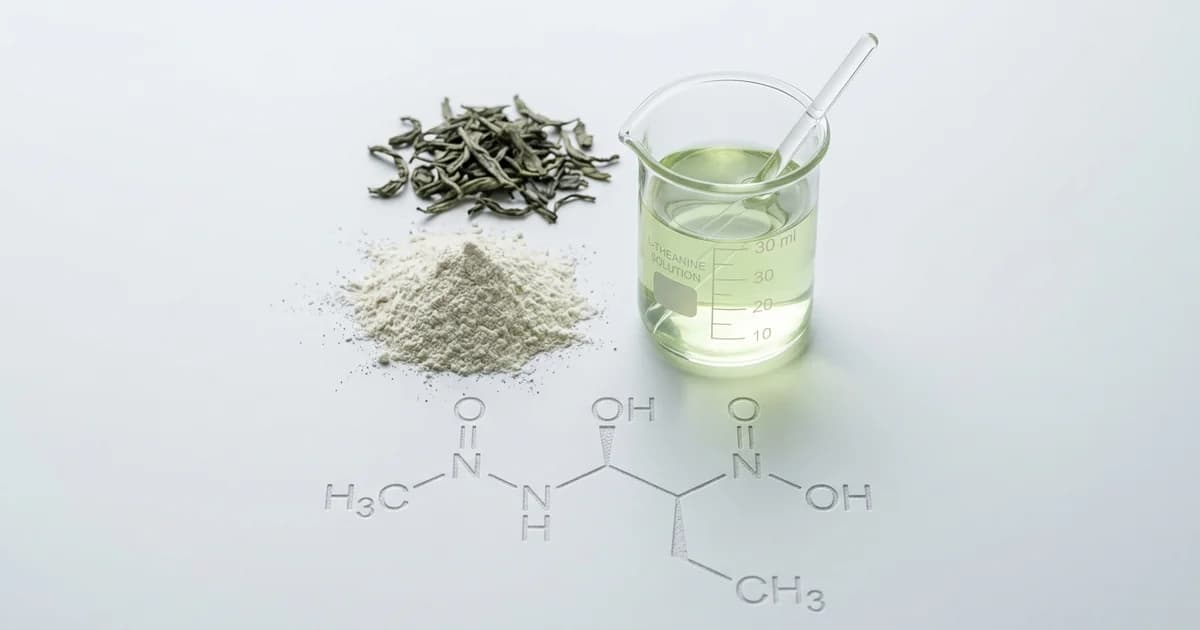
L-theanine (L-γ-glutamylethylamide) is a non-protein amino acid found almost exclusively in tea leaves. It crosses the blood-brain barrier, which is why its effects are felt within 30 to 60 minutes of ingestion.
Its primary mechanism involves the glutamate system. According to research reviewed by The Better Sleep Clinic, L-theanine has structural similarity to glutamate and can bind to glutamate receptors, but with much lower affinity. This means l theanine partially blocks the excitatory signaling that glutamate normally produces. The result is a calming effect without sedation.
L-theanine also increases alpha brain wave activity, the same pattern your brain produces during meditation or relaxed focus. A randomized, triple-blind, placebo-controlled study published in Nutrients found that a single 200mg dose of L-theanine increased frontal region alpha power compared to placebo after an acute stress challenge.
This matters for l theanine weight loss because alpha wave states are associated with reduced anxiety, better decision-making, and fewer impulsive food choices. You don't reach for the vending machine when your brain is calm.
L-Theanine Weight Loss and Cortisol: What the Studies Show
The cortisol data is where l theanine weight loss research gets interesting for anyone trying to shed fat.
A randomized, double-blind, placebo-controlled crossover trial published in PMC found that L-theanine reduced the salivary cortisol response to a stressor three hours after dosing. The same study observed increased resting state alpha oscillatory activity after active treatment compared to placebo.
Another study from 2021, also published in Nutrients, replicated these findings. Following a task-induced stress protocol and a single dose of L-theanine, healthy adults showed reductions in salivary cortisol alongside increases in alpha brain wave power.
Not every study agrees. A randomized controlled trial published in PMC looking at four weeks of L-theanine supplementation found improvements in stress-related symptoms and cognitive function, but no statistically significant changes in salivary cortisol or immunoglobulin A levels. The researchers noted this was inconsistent with previous findings.
The honest takeaway: L-theanine appears to blunt the cortisol spike that follows acute stress. Whether l theanine lowers baseline cortisol over weeks of supplementation is less clear. But even reducing the cortisol response to individual stressors throughout the day could add up, especially if those spikes are what drive your afternoon snack runs.
L Theanine Weight Loss: The Animal Evidence
No human clinical trial has directly tested whether L-theanine supplementation causes fat loss. That needs to be stated clearly. But the animal data supporting l theanine weight loss is strong enough to explain why researchers keep studying it.
A 2025 study published in Molecular Nutrition & Food Research found that 12 weeks of L-theanine supplementation in mice on a high-fat diet dose-dependently decreased body weight gain and adipose tissue mass. The mechanism involved suppressing fat-production genes in the liver while enhancing fat breakdown through oxidative phosphorylation. The researchers also found l theanine remodeled gut microbiota to increase butyrate-producing bacteria.
A 2024 study published in Foods (PMC) used transcriptomics and metabolomics to show that L-theanine suppressed lipid metabolism and inflammation pathways in high-fat-diet-fed mice, inhibiting hepatic steatosis (fatty liver).
An earlier study published in the Journal of Functional Foods demonstrated that oral L-theanine promoted fat browning (the conversion of white fat cells to metabolically active brown fat cells) in mice on a high-fat diet, associated with changes in gut microbiota composition.
And a study published in Nutrition & Metabolism showed L-theanine prevented the progression of nonalcoholic hepatic steatosis by regulating lipid metabolic pathways via the CaMKKβ-AMPK signaling pathway. In plain terms: l theanine helped prevent fat buildup in the liver.
| Pathway | What L-Theanine Does (Animal Models) | Relevance to L Theanine Weight Loss |
|---|---|---|
| Lipid metabolism | Suppresses fat-production genes, enhances fat oxidation | Less fat stored in liver and body |
| Gut microbiota | Increases butyrate-producing bacteria | Better metabolic signaling |
| Fat browning | Promotes conversion of white to brown fat | Higher energy expenditure |
| AMPK pathway | Activates metabolic regulation in liver cells | Prevents fatty liver progression |
These are animal models. Mice aren't people. But the consistency of the findings across multiple labs, using different methods, points to real biological activity worth watching.
The Sleep and Stress-Eating Connection to L Theanine Weight Loss
Even without direct fat-burning effects, l theanine weight loss benefits may come through two indirect but powerful channels: sleep quality and stress-related eating.
A 2018 study referenced by Medical News Today found that people reported greater sleep satisfaction after taking 450 to 900mg of L-theanine daily for eight weeks. Better sleep means better hunger hormone regulation, which means fewer cravings and less overeating.
On the stress-eating front, the logic is straightforward. If L-theanine reduces your cortisol response and promotes a relaxed mental state, you're less likely to eat in response to emotional triggers. Performance Lab notes that L-theanine's stress reduction and mood enhancement combination may impact eating behaviors, especially stress eating or emotional eating.
This isn't a stretch. It's basic behavioral neuroscience. Calmer brain, better decisions. Better decisions, fewer unnecessary calories.
L Theanine Weight Loss Dosage and What to Expect
Most clinical studies on L-theanine use doses between 200mg and 400mg per day. WebMD reports that L-theanine has most often been studied at 200 to 400mg daily for four to eight weeks. Healthline's review of the research found that around 200 to 400mg per day helped ease anxiety and stress.
L-theanine is generally well-tolerated. It won't make you drowsy during the day (it promotes relaxation, not sedation), and it pairs well with caffeine. In fact, the L-theanine and caffeine combination is one of the most studied nootropic stacks, producing focused alertness without the jittery edge caffeine alone can cause.
For l theanine weight loss goals, don't expect this amino acid to replace a caloric deficit. It won't. What l theanine can do is make the deficit easier to maintain by keeping cortisol in check, improving your sleep, and reducing the stress-driven eating that derails most diets by week three.
A Simpler Way to Get Your L-Theanine
If the research on l theanine weight loss, cortisol, and fat management resonates with you, the next question is delivery. Capsules work. Tea works, though you'd need several cups to hit a clinically studied dose.
Or you could skip the pill bottles entirely. Roon is a zero-nicotine sublingual pouch that pairs L-theanine with caffeine, theacrine, and methylliberine for 6 to 8 hours of sustained focus with no jitters and no crash. You get your L-theanine, plus a full cognitive performance stack, absorbed directly through the mouth for faster onset than any capsule.
Roon won't replace your training program. It won't erase a bad diet. But if stress and cortisol are the invisible forces working against your goals, getting consistent L-theanine into your routine is a smart place to start.