L-Theanine and OCD: What the Science Actually Says
Roon Team
L-Theanine and OCD: What the Science Actually Says
Your brain won't stop looping. The same thought, the same fear, the same compulsion, over and over, like a song stuck on repeat with the volume turned up. If you or someone you know lives with obsessive-compulsive disorder, you already know that standard treatments don't work for everyone. That's why l theanine ocd research has started generating real scientific interest.
L-theanine is an amino acid found naturally in green tea. It's been studied for decades as a calming agent. But recent clinical trials suggest l theanine may do something more specific: help regulate the exact neurotransmitter systems that malfunction in OCD.
This isn't about replacing medication or therapy. It's about understanding what the l theanine ocd research shows, where the gaps are, and whether L-theanine deserves a place in the conversation.
Key Takeaways
- OCD affects roughly 2-3 million adults in the U.S., and up to 40% don't respond well to first-line treatments.
- L-theanine modulates glutamate, the excitatory neurotransmitter now believed to play a central role in OCD pathology.
- A 2023 double-blind clinical trial found that L-theanine combined with fluvoxamine reduced OCD symptoms more than fluvoxamine alone.
- L-theanine promotes calm focus by increasing alpha brain wave activity and supporting GABA production, without causing sedation.
What OCD Actually Does to Your Brain
OCD isn't just "being neat" or "liking things organized." It's a neuropsychiatric condition that hijacks your brain's error-detection circuitry.
The cortico-striato-thalamo-cortical (CSTC) loop, a circuit connecting your prefrontal cortex, basal ganglia, and thalamus, gets stuck in overdrive. Your brain keeps sending alarm signals even when there's no real threat. That's what drives the obsessions. The compulsions are your brain's desperate attempt to quiet those alarms.
For years, the dominant theory focused on serotonin. SSRIs like fluvoxamine became the go-to pharmaceutical treatment. They help many people. But research published in Neuropsychopharmacology has shown that glutamate, the brain's primary excitatory neurotransmitter, is just as involved in OCD as serotonin. Possibly more.
A 2023 study in Nature Communications used 7-Tesla MRI spectroscopy to measure glutamate and GABA levels in the brains of people with OCD. The researchers found that compulsive behavior was directly related to glutamate levels in the supplementary motor area. Higher glutamate, more compulsive behavior.
This is where l theanine ocd research enters the picture.
How L-Theanine for OCD Works in the Brain
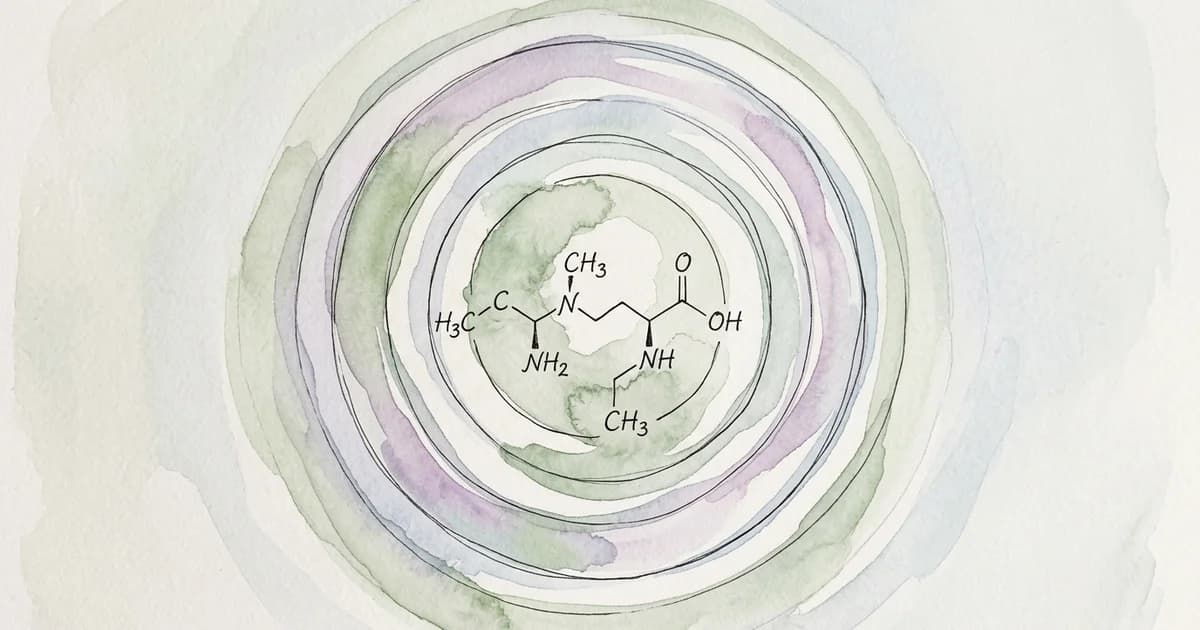
L-theanine (N-ethyl-L-glutamine) is structurally similar to glutamate. That similarity is the key to its mechanism.
According to research published on PubMed, L-theanine crosses the blood-brain barrier and acts on multiple neurotransmitter systems simultaneously. L theanine increases brain levels of serotonin, dopamine, and GABA. It also has measurable affinity for AMPA, kainate, and NMDA receptors, all of which are glutamate receptor subtypes.
Here's what that means in plain terms:
- It partially blocks glutamate receptors. Because L-theanine is structurally similar to glutamate, it competes for the same receptor sites but produces a weaker excitatory signal. Think of it as turning down the volume on an overactive system.
- It supports GABA production. GABA is the brain's primary inhibitory neurotransmitter, the counterbalance to glutamate. According to ScienceDirect, L-theanine may block glutamate's effects while increasing GABA activity.
- It promotes alpha brain wave activity. Alpha waves are associated with a state of relaxed alertness. You're calm, but you're not sleepy. This is the opposite of what sedatives do.
The net effect is a brain that's less reactive, less stuck in excitatory loops, and better able to shift between tasks without getting locked into repetitive patterns.
This dual action on glutamate and GABA is what separates l theanine ocd applications from simple sedatives or anti-anxiety compounds. L-theanine doesn't just make you feel calmer. It adjusts the underlying neurochemical balance that determines how your brain processes threat signals and habitual responses.
The L-Theanine OCD Clinical Evidence
Let's get specific about what the studies actually found.
The 2023 Fluvoxamine Trial
The strongest l theanine ocd evidence comes from a 2023 double-blind, placebo-controlled trial published in Psychiatry and Clinical Neurosciences. Researchers enrolled patients aged 18-60 with moderate-to-severe OCD (Yale-Brown Obsessive Compulsive Scale scores above 21).
Participants received either L-theanine (200mg daily) plus fluvoxamine or placebo plus fluvoxamine for 10 weeks. The L-theanine group showed a greater reduction in Y-BOCS total scores compared to the placebo group.
The study's conclusion was direct: L-theanine appears to be "a relatively safe and effective adjuvant therapy for moderate to severe OCD."
Two things matter here. First, this was a proper randomized controlled trial, not an observational study or case report. Second, the mechanism aligns with what we know about glutamate's role in OCD. L theanine modulates the glutamate pathway, and glutamate dysregulation drives OCD symptoms.
The TRON Pilot Study
A separate open-label pilot study published in CNS Spectrums tested a nutraceutical combination that included L-theanine alongside N-acetyl cysteine, zinc, magnesium, pyridoxal-5' phosphate, and selenium. The 28 participants all had treatment-resistant OCD, meaning standard therapies had already failed them.
Over 20 weeks, the group showed an estimated mean reduction of 7.8 points on the Y-BOCS. That's a meaningful drop. While this study can't isolate L-theanine's individual contribution (it was part of a combination), it reinforces the idea that targeting the glutamatergic system with nutraceuticals can move the needle on OCD symptoms.
The 2024 Systematic Review
A 2024 systematic review published in BMC Psychiatry evaluated L-theanine supplementation across multiple mental health conditions. The review found that L-theanine reduced psychiatric symptoms more effectively than control conditions in individuals with several disorders, and specifically cited the l theanine ocd trial as evidence of L-theanine's potential as an adjuvant treatment.
L-Theanine OCD Supplements vs. Other Options: How They Compare
| Supplement | Primary Mechanism | OCD Evidence Level | Typical Dose |
|---|---|---|---|
| L-Theanine | Glutamate modulation, GABA support | Randomized controlled trial | 200-400mg/day |
| N-Acetyl Cysteine (NAC) | Glutamate modulation, antioxidant | Multiple RCTs, mixed results | 2,400-3,000mg/day |
| Inositol | Serotonin receptor signaling | Small trials, inconsistent | 12-18g/day |
| Magnesium | NMDA receptor modulation | Preliminary, mostly adjunctive | 200-400mg/day |
| Milk Thistle | Serotonergic, anti-inflammatory | One small RCT | 600mg/day |
L-theanine stands out for two reasons: it has direct clinical trial evidence specific to OCD, and its side effect profile is remarkably clean. NAC has more studies overall, but results have been mixed. Inositol requires massive doses that many people can't tolerate. L theanine ocd dosing at 200mg per day is simple, well-tolerated, and backed by a proper RCT.
L-Theanine OCD Dosage, Safety, and What to Expect
According to WebMD, doses of up to 900mg daily have been used safely for 8 weeks in clinical settings. The l theanine ocd trial used 200mg per day (100mg twice daily), which is a moderate dose.
Common dosage ranges in the research:
- 100-200mg for general relaxation and focus
- 200-400mg for anxiety and stress management
- 200mg (the dose used in the OCD clinical trial)
Side effects are rare and mild. Some people report slight headaches or drowsiness, but these are uncommon at standard doses. L-theanine doesn't cause dependence, tolerance buildup, or withdrawal symptoms.
A few things to keep in mind:
- L-theanine is not a replacement for OCD-specific therapy (ERP) or prescribed medication. The clinical evidence shows l theanine as an adjuvant, meaning it works alongside standard treatment.
- If you're taking SSRIs, benzodiazepines, or other psychiatric medications, talk to your doctor before adding L-theanine. Drug interactions are unlikely but worth discussing.
- Results aren't instant. The clinical trial ran for 10 weeks. Give it time.
Why Glutamate Matters More Than You Think for L-Theanine OCD Benefits
The serotonin hypothesis dominated OCD treatment for decades. And it's not wrong. SSRIs help roughly 40-60% of OCD patients. But that leaves a large percentage of people who don't respond, or don't respond fully.
Research from the Pharmacological Reviews has made a strong case that glutamate abnormalities are central to OCD neurobiology. Elevated glutamate in the CSTC circuit creates a kind of neurological feedback loop, exactly the "stuck" feeling that OCD patients describe.
L-theanine's ability to modulate glutamate receptors without completely blocking them is what makes l theanine ocd research interesting. It doesn't shut the system down. It dials it back. That's a meaningful distinction, because glutamate isn't the enemy. You need it for learning, memory, and normal cognitive function. The problem in OCD is excess, not presence.
This is also why l theanine pairs well with SSRIs in the research. SSRIs target the serotonin side of the equation. L-theanine addresses the glutamate side. Combining both approaches tackles OCD from two different neurochemical angles, which may explain why the combination outperformed fluvoxamine alone in the 2023 trial.
Getting L-Theanine Into Your Daily Routine
You can get L-theanine from green tea, but a standard cup contains only about 20-30mg. You'd need to drink 7-10 cups daily to reach the 200mg dose used in the l theanine ocd trial. That's a lot of tea, and it comes with caffeine you may not want.
Choosing an L-theanine supplement is the more practical route. L-theanine is widely available in capsule form, and it's also found in newer delivery systems designed for faster absorption.
Roon includes L-theanine as part of its sublingual pouch formula, paired with caffeine (80mg), theacrine, and methylliberine. The sublingual delivery means L-theanine absorbs through the tissue under your tongue, bypassing the digestive system for a faster, more consistent effect. If you're looking to build L-theanine into your daily routine without swallowing pills or brewing pots of tea, it's a clean option worth considering.
This article is for informational purposes only and does not constitute medical advice. If you have OCD or suspect you do, consult a qualified healthcare professional for diagnosis and treatment.