The Huperzine A Student Study: What 34 Pairs of Teenagers Revealed
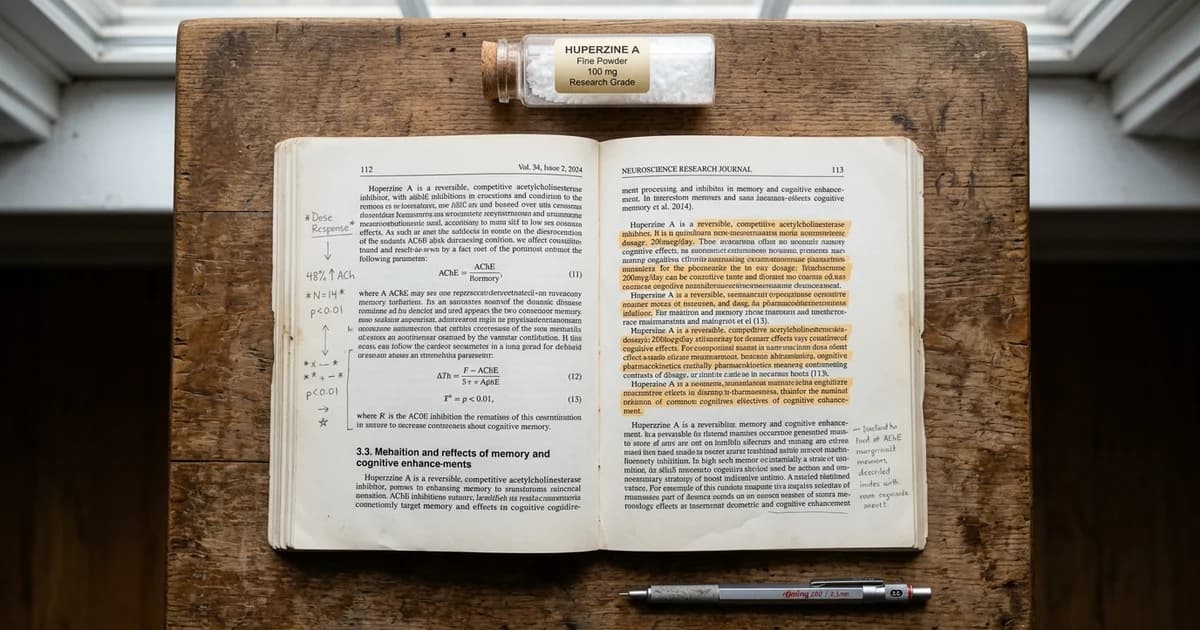
A small Chinese trial from 1999 is still the single most-cited piece of evidence behind every "study smarter" supplement that lists Huperzine A on the label. The huperzine a student study tracked 34 pairs of matched adolescent students over four weeks, gave half of them 100 mcg of huperzine A twice a day, and measured whether their memory scores moved.
The results were positive. They were also tiny, old, and easy to over-read.
Here is what the trial actually found, what it measured, and why a 27-year-old experiment with 68 teenagers became the load-bearing citation for a multimillion-dollar nootropic ingredient.
Key Takeaways
- The trial paired 34 sets of teenage students and gave one of each pair 100 mcg of huperzine A twice daily for four weeks.
- Researchers measured memory quotient, a Wechsler-style memory score, and reported gains in the huperzine group.
- Huperzine A works as an acetylcholinesterase inhibitor, slowing the breakdown of acetylcholine, a neurotransmitter tied to learning and memory.
- The study is small, short, and decades old. Long-term safety in healthy teenagers was never established.
- For daily cognitive support, a well-characterized, lower-risk stack makes more sense than a potent enzyme inhibitor.
What the Huperzine A Student Study Actually Tested
The trial behind the huperzine a student study label is Sun and colleagues, published in 1999 in Acta Pharmacologica Sinica (then titled Chung Kuo Yao Li Hsueh Pao).
According to a breakdown by physician Dr. Brad Stanfield, the controlled trial involved 34 pairs of matched healthy adolescent students who took huperzine A at 100 mcg twice daily over four weeks, with memory and learning performance as the outcome. The students were paired to keep the two groups comparable on age and baseline ability.
This matters for one reason. With only 68 participants split into matched pairs, the design was built to detect a clear effect in a clean sample, not to prove anything about the messy, varied population of real students.
How Researchers Measured Memory
The trial scored students on memory quotient, a composite number drawn from Wechsler-style memory testing.
Think of memory quotient as an IQ score for memory. It blends several subtests (recall, recognition, working memory) into a single figure where 100 is roughly average. A summary from ScienceDirect notes that huperzine A "enhanced the memory and learning performance of adolescent students," and the same source describes a separate trial in older adults with age-associated memory impairment that reported a 68.3% effective rate in the huperzine group versus 26.4% in controls.
So the headline holds up on its own terms. Students who took the compound scored better on standardized memory tests than the matched students who did not. The huperzine a memory learning link in this trial is real within the data.
The catch is what "better" means at this scale, which we will get to.
Why Huperzine A Affects Memory at All
Huperzine A is an acetylcholinesterase inhibitor. That single fact explains most of its reputation.
Acetylcholine is a neurotransmitter your brain uses heavily for learning, recall, and attention. An enzyme called acetylcholinesterase clears it out of the synapse after it fires. Huperzine A blocks that enzyme, so acetylcholine sticks around longer.
As one ingredient overview puts it, huperzine A is a potent acetylcholinesterase inhibitor that raises levels of the acetylcholine involved in memory and learning. ScienceDirect describes it as a potent, selective, and reversible inhibitor of the enzyme. This is the same mechanism class used by some prescription Alzheimer's drugs, which tells you how strong the lever is.
That potency is exactly why the "ache inhibitor students" angle deserves caution rather than excitement.
The Problems With Reading Too Much Into It
A positive result is not the same as a useful one. Three issues should temper how you read this trial.
1. The sample was tiny and the trial was short. Sixty-eight students over four weeks cannot tell you what happens to a healthy 16-year-old who takes a daily acetylcholinesterase inhibitor for a semester, a year, or longer.
2. It is old and rarely replicated in healthy youth. Most huperzine A research since has focused on dementia and age-associated memory impairment, not high-functioning teenagers. The huperzine a adolescents evidence base barely grew after 1999.
3. The mechanism cuts both ways. Because huperzine A is potent, it carries dose-dependent cholinergic side effects. Wikipedia's summary lists nausea, vomiting, diarrhea, muscle twitching, sweating, and hypersalivation among possible effects. It also notes the compound is not recommended in pregnancy or lactation due to a lack of safety data.
There is also the tolerance question. Because it is a potent inhibitor, one ingredient guide recommends cycling it (for example, three weeks on, one week off) to avoid receptor desensitization with long-term use. A compound you have to schedule around is a poor fit for a simple daily routine.
Huperzine A vs. Everyday Cognitive Ingredients
Here is how the huperzine a 100 mcg approach compares to ingredients people actually use day to day for focus.
| Ingredient | Mechanism | Onset | Daily-use profile |
|---|---|---|---|
| Huperzine A (100 mcg 2x/day) | Acetylcholinesterase inhibitor | Slow, builds over weeks | Often cycled; potent enzyme inhibition |
| Caffeine | Adenosine receptor antagonist | 5–30 min | Well-characterized; tolerance builds |
| L-theanine | Modulates alpha brain waves | 30–60 min | Smooths caffeine; very gentle |
| Methylliberine (Dynamine) | Adenosine modulation | Fast | Newer, used alongside caffeine |
| Theacrine (TeaCrine) | Adenosine/dopamine pathways | Slower than caffeine | Resists tolerance buildup |
The point is not that huperzine A is bad. It is that it sits in a different category. It is a potent, slow-building enzyme inhibitor studied mostly in clinical populations, not a fast, well-mapped focus ingredient for routine daily use.
If you want to go deeper on the everyday options, our breakdowns of L-theanine and caffeine and how to build a no-crash focus routine cover the gentler end of the spectrum.
The Verdict on a 27-Year-Old Trial
The 1999 trial showed that 100 mcg of huperzine A twice daily improved memory quotient scores in a matched group of teenage students over four weeks. That finding is genuine, and it explains why the ingredient keeps showing up on supplement labels.
It is also a single small study from the last century, run for one month, with no long-term safety data in healthy young people. One positive trial of 68 students is a reason to stay curious, not a reason to dose a potent enzyme inhibitor every day. Strong mechanisms demand strong evidence, and on that test, the huperzine A story is still thin.
Frequently Asked Questions
What did the huperzine A student study find?
It found that adolescent students who took 100 mcg of huperzine A twice daily for four weeks scored higher on memory quotient tests than matched peers who did not. The trial paired 34 sets of students to keep the groups comparable. The effect was positive within the data, but the sample was small and the study lasted only a month.
How much huperzine A did the students take?
Each treated student took 100 mcg twice daily, for a total of 200 mcg per day, across four weeks. Lower doses, around 30 mcg twice daily, have appeared in other research on memory impairment in older adults, so 100 mcg twice daily was a relatively assertive dose for healthy teenagers.
What is memory quotient?
Memory quotient is a composite score from Wechsler-style memory testing, scaled so that 100 sits near average. It combines subtests for recall, recognition, and working memory into one number. Researchers used it as the main outcome in the huperzine A student trial because it gives a single, comparable figure across participants.
How does huperzine A work in the brain?
Huperzine A is an acetylcholinesterase inhibitor. It blocks the enzyme that clears acetylcholine, a neurotransmitter central to learning and memory, so acetylcholine stays active in the synapse longer. This is a potent, selective, reversible action, and it belongs to the same mechanism class used by some prescription cognitive drugs.
Is huperzine A safe for students to take daily?
There is no strong evidence that it is safe for healthy teenagers to take daily over long periods. The main supporting trial lasted four weeks. Possible cholinergic side effects include nausea, diarrhea, and sweating, and many guides recommend cycling the compound rather than taking it continuously. Anyone considering it should speak with a clinician first.
Why is one 1999 study still cited so often?
Because it remains one of the few controlled trials looking at huperzine A in healthy young people specifically. Most later research targeted dementia and age-related memory loss. With little newer data on adolescents, marketers keep reaching back to the same small, dated study.
Is more huperzine A better for memory?
No. It is a potent enzyme inhibitor, and higher or continuous dosing raises the risk of cholinergic side effects and possible receptor desensitization. The student trial used a fixed, modest dose for a fixed period. More is not the same as better with a compound this strong.
Why We Built Roon Around Daily Use, Not Enzyme Inhibition
The huperzine A story is a clean example of a wider problem in cognitive supplements: a strong mechanism, one small old study, and a lot of marketing built on top. We took the opposite approach.
Roon is a sublingual pouch built around four well-studied ingredients meant for daily, predictable use: 80 mg caffeine, 60 mg L-theanine, 25 mg methylliberine (Dynamine), and 5 mg theacrine (TeaCrine). It is designed for a 5–10 minute onset and 6–8 hours of sustained focus with no jitters, no crash, and no tolerance buildup. It is not an acetylcholinesterase inhibitor, and it is not meant to be one.
Roon is also not a replacement for sleep, study habits, or medical advice. It is a daily focus tool built on ingredients you can actually map, not a potent enzyme blocker you have to cycle around. If you want focus you can rely on without the question marks, try Roon.
Written by Roon Team