How to Improve Focus While Studying
How to Improve Focus While Studying (Without Burning Out or Popping Pills)
You sat down to study two hours ago. You've read the same paragraph four times. Your phone screen lit up eleven minutes in, and you never quite recovered. If you're wondering how to improve focus while studying, you're asking the right question, but most of the advice you'll find online is either painfully obvious ("just turn off your phone!") or dangerously outdated.
The real problem isn't willpower. It's that your brain is working against a set of biological and environmental conditions that make sustained attention genuinely difficult. Once you learn how to improve focus while studying by fixing those conditions, focus follows naturally.
Here's what actually works, backed by research, not Reddit threads.
Key Takeaways
- Your attention isn't broken. It's being hijacked by your environment, your habits, and your biology.
- Structured study intervals (like the Pomodoro Technique) work because they respect your brain's natural attention cycles.
- Sleep, movement, and nutrition affect your ability to concentrate more than any "study hack."
- The caffeine + L-theanine combination outperforms caffeine alone for sustained, calm focus.
Why You Can't Focus (It's Not Just You)
Before you can figure out how to improve focus while studying, you need to understand why it keeps slipping.
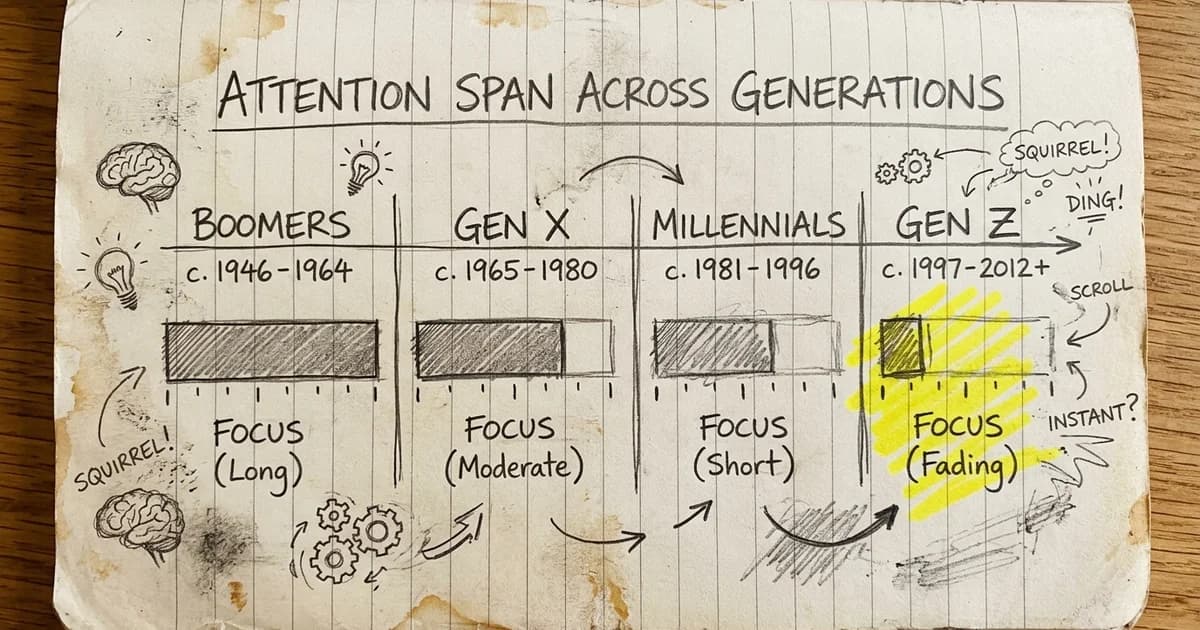
According to research covered by Journalistic Learning, user attention spans now average around 47 seconds before shifting to a new task. That's not a typo. Researcher Gloria Mark has documented this decline over the past two decades, and other research teams have reached similar conclusions.
Your brain didn't evolve for six-hour study marathons. Data compiled by Gitnux shows that students' attention levels drop after just 10 to 30 minutes of a lecture, and high school students are off-task roughly 17% of the time during class. In a self-directed study session with zero external accountability, those numbers get worse.
So how do i increase my attention span when biology seems stacked against me? You stop fighting your brain and start designing your study sessions around how it actually works.
How to Improve Focus While Studying: 8 Strategies That Actually Work
1. Use Time-Blocked Study Sessions
The Pomodoro Technique gets recommended constantly because it actually holds up under scrutiny. The concept is simple: study for 25 minutes, take a 5-minute break, repeat. After four rounds, take a longer 15 to 30 minute break.
This approach to how to improve focus while studying works because it aligns with your brain's natural attention curve. Instead of trying to white-knuckle through three straight hours, you're giving your prefrontal cortex regular recovery windows. The timer also creates a mild sense of urgency that keeps you engaged.
If 25 minutes feels too short, experiment. Some people do better with 50-minute blocks and 10-minute breaks. The principle matters more than the exact numbers: work in defined intervals, rest deliberately, and repeat.
2. Control Your Environment Before You Sit Down
Your study environment is either helping you or quietly sabotaging you. Research from the University of Texas at Austin found that the mere presence of a smartphone on your desk reduces available cognitive capacity, even if the phone is face down and on silent. You don't need to check it. Your brain is already spending resources not checking it.
If you're serious about how to improve focus while studying, the fix is boring but effective:
- Phone in another room. Not on silent. Not in your bag. Another room.
- One browser tab open. Use a site blocker like Cold Turkey or Freedom if you don't trust yourself (you shouldn't).
- Noise control. If you can't get silence, use brown noise or instrumental music. Lyrics compete with the language-processing areas you need for reading and writing.
3. Front-Load Your Hardest Material
Your cognitive resources are finite. They deplete throughout the day and throughout each study session. This is called ego depletion, and while the concept has faced some academic debate, the practical reality holds: you do your best thinking when you're fresh.
Knowing how to improve focus while studying means knowing when to tackle what. Study your hardest subject first. Save the review, the flashcards, and the lighter material for the end of your session when your focus naturally starts to fade.
4. Sleep Is Non-Negotiable
This is the strategy everyone skips and the one that matters most for how to improve focus while studying.
Sleep deprivation doesn't just make you tired, and staying awake during long sessions is a separate challenge that compounds when sleep debt builds up. It impairs your prefrontal cortex, the exact brain region responsible for sustained attention, working memory, and decision-making. College students who consistently sleep fewer than six hours per night show measurable declines in cognitive performance, reaction time, and the ability to consolidate new information into long-term memory.
You cannot out-study bad sleep. Seven to nine hours is the target. If you're pulling all-nighters before exams, you're actively making yourself dumber for the test. Sleep is just one lever; we cover the full list in our guide to building a longer attention span.
5. Move Your Body Before You Study
A short bout of physical activity before a study session can sharpen your focus for up to an hour afterward. According to The Conversation, physical activity improves two key components of concentration: sustained attention (your ability to stay locked on a task) and the ability to ignore distractions.
You don't need a full gym session. A 15 to 20 minute walk, a set of bodyweight exercises, or even a few minutes of jumping rope will increase blood flow to the brain and elevate levels of brain-derived neurotrophic factor (BDNF), a protein that supports learning and memory.
The timing matters. Exercise before studying is far more useful than exercising after. Think of it as a warm-up for your brain, not just your body. Anyone asking how do i increase my attention span should start here: consistent pre-study movement is one of the simplest, most effective answers.
6. Eat for Focus, Not Just Energy
Most students study on a diet of caffeine and simple carbohydrates, then wonder why they crash ninety minutes in. Your brain consumes about 20% of your total daily energy, and it's extremely sensitive to blood sugar fluctuations. Learning how to improve focus while studying means paying attention to what you eat before you sit down.
Here's a simple framework:
| Food Category | Examples | Effect on Focus |
|---|---|---|
| Complex carbs | Oats, sweet potatoes, brown rice | Steady glucose release, sustained energy |
| Protein | Eggs, Greek yogurt, nuts | Supports neurotransmitter production |
| Healthy fats | Avocado, olive oil, fatty fish | Supports cell membrane integrity in the brain |
| Simple sugars | Candy, soda, white bread | Rapid spike then crash, impairs focus |
Eat a balanced meal or snack 30 to 60 minutes before studying. Avoid anything that spikes your blood sugar and sends you reaching for more sugar an hour later.
7. Use Active Recall, Not Passive Review
This isn't just a study technique. It's a focus technique, and one of the best answers to how to improve focus while studying.
Passive review (re-reading notes, highlighting textbooks) lets your mind wander because it requires minimal cognitive engagement. Active recall (closing your notes and testing yourself on the material) forces your brain to work. That effort is what builds both memory and sustained attention.
Combine active recall with spaced repetition and other memory retention techniques using tools like Anki, and you'll retain more information in less time. Less time studying means less opportunity for your focus to collapse. If you've been asking how do i increase my attention span, switching from passive to active study methods is one of the fastest ways to see results.
8. Rethink Your Relationship with Caffeine
Caffeine is the most widely used cognitive enhancer on the planet, and for good reason. It blocks adenosine receptors, reducing the perception of fatigue and increasing alertness. But the way most students use caffeine (400mg energy drinks, back-to-back espressos, caffeine pills) creates a cycle of spikes and crashes that wrecks sustained focus.
The dose matters. Research suggests that low to moderate doses of caffeine (40 to 100mg) paired with L-theanine produce better sustained attention than caffeine alone. L-theanine, an amino acid found naturally in tea, promotes alpha brain wave activity associated with a state of calm alertness. The combination gives you the attentional boost of caffeine without the jittery, anxious edge that makes it hard to sit still and think clearly.
This is why the caffeine-and-L-theanine stack has become one of the most well-studied nootropic combinations in cognitive science. For anyone researching how to improve focus while studying, it's the rare case where two compounds genuinely work better together than either one does alone.
How to Build a Focus-Friendly Study Routine
Knowing the strategies is one thing. Stacking them into a repeatable routine is what produces results. Here's a template that puts everything about how to improve focus while studying into practice:
Before your session:
- 15 to 20 minutes of light exercise (walk, stretch, bodyweight circuit)
- A balanced snack with protein, complex carbs, and healthy fat
- Phone in another room, browser tabs closed
During your session:
- Start with your hardest material
- Use 25 to 50 minute focused blocks with 5 to 10 minute breaks
- Use active recall, not passive re-reading
- Low-dose caffeine + L-theanine if you need a cognitive boost
After your session:
- Review what you covered using spaced repetition
- Prioritize 7 to 9 hours of sleep that night
This isn't complicated. But it requires you to stop treating focus as a character trait and start treating it as a system you can design. That shift in thinking is the real answer to how to improve focus while studying.
Study Smarter Without a Prescription
A lot of students, especially around exam season, start looking for stronger solutions, prescription stimulants, sketchy nootropic stacks from overseas, or natural focus enhancers that actually hold up.
There's a better option for anyone serious about how to improve focus while studying.
Roon is a zero-nicotine sublingual pouch built specifically for cognitive performance. It combines 80mg of caffeine with L-theanine, theacrine, and methylliberine, four compounds that work together to support 6 to 8 hours of sustained focus without the jitters, the crash, or the tolerance buildup that comes with most stimulants.
No prescription. No nicotine. No cycling off every few weeks because it stopped working.
If you've been looking for how to improve focus while studying without reaching for something you'll regret, Roon is worth trying. Study smarter without a prescription.