Homocysteine, B Vitamins and Brain Aging: The VITACOG Study
Roon Team
Homocysteine, B Vitamins and Brain Aging: The VITACOG Study, Explained
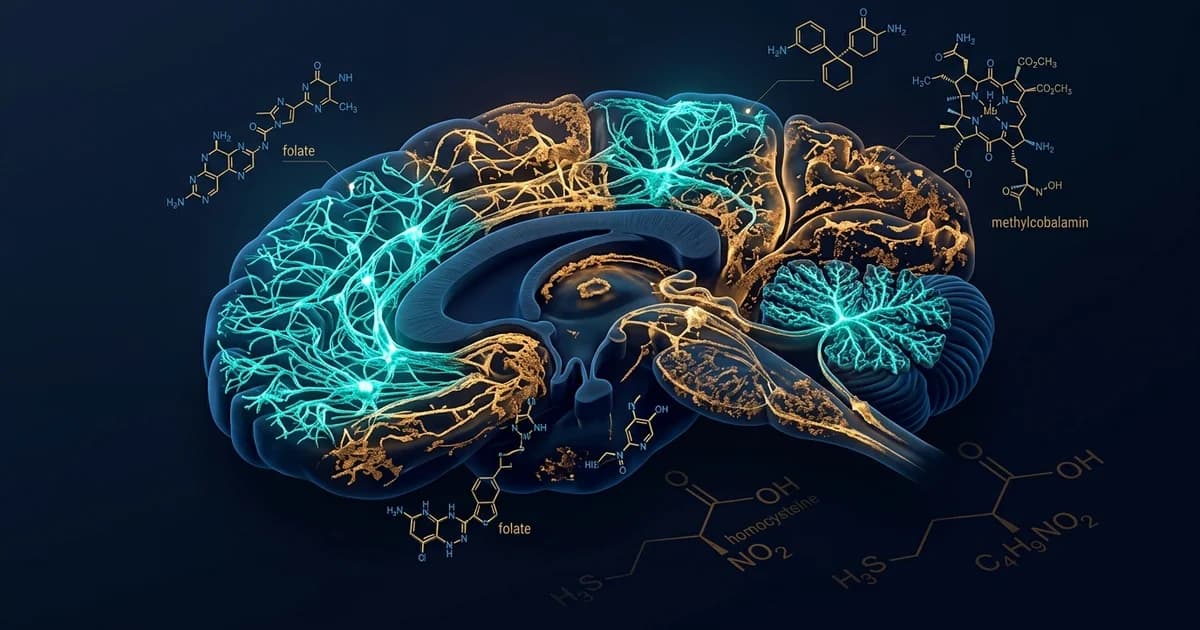
A blood marker most people never check may track how fast their brain is shrinking. That marker is homocysteine, an amino acid your body makes during normal metabolism. When it climbs too high, the link between homocysteine and brain aging gets hard to ignore.
The VITACOG study put that link to a real test. Researchers at Oxford gave older adults with mild memory problems a high dose of B vitamins, watched their homocysteine fall, and then scanned their brains for two years. What they found reshaped how scientists think about a cheap, measurable risk factor for cognitive decline.
Here is the trial, the data, and what it actually means for your brain.
Key Takeaways
- Homocysteine is an amino acid that, at high levels, is associated with faster brain shrinkage and worse memory in older adults.
- The VITACOG trial tested whether B vitamins (folic acid, B12, B6) could slow that process in people with mild cognitive impairment.
- B vitamins lowered homocysteine and slowed the rate of whole-brain atrophy compared with placebo.
- The benefit was strongest in people who started with the highest homocysteine levels.
- B vitamins are not a treatment for dementia. They address one specific, testable risk factor.
What Homocysteine Actually Is
Homocysteine is a byproduct your cells produce when they process methionine, an amino acid from protein in your diet. Your body recycles it using three nutrients: folate (B9), vitamin B12, and vitamin B6.
When you run low on those vitamins, the recycling slows and homocysteine builds up in your blood. Levels are measured in micromoles per liter (µmol/L), and many labs treat anything above roughly 10 to 15 µmol/L as raised.
High homocysteine has long been studied as a risk marker for heart disease and stroke. The newer question is what it does upstairs.
The Link Between Homocysteine and Brain Aging
Higher homocysteine is consistently associated with smaller brain volume and worse cognition in older adults. This is one of the more reproducible findings in the brain-aging literature.
In a large neuroimaging analysis using data from the Alzheimer's Disease Neuroimaging Initiative, higher homocysteine was associated with thinner cortical gray matter across hundreds of participants. The cortex is where much of your memory, reasoning, and language processing lives, so thinning there matters.
Association is not causation, of course. Maybe high homocysteine shrinks the brain. Maybe a shrinking brain and rising homocysteine are both downstream of something else. To separate those possibilities, you need to lower homocysteine on purpose and see what happens. That is exactly what VITACOG did.
The VITACOG Study, Step by Step
The VITACOG study was a randomized, double-blind, placebo-controlled trial run out of the University of Oxford, led by David Smith and Helga Refsum. It enrolled older adults with mild cognitive impairment, the stage where memory slips are measurable but daily life is still mostly intact.
Half the participants took a daily tablet combining folic acid, vitamin B12, and vitamin B6 at doses well above typical dietary intake. The other half took a placebo, and neither side knew who got what.
Everyone got an MRI brain scan at the start and again two years later. The question was simple. Would lowering homocysteine with B vitamins change how fast the brain shrank?
What the Trial Measured
The headline outcome was the rate of whole-brain atrophy, meaning how much total brain volume was lost per year. Some brain shrinkage is normal with age. Accelerated shrinkage is one of the clearest physical signatures of cognitive decline heading toward dementia.
The researchers also tracked blood homocysteine and ran cognitive tests, so they could connect the chemistry to the scans to the memory scores.
What the VITACOG Study Found
In the 2010 VITACOG results, B vitamins lowered homocysteine and slowed the rate of brain atrophy compared with placebo. The treated group lost brain volume more slowly over the two years.
The effect was not uniform. It tracked closely with starting homocysteine. People who began the trial with the highest homocysteine levels got the largest benefit from the vitamins, while those with low baseline levels saw little change.
That dose-response pattern is what makes the result compelling. The vitamins did the most for exactly the people whose chemistry suggested they needed them most. A treatment that helps the high-risk group and barely touches the low-risk group is behaving like a targeted fix, not a random fluke.
The Follow-Up: Memory and Alzheimer-Related Regions
Later analyses from the same trial dug into where the brain was being protected. The team reported that B vitamins slowed shrinkage specifically in brain regions vulnerable to Alzheimer's disease, again concentrated in participants with higher homocysteine.
The story keeps developing. A 2025 metabolomics analysis of the VITACOG trial re-examined the blood chemistry to map which metabolic pathways the B vitamins were actually changing. Work like this helps explain the biology behind the brain scans rather than just the correlation.
How Strong Is the Evidence on Homocysteine and Cognitive Decline?
VITACOG is one trial, and one trial rarely settles a question. Larger B-vitamin studies in broader populations have produced mixed results, partly because they enrolled people whose homocysteine was not high to begin with.
That is the crux of the homocysteine cognitive decline debate. B vitamins appear to help the brain mainly when they have a problem to fix, which is raised homocysteine. Give them to people with normal levels and you would not expect much, and the data largely agree.
So the honest summary is this. Lowering homocysteine with B vitamins is a promising, biologically sensible strategy for a specific subgroup of older adults with both memory complaints and high homocysteine. It is not a proven dementia preventive for the general population.
Should You Get Your Homocysteine Tested?
A homocysteine blood test is inexpensive and widely available. If you are an older adult with memory concerns, or you simply want a fuller picture of your brain-health risk factors, it is a reasonable number to know.
Diet does a lot of the work. Folate-rich foods like leafy greens, legumes, and citrus, plus adequate B12 from animal products or supplements, help keep homocysteine in a healthy range. B12 deficiency is common in older adults and in people on plant-based diets, and it is a frequent reason homocysteine creeps up.
Talk to a clinician before starting high-dose B vitamins. The VITACOG doses were specific and supervised, and B6 in particular has an upper safe limit you should not casually exceed.
How Brain-Aging Inputs Compare
Here is a plain-language comparison of common levers people use for long-term brain health and short-term performance. Each does a different job.
| Approach | What it targets | Time frame | Evidence strength |
|---|---|---|---|
| B vitamins (folate, B12, B6) | Raised homocysteine, brain atrophy rate | Months to years | Strong in high-homocysteine subgroups (VITACOG) |
| Omega-3 (DHA) | Membrane health, possible pairing with B vitamins | Months to years | Moderate, promising in combination |
| Physical exercise | Blood flow, brain volume, mood | Weeks to years | Strong and broad |
| Sleep | Memory consolidation, clearance of waste | Nightly | Strong |
| Caffeine + L-theanine (e.g., Roon) | Acute focus and alertness | 5 to 10 minutes | Strong for short-term cognition, not brain aging |
The point of the table is the rightmost columns. B vitamins work on a slow, structural timescale. A focus aid works on a same-day timescale. They are not competitors. They answer different questions.
Frequently Asked Questions
What is homocysteine and why does it matter for the brain?
Homocysteine is an amino acid your body produces when it breaks down dietary protein. Folate, B12, and B6 help clear it. When those vitamins run low, homocysteine builds up, and raised levels are associated with faster brain shrinkage and worse memory in older adults. It is a measurable, modifiable risk marker, which is why researchers find it so interesting for brain aging.
What did the VITACOG study prove?
The VITACOG study showed that B vitamins lowered homocysteine and slowed the rate of whole-brain atrophy in older adults with mild cognitive impairment, compared with placebo. The benefit was largest in those who started with the highest homocysteine. It did not prove that B vitamins prevent dementia in everyone, but it provided strong evidence for a targeted effect.
Do B vitamins reduce brain atrophy for everyone?
No. In VITACOG, the slowdown in b vitamins brain atrophy tracked with baseline homocysteine. People with high starting levels benefited most, while those with normal levels saw little change. Larger trials in general populations have shown mixed results, likely because many participants did not have raised homocysteine to begin with.
Can lowering homocysteine improve memory?
The relationship between homocysteine memory and B vitamins is most apparent in people with both memory complaints and raised homocysteine. In that group, lowering homocysteine has been linked to slower decline on some cognitive measures. For people with normal homocysteine, adding more B vitamins is not expected to sharpen memory.
What is a healthy homocysteine level?
Many labs consider levels under about 10 to 15 µmol/L to be in a normal range, though reference ranges and clinical targets vary. Some researchers studying brain aging argue for lower targets. A clinician can interpret your result alongside your B12 and folate status and overall risk profile.
How do I lower my homocysteine naturally?
Eat folate-rich foods like leafy greens, beans, and citrus, and get enough B12 from animal foods or a supplement. Address B12 deficiency, which is common with age and on plant-based diets. Limiting heavy alcohol use and not smoking also help. For high-dose B-vitamin protocols like the one in VITACOG, work with a clinician.
Is the VITACOG study still considered valid?
Yes, it remains a frequently cited landmark trial in the field. Researchers continue to analyze its data, including a 2025 metabolomics re-analysis that examined the metabolic pathways behind the results. As with any single trial, its conclusions are interpreted alongside the broader, sometimes mixed, body of B-vitamin research.
The Bottom Line on Homocysteine and Your Brain
Homocysteine is a rare thing in brain health: a risk factor you can measure with a cheap blood test and influence with diet and well-studied vitamins. VITACOG showed that when homocysteine is high, lowering it with B vitamins can slow the brain's physical decline, at least in older adults already showing memory changes.
It is not a cure, and it is not for everyone. The lesson is more useful than that. Know your number, fix it if it is high, and treat long-term brain structure as something you maintain over years, not days.
Where Slow Inputs End and Fast Ones Begin
The VITACOG story is about the slow lane: structural brain health measured over years, driven by nutrients and tested with MRI scans. That is the right way to think about aging well. It is also a separate question from how clearly you can think this afternoon.
Roon lives in that second lane. It is a zero-nicotine sublingual pouch with four ingredients, 80 mg caffeine, 60 mg L-theanine, 25 mg methylliberine (Dynamine), and 5 mg theacrine (TeaCrine), built for fast, steady focus. It absorbs in 5 to 10 minutes and is designed for 6 to 8 hours of clean attention with no jitters, no crash, and no tolerance buildup.
To be clear, Roon is not a brain-aging intervention and it is not a substitute for B vitamins, good sleep, or a homocysteine test. It does one job, sharpening your focus when you need it now. If you want the deeper science on the nutrients behind long-term brain health, our guide to B vitamins and cognition is the better next read. Try Roon when the task is today, and keep the blood work for the decade.
Written by Roon Team