Ginkgo vs Bacopa: Blood Flow or Acetylcholine for Memory?
Roon Team
Ginkgo vs Bacopa: Blood Flow or Acetylcholine for Memory?
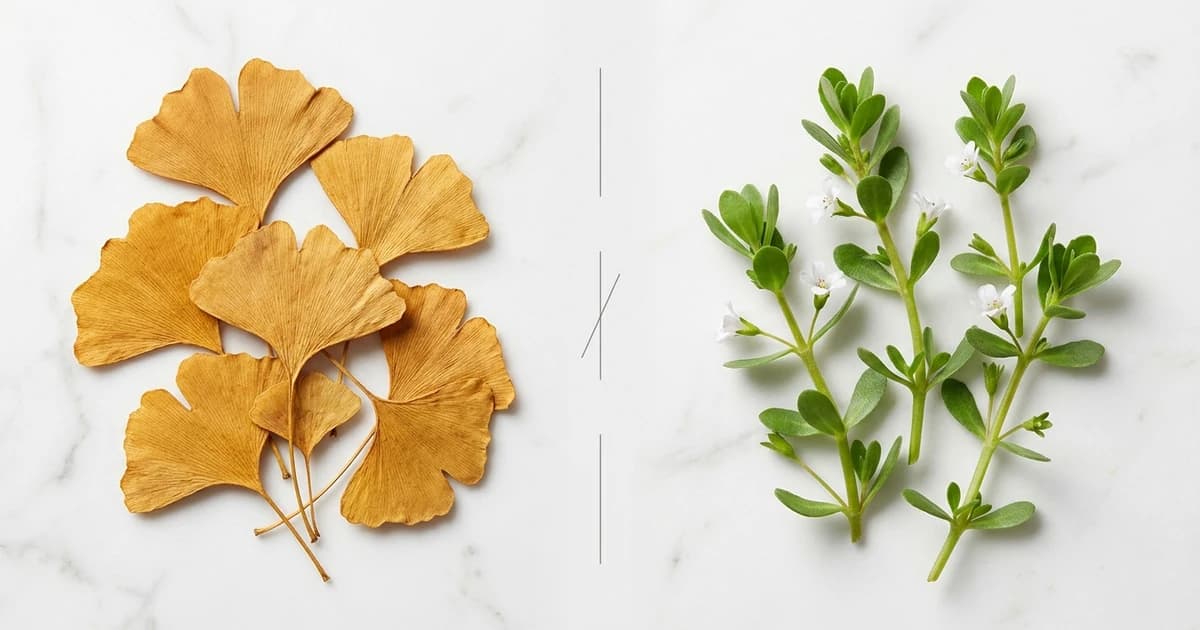
The ginkgo vs bacopa debate usually gets framed as "which herb is better for memory," and that question misses the point. These two plants do different jobs through different biology. Ginkgo works on circulation. Bacopa works on your brain's chemical messengers and the structure of your neurons.
One comes from traditional Chinese medicine. The other is a staple of Ayurveda. Both have been studied in real human trials, with real results and real limits.
This is a head-to-head on mechanism, evidence, timeline, and who each one actually suits. No hype, just what the data supports.
Key Takeaways
- Ginkgo biloba is a blood-flow play. It supports cerebral circulation and oxygen delivery, with the strongest evidence in older adults and people with cognitive decline.
- Bacopa monnieri is an acetylcholine and neuron-structure play. Its bacosides support memory consolidation, with the best evidence for delayed recall in healthy adults.
- Both are slow burners. You measure their effects in weeks and months, not minutes.
- Neither herb fixes acute focus or reaction time on demand. That is a separate problem with a separate solution.
Ginkgo vs Bacopa: The Two-Sentence Answer
If you want a memory herb backed by stronger trial data in healthy adults, Bacopa monnieri is the better-supported choice, especially for verbal learning and delayed recall after 8 to 12 weeks of daily use. Ginkgo biloba is the better fit if your concern is age-related cognitive decline and brain circulation, where its evidence is strongest.
That is the short version of the bacopa vs ginkgo memory question. The longer version depends on how each one works, so let's look at the biology.
How Ginkgo Works: The Blood Flow Hypothesis
Ginkgo's main mechanism is vascular. Its standardized extract, usually labeled EGb 761, contains flavonoid glycosides and terpene lactones that support blood vessel tone and help maintain healthy cerebral circulation.
The logic is simple. Better blood flow means better oxygen and glucose delivery to brain tissue. Ginkgo also acts as an antioxidant and influences platelet activity, which is part of why it has been studied so heavily in aging populations.
The evidence is real but narrow. A meta-analysis of EGb 761 for dementia found that the extract showed benefits for cognition and daily function in people with dementia and cognitive impairment, particularly at higher doses. A separate systematic review of ginkgo in dementia reported inconsistent results across trials, which is the recurring theme with this herb.
Here is the honest part. For prevention in healthy people, the picture is weak. A large systematic review on ginkgo for dementia prevention did not find convincing evidence that it stops cognitive decline before it starts. Ginkgo helps most where there is already a circulation-related deficit to address.
How Bacopa Works: The Acetylcholine Hypothesis
Bacopa's main mechanism is neurochemical. Its active compounds, called bacosides, support the cholinergic system, meaning they influence acetylcholine, the neurotransmitter most tied to learning and memory.
Acetylcholine is central to how you encode new information. Many memory-supporting drugs work by slowing its breakdown, and bacopa appears to support cholinergic signaling through a gentler, food-based route.
There is a structural angle too. Preclinical research suggests bacosides promote dendritic branching, the growth of connection points between neurons in memory-related brain regions. More connections, better consolidation. That helps explain why bacopa's effects build slowly rather than hitting you in an afternoon.
The human evidence is where bacopa pulls ahead for everyday users. A systematic review of randomized controlled trials by Pase and colleagues concluded that bacopa improved memory in healthy adults, with the most consistent effect on delayed recall. A 12-week placebo-controlled trial in older adults found that 300 mg per day of standardized extract improved delayed recall on the Rey Auditory Verbal Learning Test compared to placebo.
That word, delayed recall, matters. It means remembering something later, which is the part of memory most people actually care about.
Ginkgo or Bacopa Monnieri: Side-by-Side
Here is the herbal memory comparison in one view, with an acute-focus option included for contrast.
| Factor | Ginkgo Biloba | Bacopa Monnieri | Roon (for contrast) |
|---|---|---|---|
| Tradition | Chinese medicine | Ayurveda | Modern nootropic stack |
| Primary mechanism | Cerebral blood flow, antioxidant | Acetylcholine support, dendritic growth | Caffeine + L-theanine + Dynamine + TeaCrine |
| Best-supported benefit | Cognition in dementia and decline | Delayed recall in healthy adults | Acute attention and reaction time |
| Typical dose | 120 to 240 mg standardized extract | 300 mg standardized extract | 1 pouch |
| Time to effect | Weeks | 8 to 12 weeks | 5 to 10 minutes |
| Strongest population | Older adults | Healthy adults, students | Anyone needing focus now |
| What it does not do | Acute focus | Acute focus | Long-term memory consolidation |
The pattern is clear. Ginkgo and bacopa are both long-horizon tools. They reward consistency over weeks. Neither is something you take before a meeting and feel within the hour.
Ayurvedic vs Chinese Memory Herb: Which One Fits You
The ayurvedic vs chinese memory herb choice comes down to your goal and your age.
Choose bacopa if you are a healthy adult or student who wants stronger learning and recall, you can commit to daily dosing for at least two to three months, and you want the better trial data for non-dementia populations.
Choose ginkgo if your concern is age-related cognitive support, brain circulation, or you are older and want a herb with a long history of use in that population.
Some people stack both, since the mechanisms do not overlap. One supports the plumbing, the other supports the wiring and the chemistry. If you go that route, use standardized extracts and give it a full season before judging the result.
A note on safety. Ginkgo can affect platelet function, so if you take blood thinners or are heading into surgery, talk to a doctor first. Bacopa commonly causes mild digestive upset when taken on an empty stomach, which is why most people take it with food.
What Neither Herb Solves: The Best Memory Herb Is Not a Focus Tool
This is the part most articles skip. The best memory herb in the world will not sharpen your attention in the next ten minutes.
Bacopa needs months to remodel your neurons. Ginkgo needs weeks to influence circulation. Both work on the slow, structural side of cognition. That is a feature, not a flaw, but it means they answer a different question than "how do I focus right now."
Acute focus is a stimulant-and-balance problem, not a botanical-memory problem. If you need to lock in for a deadline, a study block, or a long drive, you are looking for fast onset and clean energy, not a 12-week consolidation curve. Keep those two needs separate and you will pick the right tool every time.
Conclusion
Ginkgo and bacopa are not really competitors. They are specialists. Ginkgo supports the brain's blood supply and has its strongest case in older adults and cognitive decline. Bacopa supports acetylcholine and neuron structure, with the cleaner evidence for memory in healthy adults.
Pick based on your goal. If you are young and healthy and want better recall, bacopa has the data. If circulation and aging are your concern, ginkgo earns its place. Both demand patience, because memory is built slowly and there is no shortcut around that biology.
What neither herb does is fix focus on demand. That is a different timeline and a different tool entirely.
Frequently Asked Questions
Which is better for memory, ginkgo or bacopa?
For healthy adults wanting better learning and recall, bacopa has the stronger human evidence, especially for delayed recall after 8 to 12 weeks. Ginkgo's best support is in older adults and people with cognitive decline, where its blood-flow mechanism matters most. Your age and goal decide the winner, not a single ranking.
How long does bacopa take to work?
Plan on 8 to 12 weeks of daily use at 300 mg of a standardized extract. The 12-week trial that showed delayed-recall benefits ran the full period before measuring results. Bacopa works by supporting neuron structure and acetylcholine, which is a gradual process, so do not expect a same-day effect.
Can I take ginkgo and bacopa together?
Yes, many people do, since the mechanisms do not overlap. Ginkgo supports circulation while bacopa supports acetylcholine and neuron connections. Use standardized extracts, take bacopa with food to avoid stomach upset, and check with a doctor first if you take blood thinners, because ginkgo can affect platelet activity.
Does ginkgo work for healthy young people?
The evidence is weak here. Ginkgo's strongest results come from older adults and those with existing cognitive decline, where impaired circulation is part of the problem. Reviews on using ginkgo to prevent decline in healthy people have not found convincing benefits, so a young, healthy person may see little from it.
Is bacopa or ginkgo better for studying?
Bacopa fits studying better because it supports the memory consolidation that learning depends on, and its trial data centers on healthy adults. The catch is time. You need to start it weeks before you need it. Neither herb gives you the immediate attention boost most students want during a single study session.
Are these herbs safe to take daily?
Both have long histories of daily use at standard doses. Bacopa's most common side effect is mild digestive upset, easily reduced by taking it with food. Ginkgo can influence platelet function, which matters if you use blood thinners or face surgery. As with any supplement, talk to your doctor if you take medication or have a health condition.
Where Slow Herbs End and Fast Focus Begins
Bacopa and ginkgo are long-game memory tools. You take them for weeks to support recall and brain circulation, and that patience is the whole point. They were never built to help you concentrate in the next ten minutes.
That acute window is exactly where Roon does its job. It is a zero-nicotine sublingual pouch with a four-ingredient stack, 80 mg caffeine, 60 mg L-theanine, 25 mg methylliberine (Dynamine), and 5 mg theacrine (TeaCrine), designed for a 5 to 10 minute onset and 6 to 8 hours of focus with no jitters, no crash, and no tolerance buildup. Different job, different timeline.
To be clear, Roon is not a memory herb and it will not replace months of bacopa or ginkgo for long-term recall. It handles the part those herbs cannot: focus and reaction time when you need them now. If you want sustained attention for a deadline or a study block, try Roon for the moments that demand it, and let the botanicals handle the slow build.
Written by Roon Team