The Neurochemistry of Flow State: What Happens in Your Brain "In the Zone"
A surgeon loses track of four hours in the operating room. A guitarist forgets the crowd exists. A coder looks up and the afternoon is gone. They are all describing the same thing, and flow state neuroscience has spent two decades figuring out what their brains were actually doing.
The short version surprises most people. Flow is not your brain working harder. It is large parts of your brain going quiet so the rest can fire cleanly.
That quieting has a name, a chemistry, and a set of conditions you can engineer. Here is what happens when you slip into the zone.
Key Takeaways
- Flow is driven by transient hypofrontality, a temporary dial-down of the prefrontal cortex rather than a ramp-up of effort.
- The part that goes offline includes the dorsolateral prefrontal cortex, the seat of your inner critic and your sense of time.
- A cocktail of dopamine, norepinephrine, endorphins, anandamide, and serotonin drives focus, pattern recognition, and reward during flow.
- Flow lives in a narrow band of arousal: enough drive to engage, not so much that the inner critic comes back online.
What Happens in the Brain During Flow
During flow, your brain selectively shuts down regions that handle self-monitoring and conscious control, then floods the focused circuits with performance neurochemicals. That trade is the whole trick.
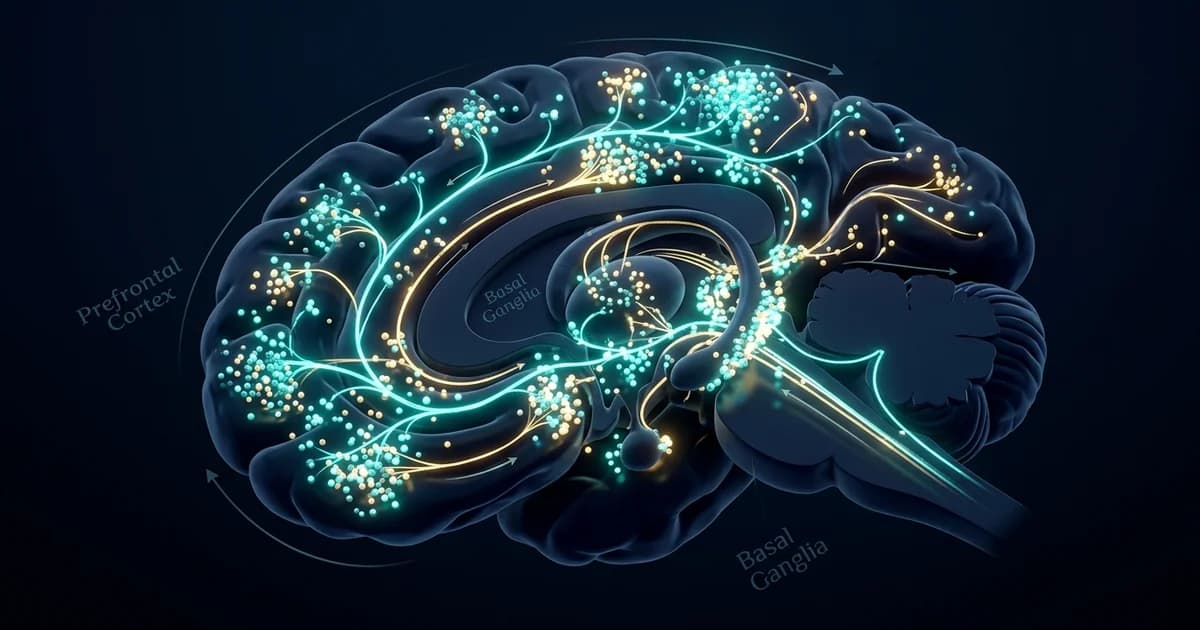
For years, researchers assumed peak performance meant peak brain activity everywhere. The opposite turned out to be true. Neuroscientist Arne Dietrich proposed that intense focus forces the brain to ration its limited attention, and the first system to get throttled is the energy-hungry prefrontal cortex. He called it transient hypofrontality.
Research on the transient hypofrontality hypothesis describes a temporary downregulation of the prefrontal cortex, the region that handles self-monitoring, planning, and decision-making. With those functions dimmed, you get full immersion without the second-guessing.
The same source notes this drop in prefrontal activity can also loosen cognitive inhibition, which is why people often feel more spontaneous and creative once they are in the zone.
Why "The Zone" Feels Like You Disappear
The signature feeling of flow, that sense of losing yourself and losing track of time, comes straight from one structure going quiet: the dorsolateral prefrontal cortex.
Flow researcher Steven Kotler puts it plainly. Speaking to IFLScience, he describes the dorsolateral prefrontal cortex as the part of the brain that houses your inner critic, the nagging, defeatist voice in your head, and explains that it switches off in flow. The result, he says, is a feeling of liberation as you get out of your own way.
Time distortion has the same root. According to Neurosity's breakdown of flow, the dorsolateral prefrontal cortex tracks time intervals and maintains your awareness of duration, and its activation drops during flow. Without that internal clock, the minutes stop registering.
That explains the surgeon and the guitarist. There was no clock running, because the part of the brain that watches the clock had clocked out.
Flow State Brain Chemistry: The Five Neurochemicals
Flow runs on five performance chemicals released in sequence: norepinephrine, dopamine, endorphins, anandamide, and serotonin. Each one does a specific job, and together they produce the focus and reward that make flow feel so good.
Kotler has called this the most potent neurochemical cocktail the brain produces. His framework describes dopamine, norepinephrine, anandamide, serotonin, and endorphins releasing during deep flow, which accounts for both the performance boost and the addictive pull of the state.
Here is how the flow state dopamine norepinephrine pairing works on the front end. In a Big Think interview, Kotler explains that norepinephrine and dopamine tighten focus so you take in more information per second, and they lower the signal-to-noise ratio so you detect more patterns. That is the engine of being "switched on."
| Neurochemical | Primary role in flow | When it shows up |
|---|---|---|
| Norepinephrine | Sharpens attention, raises arousal | Front end, at flow onset |
| Dopamine | Drives motivation and focus, boosts pattern recognition | Front end, during the task |
| Endorphins | Mask discomfort, add pleasure | During flow |
| Anandamide | Supports lateral, creative connections | During flow |
| Serotonin | Produces the calm afterglow | Post-flow |
There is harder physiology behind the headline. The MindLab summary notes that salivary alpha-amylase, a proxy for norepinephrine, peaks predictably at flow onset. In plain terms, a measurable spike in arousal chemistry marks the doorway into the zone.
The Arousal Window: Why Flow Is So Hard to Force
Flow only appears inside a narrow band of nervous-system arousal. Too little and you drift toward boredom. Too much and anxiety drags your inner critic back online. Hit the middle and the prefrontal cortex can quiet down on schedule.
This is the modern read on Csikszentmihalyi's classic challenge-skill balance. The task has to stretch you slightly past your current ability. Easy work bores you. Overwhelming work spikes stress, and a stressed prefrontal cortex stays loud rather than going quiet.
That tension explains why "just focus harder" backfires. Cranking up effort raises arousal, and past a certain point it blocks the very hypofrontality that flow depends on. The goal is not maximum drive. It is the right drive.
It also explains why caffeine alone can be a blunt instrument. A double espresso under deadline pressure can push you straight past the flow window into jittery over-arousal, where the inner critic is wide awake and pattern recognition suffers.
How Flow Compares to Ordinary Focus
Flow is not the same as plain concentration, and the brain states behind them differ.
| Ordinary focus | Flow state | |
|---|---|---|
| Prefrontal cortex | Fully active, self-monitoring | Selectively downregulated |
| Sense of time | Intact, you watch the clock | Distorted, time vanishes |
| Effort | Feels effortful | Feels automatic |
| Inner critic | Present, often loud | Quiet |
| Reward chemistry | Mild | Strong, five-chemical cascade |
The practical upshot: you cannot white-knuckle your way into flow. You set the conditions and let the brain do the rest. If you want the mechanics of building those conditions, our guide to building focus without burnout covers the daily habits that make flow more reachable.
Can You Train Your Brain for More Flow?
You cannot summon flow on command, but you can stack the odds. The research points to a clear set of levers.
- Pick a task at the edge of your skill. Slightly hard beats easy or impossible.
- Remove interruptions. Every notification reboots the prefrontal cortex you are trying to quiet.
- Build a pre-task ritual. Consistent cues prime the brain to drop into focus faster.
- Manage your arousal, not just your willpower. Aim for calm alertness, not maximum stimulation.
- Protect a long enough runway. Flow onset takes time; most people need a clear block, not a fragmented one.
The fourth lever is the one most people get wrong, and it is where brain chemistry meets daily practice.
Conclusion
Flow is less about pushing and more about getting out of the way. Your brain dials down the prefrontal regions that monitor, judge, and track time, then releases a sequence of focus and reward chemicals that let you operate at the edge of your ability without friction.
The state is reliable but conditional. It needs a task that stretches you, an environment free of interruption, and a nervous system tuned to the narrow band between bored and overwhelmed. Master those conditions and the zone stops feeling like luck. It starts feeling like a setting you can reach.
Frequently Asked Questions
What is transient hypofrontality?
Transient hypofrontality is the temporary downregulation of the prefrontal cortex during states like flow, exercise, and meditation. Neuroscientist Arne Dietrich coined the term to describe how the brain rations its limited attention by quieting the energy-hungry prefrontal regions that handle planning and self-monitoring. With those functions dimmed, you get deep immersion in a task without the constant internal commentary that usually accompanies conscious effort.
Which brain chemicals are involved in flow state?
Flow involves five main neurochemicals: norepinephrine and dopamine on the front end for attention and pattern recognition, endorphins and anandamide during the experience for pleasure and creative connection, and serotonin afterward for the calm afterglow. This combination drives both the performance boost and the rewarding, almost addictive quality that makes people want to find flow again.
Why do I lose track of time in the zone?
You lose track of time because the dorsolateral prefrontal cortex, which normally tracks duration, goes quiet during flow. Without that internal timekeeper running, the brain has no scaffolding to register minutes passing. Time does not feel slow or fast; it simply drops out of your experience until you resurface and notice hours have gone by.
Is flow state the same as concentration?
No. Ordinary concentration keeps the prefrontal cortex fully active and self-monitoring, which is why it feels effortful and you stay aware of time. Flow involves selectively dialing that activity down, so focus feels automatic, the inner critic goes quiet, and a strong reward chemistry kicks in. Concentration is a tool you apply; flow is a state your brain falls into once conditions are right.
Can caffeine help or hurt flow?
It can do both. Moderate stimulation raises the arousal and drive that flow needs to begin. Too much pushes you past the window into jittery over-arousal, where stress keeps the prefrontal cortex loud and the inner critic stays awake. The sweet spot is calm alertness, which is why pairing caffeine with a calming compound like L-theanine tends to support focus better than caffeine alone.
How long does it take to enter flow?
Flow onset is not instant. Most people need a sustained, uninterrupted block of focused work before the prefrontal cortex begins to quiet and the neurochemistry shifts. This is why fragmented schedules full of meetings and notifications make flow nearly impossible: every interruption resets the process and forces your brain to start the climb over again.
Tuning the Arousal That Flow Requires
Everything above points to one practical bottleneck: flow needs the right arousal and a quiet inner critic, and most stimulants overshoot on the first while doing nothing for the second. A jittery, over-caffeinated brain is the opposite of a flow-ready brain.
That gap is what Roon is built to address. Each sublingual pouch pairs 80 mg of caffeine for drive with 60 mg of L-theanine for calm, alpha-supported alertness, plus 25 mg of methylliberine (Dynamine) and 5 mg of theacrine (TeaCrine) to extend the window. The combination supports the on-demand, calm attention that precedes flow without the over-arousal that blocks it, with a 5 to 10 minute onset and 6 to 8 hours of focus, no jitters, no crash, no tolerance buildup.
Roon will not hand you flow. No pouch can, because flow still depends on the right task, a clear block of time, and an interruption-free environment. What it can do is tune the nervous system toward the calm-focus band where the zone becomes reachable. Try Roon on a deep-work block and judge it by whether the inner critic stays quiet.
Written by Roon Team