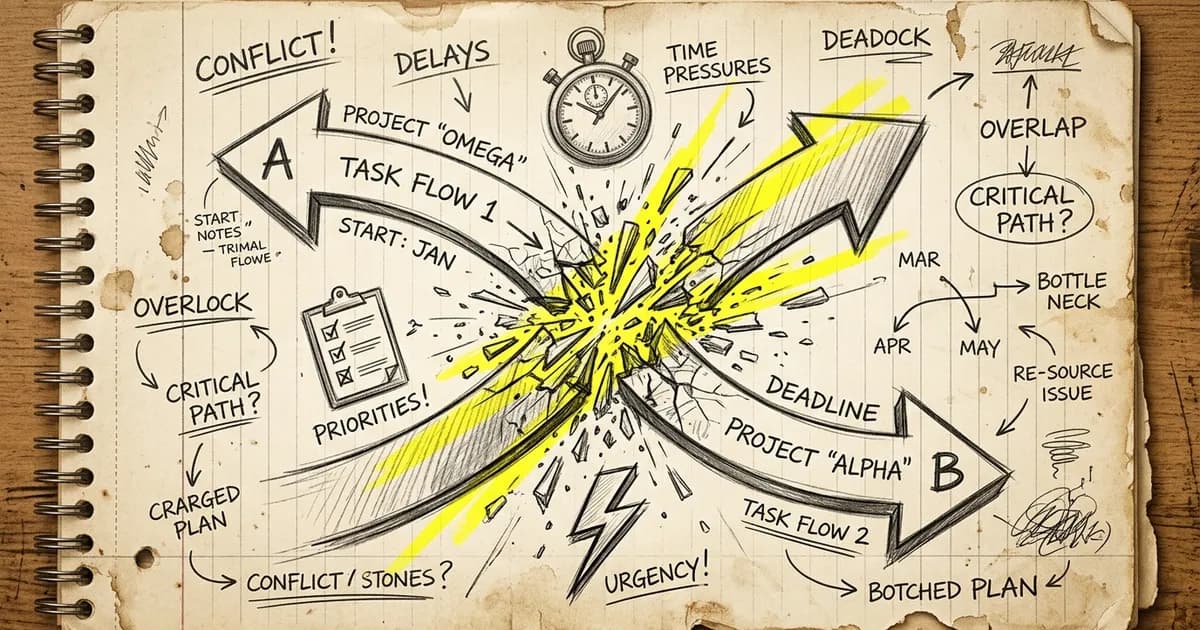
The Multitasking Myth: Why Your Brain Can't Actually Do Two Things at Once
You think you are answering an email while listening to the meeting. You are not.
So does multitasking work? For almost everyone, the honest answer is no. Your brain is not running two tasks in parallel. It is flipping between them, one at a time, fast enough to fool you into thinking you are doing both. Each flip carries a hidden tax, and that tax is bigger than you would guess.
This is the multitasking myth. The science behind it is clean, settled, and a little uncomfortable to read if you pride yourself on juggling six things at once.
Key Takeaways
- Your brain does not process two demanding tasks at the same time. It switches between them, and switching is not free.
- Research links chronic multitasking to measurable productivity loss, slower task completion, and more errors.
- Heavy media multitasking is associated with structural and performance differences in attention-related brain regions.
- True "supertaskers" who can multitask without a penalty are rare, roughly 1 in 40 people.
- The fix is not a trick. It is single-tasking and protecting blocks of uninterrupted focus.
Does Multitasking Work? What the Brain Actually Does
For complex tasks, multitasking does not work the way it feels like it does. Your prefrontal cortex handles one goal-directed task at a time, so when you "multitask," you are really task switching: dropping one task, loading the rules and context for another, then switching back.
That reloading is where the cost lives. Cognitive scientists call it task switching cost, and it shows up as lost time and lower accuracy every time you jump.
According to the American Psychological Association, even brief mental blocks created by shifting between tasks can cost as much as 40% of someone's productive time. That number is not a typo. Nearly half your working capacity can leak out through the cracks between tasks.
Switching is not instant. Each one requires "goal shifting" (deciding to do the new thing) and "rule activation" (turning off the old task's rules and turning on the new ones). Do that hundreds of times a day and the small costs compound into hours.
Why Multitasking Hurts Focus More Than You Realize
Multitasking hurts focus because the residue of the last task does not clear out cleanly. When you switch from a spreadsheet to a Slack message and back, part of your attention is still stuck on the spreadsheet. Psychologists call this attention residue, and it quietly drags down whatever you do next.
There is also a quality cost, not just a speed cost. You make more mistakes. You miss details. You re-read the same paragraph three times because your attention keeps fragmenting.
And the feeling of productivity is the trap. Switching tasks gives you a small hit of novelty that feels like momentum, even while your actual output drops. You feel busy. You are not being effective.
The Media Multitasking Brain
Heavy media multitasking, the kind where you watch a video, text, and scroll at once, is linked to worse attention control, not better. The people who do it most are often the worst at filtering out distraction.
A widely cited Stanford study found that heavy media multitaskers performed worse on tests of filtering irrelevant information and switching between tasks than people who rarely multitasked across media. The habit did not build a stronger switching skill. It correlated with a weaker one.
The brain structure findings are harder to shrug off. A study published in PLOS ONE reported that people with higher media multitasking activity had smaller gray-matter density in the anterior cingulate cortex, a region tied to attention and emotional control. As coverage by ScienceDaily explained, the study was correlational, so it cannot prove media multitasking shrinks that region. It is a flag, not a verdict.
Still, the direction is consistent across the research. The media multitasking brain is not a more capable brain. It is a more distractible one.
Can You Multitask? The Rare Exception
Can you multitask without paying the price? Statistically, almost certainly not. A small fraction of people, called "supertaskers," appear to handle two demanding tasks at once without measurable decline.
Research from the University of Utah, reported by CBS News, found that only about 2.5% of people could safely drive while on the phone without performance dropping. That is roughly 1 in 40. The other 39 think they can, and they are wrong.
Here is the uncomfortable part. The people most confident in their multitasking are often the ones who do it most, and they tend to perform worse, not better. Confidence is not the same as capacity.
Single-Tasking vs. Multitasking: The Honest Comparison
The data points one direction. Doing one thing at a time, on purpose, beats spreading your attention thin.
| Approach | What your brain does | Speed | Error rate | Sustained focus |
|---|---|---|---|---|
| Multitasking | Rapid task switching with attention residue | Slower overall | Higher | Poor, fragmented |
| Single-tasking | One goal-directed task at a time | Faster on complex work | Lower | Strong, sustained |
| Batching similar tasks | Fewer context switches per hour | Faster than mixed switching | Lower | Good |
| Background autopilot tasks | Pairing one automatic task with one focused one (e.g. walking + thinking) | Neutral | Low | Workable |
The last row matters. You can genuinely pair a fully automatic task, like walking, with a thinking task. The myth only applies to two tasks that both demand your prefrontal cortex.
How to Stop Multitasking Without Forcing It
The repair is structural, not motivational. You do not need more willpower. You need fewer chances to switch.
- Work in protected blocks. Pick one task and give it 45 to 90 minutes with notifications off. This is the core of deep work, and it is where your best thinking happens.
- Batch the small stuff. Answer email and messages in two or three windows a day instead of all day.
- Close the loop before switching. Finish a thought or jot down where you are before you move on. This shrinks attention residue.
- Make distraction harder than focus. Phone in another room. One browser tab. The friction does the work for you.
The goal is not heroic concentration. It is removing the conditions that pull you into switching in the first place.
The Real Cost of Believing the Myth
Multitasking is not a skill you are bad at. It is a thing the human brain mostly cannot do for demanding work. What feels like doing two things at once is your attention sprinting back and forth, dropping bits of performance with every lap.
Single-tasking is slower in feel and faster in fact. You finish sooner, make fewer mistakes, and end the day less drained, because you stop paying the switching tax over and over.
The smartest workers are not the ones juggling the most. They are the ones who protect one thing at a time and let their full attention land on it.
Frequently Asked Questions
Does multitasking work for simple tasks?
Sometimes, yes. You can pair a fully automatic task, like walking or folding laundry, with a thinking task, because the automatic task does not compete for your prefrontal cortex. The myth applies to two tasks that both need active attention. Two demanding tasks at once will slow you down and raise your error rate, even if it feels efficient in the moment.
What is task switching cost?
Task switching cost is the time and accuracy you lose every time you shift from one task to another. Your brain has to disengage from the old task, load the rules and context for the new one, then do it again on the way back. These costs feel tiny, but the American Psychological Association notes they can add up to as much as 40% of your productive time.
Why does multitasking feel productive if it isn't?
Switching tasks delivers a small hit of novelty and stimulation that registers as momentum. You feel busy and engaged. But that feeling tracks activity, not output. Studies consistently show that people who multitask heavily complete complex work more slowly and with more errors, even while reporting that they feel highly productive. The feeling is real. The productivity is not.
Is the media multitasking brain permanently changed?
The honest answer is we do not know. A PLOS ONE study found that heavy media multitaskers had smaller gray-matter density in an attention-related brain region, but the research is correlational. It cannot prove the habit caused the difference. Attention is also trainable, so reducing media multitasking and practicing focused attention is a reasonable response either way.
Can you multitask if you are a supertasker?
A rare group, about 2.5% of people per University of Utah research reported by CBS News, can handle two demanding tasks without a measurable drop. The problem is self-assessment. The people most confident they are supertaskers usually are not, and they perform worse than they think. Assume you are in the 97.5% and plan accordingly.
How long does it take to refocus after an interruption?
Longer than most people expect. After switching away from a task, part of your attention stays stuck on the previous one, an effect called attention residue. Even short interruptions can require several minutes to fully recover focus on demanding work. This is why protecting uninterrupted blocks matters more than working faster.
What is the single best fix for multitasking?
Single-tasking inside protected time blocks. Pick one task, kill your notifications, and work on it alone for a set stretch. Batch the small interruptions like email into a few windows a day. The point is to remove the chances to switch, not to white-knuckle your way through distraction with willpower.
The Focus a Single-Task Block Actually Needs
If the science says anything practical, it is this: stop trying to do two things at once, and start protecting one thing at a time. The hard part is not understanding that. It is holding attention steady through a 60 or 90 minute block without your mind drifting toward the next tab.
That is the gap Roon is built for. It is a zero-nicotine sublingual pouch with four ingredients, 80 mg caffeine, 60 mg L-theanine, 25 mg methylliberine (Dynamine), and 5 mg theacrine (TeaCrine), designed for a 5 to 10 minute onset and 6 to 8 hours of steady focus with no jitters and no crash. It supports the sustained attention that single-tasking demands.
Roon is not a substitute for the habits. It will not block your notifications or batch your email for you, and it cannot turn anyone into a supertasker. It is the layer that makes a protected focus block easier to hold. Pair it with the structure, and try Roon when your next deep block actually matters.
Written by Roon Team