Creatine for Vegetarians and Vegans: The Group That Responds Most
Your muscles run on creatine. So does your brain. And if you don't eat meat, you're walking around with less of it than the person next to you.
That single fact explains one of the most interesting findings in cognitive nutrition. When researchers study creatine for vegetarians cognition, the people who eat the least dietary creatine tend to show the biggest mental gains when they supplement. The headline name here is Rae 2003, a small but tidy study that put numbers to the idea. Vegetarians and vegans were not the exception in the data. They were the main event.
This article breaks down what Rae actually measured, why a meat-free diet leaves your brain short, and what the follow-up research found.
Key Takeaways
- Vegetarians and vegans eat almost no dietary creatine, so their baseline stores sit lower than meat eaters'.
- The rae 2003 creatine study reported gains in working memory and reasoning speed after six weeks of supplementation.
- Later work, including Benton and Donohoe (2011), found the memory benefit showed up in vegetarians but not in omnivores.
- Lower baseline equals bigger response. That is the core logic behind the low creatine diet cognition link.
Why a Meat-Free Diet Leaves Your Brain Short on Creatine
Creatine is not just a sports supplement. Your body makes about half of what it needs in the liver, kidneys, and pancreas, and you get the rest from food, mostly red meat and fish.
Plants contain essentially none. According to VeganHealth.org, vegetarians take in roughly 0.03 grams of creatine per day from diet, while omnivores get close to 1 gram. That is a thirtyfold gap before anyone touches a supplement.
The brain keeps its own creatine pool and uses it to recycle ATP, the molecule that powers every neuron. When demand spikes during a hard mental task, creatine helps refill energy fast. A smaller starting reserve means less buffer when you need it most. This is the foundation of the creatine vegan brain discussion, and it is why the supplement appears to do more for people who start with less.
The Rae 2003 Study, Broken Down
Rae and colleagues ran a double-blind, placebo-controlled crossover trial in vegetarians and vegans, published in the Proceedings of the Royal Society B. The design matters. Each participant served as their own control, taking both creatine and placebo across two arms with a washout in between.
Participants took 5 grams of creatine monohydrate per day for six weeks. The team then tested two things that load heavily on mental energy: working memory and reasoning under time pressure.
The results pointed in one direction. On a backward digit span task, a classic measure of working memory, performance improved during the creatine phase. On Raven's Advanced Progressive Matrices, a test of fluid reasoning done against the clock, scores rose as well. The placebo phase did not produce the same lift.
Here is the part worth sitting with. The participants were vegetarians and vegans on purpose. Rae picked the group most likely to respond, and they did. That choice turned the study into one of the cleaner demonstrations of creatine working memory vegetarians effects in the literature. You can find the paper and its details indexed on PubMed.
What the Study Did Not Claim
The trial was small, and the effects were specific to demanding, time-pressured tasks. Rae did not show that creatine makes everyone smarter, and it did not test meat eaters head to head. It showed that in a low-creatine population, topping up the tank helped on hard cognitive work.
The Follow-Up: Benton and Donohoe (2011)
If Rae raised the hypothesis, Benton and Donohoe tested it against the obvious control group: people who already eat meat.
Their trial, published in the British Journal of Nutrition, compared vegetarians and omnivores after a five-day creatine protocol. The finding was direct. Memory recall task performance was better in vegetarians in the creatine condition than meat eaters in the creatine condition, but no difference in memory task performance was observed in the placebo condition. You can read the study on PubMed.
In plain terms, creatine helped the people who needed it and did little for the people who were already topped up. That is the pattern you would predict if baseline stores drive the response.
This is also where the creatine vegan brain story gets its strongest support. Two independent teams, two designs, one conclusion: the less creatine your diet supplies, the more a supplement appears to give your memory.
Who Responds Most? A Quick Comparison
The likely response to supplementation tracks closely with how much creatine your diet already provides.
| Group | Dietary creatine intake | Baseline body stores | Expected cognitive response |
|---|---|---|---|
| Vegans | Near zero | Lowest | Largest |
| Vegetarians | Very low (~0.03 g/day) | Low | Large |
| Light meat eaters | Moderate | Moderate | Small to moderate |
| Heavy meat eaters | High (~1 g/day) | High | Minimal |
The table is a model, not a guarantee. Individual genetics and brain creatine transport vary. But the gradient is consistent across the research, and it is the simplest way to understand the low creatine diet cognition relationship.
What This Means If You Don't Eat Meat
A direct answer: if you are vegetarian or vegan, you are the population most likely to notice a cognitive change from creatine. The science does not promise it, but the odds favor you more than anyone else.
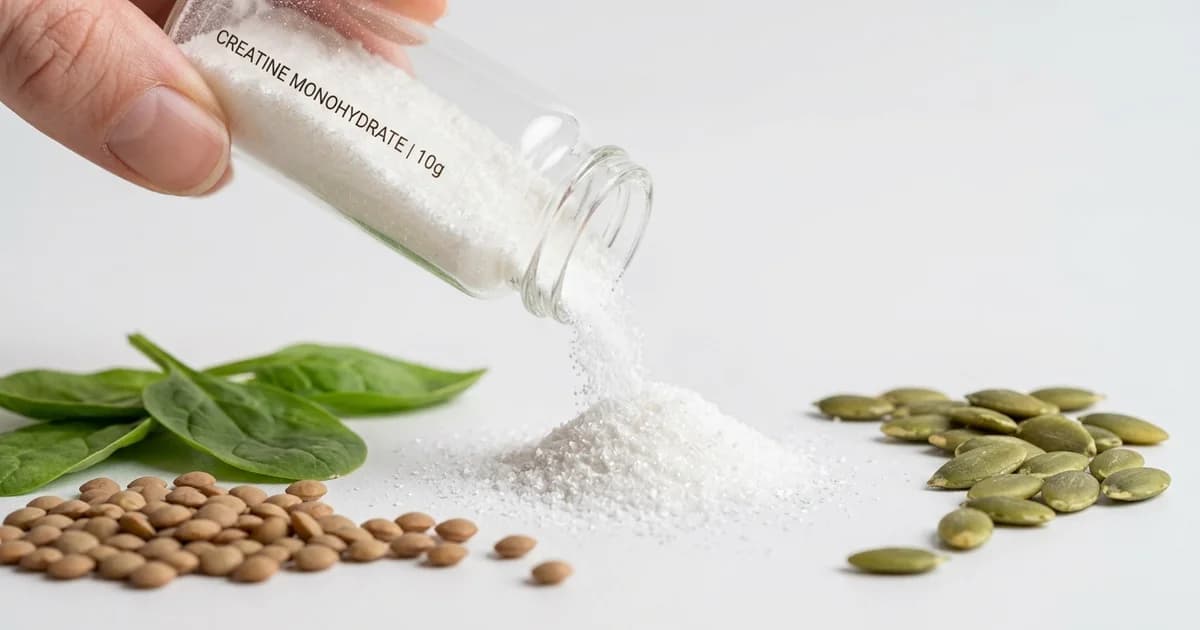
The standard maintenance dose used in cognition research is around 3 to 5 grams per day. Creatine monohydrate is the form studied in nearly all of this work, including Rae's trial. It is cheap, widely available, and unflavored.
One caveat on expectations. These studies measured effort-heavy tasks like rapid reasoning and short-term recall, not vague feelings of sharpness. The benefit, where it shows up, is most visible when your brain is working hard and burning energy fast. If you want a broader picture of how brain fuel affects focus, see our related breakdowns on cognitive energy and sustained attention.
Conclusion
The pattern across Rae 2003 and Benton and Donohoe 2011 is unusually clean for nutrition science. People with the lowest dietary creatine, vegetarians and vegans, show the clearest cognitive response when they supplement, while meat eaters who are already topped up show little.
The mechanism is not mysterious. Creatine helps your neurons recycle energy, and a diet without meat leaves that reserve running low. Fill the gap, and the brain appears to have more to draw on during hard mental work.
The takeaway is about matching the intervention to the deficit. Creatine is not a universal cognitive booster. It is a fuel top-up that helps most when the tank started near empty.
Frequently Asked Questions
Does creatine actually improve cognition in vegetarians?
In controlled studies, yes, on specific tasks. Rae 2003 reported gains in working memory and timed reasoning in vegetarians and vegans after six weeks. Benton and Donohoe 2011 found a memory benefit in vegetarians but not in meat eaters. The effect is most reliable for demanding, time-pressured tasks rather than general feelings of alertness, and it appears strongest in people with low dietary creatine intake.
How much creatine should a vegetarian take for brain benefits?
Cognition research generally uses 3 to 5 grams of creatine monohydrate per day. Rae's trial used 5 grams daily for six weeks. Brain creatine stores fill more slowly than muscle, so consistency over several weeks matters more than a single dose. Creatine monohydrate is the form used in nearly all of this research and is the most studied option available.
Why do vegetarians respond more than meat eaters?
Because they start with lower baseline creatine. Plants contain almost no creatine, so a meat-free diet supplies a fraction of what omnivores get. When baseline stores are low, supplementing fills a real gap. When stores are already high from a meat-heavy diet, there is less room to add, which is why omnivores show smaller cognitive responses in the data.
What did the Rae 2003 study test exactly?
Rae used a double-blind, placebo-controlled crossover design in vegetarians and vegans. Participants took 5 grams of creatine daily for six weeks. The team measured working memory with a backward digit span task and fluid reasoning with Raven's Advanced Progressive Matrices, a timed intelligence test. Both improved during the creatine phase relative to placebo.
Is creatine safe for long-term use?
Creatine monohydrate is one of the most studied supplements available, with a long safety record at standard doses in healthy adults. Most research uses 3 to 5 grams per day. As with any supplement, people with kidney conditions or other medical concerns should speak with a doctor before starting. This article is informational and not medical advice.
Will creatine help meat eaters think better too?
The evidence is weaker. Benton and Donohoe found no clear memory benefit in omnivores, likely because their stores were already high. Some research suggests creatine may still help during sleep deprivation or high mental stress, when brain energy demand spikes regardless of diet. For everyday cognition, though, meat eaters are less likely to notice a difference than vegetarians.
Creatine Fills One Gap. Focus Is a Different Problem.
This article is about a specific deficit. If you don't eat meat, your brain runs low on creatine, and the research suggests topping it up can help your memory on hard tasks. That is a slow, structural fix you build over weeks.
Acute focus is a separate question. When you need to lock in for a meeting, a deep-work block, or an exam in the next ten minutes, creatine is not the tool, and we would not pretend otherwise. That is the lane Roon was built for. Our sublingual pouch pairs 80 mg caffeine and 60 mg L-theanine with 25 mg methylliberine (Dynamine) and 5 mg theacrine (TeaCrine), designed for a 5 to 10 minute onset and 6 to 8 hours of clean focus without the jitters, crash, or tolerance creep.
Think of them as different layers. Creatine is dietary maintenance for the brain's energy reserve. Roon is for the moment you need to perform. If you want focus that shows up fast and holds, try Roon and see how it fits your routine.
Written by Roon Team