Cordyceps vs Caffeine: Mitochondrial Energy vs Stimulant Energy
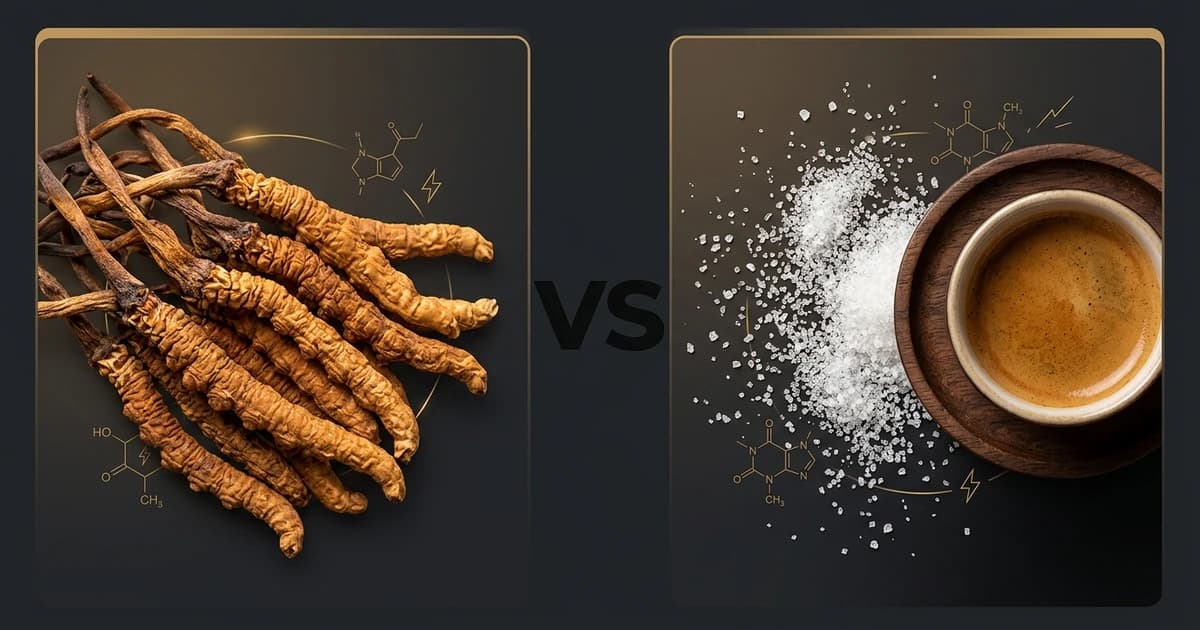
The cordyceps vs caffeine debate gets framed as a fight, but they are not even playing the same sport. One works on your central nervous system in minutes. The other works on your cells over weeks. Calling them rivals is like asking whether a sprinter or a marathoner is the "better runner."
If you want a clean answer, here it is: caffeine gives you fast, felt energy by blocking the chemical that makes you tired. Cordyceps supports the machinery that produces energy inside your cells, slowly, with nothing you can feel in the moment.
So the real question is not which one wins. It is which job you are trying to do.
Key Takeaways
- Caffeine is a stimulant. It blocks adenosine receptors in your brain, producing alertness you feel within 15 to 45 minutes.
- Cordyceps is an adaptogenic mushroom. It supports cellular ATP production and oxygen use, with effects that build over weeks, not minutes.
- Caffeine has stronger acute evidence for endurance and focus. Cordyceps has more modest, slower-building evidence for aerobic capacity.
- They are complementary, not interchangeable. A cordyceps base layer plus acute caffeine covers two different energy systems.
Cordyceps vs Caffeine: What Each One Actually Does
Caffeine creates the feeling of energy. Cordyceps supports the production of it. That single distinction explains almost every difference between the two.
Caffeine is a stimulant. Throughout the day, a molecule called adenosine builds up in your brain and binds to receptors that slow neural activity, which is part of why you feel tired. Caffeine is a competitive antagonist at adenosine receptors, meaning it sits in those receptor slots without activating them. The drowsiness signal gets blocked, and you feel alert. Nothing new was created. The off switch just got covered.
Cordyceps works on a different level entirely. It is a parasitic fungus used in traditional Chinese medicine, now studied as a cordyceps energy mushroom for endurance and aerobic capacity. Instead of masking fatigue, the research interest centers on whether it helps your cells generate energy more efficiently through improved oxygen use and ATP turnover.
This is the heart of the mushroom vs caffeine energy question. Stimulant energy is borrowed against the present moment. Mitochondrial energy is built into your baseline capacity over time.
The Science of Stimulant Energy
Caffeine is one of the best-supported performance compounds in sports science. The evidence for acute energy and endurance is strong and consistent.
A systematic review and meta-analysis in Nutrients found that the time to exhaustion in running tests was improved with caffeine, with the benefit holding across both recreational and trained runners. That effect shows up fast, within the same session you take it.
Caffeine is also the most-used ergogenic aid in elite sport. The International Society of Sports Nutrition position stand reports that roughly 74% of elite athletes used caffeine as an ergogenic aid prior to or during a sporting event, with endurance sports showing the highest use.
The catch is tolerance. Your brain responds to chronic caffeine by building more adenosine receptors, so the same dose does less over time. Receptor up-regulation during chronic drug treatment has been proposed to be the mechanism of tolerance to the behavioral stimulant effects. That is why your third coffee of the day barely registers, and why pairing caffeine with smarter compounds matters.
The Science of Mitochondrial Energy
Cordyceps does not stimulate you. It is studied for slowly improving how efficiently your body uses oxygen. The evidence is real but more modest, and it depends heavily on which strain and dose you use.
In a double-blind, placebo-controlled trial in healthy older adults, researchers tested a standardized Cordyceps sinensis preparation (Cs-4). The honest result: changes in VO2 max were not observed in the group who received supplementation with Cs-4 nor in the group who received placebo. So the headline "cordyceps boosts VO2 max" is not universally true.
Other work points to benefits beyond raw VO2 max. According to Longevity Botanicals' review of the research, in a 12-week trial using Cs-4, participants improved ventilatory threshold and markers of exercise performance compared with placebo. Ventilatory threshold is the intensity at which breathing gets labored, so a higher threshold means you can hold a hard pace longer before you blow up.
The pattern is clear. Cordyceps endurance benefits are slow, cumulative, and tied to aerobic efficiency rather than the jolt you feel from a stimulant. This is exactly why people search for natural energy without caffeine and land on cordyceps. There is no buzz to feel, which is the point and also the limitation.
Head to Head: Cordyceps or Caffeine
Use this table to decide which tool fits your goal. Note that they sit in different categories on purpose.
| Factor | Caffeine | Cordyceps |
|---|---|---|
| Mechanism | Blocks adenosine receptors (stimulant) | Supports cellular ATP and oxygen use (adaptogen) |
| Onset | 15 to 45 minutes (faster sublingual) | Weeks of daily use |
| What you feel | Clear alertness and drive | Little to nothing acutely |
| Best for | Acute focus, pre-workout, deadlines | Baseline aerobic capacity, endurance |
| Evidence strength | Strong, consistent | Modest, strain-dependent |
| Tolerance | Builds with daily use | Minimal reported |
| Crash risk | Possible with high doses | None |
The takeaway from the cordyceps or caffeine comparison is not a winner. It is a division of labor. Caffeine handles the next two hours. Cordyceps plays a longer game on your aerobic base.
How to Use Them Together
The smartest athletes do not choose. They layer. A daily cordyceps base supports your aerobic engine over months, while caffeine handles the acute demand of a specific session or work block.
If your goal is a hard interval session or a focused afternoon, caffeine is the better acute tool. The trick is dosing it well and pairing it with compounds that smooth out the jitters and slow the tolerance curve, which is where smarter formulas beat a third cup of coffee.
If your goal is building the engine that powers long efforts, cordyceps belongs in your daily routine. Think of it as training support, not a pre-workout. You will not feel it kick in, and that is expected.
Conclusion
Cordyceps and caffeine answer two different questions. Caffeine answers "how do I feel sharp and capable right now," by blocking the brain's fatigue signal with fast, well-documented results. Cordyceps answers "how do I make my aerobic system more efficient over time," with slower, strain-dependent support for oxygen use and endurance.
Framing them as competitors misses the point. Stimulant energy is acute and felt. Mitochondrial energy is built and quiet. The best approach for most people who train hard is not picking one. It is using each for the job it actually does, then letting them complement each other.
Frequently Asked Questions
Is cordyceps a good caffeine replacement?
Only partly. Cordyceps will not give you the acute alertness caffeine does, because it is not a stimulant. It supports cellular energy production over weeks rather than blocking fatigue signals in minutes. If you want natural energy without caffeine for daily aerobic support, cordyceps fits. If you need to feel switched on for a meeting or a workout in the next hour, it will not replace caffeine.
Does cordyceps actually boost VO2 max?
The evidence is mixed. One placebo-controlled trial in older adults found no VO2 max change from a standardized Cs-4 preparation. Other trials report improved ventilatory threshold and exercise markers over 12 weeks. The fairer claim is that cordyceps may support aerobic efficiency and time to exhaustion in some people, depending on strain, dose, and duration, rather than reliably raising peak oxygen uptake.
Which works faster, cordyceps or caffeine?
Caffeine, by a wide margin. You feel caffeine within 15 to 45 minutes, faster with a sublingual format. Cordyceps produces no acute sensation at all. Its proposed benefits build over weeks of consistent daily use. If speed of onset is your priority, caffeine is the clear choice in the mushroom vs caffeine energy question.
Can I take cordyceps and caffeine together?
Yes, and they pair logically. They work through separate mechanisms, so there is no direct conflict. A daily cordyceps base supports your aerobic capacity over time, while caffeine handles acute focus and pre-workout demand. Many endurance athletes treat cordyceps as a training-support layer and use caffeine situationally for hard sessions.
Does cordyceps cause jitters or a crash?
No. Because cordyceps is not a stimulant, it does not produce the jitters, racing heart, or afternoon crash some people get from high caffeine doses. That smooth profile is the main appeal of cordyceps energy. The tradeoff is that you also do not get the immediate lift, so it is poorly suited to moments when you need to feel alert right away.
Is caffeine bad because of tolerance?
Not bad, just predictable. With daily use, your brain builds more adenosine receptors, so the same dose does less over time. You can manage this by keeping doses moderate, cycling intake, and pairing caffeine with compounds like L-theanine, theacrine, and methylliberine that support a steadier response without the same tolerance curve.
Where Acute Focus Fits Alongside Your Aerobic Base
If this article convinced you that cordyceps and caffeine do different jobs, that framework is exactly where Roon fits. Cordyceps is your slow, quiet base layer for aerobic capacity. Roon is the acute tool for the moments you need to be sharp now.
Each Roon pouch is sublingual, with a 5 to 10 minute onset and a 4-ingredient stack built to last: 80 mg caffeine, 60 mg L-theanine, 25 mg methylliberine (Dynamine), and 5 mg theacrine (TeaCrine). The L-theanine smooths the edge off the caffeine, and the Dynamine and TeaCrine are included to support a longer, steadier 6 to 8 hour window with no jitters, no crash, and no tolerance buildup.
To be clear about what Roon is not: it is not an endurance-base supplement, and it will not replace the slow aerobic adaptations a daily cordyceps routine supports. It is the acute focus layer that sits on top of that base. If you want fast, clean energy for a hard session or a deep work block, try Roon as the stimulant half of your stack.
Written by Roon Team