Caffeine and L-Theanine Synergy: Why the Combo Works
Roon Team
Why Caffeine + L-Theanine Is Synergistic: The Two-Pathway Neuroscience
Coffee makes you alert. It can also make your hands buzz, your chest tighten, and your focus scatter across nine browser tabs. That second part is the problem most people accept as the price of caffeine.
The fix is older than your espresso machine. It lives in the same leaf that produces green tea, and the caffeine and l-theanine synergy behind it is one of the most studied pairings in cognitive science. Caffeine pushes the gas. L-theanine eases the ride.
This is not a vibe or a wellness rumor. It is two separate molecules acting on two separate brain pathways at the same time, and the result is sharper than either one alone.
Key Takeaways
- Caffeine works by blocking adenosine, the brain's tiredness signal, which raises alertness, dopamine activity, and reaction speed.
- L-theanine works through a different route, nudging up alpha brain waves and calming overexcited signaling, which produces relaxed wakefulness.
- Because the two act on separate systems, l-theanine smooths caffeine rather than canceling it. You keep the focus and lose much of the edge.
- Human trials show the combination improves speed and accuracy on attention tasks and reduces distraction better than caffeine alone.
The Caffeine Pathway: Taking the Brakes Off
Caffeine does not directly stimulate your brain. It removes a brake.
Throughout the day, a molecule called adenosine builds up in your brain and binds to its receptors, which is part of why you feel progressively more tired. Caffeine is shaped enough like adenosine to slip into those same docking points. According to a review on epicatelean.com, caffeine functions as a non-selective adenosine receptor antagonist that blocks both A1 and A2A receptors, so the tiredness signal cannot land.
When adenosine cannot bind, the downstream effects follow fast. When adenosine, the brain's natural "tiredness" signal, cannot bind to its receptors, the result is increased alertness, improved reaction time, and enhanced cognitive processing, a mechanism associated with increased neurotransmitter activity including dopamine, norepinephrine, and acetylcholine.
That A2A receptor matters more than people realize. As neuroactive.co.za explains, caffeine seems to have the highest affinity for antagonising the A2A receptor, which is the primary mechanism for its wakefulness-promoting effects, and this receptor also plays an important role in regulating glutamate and dopamine in the brain.
Here is the catch. The same surge that sharpens you also drives the unwanted parts: the racing heart, the restless legs, the slight anxiety that turns a deadline into a panic. Caffeine alone gives you alertness with a side of static.
The L-Theanine Pathway: Calm Without Sedation
L-theanine is an amino acid found almost exclusively in tea, and it solves the static problem by working somewhere caffeine does not.
Structurally, l-theanine resembles glutamate, the brain's main excitatory neurotransmitter. That resemblance lets it interact with glutamate signaling in a dampening way. Research summarized by performancelab.com notes that it acts antagonistically to inhibit the reuptake of glutamine and glutamate, thereby blocking their actions, and it may also boost dopamine and serotonin levels via increasing alpha brain wave activity.
Those alpha waves are the signature. Alpha activity is the brain state of calm, alert attention, the mode you slip into when you are focused but not tense. A clinical write-up from nutraceuticalbusinessreview.com reports that increases in brainwave alpha power indicate greater relaxation without drowsiness.
The phrase to hold onto is relaxed wakefulness. In that same study, subjects given 200mg of L-theanine showed reduced anxiety and tension and experienced reduced fatigue, confirming the relaxed wakefulness effects of increased alpha brain wave activity, and L-theanine also lowered heart rate compared with placebo.
So l-theanine does not knock you out. It takes the jagged edges off an overstimulated brain and leaves the lights on.
Why Caffeine and L-Theanine Work Together: The Two-Pathway Model
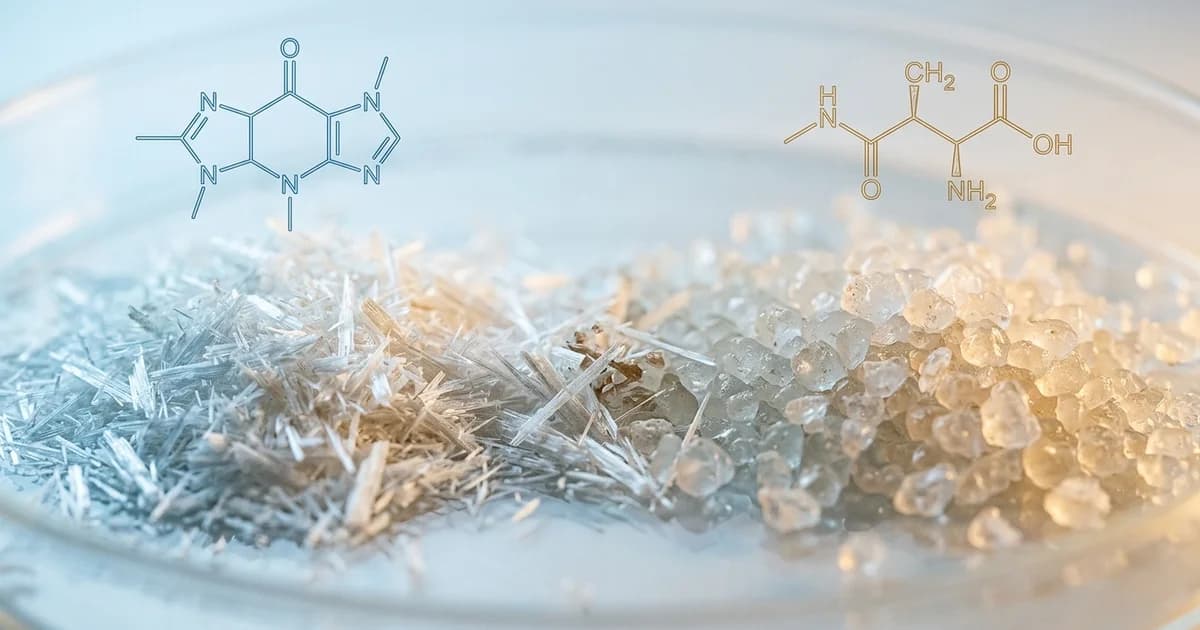
The reason caffeine and l-theanine synergy holds up is mechanical, not magical. The two compounds do not compete for the same receptors, so they do not cancel each other.
Picture two dials. Caffeine turns the arousal dial up by blocking adenosine. L-theanine turns the noise dial down by calming glutamate-driven overexcitation and raising alpha activity. You end up high on focus, low on jitter.
This is the core of the l-theanine caffeine mechanism. One molecule increases the signal you want. The other reduces the interference you do not. The science of this calm focus stack rests entirely on that division of labor.
There is also direct evidence that theanine smooths caffeine on the physical side. Per a summary from the Alzheimer's Drug Discovery Foundation, one trial found that while caffeine increased blood pressure and alertness, theanine attenuated this increase in blood pressure without affecting caffeine's positive effects on alertness. That is the synergy in one sentence: it softens the cost, not the benefit.
What the Attention Research Actually Found
The behavioral payoff shows up in attention tasks, not just brain scans.
The most cited trial here is Owen and colleagues from 2008. As described by research published on ScienceDirect, in the Owen et al. (2008) study, both the 100 mg L-theanine plus 50 mg caffeine combination and 50 mg caffeine alone improved accuracy on a switch task. The combination did something caffeine alone did not.
A Semantic Scholar summary of that work puts the difference plainly. Caffeine improved subjective alertness and accuracy on the attention-switching task, but the L-theanine and caffeine combination improved both speed and accuracy of performance on the attention-switching task and reduced susceptibility to distracting information in the memory task.
Reduced susceptibility to distraction is the line that matters. That is the difference between reading the same paragraph four times and actually finishing it.
More recent work backs this up under harder conditions. A 2025 double-blind crossover study in the British Journal of Nutrition tested a high-dose l-theanine and caffeine combination in acutely sleep-deprived young adults and found it improved both neurobehavioural and neurophysiological measures of selective attention. The pairing earns its reputation across multiple labs and decades.
The Ratio Question: 2:1 vs Caffeine-Forward
The popular internet answer is a 2:1 ratio of l-theanine to caffeine. The honest answer is that no single trial crowned it.
According to drstanfield.com, the combination is popular in nootropic stacks with a commonly cited ratio of 2:1 of L-theanine to caffeine, though this ratio is not based on any single definitive clinical trial. It became a default because it is conservative and forgiving, not because it is the proven optimum.
What you choose depends on your goal. More theanine relative to caffeine leans calmer and is friendlier to anxious responders. More caffeine relative to theanine leans toward drive and output while still using theanine to file down the rough edges.
| Approach | Theanine:Caffeine | Best for | Trade-off |
|---|---|---|---|
| Calm-forward | 2:1 (e.g. 200/100) | Anxiety-prone users, study sessions | Less raw drive |
| Balanced | ~1:1 | First-time stackers | Middle of the road |
| Caffeine-forward | <1:1 (e.g. 60/80) | Output, deep work, performance | Needs quality theanine to stay smooth |
There is no single correct number. There is only the dose that matches what you are trying to do.
How the Stack Compares to Plain Caffeine
A quick side-by-side shows why the pairing wins for sustained mental work.
| Outcome | Caffeine alone | Caffeine + L-theanine |
|---|---|---|
| Alertness | Yes | Yes |
| Reaction speed | Improved | Improved |
| Jitter / restlessness | Common | Reduced |
| Distraction resistance | Limited | Improved in trials |
| Blood pressure bump | Present | Attenuated by theanine |
| Subjective calm | Lower | Higher (relaxed wakefulness) |
If you want to go deeper on the inputs, see our breakdowns of how caffeine actually affects focus and what L-theanine does to the brain.
Conclusion
Caffeine and l-theanine are not the same tool used twice. They are two tools working on two separate pathways at once.
Caffeine removes the adenosine brake and lifts alertness, dopamine activity, and speed. L-theanine raises alpha brain waves and tempers the glutamate-driven overexcitation that turns alertness into anxiety. Put them together and the research points the same direction: faster, more accurate attention, better resistance to distraction, and a calmer physiological profile than caffeine on its own.
The takeaway is simple. If caffeine is the engine, l-theanine is the suspension. You need both to drive fast without rattling apart.
Frequently Asked Questions
Does L-theanine cancel out caffeine?
No. L-theanine and caffeine act on different brain systems, so theanine does not block caffeine's alertness. In trials, the pairing kept caffeine's benefits to focus and reaction speed while reducing jitter and attenuating caffeine's blood pressure increase. Theanine smooths the experience rather than erasing the stimulation. You stay alert, just with less of the buzzing edge that pure caffeine tends to deliver.
What is the best ratio of L-theanine to caffeine?
There is no clinically crowned optimum. The popular 2:1 ratio of theanine to caffeine is conservative and widely used, but it is not anchored to a single definitive trial. Calm-forward users often prefer more theanine, while people chasing output sometimes run caffeine-forward and rely on quality theanine to keep things smooth. Match the ratio to your goal, your caffeine tolerance, and how anxiety-prone you are.
How long does the combination take to work?
Caffeine generally reaches meaningful blood levels within roughly 30 to 60 minutes when swallowed, and l-theanine acts on a similar acute timeline. Attention benefits in the Owen study appeared around 60 to 90 minutes after consumption. Sublingual and faster-absorbing formats can shorten onset considerably, since the compounds bypass slower digestion. Individual timing varies with body weight, food in the stomach, and habitual caffeine intake.
Why does caffeine give me jitters and anxiety?
Caffeine blocks adenosine and ramps up dopamine and norepinephrine activity, which raises arousal across the body, not just the brain. In sensitive people that shows up as a racing heart, restless limbs, and edginess. L-theanine helps because it nudges the brain toward alpha-wave relaxed wakefulness and dampens overexcited glutamate signaling, which counteracts much of that overstimulation without putting you to sleep.
Do alpha brain waves really matter for focus?
Yes. Alpha activity reflects a state of calm, alert attention, often described as relaxed wakefulness. L-theanine reliably raises alpha power in human studies, and that increase tracks with lower anxiety and tension without drowsiness. This is part of why the theanine pathway pairs so well with caffeine: it adds composure to caffeine's raw arousal instead of competing with it.
Is the caffeine and l-theanine synergy proven or hype?
It is well supported. Multiple human trials, including the frequently cited Owen 2008 study and a 2025 sleep-deprivation crossover, show the combination improves attention measures beyond caffeine alone. The mechanisms are also clear and separate: adenosine blockade for caffeine, alpha-wave and glutamate modulation for theanine. That two-pathway logic is why the pairing holds up under scrutiny rather than fading like most supplement trends.
The Two-Pathway Logic, Built Into One Pouch
Roon was designed around the exact mechanism this article describes. Caffeine takes the adenosine brake off, l-theanine raises alpha activity and files down the edge, and the two run on separate pathways so you get focus without the rattle.
Each Roon sublingual pouch carries 80 mg caffeine, 60 mg L-theanine, 25 mg methylliberine (Dynamine), and 5 mg theacrine (TeaCrine). That is a caffeine-forward ratio on purpose. The goal is real cognitive drive for deep work, with enough theanine to keep the caffeine feeling like clean focus instead of jitter, across a 6 to 8 hour window with no crash and no tolerance buildup.
Roon is not a replacement for sleep, and it is not a cure for anything. It is a precise application of the two-pathway model in a format that absorbs fast. If you want caffeine that feels sharp instead of shaky, try Roon and judge it by the second hour, not the first.
Written by Roon Team