Adaptogens vs Caffeine: Stress-Buffering vs Stimulation
Roon Team
Adaptogens vs Caffeine: Stress-Buffering vs Stimulation
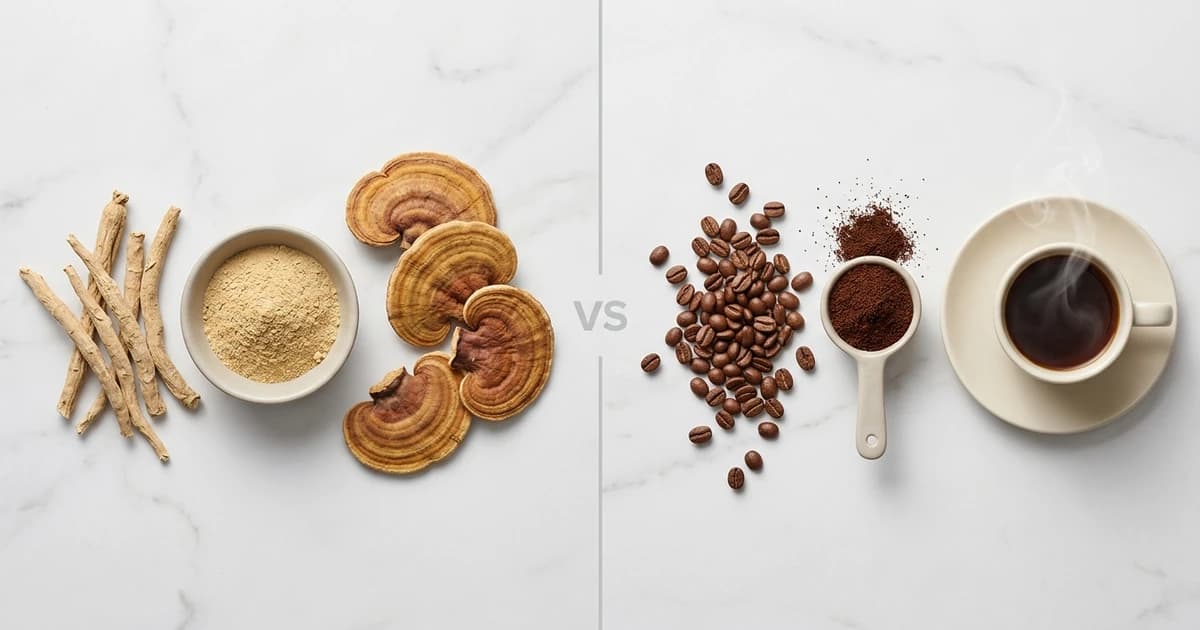
Most people reach for caffeine to feel sharper and an adaptogen to feel calmer, then wonder why they're still tired at 3 p.m. The adaptogens vs caffeine question isn't really about which one is "better." They solve different problems. One pushes your nervous system harder. The other tries to keep it from breaking under load.
Caffeine is a stimulant. It borrows energy you don't have yet. Adaptogens are stress-buffering compounds that aim to keep your stress response from running hot in the first place.
Understanding that split is the whole game. Once you see what each tool actually does to your biology, the right choice for a study sprint, a stressful quarter, or a 6 a.m. workout becomes obvious.
Key Takeaways
- Caffeine stimulates. It blocks adenosine, the molecule that makes you feel sleepy, producing fast alertness with a defined onset and offset.
- Adaptogens buffer. They work slowly on your stress-response system to blunt cortisol spikes, not to spike energy.
- They aren't interchangeable. Caffeine fixes acute drowsiness. Adaptogens target chronic stress load over weeks.
- The best stacks combine logic, not hype. Caffeine paired with L-theanine gives you stimulation with the edges sanded down, which is closer to "calm energy" than most adaptogen marketing.
What Adaptogens Actually Do
Adaptogens are plant compounds that help your body resist physical and mental stress by acting on your stress-response system rather than your alertness directly. The category includes ashwagandha, rhodiola, ginseng, and a handful of others with a real evidence base.
The proposed mechanism centers on the hypothalamic-pituitary-adrenal (HPA) axis, the loop that governs how your body releases cortisol. According to a review of adaptogen mechanisms from BodySpec, these compounds appear to modulate stress mediators and help the body return to balance after a stressor, rather than simply sedating or stimulating you.
The headline ingredient is ashwagandha. In a randomized, double-blind, placebo-controlled study published in the Indian Journal of Psychological Medicine, adults taking a high-concentration ashwagandha root extract showed a substantial reduction in serum cortisol compared to placebo, alongside lower self-reported stress scores.
That's the value proposition. Adaptogens don't make you feel switched on. They try to keep your stress thermostat from spiking.
The catch is timing. Most adaptogen benefits show up over weeks of consistent use, not minutes. You don't take ashwagandha at 2 p.m. and feel a wave of focus by 2:10. That isn't how it works.
What Caffeine Actually Does
Caffeine produces alertness by blocking adenosine, the neurochemical that builds up during the day and signals your brain that it's time to rest. As the NCBI pharmacology overview on caffeine explains, caffeine binds to adenosine receptors without activating them, which prevents the drowsiness signal from landing.
The effect is fast and direct. You feel it. Reaction time, vigilance, and sustained attention all improve, which is why caffeine is the most-used cognitive stimulant on the planet.
But blocking adenosine doesn't delete it. The molecule keeps accumulating behind the dam. When the caffeine clears, that backlog floods your receptors at once, and you get the slump people call a crash.
Caffeine also nudges your sympathetic nervous system, the "fight or flight" branch. That's the source of jitters, a racing heart, and the anxious edge that hits some people hard at higher doses. So caffeine and stress aren't opposites. Past a certain point, caffeine is a stressor.
Adaptogens vs Caffeine: The Core Difference
Here is the cleanest way to frame the stimulant vs adaptogen divide: caffeine adds stimulation, adaptogens subtract stress reactivity. They operate on different systems, on different timelines, for different goals.
| Factor | Caffeine (Stimulant) | Adaptogens (Stress-Buffer) |
|---|---|---|
| Primary target | Adenosine receptors | HPA axis / cortisol response |
| Onset | 15-45 min (sublingual formats faster) | Days to weeks of daily use |
| Main effect | Acute alertness, focus, reaction time | Reduced stress reactivity over time |
| Energy type | Direct stimulation | Indirect, by lowering stress drain |
| Crash risk | Yes, from adenosine rebound | No (not a stimulant) |
| Best for | Immediate focus, fatigue, workouts | Chronic stress, resilience, recovery |
| Common examples | Coffee, tea, pouches, pre-workout | Ashwagandha, rhodiola, ginseng |
Notice what this table doesn't say. It never claims adaptogens give you energy the way caffeine does. The "adaptogen energy vs caffeine" comparison is mostly a marketing frame. Adaptogens don't generate alertness. They reduce the energy you lose to a stress response that's stuck in overdrive.
So the honest answer to "caffeine vs adaptogens" is that you might want both, for entirely separate reasons.
The Calm Energy Problem
"Calm energy" is what everyone actually wants: focus without the buzz, drive without the dread. Adaptogen brands tend to own that phrase, but the science points somewhere more specific.
The most reliable route to calm energy isn't an adaptogen. It's caffeine paired with L-theanine, an amino acid found in green tea. In a double-blind, placebo-controlled crossover study in the British Journal of Nutrition, a high-dose L-theanine and caffeine combination improved measures of selective attention in sleep-deprived adults.
L-theanine promotes alpha brain-wave activity, the state linked to relaxed alertness. Pair it with caffeine and you keep the focus while softening the jittery, sympathetic-nervous-system edge. Reporting on related research, PsyPost notes the combo improved focus after sleep loss.
This matters for the caffeine alternative adaptogens search. If you're chasing calm energy and reaching for adaptogens to get it today, you may be using the wrong tool. Adaptogens are a long-game stress play. Caffeine plus L-theanine is the short-game focus play. If you want to go deeper on that pairing, see our breakdown of how L-theanine smooths out caffeine.
When To Use Which
Use caffeine when the problem is acute. You're underslept, you have a deadline at noon, you need vigilance for the next three hours, or you want output in the gym. That's a stimulation problem, and stimulation is what caffeine delivers.
Use adaptogens when the problem is chronic. You're under sustained pressure for weeks, your sleep is degrading, and you want your body to handle the load with less wear. That's a stress-buffering problem, and you have to commit to daily use for a stretch before judging the result.
You can run both. An adaptogen in your morning routine for baseline resilience and a measured dose of caffeine for acute focus aren't in conflict. They're two different levers.
What you shouldn't do is expect an adaptogen to wake you up on demand, or expect caffeine to fix a stress response that's been redlined for a month. Each fails badly at the other's job.
Conclusion
The adaptogens vs caffeine debate dissolves once you stop treating them as competitors. Caffeine is a stimulant that blocks adenosine for fast, finite alertness, with a crash on the back end if you overdo it. Adaptogens are stress-buffers that work slowly on your cortisol system to make you more resilient over weeks.
One is for the hour in front of you. The other is for the season you're in. The smartest approach is to match the tool to the actual problem, and to recognize that "calm energy" on demand comes less from an adaptogen and more from a well-built stimulant, caffeine with L-theanine, that gives you focus without the spike.
Frequently Asked Questions
Are adaptogens a good caffeine alternative?
Not for acute alertness. Adaptogens like ashwagandha and rhodiola buffer your stress response over weeks rather than producing fast energy, so they won't replace the immediate lift caffeine gives you before a meeting or workout. They can complement caffeine by supporting stress resilience, but the "caffeine alternative adaptogens" idea oversells what adaptogens do in the short term. If you need to feel sharper within the hour, that's a job for caffeine, ideally paired with L-theanine.
Do adaptogens give you energy like caffeine?
No, and that's the most common misunderstanding in the adaptogen energy vs caffeine comparison. Caffeine directly stimulates your nervous system by blocking adenosine. Adaptogens don't stimulate anything. They reduce the energy your body wastes on an overactive stress response, which can feel like more energy over time, but it isn't the direct, fast effect caffeine produces. The two work on different systems with different timelines.
Which is better for focus, a stimulant or an adaptogen?
For immediate, measurable focus, the stimulant wins. Caffeine reliably improves attention and reaction time, especially when paired with L-theanine to smooth the edges. Adaptogens support focus indirectly by lowering stress that fragments attention, but they don't sharpen cognition on a fast clock. For a deadline today, choose the stimulant. For a high-stress month, an adaptogen can support the background conditions that make focus easier.
Can I take adaptogens and caffeine together?
Yes. They target different systems, so there's no inherent conflict in using both. Many people take an adaptogen daily for baseline stress resilience and use caffeine for acute focus when needed. The main caution is general: keep caffeine to a sensible dose so you don't trigger the jitters and crash. As always, check with a clinician if you take medication or have a health condition, since some adaptogens can interact.
Does caffeine cause a crash and do adaptogens?
Caffeine can cause a crash because it blocks adenosine without removing it. When the caffeine clears, the backlog of adenosine hits at once, producing the familiar slump. Adaptogens don't cause a crash because they aren't stimulants, so there's no rebound to come down from. If your goal is sustained energy without a hard drop, a lower, smarter caffeine dose paired with L-theanine usually beats stacking more stimulant.
What is "calm energy" and how do I get it?
Calm energy means staying alert and focused without feeling wired or anxious. The most evidence-backed route is caffeine combined with L-theanine, which preserves the alertness while reducing the jittery, sympathetic edge. Adaptogen brands often claim the calm-energy label, but their effect is slower and aimed at stress resilience rather than on-demand focus. If you want calm energy in the next ten minutes, the caffeine plus L-theanine pairing is the reliable choice.
Where the Stimulant Side Wins, Done Right
This article lands on a clear position: if you need focus right now, you want stimulation, not a stress-buffer that takes weeks to show up. Roon is built squarely on the stimulant side of this debate, and we're not pretending otherwise. It's a caffeine product.
What makes it different is how it handles caffeine's downsides. Instead of reaching for an adaptogen to manufacture "calm," each sublingual pouch pairs 80 mg caffeine with 60 mg L-theanine for relaxed alertness, plus 25 mg methylliberine (Dynamine) and 5 mg theacrine (TeaCrine) to extend the window without the tolerance buildup that makes coffee feel weaker over time. You get a 5 to 10 minute onset and 6 to 8 hours of focus with no jitters and no crash.
Roon isn't a stress-resilience program, and it won't replace sleep, real recovery, or an adaptogen routine if chronic stress is your actual problem. But if the issue is the hour in front of you, try Roon as stimulation with the edges engineered out.
Written by Roon Team