You know the feeling before it arrives. Fifteen minutes after your scoop, your face starts prickling. Then your ears. Then the back of your hands. You are mid-warmup, trying to focus on your first working set, and instead your skin feels like it is receiving a low-voltage current. That sensation has a name, paraesthesia, and a cause, beta-alanine. If you have searched for a pre-workout without beta-alanine, you already know you do not want it. The real question is what you lose by dropping it, and what you actually need for a good session.
The short answer: you lose almost nothing on a per-session basis. Beta-alanine's ergogenic benefit comes from weeks of daily loading, not from the scoop you took twenty minutes ago. What you do need is reliable, fast-acting caffeine with a clean offset. The rest of this page explains why, and what that looks like in practice.
Key takeaways
- The tingle is not the benefit. Beta-alanine causes paraesthesia by activating MrgprD receptors on skin sensory neurons. That sensation is dose-dependent and harmless, but it is not a signal that your pre-workout is "working."
- Beta-alanine's real value takes weeks to build. Its ergogenic effect comes from raising muscle carnosine over 4+ weeks of daily loading at 4 to 6 grams per day, not from a single pre-workout serving.
- For a single session, caffeine timing matters more than anything else in the tub. Most pre-workouts pack 150 to 400 mg of caffeine, two to five times what most people need to improve performance.
- A controlled caffeine dose absorbed through the mouth lining reaches the blood in 5 to 10 minutes, fitting a warm-up window precisely, with no shaker bottle, no liquid sloshing, and no proprietary blend.
Why Beta-Alanine Makes You Itch (and Why It Does Not Help Today's Workout)
The tingle you feel from beta-alanine is called paraesthesia, and it is one of the most well-characterized side effects in sports nutrition. A 2012 study published in The Journal of Neuroscience identified the mechanism: beta-alanine activates MrgprD, a G-protein-coupled receptor expressed on a subpopulation of sensory neurons that exclusively innervate the skin. These neurons respond to beta-alanine, heat, and mechanical stimuli, but not to histamine, which is why the sensation feels like tingling or itching rather than a typical allergic response. The intensity is dose-dependent: the ISSN position stand on beta-alanine notes that paraesthesia is typically dose-dependent, with higher doses resulting in greater side effects, which is why a 3.2 g pre-workout scoop can light up your face and hands while an 800 mg capsule barely registers.
Here is the part most pre-workout marketing skips over: the tingle and the ergogenic effect are completely unrelated biological events.
The performance benefit of beta-alanine comes from carnosine, a dipeptide stored in skeletal muscle that buffers hydrogen ions during high-intensity exercise. Beta-alanine is the rate-limiting precursor to carnosine synthesis. But raising muscle carnosine is slow. The ISSN position stand on beta-alanine states that four weeks of supplementation at 4 to 6 grams daily is required to meaningfully augment muscle carnosine concentrations. A 2021 study testing a single dose of beta-alanine on well-trained rowing athletes concluded plainly: a single dose of beta-alanine supplementation has no effect on performance.
So when your pre-workout makes your skin crawl, that is not the formula kicking in. It is plasma beta-alanine spiking, activating skin neurons, and producing a sensation that has zero relationship to what is happening in your muscles during that session. The carnosine loading requires days and weeks of consistent dosing. The tingle happens in minutes and is gone in under an hour.
This distinction matters because it reframes the whole question. If you are deliberately running a beta-alanine loading protocol for endurance work, you should keep taking it daily, ideally in divided doses to reduce paraesthesia. But if you are simply looking for something to sharpen your session, beta-alanine in a pre-workout scoop is not doing what you think it is doing today.
What Actually Drives a Good Training Session
Strip away the proprietary blends, the label decoration, and the beta-alanine tingle, and the ingredient with the strongest acute evidence for exercise performance is caffeine. That is not controversial. It is the single most studied ergogenic aid in sports science.
Caffeine timing and the gut problem
When you drink caffeine, whether as coffee, an energy drink, or a pre-workout shake, it passes through the stomach and small intestine before reaching the bloodstream. Peak plasma caffeine concentration is typically reached within 30 to 60 minutes of oral ingestion, but that window can stretch to 15 to 150 minutes depending on gastric emptying, fiber, and what you last ate. This is why the standard advice is to take your pre-workout 30 to 60 minutes before training. You are not waiting for the caffeine to work. You are waiting for it to clear your gut.
An oral pouch absorbed through the mucous membrane of the mouth bypasses the GI tract entirely. The lining of the mouth is thin, highly vascular, and delivers compounds directly into venous circulation. That is why buccal and sublingual delivery routes are used in pharmacology when speed matters. For caffeine, this means a felt onset of 5 to 10 minutes, which slots directly into a warm-up window instead of requiring you to plan around digestion.
Dose: why 80 mg is enough
Most pre-workouts contain 150 to 400 milligrams of caffeine per serving. That is the equivalent of two to four cups of coffee in a single scoop. For some people, that is a productive dose. For many, it overshoots the point of useful stimulation and produces jitters, elevated heart rate, and a hard crash 3 to 4 hours later.
Eighty milligrams of caffeine is roughly one small cup of coffee. It is enough to improve alertness and reaction time without pushing most people past their comfort zone. And when paired with compounds that extend and refine caffeine's action, the dose goes further than it would alone.
Extending and refining the dose
Two modifications change what 80 mg of caffeine feels like in practice:
| Modifier | Mechanism | Effect |
|---|---|---|
| L-theanine (60 mg) | Promotes alpha-wave brain activity; modulates the excitatory edge of caffeine | Refines the response: takes the jitter and scattered feeling off while preserving alertness |
| Dynamine® (25 mg) | Slows caffeine's hepatic clearance | Extends the felt window beyond coffee's typical 3 to 4 hours, without increasing peak stimulation |
The Dynamine® effect has pharmacokinetic data behind it. A randomized, double-blind crossover study (n=12) found that co-administering 100 mg of Dynamine® with 150 mg of caffeine cut caffeine's oral clearance from 41.9 to 17.1 L/hr and extended its half-life from 7.2 to 15 hours, with no increase in peak concentration. Same peak, longer tail. Roon uses a much lower dose of Dynamine® (25 mg) with less caffeine (80 mg), so the magnitude of the clearance effect will differ, but the same mechanism is at work: Dynamine® slows caffeine's elimination, stretching its useful window. The company's own figure for that window is 6 to 8 hours.
A 15-hour half-life does not mean 15 hours of felt energy. Half-life is a measure of clearance, not perceived effect. The felt window is 6 to 8 hours, which carries an honest trade-off: if you train in the evening, that window can push into your sleep. Plan accordingly.
Roon: The Full Stack in a Pouch
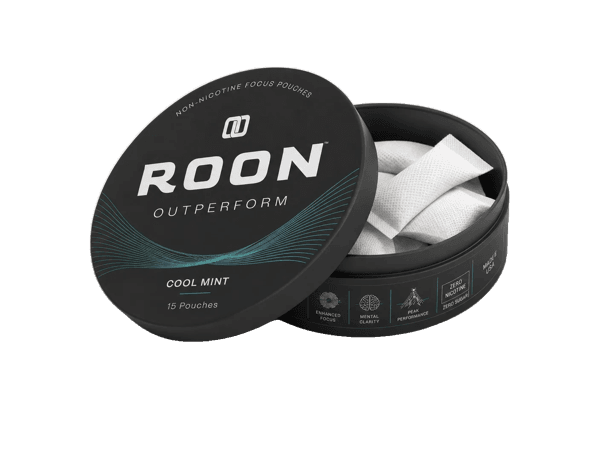
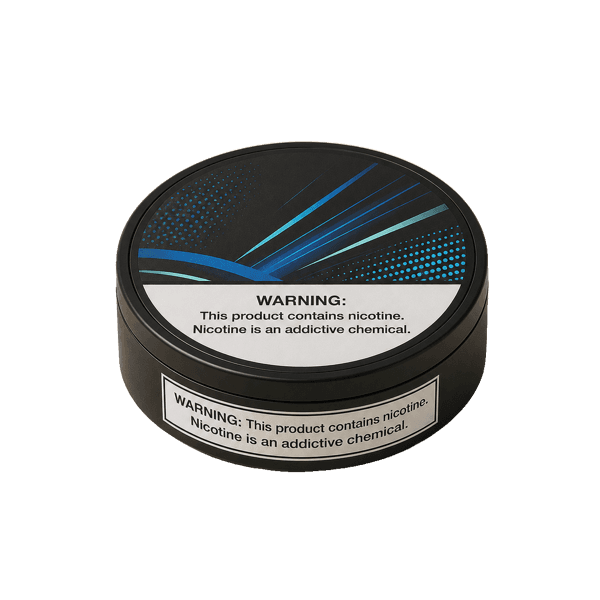
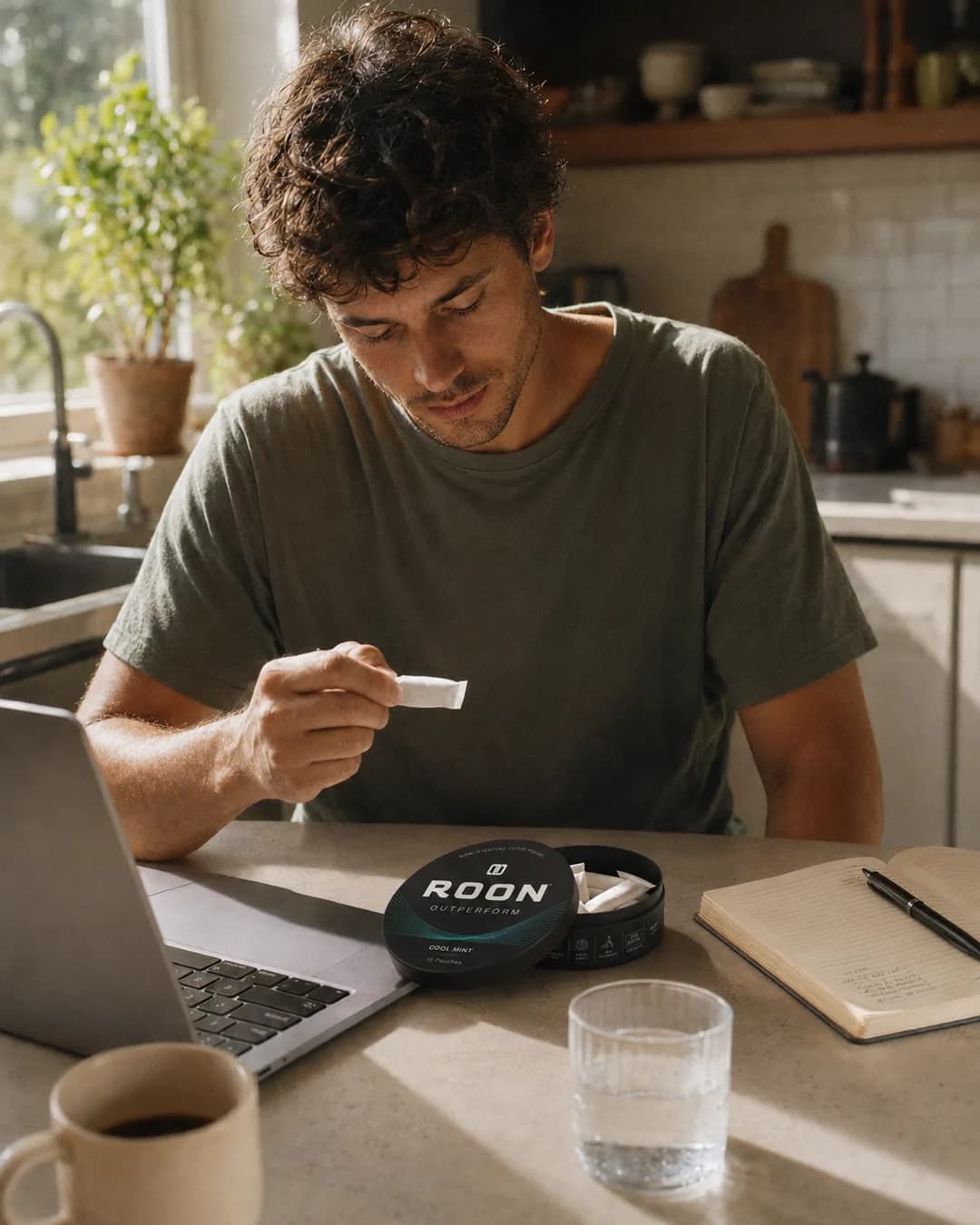
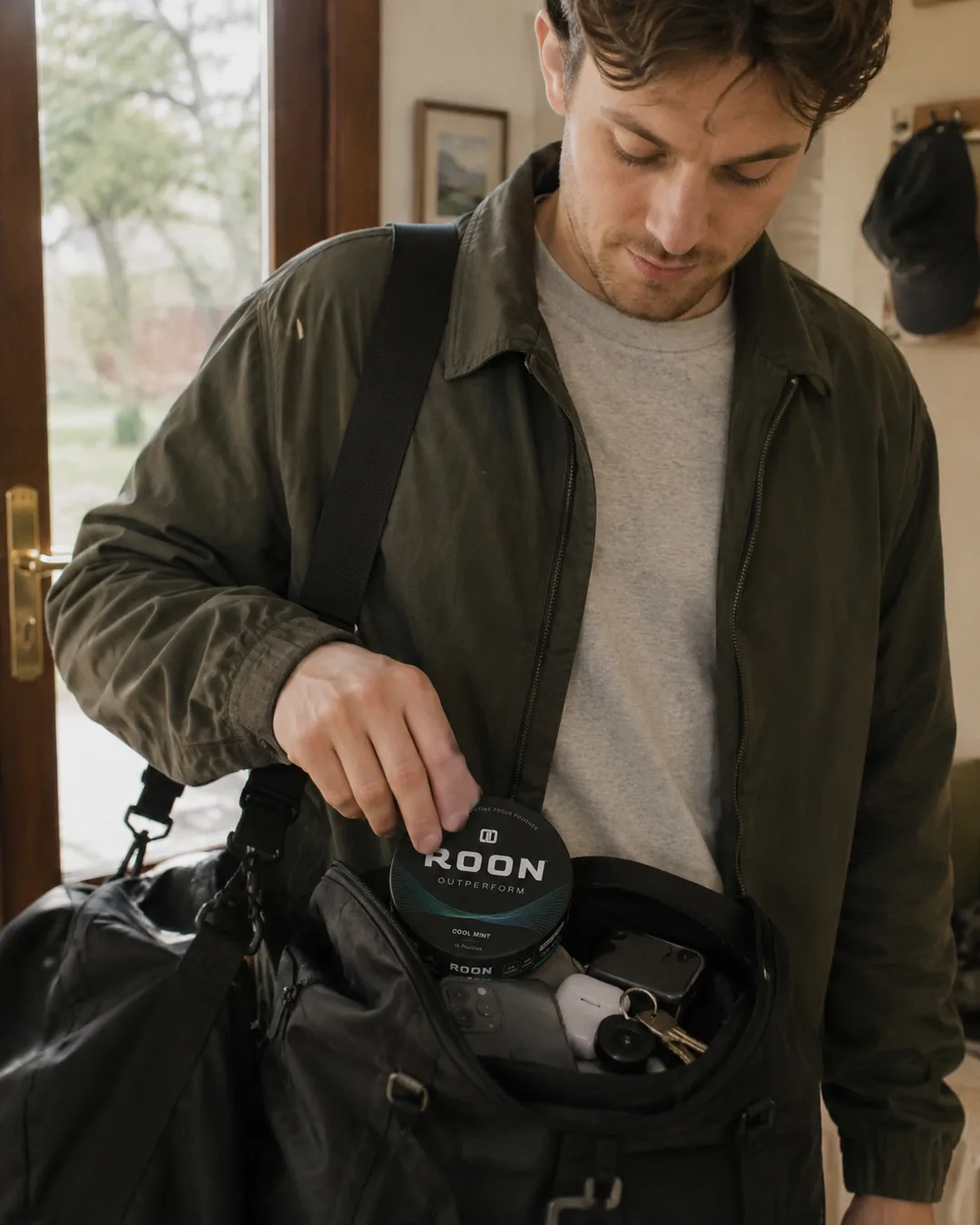
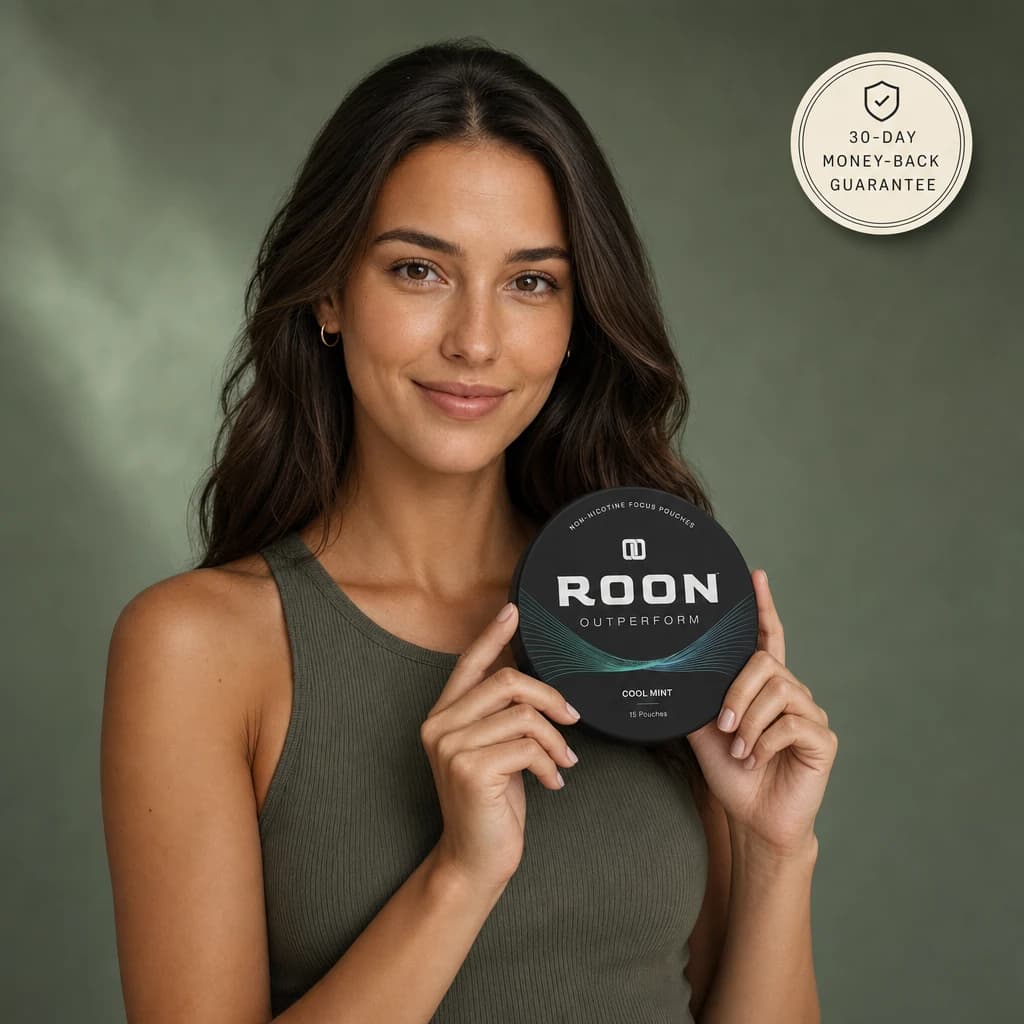
Everything described above is the formula inside Roon, a zero-nicotine, zero-tobacco oral pouch built for exactly this use case.
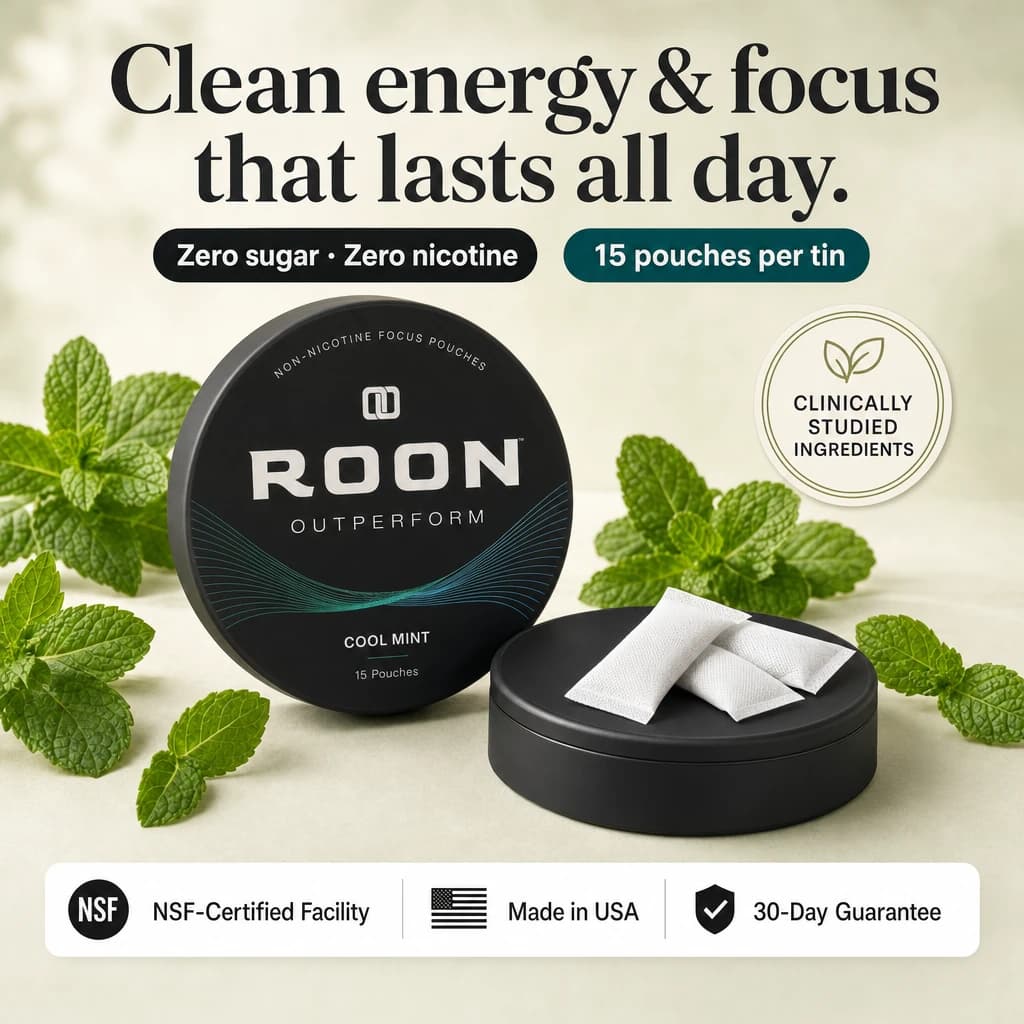
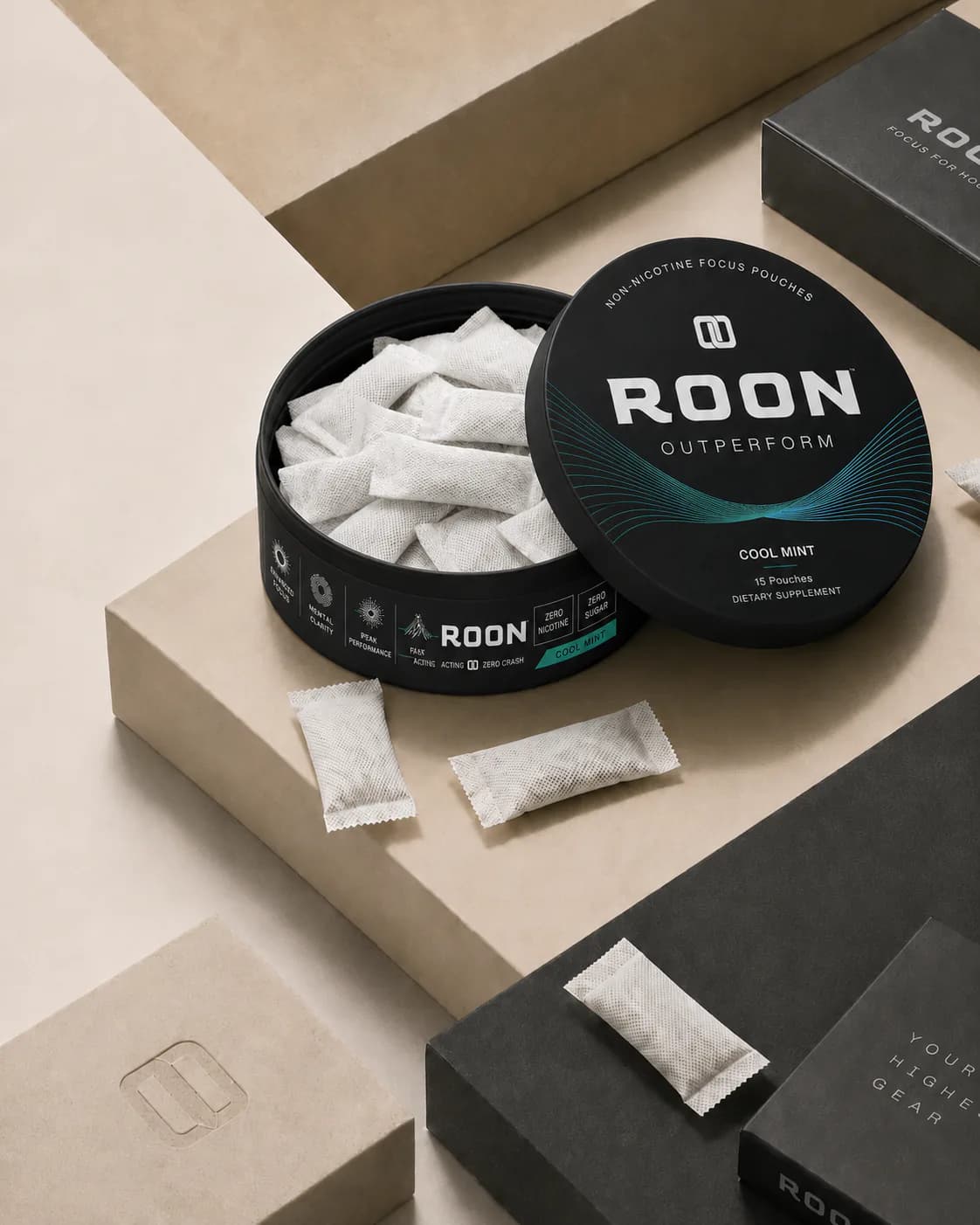
Each pouch contains 80 mg caffeine, 60 mg L-theanine, 25 mg Dynamine®, and 5 mg TeaCrine® (standardized to 40%), with 15 pouches per tin in a single flavor: Cool Mint. TeaCrine® adds a useful property of its own: an eight-week study of 60 healthy adults published in the Journal of the International Society of Sports Nutrition found no habituation to daily TeaCrine® at doses up to 300 mg, which matters for daily users. That said, Roon still contains 80 mg of caffeine and will produce caffeine tolerance like any caffeine source.
The practical case for the gym is straightforward. You tuck a pouch between your gum and lip during your warm-up. Onset is 5 to 10 minutes. There is no shaker bottle, no half-liter of liquid sitting in your stomach during squats, no powder to measure, and no proprietary blend to decode. The 6 to 8 hour felt window covers a training session plus the focus-demanding hours after it, tapering slowly rather than crashing.
Roon's own characterization of the four-ingredient stack is a 2.5x caffeine effect, meaning the combination extends and smooths the response of a moderate caffeine dose beyond what caffeine alone would produce. That is an internal framing, not an independent clinical finding, but the pharmacokinetic data on Dynamine®'s clearance effect supports the direction of the claim.
What Roon is not. It has no creatine, no citrulline, no beta-alanine. If you specifically want a pump formula, a nitric oxide booster, or you are deliberately loading beta-alanine for carnosine over a multi-week protocol, Roon is not a replacement for those products. It is also not a substitute for sleep, food, or medical care. What it replaces is the stimulant-and-focus layer of your pre-workout, cleanly and portably, at a controlled dose.
For a deeper comparison of pouch-based pre-workout alternatives, see Pre-Workout Without Beta-Alanine: How to Lose the Itchy Tingles and Keep the Drive and 5 Reasons Nootropic Pouches Are the New 'Clean' Pre-Workout.
Roon is available in 4-tin bundles starting from as little as $0.61 per pouch ($9.16 per tin) with a subscription, or $1.00 per pouch ($15.00 per tin) for a one-time 4-tin bundle. A single tin is $19.99. See the product page for the live buy box.