You tucked a caffeine pouch between your lip and gum, waited ten minutes, and felt something. Or you are thinking about trying one and you want to know if the effect is real before you spend the money. Either way, the short answer: yes, caffeine pouches work, and the mechanism is well understood. Caffeine absorbed through the lining of your mouth enters the bloodstream faster than caffeine swallowed in a drink, and the stimulant effect on alertness and reaction time is one of the most replicated findings in nutrition research. The longer answer, including what is not yet proven, is worth the next few minutes.
The harder question is not "does caffeine do something" but "does a pouch deliver it in a way that is meaningfully better than coffee or an energy drink?" That is a delivery question, not a chemistry question, and it has a concrete answer rooted in how the oral mucosa handles absorption.
This page covers the research on the delivery route, the ingredient stack behind the Roon pouch, and where the evidence stops. If you are the kind of person who reads the label before buying, you are exactly who this is for.
Key takeaways
- Caffeine pouches deliver caffeine through the mouth lining (buccal absorption), which bypasses the stomach and produces a faster onset than drinking coffee or an energy drink, typically 5 to 10 minutes versus 20 to 45 minutes.
- 80 mg of caffeine, the dose in a Roon pouch, is roughly one small cup of coffee. The FDA's commonly cited guidance is that up to 400 mg per day is not generally associated with negative effects in most healthy adults.
- The caffeine plus L-theanine combination has real human trial data behind it. A double-blind study (n = 44) published in Nutritional Neuroscience found the combination helped focus attention during a demanding cognitive task (Giesbrecht et al., 2010).
- No company has published a randomized controlled trial of a caffeine pouch as a finished product. Ingredient-level evidence is strong; product-level evidence comes from user reports, not clinical trials. That distinction matters.
Why coffee's timing does not match when you actually need it
When you drink coffee, the caffeine has to pass through your stomach, move into the small intestine, cross the intestinal wall, and enter the bloodstream before it does anything. That process typically takes 20 to 45 minutes, which is why you can finish a cup and still feel nothing for half an hour. Peak plasma concentration from an oral dose usually lands around 30 to 60 minutes after swallowing.
That delay is fine when you are waking up at home and making breakfast. It is less fine when you need to be sharp for a meeting that starts in ten minutes, or when you are midway through an afternoon and the window between "need focus now" and "done for the day" is narrow.
There is also the practical side. Coffee is a liquid, which means a bathroom, a mug, a temperature you have to manage, and a window of drinkability. Energy drinks come with sugar (often 40 to 60 grams), artificial coloring, and a can you cannot put in your pocket during a workout or a commute. These are not fatal flaws. They are friction, and friction determines whether something gets used consistently.
The deeper problem is duration. A standard cup of coffee delivers caffeine with a half-life of roughly 5 hours in most adults, but the felt window of alertness is shorter, usually 3 to 4 hours before you notice the energy fading. If you re-dose with another cup to cover the rest of the afternoon, you push your total caffeine load higher and risk disrupting sleep. This is the cycle most daily coffee drinkers know well: drink, peak, fade, drink again, sleep poorly, repeat.
None of this means coffee is bad. It means swallowing caffeine in a liquid is a delivery method with specific constraints. A different delivery method changes the constraints.
How caffeine pouches actually deliver the effect
Buccal absorption: skipping the stomach entirely
The tissue lining your mouth is thin, well-vascularized, and permeable to small molecules. Pharmacology has used this route for decades. Nitroglycerin tablets dissolve under the tongue for fast cardiac relief. Certain pain medications and hormone treatments use buccal delivery for the same reason.
A review published in Frontiers in Pharmacology confirms that sublingual and buccal routes "produce faster onset of action compared to orally ingested drug formulations" and bypass hepatic first-pass metabolism. This is not a novel claim; it is a well-established pharmacokinetic principle.
When a caffeine pouch sits against your gum or under your lip, the caffeine dissolves and absorbs across the buccal mucosa directly into the capillary bed. From there, it reaches the brain without the 20 to 45 minute detour through the gut. The felt onset is 5 to 10 minutes.
What caffeine actually does (and does not do)
Caffeine is an adenosine receptor antagonist. Adenosine builds up in your brain throughout the day and promotes sleepiness; caffeine blocks those receptors, which is why you feel more alert. Research at Bangor University found that caffeine has a "well-established effect on reaction times" mediated by attentional rather than motor processes. That study confirmed caffeine speeds up how quickly you notice a stimulus, not just how fast your hand moves.
What caffeine does not do: it does not create energy out of nothing. It blocks the signal that says you are tired. If you are severely sleep-deprived, caffeine can temporarily mask the fatigue, but the debt remains. And caffeine produces tolerance; regular use reduces the magnitude of the effect over time.
Caffeine as an ergogenic aid
Beyond focus and alertness, caffeine is one of the most studied performance-enhancing compounds in sports nutrition. Systematic reviews and meta-analyses consistently show that caffeine improves endurance exercise performance, reduces perceived exertion, and enhances power output. These effects are driven by the same central mechanism: adenosine receptor antagonism in the brain reduces the perception of effort, which allows sustained output at a given intensity for longer. The research base here is large enough that the International Society of Sports Nutrition recognizes caffeine as an effective ergogenic aid. Most exercise studies use doses of 3 to 6 mg per kilogram of body weight, which is well above what a single 80 mg pouch provides for most adults. The mechanism is still active at lower doses, but the magnitude of the ergogenic benefit is smaller than what the literature typically reports. This matters for the pouch format because the 5 to 10 minute buccal onset means you can time your dose closer to the start of a session, rather than drinking coffee 30 to 60 minutes beforehand and hoping the peak lines up with your warm-up.
L-theanine: refining caffeine instead of canceling it
L-theanine is an amino acid found naturally in tea leaves. It promotes alpha brain wave activity, which is associated with relaxed focus rather than drowsiness. When paired with caffeine, it does not cancel the stimulant effect. It refines it: blunting the jitter and the scattered, anxious edge while preserving alertness.
A double-blind, placebo-controlled study published in Nutritional Neuroscience tested 97 mg of L-theanine combined with 40 mg of caffeine on 44 young adults and found the combination "helps to focus attention during a demanding cognitive task" (Giesbrecht et al., 2010). A more recent double-blind crossover study published in the British Journal of Nutrition (2025) found that L-theanine combined with caffeine improved neurobehavioral and neurophysiological measures of selective attention in sleep-deprived adults (Nawarathna et al., 2025). The two-ingredient combination has research support. The question is whether a finished pouch product delivers on it.
How Dynamine® extends caffeine's working life
Dynamine® appears to slow caffeine's metabolic clearance, stretching the tail of the effect curve without raising the peak. A randomized, double-blind, crossover pharmacokinetic study (n = 12) tested this directly. The caffeine-interaction arm co-administered 100 mg of Dynamine® with 150 mg of caffeine and found that oral clearance fell from 41.9 to 17.1 L/hr while half-life rose from 7.2 to 15 hours, with no increase in peak concentration (Taylor et al., Journal of Exercise and Nutrition). Same peak, longer tail. A 15-hour half-life does not mean 15 hours of felt energy; half-life is a pharmacokinetic measure of clearance, not perceived alertness. But the mechanism, slowed clearance keeping caffeine above its effective threshold for longer, is what makes the combination interesting for pouch formulations.
| Factor | Coffee (swallowed) | Caffeine pouch (buccal) |
|---|---|---|
| Typical onset | 20 to 45 minutes | 5 to 10 minutes |
| Absorption route | Stomach and intestine | Oral mucosa |
| First-pass metabolism | Yes | Largely bypassed |
| Liquid required | Yes | No |
| Sugar content | 0 g (black) or variable | Zero sugar |
| Portability | Low to moderate | High (fits in pocket) |
What Roon's pouch actually contains, and what users report
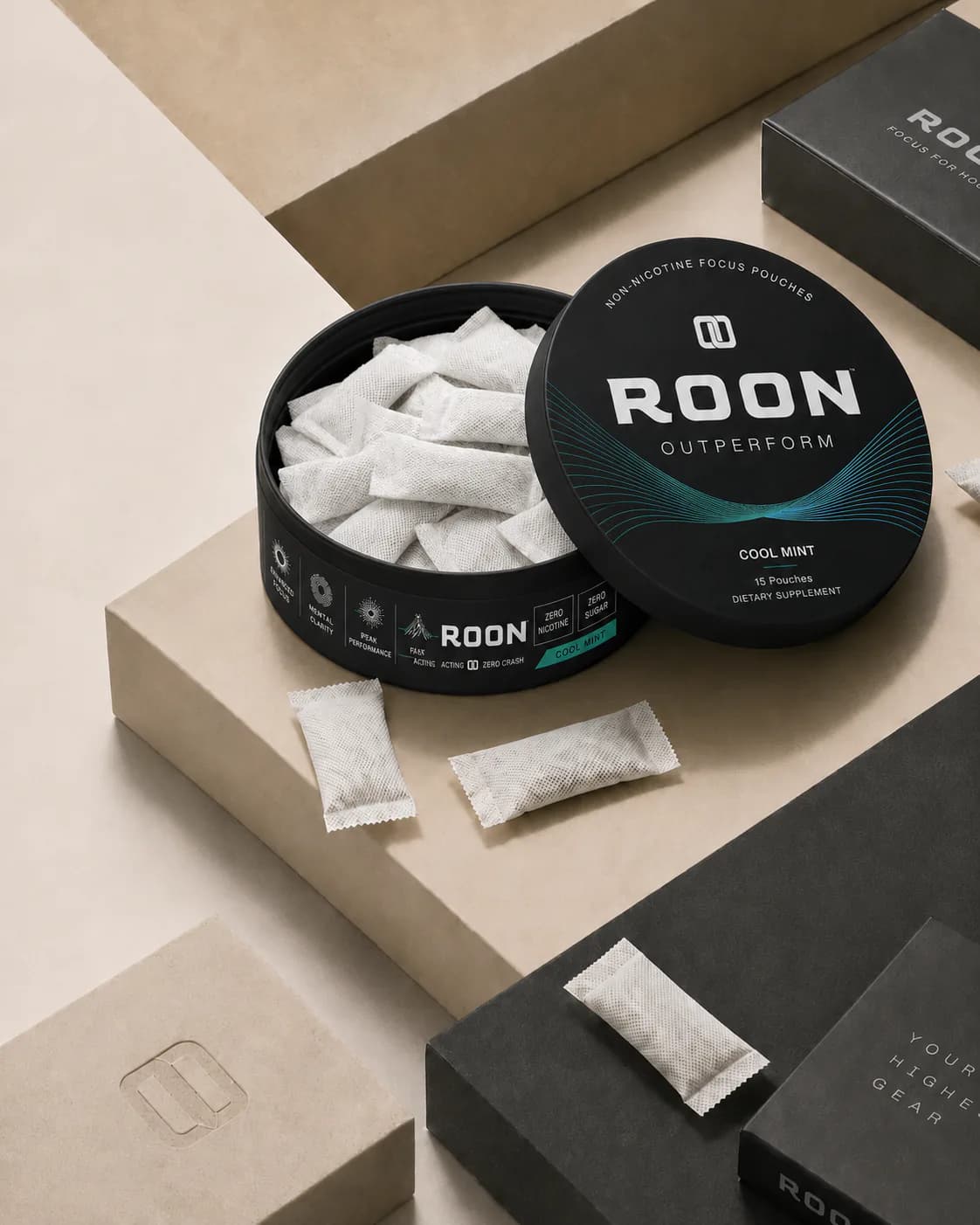
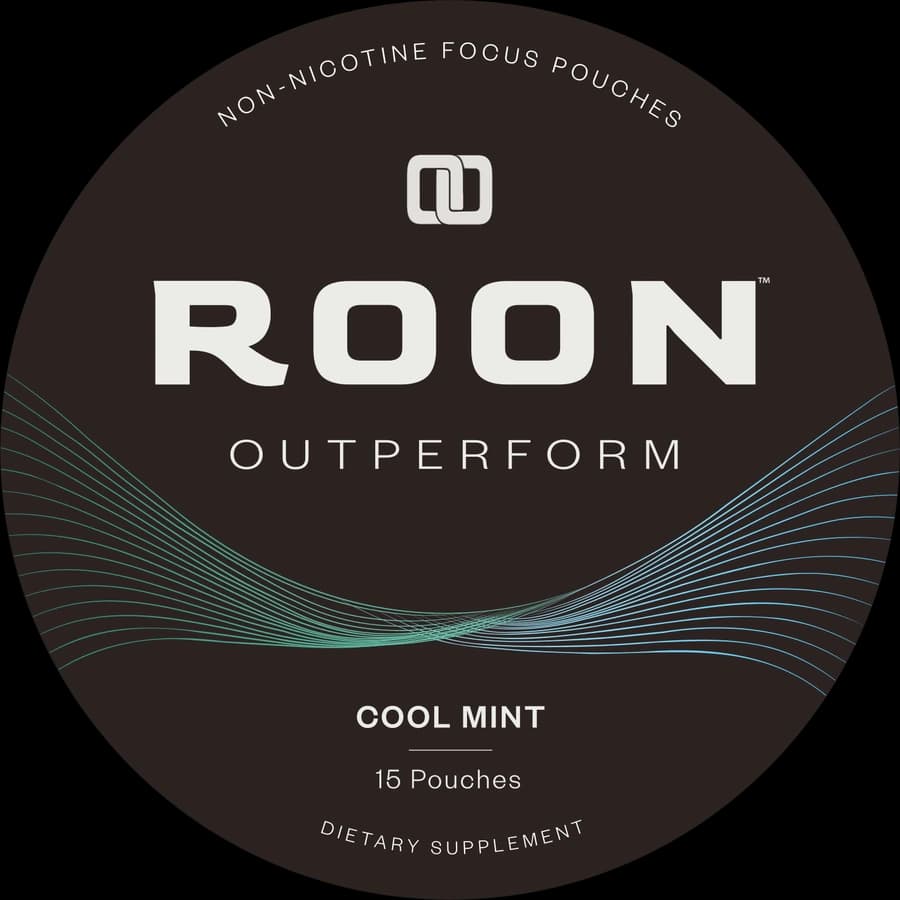
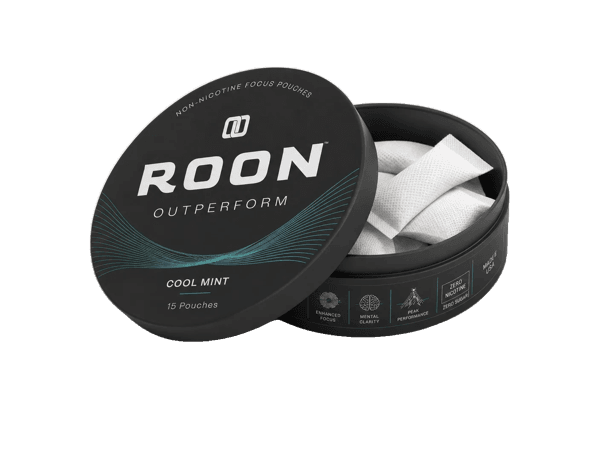
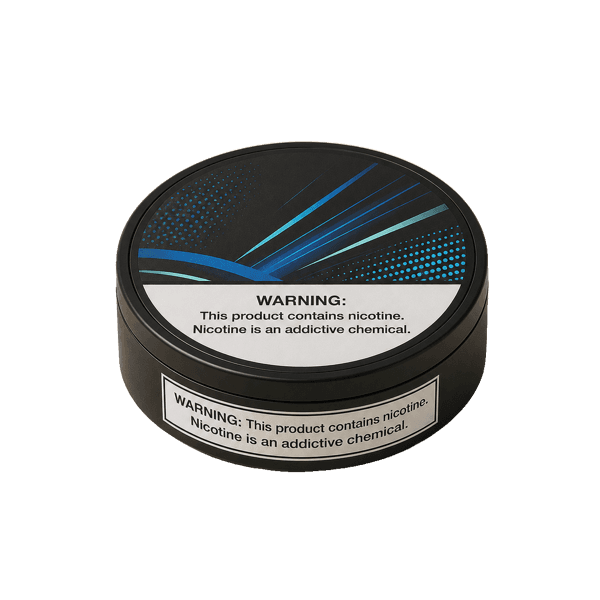
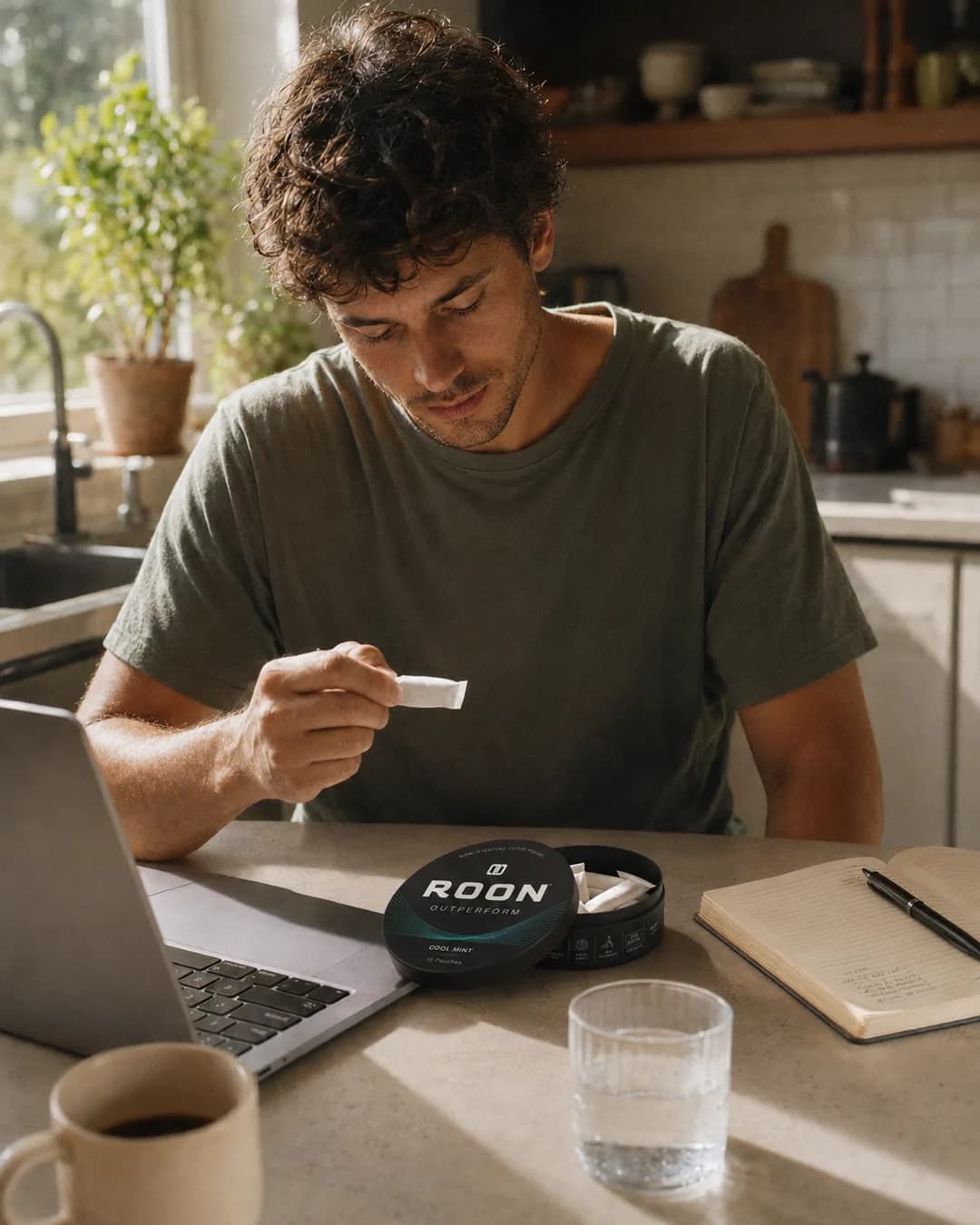
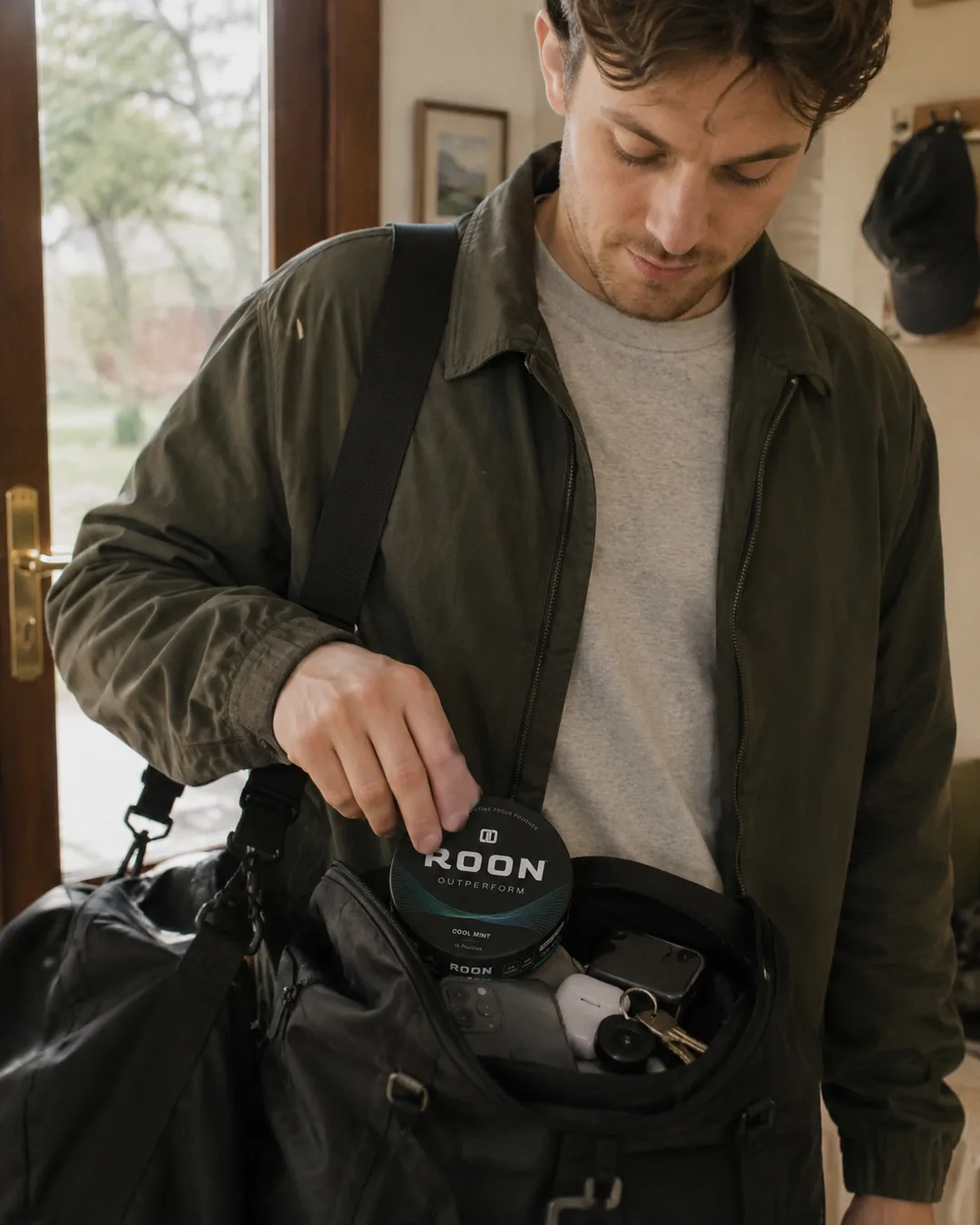
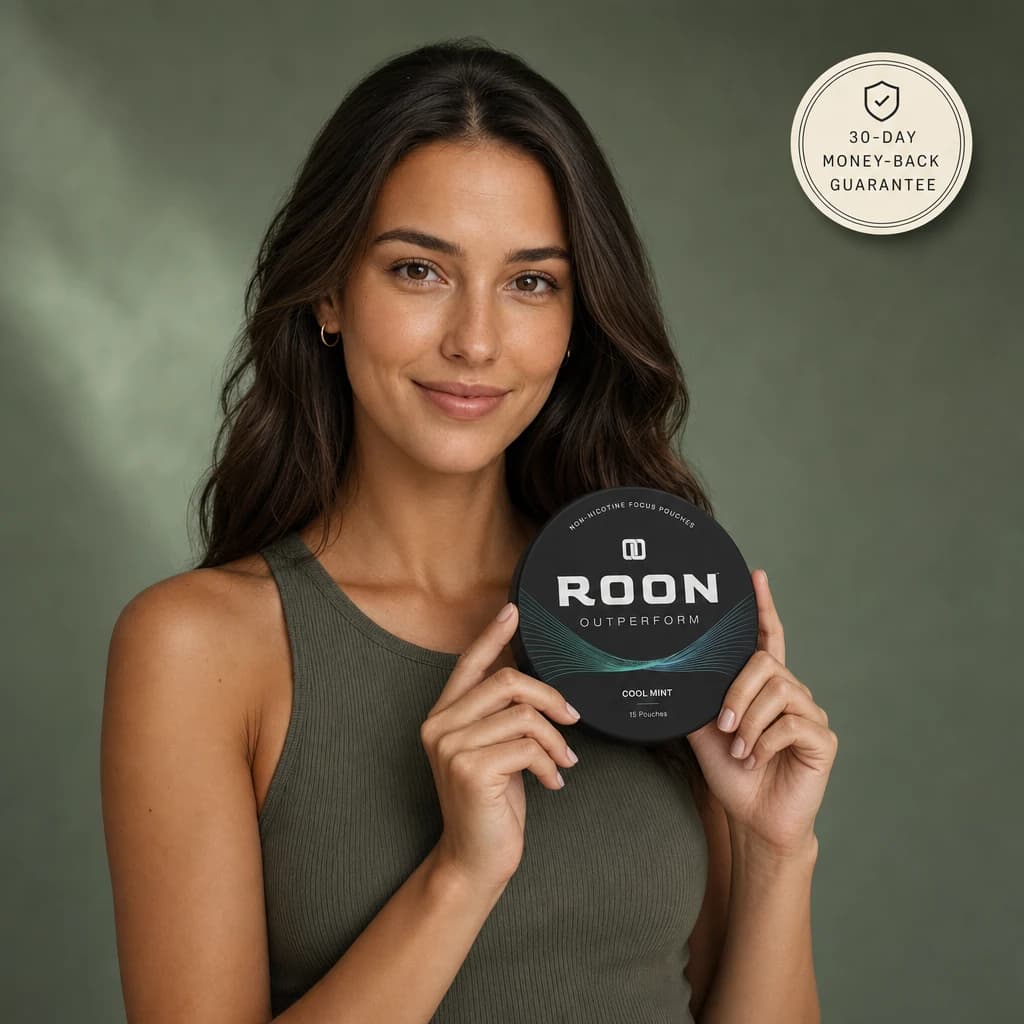
Roon is a zero-nicotine, zero-tobacco oral pouch in Cool Mint flavor, with 15 pouches per tin. Each pouch delivers a four-ingredient stack:
- 80 mg caffeine, roughly one small cup of coffee
- 60 mg L-theanine
- 25 mg Dynamine®
- 5 mg TeaCrine®, from material standardized to 40%
The first two ingredients have the research base described above. The second two are what extend the effect window beyond what coffee can do on its own.
How the full stack works together
The Dynamine® study cited above used 100 mg of Dynamine® with 150 mg of caffeine, roughly four times more Dynamine® and nearly twice the caffeine in a Roon pouch. The same clearance-slowing mechanism operates at Roon's lower dose, but the magnitude of the effect will differ from the published figures. Roon's stated felt window of 6 to 8 hours, with onset in 5 to 10 minutes and peak around 30 to 60 minutes, is the company's own figure based on user data, not a study endpoint from the trial. Roon characterizes the combined effect of the four-ingredient stack as a 2.5x caffeine effect; that is their own framing of the formula, not an independent clinical finding.
The trade-off: do not take it late. Roon recommends stopping at least 8 hours before bed. If you go to sleep at 11 PM, your last pouch should be at 3 PM. That is a real constraint.
TeaCrine® plays a different role. Unlike caffeine, TeaCrine® does not appear to build tolerance with habitual use. That does not make the whole product tolerance-free; Roon contains 80 mg of caffeine, which produces tolerance like any caffeine source. But the TeaCrine® component retains its effect.
What users report (and what that does not prove)
About 6,000 people have switched to Roon across all sales channels. Verbatim customer feedback is displayed on the product page.
Here is what users consistently report: fast onset, clean sustained energy without jitters, and a smooth taper instead of a crash. The most common constructive note is that the pouch's mint flavor fades well before the 6 to 8 hour effect window ends. That is worth knowing, because it can make you think the pouch stopped working when it has not. The effect outlasts the taste.
Here is what those reports do not prove: efficacy in a controlled research setting. Self-selected customer feedback is not a clinical trial. People who hated the product are less likely to leave reviews. Roon has not published a randomized controlled trial of the finished product, and this article will not pretend otherwise. The ingredient research is strong. User reports are useful context. Those are two separate kinds of evidence, and treating them as interchangeable would be dishonest.
What Roon is not: a substitute for sleep, food, or medical care. It is a caffeine delivery method, and the four-ingredient stack is designed to make a small dose of caffeine go further and feel smoother than the same dose in a drink.
Roon is sold in 4-tin bundles, starting from $9.16 per tin (as little as $0.61 per pouch) with a subscription. The one-time 4-tin bundle is $15.00 per tin ($1.00 per pouch). A single tin is $19.99. For more on how buccal delivery works at the pharmacokinetic level, see this guide on sublingual absorption. For a comparison of caffeine pouch options, see Best Caffeine Pouches Ranked (2026).