Tobacco Harm Reduction: What the Science Actually Says
Tobacco Harm Reduction: What the Science Actually Says (And What It Means for You)
Tobacco kills more than 7 million people every year. That number comes straight from the World Health Organization, and it hasn't budged much in over a decade. The global public health establishment has spent billions trying to get people to quit smoking cold turkey, and tobacco harm reduction offers a different path forward. That's the core idea: if you can't eliminate nicotine use entirely, you can at least remove the thing that's actually killing people. The combustion.
This isn't a fringe theory. Tobacco harm reduction is backed by decades of epidemiological data, endorsed by major medical bodies, and already proven at national scale in at least one country. Here's what you need to know.
Key Takeaways
- Burning tobacco, not nicotine itself, causes the vast majority of smoking-related disease and death.
- Tobacco harm reduction focuses on replacing combustible cigarettes with lower-risk nicotine delivery systems.
- Sweden's decades-long adoption of snus has given it the lowest smoking rate and lowest tobacco-related disease rate in the EU.
- The real question isn't whether tobacco harm reduction works. It's whether you even need nicotine in the first place.
What Is Tobacco Harm Reduction?
Tobacco harm reduction (THR) refers to strategies designed to lower the health risks associated with tobacco use, without requiring complete abstinence from nicotine. The logic is simple: nicotine is the compound people are addicted to, but it's not the compound doing most of the damage. That distinction matters enormously.
When a cigarette burns, it produces roughly 7,000 chemicals. At least 70 of those are known carcinogens. Tar, carbon monoxide, formaldehyde, benzene, arsenic. The list reads like a chemistry lab's hazardous waste manifest.
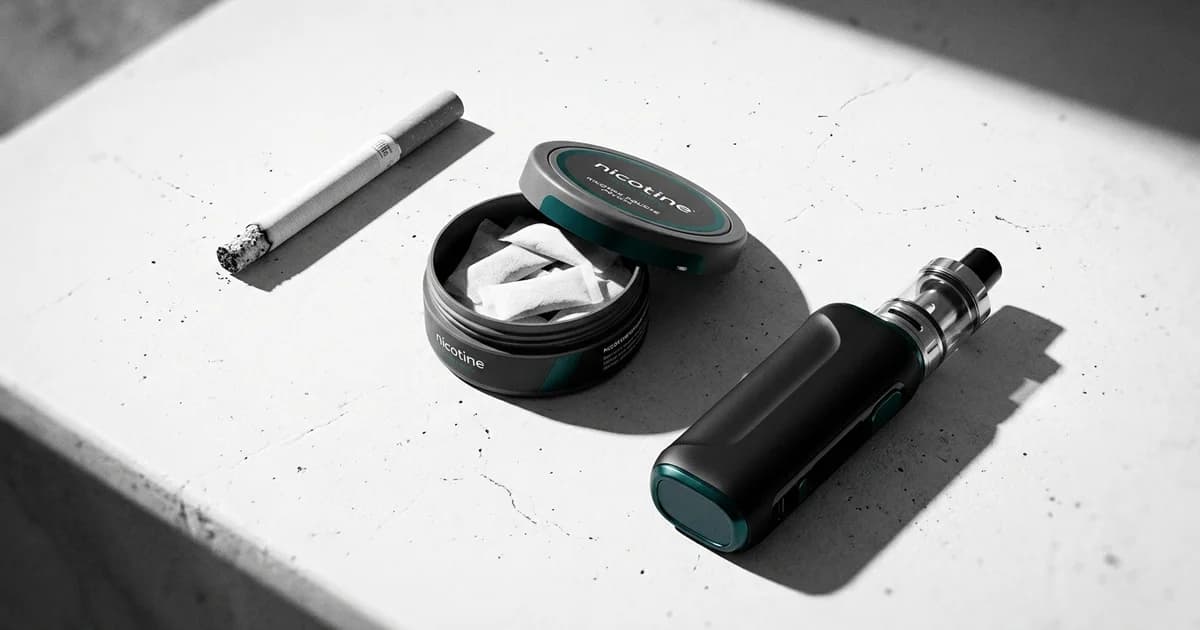
Nicotine, on its own, is a stimulant. It raises heart rate, constricts blood vessels, and is highly addictive. But it doesn't cause cancer. It doesn't destroy lung tissue. The harm minimization continuum, described in research published on PMC, positions nicotine-containing products on a spectrum: combusted cigarettes and cigars sit at the top (highest harm), while non-combustible nicotine delivery systems like NRT patches, snus, and nicotine pouches sit at the bottom (lowest harm).
The principle behind tobacco harm reduction says: if someone can't quit nicotine, get them off the fire.
The Sweden Case Study: Proof Tobacco Harm Reduction Works
If you want to see tobacco harm reduction in action, look at Sweden.
Since the 1970s, Swedes have been shifting away from cigarettes and toward snus, a moist, pasteurized oral tobacco product placed under the lip. The result? Sweden now has the lowest smoking prevalence of any country in Europe at 5.8%, according to the Global State of Tobacco Harm Reduction. The EU average hovers around 23%.
That's not just a statistical curiosity. It translates directly into lives saved. Sweden has a 41% lower incidence of cancer than other European countries and the lowest percentage of tobacco-related diseases in the EU, according to Smoke Free Sweden. In November 2024, Sweden effectively became the first country in the world to reach "smoke-free" status (defined as less than 5% daily smoking prevalence).
The Swedish model didn't rely on banning tobacco. It gave smokers a less harmful alternative, and millions of them took it. That's tobacco harm reduction working at population scale.
The Continuum of Risk: Not All Nicotine Products Are Equal
One of the most useful frameworks in tobacco harm reduction is the continuum of risk. As described by PMI Science, noncombustible products sit lower on the risk spectrum than cigarettes. Combustible products (cigarettes, cigars, cigarillos) carry the highest risk. Noncombustible products (e-vapor devices, heated tobacco products, nicotine pouches, snus) carry lower risk.
Here's a simplified version of that hierarchy:
| Product Type | Combustion? | Relative Risk |
|---|---|---|
| Cigarettes, cigars | Yes | Highest |
| Heated tobacco products | Partial (no combustion) | Lower |
| E-cigarettes / vapes | No | Lower |
| Nicotine pouches | No | Lower |
| Snus (oral tobacco) | No | Lower |
| NRT (patches, gum) | No | Lowest |
| No nicotine use | N/A | Zero risk |
The debate around e-cigarettes illustrates the tension in this field. Public Health England famously estimated that vaping is at least 95% less harmful than smoking, a figure that has been both widely cited and contested. Whether the exact number is 95% or 80% or somewhere else, the directional conclusion holds: removing combustion removes the majority of the danger.
A 2024 scoping review published on PMC examined tobacco-free nicotine pouches specifically and found that their use may result in lower exposure to toxicants than other tobacco or nicotine-containing products, both combustible and non-combustible. This finding reinforces the continuum of risk that underpins tobacco harm reduction strategies.
Where the Tobacco Harm Reduction Debate Gets Complicated
Tobacco harm reduction isn't without its critics, and some of their concerns deserve attention.
The Gateway Argument
The worry: if you make nicotine products safer and more accessible, won't non-smokers (especially young people) pick them up? This is a legitimate concern. Nicotine is addictive regardless of how it's delivered. Any honest conversation about tobacco harm reduction has to acknowledge that reducing harm for current smokers is a different goal than preventing new nicotine addiction.
The Nicotine Dependence Problem
Even the cleanest nicotine delivery system still delivers nicotine. And nicotine dependence is real. Research published on PMC has examined how dependence varies across different types of nicotine-containing products. Cigarettes tend to produce the highest levels of dependence, but oral nicotine products still carry addiction potential. Switching from cigarettes to pouches reduces your health risk. It doesn't free you from the cycle of dependence. That's a limitation that even the strongest advocates of tobacco harm reduction must acknowledge.
Regulatory Fragmentation
The global regulatory picture is a mess. The WHO's latest tobacco trends report notes that while tobacco users dropped from 1.38 billion in 2000 to 1.2 billion in 2024, progress has fallen short of targets. One in five adults worldwide remains addicted to tobacco. Different countries take wildly different approaches to tobacco harm reduction products. France is banning nicotine pouches. The UK actively promotes vaping as a cessation tool. The FDA has authorized certain nicotine pouches for sale in the U.S. There's no global consensus.
The Numbers That Matter
Let's ground this in current data.
- Adult cigarette smoking rates in the U.S. declined from 23.3% in 2000 to a record low of 9.9%, according to the 2024 National Health Interview Survey cited by the American Lung Association.
- Overall adult tobacco use in the U.S. decreased from 19.3% in 2022 to 16.4% in 2023, per the same source.
- The Global State of Tobacco Harm Reduction 2024 report forecasts that a little over 10% of adults will still smoke globally, while the number who vape will continue to rise from the 11% recorded in 2024.
- Around 80% of the world's 1.3 billion tobacco users live in low- and middle-income countries, where access to tobacco harm reduction tools is most limited.
The trend lines are moving in the right direction. They're just not moving fast enough.
Tobacco Harm Reduction vs. Nicotine Elimination: The Bigger Question
Here's the part of the conversation most articles skip.
Tobacco harm reduction accepts nicotine use as a given and tries to make it less deadly. That's a pragmatic, evidence-based approach, and for the 1.2 billion people currently using tobacco, it could save millions of lives. No argument there.
But there's a different question worth asking: do you actually need nicotine?
Most people reach for nicotine products because they want focus, stress relief, or a cognitive edge. Those are real needs. The problem is that nicotine solves them by creating a dependency loop. The "focus" you feel from a nicotine pouch is partly just the relief of withdrawal symptoms from the last one. As Medical News Today explains, nicotine is a highly addictive substance where the temporary feeling of well-being and relaxation is often a response to the relief of nicotine withdrawal rather than an actual reduction in stress.
Caffeine works differently. It has a much lower risk of addiction and milder withdrawal symptoms, making it a more sustainable option for cognitive performance, according to FlowBlend. That's not to say caffeine is perfect on its own. Too much of it gives you jitters. Too little and you crash. The delivery method and what you pair it with matters.
A Smarter Way to Get the Focus You're After
If you're someone who never smoked but picked up nicotine pouches for the focus, it's worth reconsidering the trade-off. You're getting a cognitive bump at the cost of a dependency that's genuinely difficult to break.
Roon was built for exactly this scenario. It's a zero-nicotine sublingual pouch that combines 80mg of caffeine with L-Theanine, Theacrine, and Methylliberine to support sustained focus for 6 to 8 hours. No nicotine. No jitters, no crash, no tolerance buildup.
The ingredients work together: L-Theanine smooths out caffeine's rough edges, while Theacrine and Methylliberine extend the duration without the tolerance curve that caffeine alone creates over time.
Tobacco harm reduction is a smart, necessary strategy for the billions of people trapped in nicotine dependence. But if you're not one of them, there's no reason to opt in. You can get the focus without the hook.