Anxiety Supplements for Kids: What Actually Works

Anxiety Supplements for Kids: What Actually Works (and What's Just Marketing)
Roughly 11% of U.S. children ages 3 to 17 have a diagnosed anxiety disorder, according to 2022–2023 data from the CDC. If you're researching anxiety supplements for kids, you're far from alone. Millions of parents are watching their children struggle with worry, sleep trouble, or social dread, and the supplement aisle starts to look very tempting. The problem? Most anxiety supplements for kids are backed by thin evidence, aggressive marketing, or both.
This article breaks down which anxiety supplements for kids have real science behind them, which ones are overhyped, and what you should actually consider before giving your child anything.
Key Takeaways
- L-Theanine and magnesium have the strongest preliminary evidence among anxiety supplements for kids that support calm.
- Omega-3 fatty acids show modest benefits, mostly for mood rather than anxiety specifically.
- Ashwagandha has very limited pediatric research and should be used with caution.
- No supplement replaces therapy or medical evaluation. Talk to your child's pediatrician first.
Why Parents Are Searching for Anxiety Supplements for Kids
Pediatric anxiety rates have been climbing for over a decade. A global analysis published in PMC tracked rising anxiety disorder burdens among adolescents and young adults from 1990 to 2021, with COVID-19 accelerating the trend. The Annie E. Casey Foundation reports similar patterns in U.S. youth mental health data.
Parents see these numbers. They also see waitlists for child psychologists stretching months out. So they turn to anxiety supplements for kids as something they can do right now.
That instinct makes sense. But supplements exist in a regulatory gray zone. The NIH Office of Dietary Supplements notes that many supplements have not been well tested for safety in children. Unlike prescription medications, dietary supplements don't require FDA approval before hitting shelves. The burden of proof for safety and efficacy lands on you, the parent.
That doesn't mean all anxiety supplements for kids are useless, and the natural anxiety supplement evidence for adults offers useful context. It means you need to read the evidence yourself instead of trusting the label.
The Anxiety Supplements for Kids With Actual Evidence
L-Theanine: The Strongest Candidate
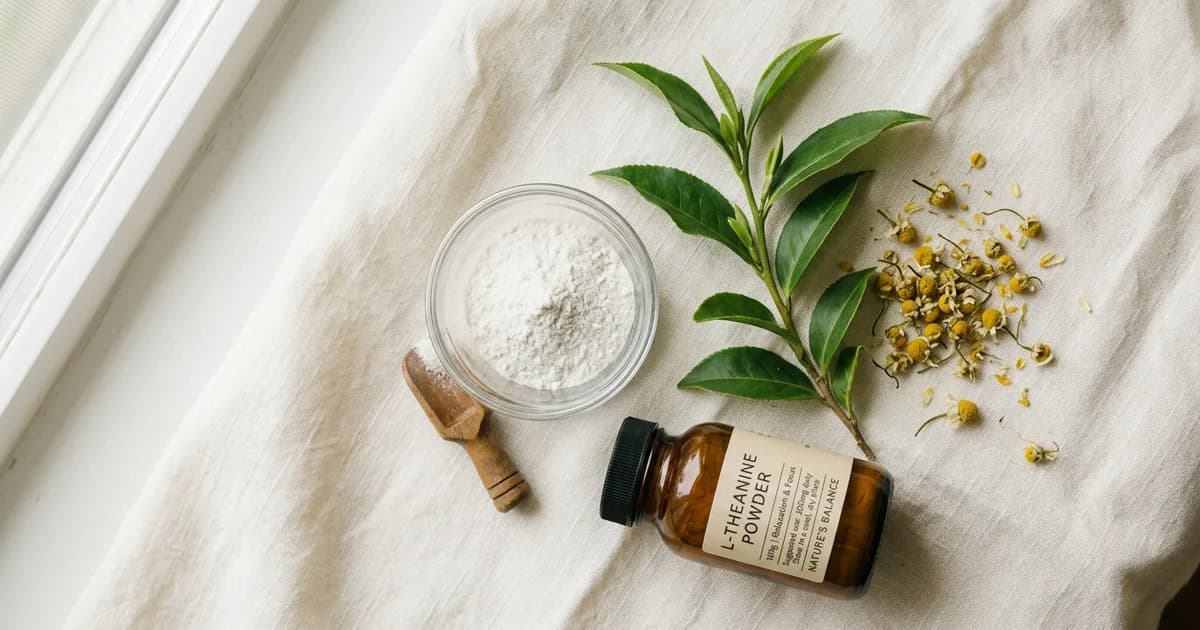
L-Theanine is an amino acid found naturally in green tea. It crosses the blood-brain barrier and influences several neurotransmitter systems. According to a study published in PubMed, L-theanine increases brain serotonin, dopamine, and GABA levels while also interacting with glutamate receptors. That's a real pharmacological profile, not just marketing copy.
What does this mean in practice? A separate PubMed review found that L-theanine increases activity in the alpha frequency band of brainwaves, which is associated with relaxed alertness. Think calm focus, not drowsiness.
For children specifically, a 2024 systematic review on PubMed concluded that L-theanine supplementation reduced psychiatric symptoms more effectively than control conditions in individuals with anxiety disorders and ADHD. While much of the L-theanine literature focuses on adults, the pediatric data that does exist is encouraging, making L-theanine one of the most promising anxiety supplements for kids available today.
The typical dose studied in children ranges from 100 to 400mg per day. Side effects are rare and mild. Of all the anxiety supplements for kids on this list, L-theanine has the most favorable risk-to-benefit ratio.
Magnesium: Filling a Common Gap
Magnesium plays a role in over 300 enzymatic reactions in the body, including those that regulate the nervous system. Many children don't get enough of it through diet alone, which is why magnesium ranks high among anxiety supplements for kids worth considering.
A study published in PMC found that supplementation with vitamin D and magnesium caused a decrease in anxiety scores among children with ADHD. The effect wasn't isolated to magnesium alone in that trial, but the broader magnesium-anxiety connection is well-documented in adult anxiety supplement research.
Not all forms of magnesium are equal. Here's a quick comparison:
| Magnesium Form | Best For | Notes |
|---|---|---|
| Magnesium Glycinate | Anxiety, sleep | Well-absorbed, gentle on the stomach |
| Magnesium Taurate | Anxiety, heart health | Combined with calming amino acid taurine |
| Magnesium Citrate | General supplementation | Good absorption, but can cause loose stools |
| Magnesium Oxide | Budget option | Poorly absorbed; not ideal for anxiety support |
If your child's diet is low in leafy greens, nuts, and whole grains, a magnesium glycinate or taurate supplement is a reasonable starting point. Dosing depends on age, so consult your pediatrician.
Omega-3 Fatty Acids: Modest but Real
Omega-3s, particularly EPA and DHA, are structural components of brain cell membranes. The theory is straightforward: a brain with adequate omega-3s functions better than one without. Parents exploring anxiety supplements for kids will encounter omega-3s frequently, and for good reason.
A randomized controlled trial published in PMC found that omega-3 supplementation reduced behavior problems in children aged 8 to 16. The effects were measurable at six months, with the supplement group showing higher blood omega-3 levels and improved parent-reported outcomes.
For anxiety specifically, the evidence is more mixed. A pilot trial on PubMed evaluated omega-3 supplementation for anxiety in adolescent females with anorexia nervosa, finding it tolerable but with limited sample sizes. The honest summary: omega-3s probably help mood and behavior broadly, but they're not a targeted anxiety fix.
Still, most kids don't eat enough fatty fish. An omega-3 supplement is unlikely to hurt and may provide general brain support.
Vitamin D and B Vitamins: The Supporting Cast
Low vitamin D levels correlate with poorer mental health outcomes in children. A systematic review in PMC examined the influence of vitamin D intake and status on mental health in children, with the most prominent studies supporting a potential positive influence.
B vitamins, particularly B6, B9 (folate), and B12, are cofactors in neurotransmitter synthesis. A systematic review on PubMed found that B vitamins and vitamin D may be effective and well-tolerated adjuvant strategies for improving symptoms of depression and anxiety.
The key word is adjuvant. These vitamins work best alongside other interventions, not as standalone anxiety supplements for kids. Think of them as making sure the foundation is solid, not as the whole building.
The Overhyped Options
Ashwagandha: Popular, but Understudied in Kids
Ashwagandha is everywhere right now. Adults swear by it for stress. But when evaluating anxiety supplements for kids, the pediatric data on ashwagandha is thin.
A clinical assessment presented in the Journal of the American Academy of Child & Adolescent Psychiatry found that 150mg twice daily enhanced cognition and sleep-related disturbance in children aged 6 to 12, but showed no effect on emotional behavior. That's a narrow finding from a single study.
Multiple sources, including Clearfork Academy, note that research on ashwagandha in children and teens is still limited, and the effects on the developing brain are not fully understood.
The bottom line: ashwagandha isn't dangerous in moderate doses, but calling it an evidence-based anxiety supplement for kids is a stretch. Wait for more research.
Melatonin for Anxiety? Not Quite.
Many parents give melatonin for sleep, then notice their child seems less anxious. That's likely because a well-rested child handles stress better, not because melatonin treats anxiety directly. If your kid's anxiety is driven by poor sleep, fixing the sleep problem is smart. But melatonin is a sleep-timing hormone, not an anxiolytic, so it doesn't belong on a list of true anxiety supplements for kids.
A Decision Framework for Parents
Before buying any anxiety supplements for kids, run through this checklist:
- Has your child seen a pediatrician or therapist? Supplements should complement professional care, not replace it.
- Is there a nutritional gap? A basic blood panel can reveal low magnesium, vitamin D, or omega-3 levels. Correcting a deficiency is different from megadosing a nutrient your child already has enough of.
- Does the supplement have pediatric data? "Studied in adults" is not the same as "safe and effective for children." Look for trials that actually enrolled kids.
- Is the brand third-party tested? Since the FDA doesn't pre-approve supplements, look for NSF, USP, or ConsumerLab seals.
- Are you tracking the results? Give any supplement 4 to 8 weeks, and note specific behaviors. "He seems calmer" is less useful than "She's had fewer meltdowns before school this month."
What the Evidence Actually Points To for Anxiety Supplements for Kids
| Supplement | Pediatric Evidence | Anxiety-Specific? | Risk Level |
|---|---|---|---|
| L-Theanine | Moderate (growing) | Yes | Very Low |
| Magnesium | Moderate | Indirect | Low |
| Omega-3s | Moderate | Indirect (mood/behavior) | Very Low |
| Vitamin D | Moderate | Indirect | Low |
| B Vitamins | Low-Moderate | Indirect | Very Low |
| Ashwagandha | Low | Unclear | Low-Moderate |
| Melatonin | N/A for anxiety | No | Low |
Among all anxiety supplements for kids, L-Theanine stands out. It has a plausible mechanism (boosting GABA, serotonin, and dopamine while promoting alpha brainwave activity), a growing body of clinical evidence, a strong safety profile, and it targets the specific neurochemistry involved in anxiety.
Calm Focus Without the Fog
If you've read this far, you're clearly serious about finding anxiety supplements for kids that work without guessing. The same L-theanine that shows up repeatedly in the research is one of the core ingredients in Roon, a zero-nicotine sublingual pouch designed for sustained cognitive performance. Roon pairs L-theanine with caffeine, theacrine, and methylliberine to promote calm focus through GABA enhancement, without sedation and without a crash.
It's not designed for children. But if you, the parent, are running on fumes while managing your kid's anxiety, school logistics, and everything else, Roon delivers 6 to 8 hours of clean, focused energy. Calm focus, not drowsy calm. You can learn more at takeroon.com.