Taurine Benefits: What This Amino Acid Actually Does for Your Energy, Heart, and Brain
Roon Team
Taurine Benefits: What This Amino Acid Actually Does for Your Energy, Heart, and Brain
Your body already makes taurine, and the taurine benefits it provides are wide-ranging. It's one of the most abundant amino acids in your heart, brain, and skeletal muscle. So why are so many people now taking a taurine supplement?
Because the amount your body produces declines with age. And the taurine benefits backed by clinical research, from cardiovascular support to neuroprotection to improved exercise performance, are hard to ignore. A 2024 meta-analysis published in Nutrition & Diabetes found that taurine supplementation produced measurable reductions in blood pressure, fasting blood glucose, and triglycerides across 25 randomized controlled trials.
This guide breaks down what is taurine, what the science actually says about taurine benefits, the right taurine dosage, and how popular taurine supplements compare.
Key Takeaways
- Taurine is a conditionally essential amino acid found in high concentrations in the heart, brain, and muscles. Your body makes less of it as you age, which is why taurine benefits become more relevant over time.
- Cardiovascular support is where taurine benefits have the strongest evidence base. Meta-analyses show it reduces systolic blood pressure by roughly 4 mmHg and supports healthy heart function.
- Brain-related taurine benefits are real but still emerging. Taurine acts as a neuromodulator, supports inhibitory signaling, and shows neuroprotective properties in preclinical research.
- Most standalone taurine supplements deliver 1,000 mg per capsule but miss the broader picture of how taurine interacts with other energy-supporting compounds.
What Is Taurine?
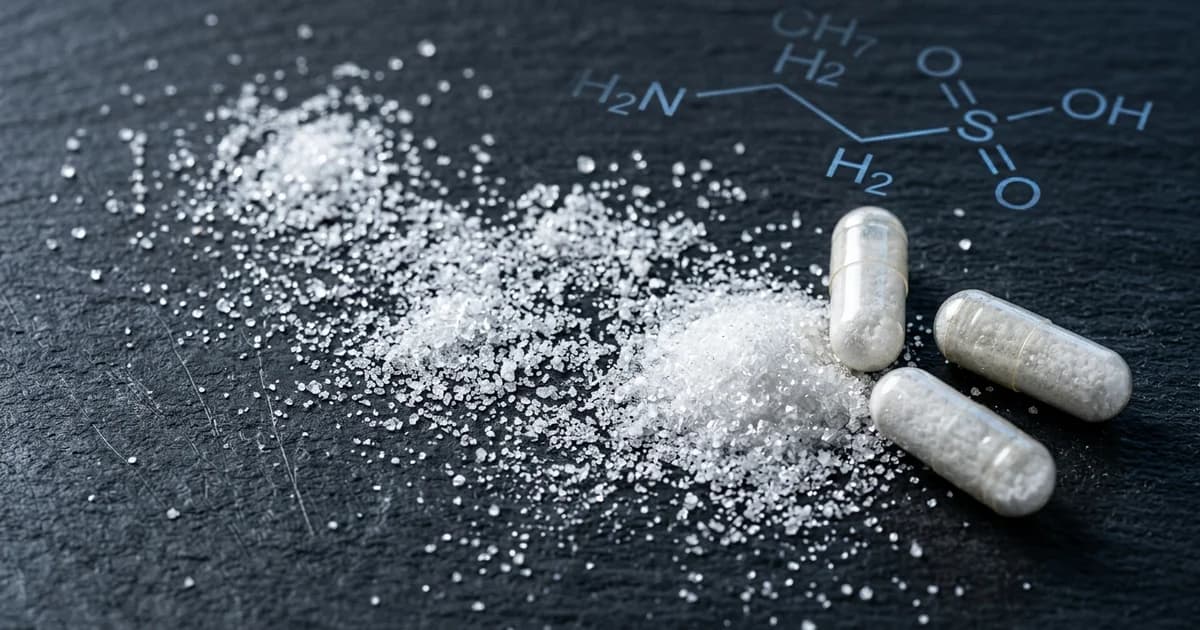
So what is taurine, exactly? Taurine (2-aminoethanesulfonic acid) is a sulfur-containing amino acid, but it's technically not used to build proteins. Unlike leucine or lysine, taurine doesn't get incorporated into muscle tissue. Instead, it acts as a free-floating agent throughout your body, concentrated in organs with high metabolic demand.
Your heart contains the highest concentration. Your brain and retinas come next. Skeletal muscle holds about 70% of the total taurine pool.
You get taurine from food (meat, fish, and dairy are the richest sources) and from internal synthesis via the amino acid cysteine. Vegetarians and vegans tend to have lower circulating taurine levels, which is one reason a taurine supplement has gained traction in those populations.
Understanding what is taurine also means understanding the roles it plays:
- Bile salt formation (critical for fat digestion)
- Cell membrane stabilization
- Calcium signaling in the heart
- Neurotransmitter modulation in the brain
- Antioxidant defense against oxidative stress
That's a lot of jobs for a single molecule. And it explains why researchers keep finding connections between taurine status and health outcomes across seemingly unrelated systems, reinforcing why taurine benefits span so many areas of health.
Taurine Benefits for Heart Health
This is where the evidence for taurine benefits is strongest. Taurine's role in cardiovascular function has been studied for decades, and the data keeps accumulating.
A 2024 systematic review and meta-analysis indexed on PubMed pooled data from multiple randomized controlled trials and found that taurine supplementation reduced systolic blood pressure by approximately 3.99 mmHg and heart rate by about 3.58 bpm. Those numbers might sound modest, but population-level reductions in systolic pressure of just 2 mmHg are associated with meaningful decreases in cardiovascular event risk.
The same meta-analysis found dose-dependent effects, meaning higher taurine dosage correlated with larger reductions in both blood pressure and heart rate.
How Taurine Supports the Heart
The mechanisms behind these taurine benefits are well-mapped:
- Calcium regulation: Taurine modulates calcium flux in cardiac muscle cells, which helps maintain normal heart rhythm and contractile function.
- Blood pressure: Taurine appears to reduce blood pressure through multiple pathways, including interaction with the renin-angiotensin system and direct effects on vascular smooth muscle. Research published in PMC has shown that taurine reduces ACE overactivation in animal models of hypertension.
- Anti-inflammatory effects: Chronic low-grade inflammation damages blood vessels over time. Taurine's antioxidant and anti-inflammatory properties help protect vascular endothelium.
For people with congestive heart failure, the taurine benefits are particularly interesting. Taurine supplementation has been associated with improvements in left ventricular ejection fraction (LVEF) and New York Heart Association (NYHA) functional class in clinical trials.
Taurine Benefits for Brain Function
Your brain relies on a delicate balance between excitatory and inhibitory signaling. Too much excitation leads to neurotoxicity. Too little, and cognitive function stalls. This is where the neuroprotective taurine benefits come into play.
Taurine acts primarily as a neuromodulator, supporting inhibitory neurotransmission through its interaction with GABA and glycine receptors. According to research published in Neural Regeneration Research, taurine protects against several neurological conditions in preclinical models, including stroke, epilepsy, and memory dysfunction.
What the Research Shows
A report from the Alzheimer's Drug Discovery Foundation reviewed the cognitive evidence and noted that lower circulating taurine levels may correlate with higher dementia risk. In animal studies, taurine treatment attenuated cognitive impairment while decreasing inflammation and oxidative stress markers.
The human clinical trial data for cognition is still limited. A meta-analysis of 7 randomized controlled trials found no overall cognitive benefit from a taurine supplement in healthy adults. But the preclinical signal is strong enough that researchers continue to investigate taurine benefits in aging populations where taurine levels naturally decline.
Here's what we can say with confidence: taurine supports the neurochemical environment your brain needs to function well. It promotes the excitatory-inhibitory balance that underlies focus, memory, and mental clarity. Whether supplemental taurine meaningfully boosts cognition in healthy young adults remains an open question.
Taurine Benefits for Energy and Exercise
Taurine shows up in nearly every energy drink on the market. That's not an accident, but the reasons behind these taurine benefits might surprise you.
Taurine doesn't give you energy the way caffeine does. It doesn't block adenosine receptors or spike your adrenaline. Instead, taurine benefits energy metabolism at the cellular level by protecting mitochondria from oxidative damage and supporting efficient calcium handling in muscle tissue.
A systematic review published in PMC examined the dose-response relationship of taurine dosage on exercise performance and found that doses around 1 to 3 grams taken before exercise improved endurance capacity. The review also noted that different exercise types (aerobic vs. strength) may require different dosing strategies.
Why Taurine Pairs Well With Other Compounds
Taurine's real value in an energy context isn't as a standalone stimulant. The taurine benefits here come from its role as a support compound that smooths out the effects of actual stimulants like caffeine. Taurine's calming, inhibitory influence on the nervous system can help counterbalance the jitteriness and anxiety that high-dose caffeine sometimes produces.
This is why you'll find taurine in energy drinks alongside caffeine. The combination makes physiological sense, even if most energy drinks deliver it in a sugar-loaded, poorly dosed package.
Taurine Dosage: How Much Should You Take?
The research points to a clear taurine dosage range. According to Examine.com, a regular intake of up to 3 grams per day can be consumed without safety concerns. The Drugs.com clinical monograph notes that taurine has been tested in doses as high as 10 grams per day for 6 months, though long-term safety data at those levels is limited.
Most clinical trials demonstrating taurine benefits for cardiovascular and metabolic health used doses between 500 mg and 6 grams per day. For general health support, a taurine dosage of 1 to 3 grams daily is the most common recommendation.
| Goal | Suggested Taurine Dosage | Timing |
|---|---|---|
| General health support | 500 mg to 1,000 mg/day | With meals |
| Cardiovascular support | 1,000 mg to 3,000 mg/day | Split doses |
| Exercise performance | 1,000 mg to 3,000 mg | 30-60 min pre-workout |
| Cognitive support | 1,000 mg to 2,000 mg/day | Morning or split doses |
Side effects are rare at recommended doses. Some people report mild gastrointestinal discomfort at higher intakes, but taurine is generally well-tolerated.
Comparing Popular Taurine Supplements
If you're shopping for a taurine supplement, the market is dominated by standalone capsules and powders. Here's how the major options stack up:
| Product | Taurine Dose | Form | Other Active Ingredients | Approx. Price |
|---|---|---|---|---|
| NOW Foods Taurine Double Strength | 1,000 mg | Veg capsule | None | ~$12 for 100 caps |
| Life Extension Taurine | 1,000 mg | Veg capsule | None | ~$10 for 90 caps |
| Nutricost Taurine | 1,000 mg | Capsule | None | ~$15 for 400 caps |
| NatureBell Taurine Powder | 2,000 mg/serving | Powder | None | ~$20 for 1 kg |
Product details sourced from NOW Foods, Life Extension, and Amazon listings.
These are all solid, reputable products. Each taurine supplement delivers what it promises: pure taurine at a fair price.
But they all share the same limitation.
What's Missing From Standalone Taurine Supplements
Every product in the table above gives you taurine and nothing else. That's fine if you already have a complete supplement stack dialed in. For most people, though, relying on a single taurine supplement creates a gap, and the taurine benefits alone won't fill it.
No complementary stimulants. Taurine supports cellular energy but doesn't provide the acute focus and alertness most people are actually looking for. You still need a separate caffeine source, and now you're managing two supplements.
No complementary calming agents. Taurine benefits include mild calming properties through its GABA-receptor activity, but taurine is not L-Theanine. If you want the smooth, jitter-free focus that comes from pairing caffeine with a true anxiolytic amino acid, a standalone taurine supplement doesn't get you there.
No sustained-release energy profile. Caffeine hits fast and fades fast. Taurine doesn't address this. You need compounds like Theacrine or Methylliberine, which extend the energy curve and reduce tolerance buildup over time, to solve the crash problem.
Delivery format is outdated. Capsules and powders require water, digestion time, and a 30 to 45-minute wait before effects kick in. Sublingual delivery, where active compounds absorb directly through the mucous membrane under your tongue, bypasses the GI tract entirely and gets ingredients into your bloodstream faster.
In short: taurine benefits are real and well-documented, but taurine works best as part of a system, not in isolation.
A Smarter Approach to Clean Energy
This is exactly the problem Roon was designed to solve. Instead of stacking individual capsules and hoping the doses and timing align, Roon's nootropic pouches combine 80 mg of caffeine, L-Theanine, Theacrine, and Methylliberine in a single sublingual pouch.
The caffeine (roughly equivalent to a cup of coffee) provides the alertness. L-Theanine smooths out the stimulant edge (the same inhibitory-excitatory balancing act that makes taurine benefits interesting, but with stronger clinical evidence for focus). Theacrine and Methylliberine extend the energy curve to 6 to 8 hours without the crash or tolerance buildup that regular caffeine causes.
No water needed. No pills to swallow. No waiting 45 minutes for a capsule to dissolve.
If you've been researching taurine benefits because you want sustained, clean energy without jitters, the stack inside Roon addresses that goal more directly than any single-ingredient taurine supplement can. Check it out here.