Attention Span of a Gnat: The Science Behind Why You Can't Focus (And What Actually Helps)
If you've ever been told you have the attention span of a gnat, you're not alone. You read the first sentence of an email, then check Slack, then open a new tab, then forget why you opened it. Forty seconds later, you're somewhere else entirely. You probably laughed off the comparison, but the attention span of a gnat is more accurate a description of modern focus than you'd like to admit.
A gnat has an attention span of effectively zero. It has no memory. It responds to stimuli like a machine, bouncing from one signal to the next with no ability to sustain focus on anything. According to the Cambridge English Dictionary, the phrase means "to be able to pay attention to something for only a very short time before becoming bored." And right now, the data on human attention is creeping uncomfortably close to that definition.
This isn't a moral failing. It's a neurochemical problem with a measurable footprint. Here's what's actually happening inside your brain, why the attention span of a gnat keeps coming up in conversation, and what the science says about fixing it.
Key Takeaways
- The average attention span on a screen is now 47 seconds before switching tasks, according to UC Irvine research.
- Task switching doesn't just waste time. It degrades the quality of your thinking by forcing your prefrontal cortex to constantly reload context.
- Three neurotransmitter systems (adenosine, dopamine, GABA) play a direct role in whether you can hold focus or slip into brain fog.
- Specific compounds, including L-theanine, caffeine, and theacrine, have clinical evidence supporting their effects on sustained attention.
47 Seconds: The Attention Span of a Gnat in Human Form
The phrase "attention span of a gnat" used to be hyperbole. Now it's closer to a rounding error.
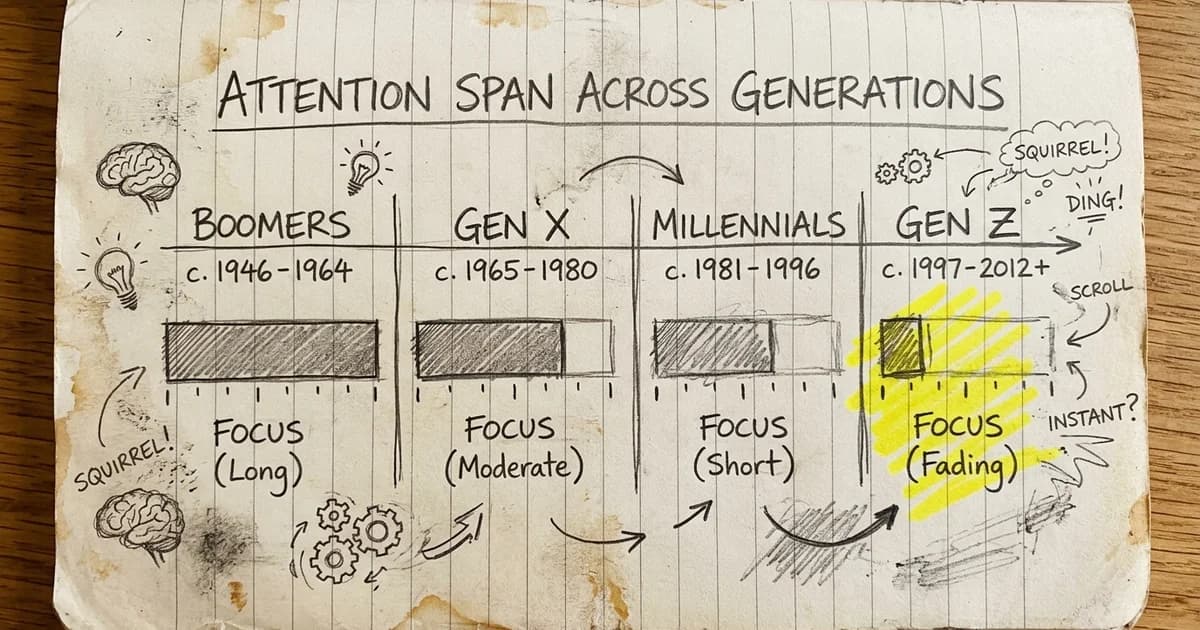
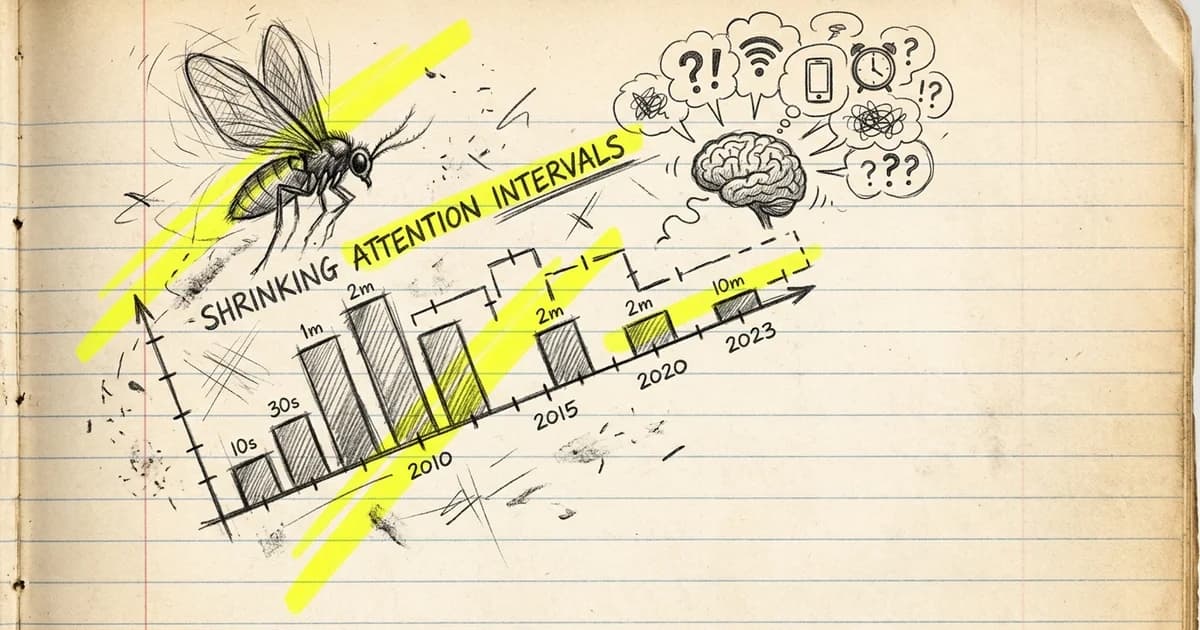
Dr. Gloria Mark, Professor of Informatics at UC Irvine and author of Attention Span, has tracked on-screen focus for nearly two decades. Her research shows that the average attention span on any screen is just 47 seconds before switching to something else. The median is even worse: 40 seconds. That means half the time, people shift focus in under 40 seconds. That's getting dangerously close to the attention span of a gnat territory.
For context, in 2004, the average was around 2.5 minutes. That's a roughly 70% decline in two decades.
And the commonly cited statistic that the average human attention span is 8.25 seconds (shorter than a goldfish's 9 seconds) paints an even bleaker picture. While that specific number has been debated by researchers, the direction of the trend is not in question. We are getting worse at holding focus. Period.
What's Actually Happening in Your Brain
Attention isn't willpower. It's chemistry. And understanding why you feel like you have the attention span of a gnat starts with understanding three neurotransmitter systems.
Your ability to focus depends on a tightly coordinated set of these systems. When they fall out of balance, the result is what most people describe as "brain fog," that frustrating state where you're technically awake but can't seem to lock onto anything.
Three systems matter most:
Adenosine: The Fatigue Signal
Adenosine is a byproduct of neural activity. The longer you've been awake and thinking, the more adenosine builds up in your brain. It binds to receptors that slow neural firing, making you feel tired and unfocused. This is your brain's built-in "time to rest" signal, and when it's overactive, you end up with the attention span of a gnat.
Caffeine works by blocking adenosine receptors. That's why coffee makes you feel alert. But caffeine alone is a blunt instrument. It blocks the fatigue signal without doing anything to improve the quality of your attention. That's why you can drink three cups of coffee and still feel scattered.
Dopamine: The Relevance Filter
Dopamine doesn't just make you feel good. It tells your brain what's worth paying attention to. When dopamine signaling is disrupted, everything feels equally (un)interesting. Your brain can't prioritize, so it bounces between stimuli like, well, a gnat.
Research from the Attention Deficit Disorder Association confirms that disrupted dopamine transmission is a key factor in attention difficulties and the foggy, unfocused state that follows. This isn't limited to clinical populations. Anyone running on poor sleep, chronic stress, or a diet heavy in processed food can experience dopamine dysregulation, and with it, the attention span of a gnat.
GABA: The Noise Canceler
GABA (gamma-aminobutyric acid) is your brain's primary inhibitory neurotransmitter. Its job is to quiet the neural chatter that doesn't matter so you can focus on what does. Think of it as noise cancellation for your prefrontal cortex.
A study published in the Journal of Cognitive Enhancement (via PMC) found that dopamine and GABA are both important modulators of cognitive flexibility, the ability to switch between tasks efficiently without losing your train of thought. When GABA levels are off, your brain struggles to filter out distractions, and every notification, background conversation, or stray thought gets equal airtime.
The Real Cost of Constant Switching
Here's where the attention span of a gnat comparison gets uncomfortable.
A gnat moves from stimulus to stimulus because it has no capacity for sustained attention. You move from stimulus to stimulus because your environment is designed to make you do exactly that.
Every time you switch tasks, your brain pays what researchers call a switch cost. According to Wake Forest University neuroscience research, cognitive efficiency drops each time the brain disengages from one task and reorients to another. The frontal and parietal lobes have to reconfigure, reload context, and suppress the residual activation from whatever you were just doing.
This isn't a minor inconvenience. A 2023 Asana study found that employees switch between 10 or more apps daily, costing an average of 3.6 hours per week in lost efficiency. That's nearly a full half-day of work, gone, every single week.
The problem compounds. Each switch doesn't just cost time. It costs cognitive quality. Your thinking gets shallower. Your error rate increases. Your ability to hold complex ideas in working memory degrades. You aren't multitasking. You're rapidly failing at multiple things in sequence, performing with the attention span of a gnat while telling yourself you're being productive.
Why Willpower Alone Won't Fix the Attention Span of a Gnat
The standard advice for improving focus sounds reasonable: put your phone in another room, use a Pomodoro timer, meditate. And those strategies can help. But they treat the symptom without addressing the underlying neurochemistry.
If your adenosine levels are elevated because you slept six hours, no timer is going to give you deep focus. If your dopamine system is burned out from constant micro-rewards (every like, every notification, every scroll), your brain physically cannot assign priority to a single task. If your GABA system is underperforming, the noise never stops.
This is why the same person can crush a focused work session on Tuesday and feel like they have the attention span of a gnat on Thursday. The difference isn't discipline. It's brain chemistry.
What the Research Says About Targeted Support
The most interesting work in attention science right now isn't about productivity hacks. It's about compounds that directly support the neurotransmitter systems responsible for focus, the same systems that, when depleted, leave you operating with the attention span of a gnat.
Caffeine + L-Theanine: The Evidence-Based Pair
A study published on PubMed tested a combination of 97mg L-theanine and 40mg caffeine in young adults. The result: the combination improved accuracy during task switching and increased self-reported alertness, while reducing tiredness. These effects were statistically significant (p < 0.01 for accuracy and alertness).
What makes this pairing interesting is the mechanism. Caffeine blocks adenosine (reducing the fatigue signal), while L-theanine promotes alpha brain wave activity and modulates GABA, effectively turning down neural noise. Together, they produce a state that researchers describe as "alert calm," focused without the jittery edge that caffeine alone creates.
A 2024 crossover study published in the British Journal of Nutrition confirmed that this combination enhances attentional focus by suppressing mind wandering and reducing attention to distractors, even in sleep-deprived subjects.
Theacrine: The Non-Habituating Stimulant
Theacrine is a purine alkaloid structurally similar to caffeine. It acts as an adenosine receptor antagonist, meaning it blocks fatigue signals through the same pathway as caffeine. But with a key difference: early studies show non-habituating effects, meaning your body doesn't build tolerance to it the way it does with caffeine.
A study in Scientific Reports found that theacrine consumption improved certain aspects of next-morning cognitive performance, suggesting it supports sustained mental function beyond its acute window.
Methylliberine: The Speed Enhancer
Methylliberine (marketed as Dynamine) is another purine alkaloid in the same chemical family as caffeine and theacrine. It has a faster onset than theacrine and is believed to work on both adenosine and dopamine pathways. While the clinical literature on methylliberine is still growing, its inclusion in nootropic stacks is based on its rapid onset and its complementary action with caffeine and theacrine.
Building a Brain That Doesn't Have the Attention Span of a Gnat
The path out of gnat-level attention isn't a single fix. It's a stack of interventions that address the problem at multiple levels:
| Layer | What It Does | Examples |
|---|---|---|
| Environment | Reduces external triggers for task switching | Phone in another room, notification blocking, single-tab browsing |
| Behavior | Builds focus as a practiced skill | Time-blocked deep work, strategic breaks, sleep hygiene |
| Neurochemistry | Supports the brain systems that enable sustained attention | Targeted compounds that modulate adenosine, dopamine, and GABA |
Most people only work on the first two layers. They rearrange their environment and try harder. That's like trying to run a marathon on a sprained ankle by just changing your shoes. The shoes help. But the ankle still needs support.
Cut Through the Fog
If you've made it this far (congratulations, by the way, your attention span is doing better than average), the takeaway is simple. The attention span of a gnat problem isn't about laziness or lack of discipline. It's about a brain running on depleted neurochemistry in an environment designed to fragment your focus. You don't have to accept the attention span of a gnat as your default setting.
Roon was built for exactly this problem. It's a zero-nicotine sublingual pouch that delivers a precise stack of caffeine (80mg), L-theanine, theacrine, and methylliberine, the same compounds with clinical evidence for supporting sustained attention. It targets the adenosine, GABA, and dopamine pathways behind brain fog and delivers 6 to 8 hours of clean, sustained focus without the jitters, crash, or tolerance buildup that come with coffee or energy drinks.
No gnat brain required. Just better chemistry.