Nootropic Pouches vs Nootropic Pills: Which Format Wins?
Roon Team
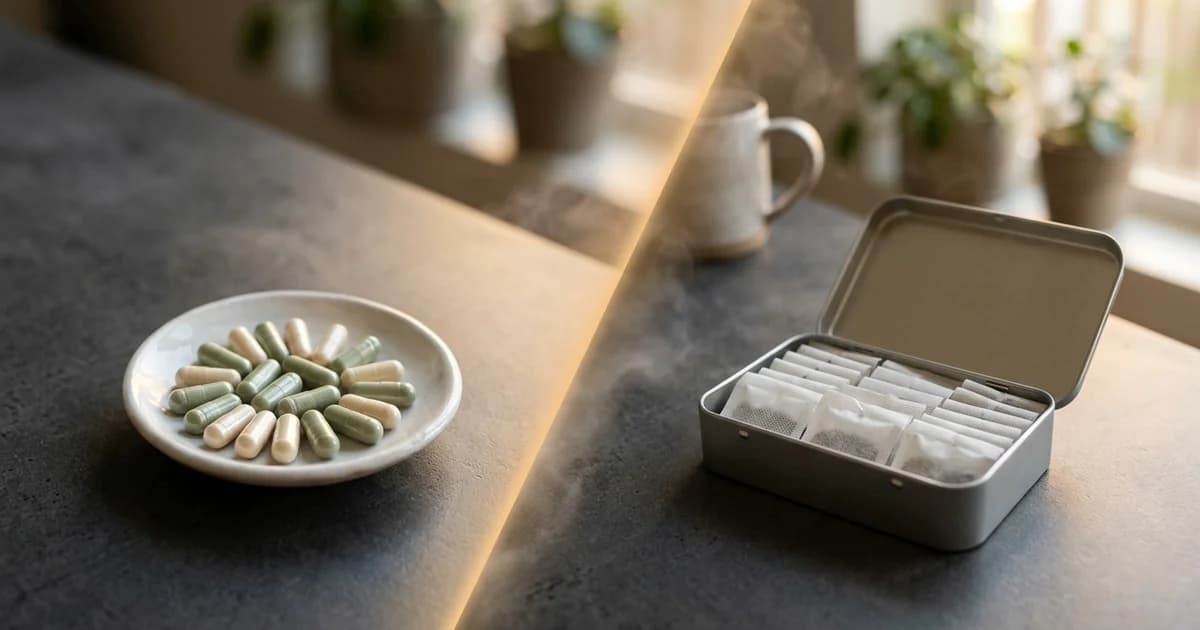
Nootropic Pouches vs Pills: 5 Reasons the Format You Choose Matters More Than the Formula
You spent twenty minutes comparing ingredient labels. Dosages, proprietary blends, clinical references. But here's what most nootropic shoppers miss entirely: the nootropic pouches vs pills debate isn't just about what's inside. It's about what actually reaches your brain, how fast it gets there, and whether the format fits the moments you need it most.
The difference between a capsule that dissolves in your stomach and a pouch that absorbs through your cheek lining isn't trivial. It changes onset speed, bioavailability, and real-world usability in ways that matter more than an extra 50mg of any single ingredient.
Key Takeaways:
- Sublingual and buccal delivery bypasses first-pass liver metabolism, which can reduce the active dose of swallowed pills before it ever reaches your bloodstream.
- Nootropic pouches typically deliver effects in 5 to 15 minutes; capsules take 30 to 60 minutes.
- Pouches require no water, no timing around meals, and no pill organizer.
- The best oral nootropic delivery format depends on your goals, but speed and absorption efficiency give pouches a clear edge for on-demand cognitive support.
1. Buccal Absorption Bypasses the Liver (and That Changes Everything)
Every pill you swallow takes the long route. It drops into your stomach, passes through the intestinal wall, and filters through your liver before any active compound reaches systemic circulation. Pharmacologists call this first-pass metabolism, and it's the single biggest reason oral bioavailability varies so wildly between compounds.
A 2025 review in Pharmaceutics confirms that oral mucosal delivery bypasses both the gastrointestinal environment and hepatic first-pass metabolism, making it a growing area of pharmaceutical research. The practical result: compounds absorbed through the cheek or under the tongue can enter the bloodstream more intact.
This isn't theoretical. According to a PMC review on sublingual and buccal delivery, oral verapamil had just 10 to 20% systemic bioavailability when swallowed, but sublingual and buccal routes provided a clear pharmacokinetic advantage by sidestepping first-pass degradation. The same principle applies to nootropic compounds. When you place a pouch against your gum, the active ingredients diffuse through thin, highly vascularized tissue directly into your blood.
Not every compound suffers equally from first-pass metabolism. Caffeine, for example, has near-complete oral bioavailability on its own. But many nootropic ingredients are less resilient. The more compounds in your stack that lose potency in the gut and liver, the more the delivery route matters.
Best for: Anyone who wants more of each dose to actually reach the brain, not the liver.
2. The 5-Minute Rule: Nootropic Pouches vs Pills for Speed
You don't plan brain fog. It shows up mid-meeting, mid-deadline, mid-afternoon slump. And when it does, the difference between 5 minutes and 50 minutes matters.
Oral nootropic capsules typically take 30 to 60 minutes to produce noticeable effects. According to a pharmacology resource on nootropic timing, caffeine in pill form usually kicks in within 30 to 60 minutes. That timeline depends on stomach contents, gastric emptying rate, and capsule dissolution speed. Eat a big lunch first? Add another 20 minutes.
Sublingual and buccal formats work faster. A clinical guide from National Addiction Specialists reports that sublingual medications typically work within 2 to 5 minutes, bypassing the 30 to 60 minute delay of oral pills entirely. Nootropic pouches sit in that same delivery category. Roon's own research on the topic puts the typical onset window for sublingual pouches at 5 to 15 minutes.
Typical onset: Pouches: 5-15 min | Capsules: 30-60 min
3. No Water, No Timing, No Ritual: The Convenience Factor
Nootropic pills come with invisible friction. You need water. You need to remember them. You probably need to time them around food for best absorption. Miss the window and you're either waiting until tomorrow or dry-swallowing a capsule at your desk like a feral raccoon.
Pouches eliminate all of that. As noted by the Nectr nootropic pouch brand, pouches remove the need for water, mixing, or swallowing pills, making them the most portable and discreet option. You can use one in a meeting, on a commute, or at your desk without drawing attention.
This sounds like a minor point until you consider adherence. Research published in PMC on medication regimen factors shows that complexity of a dosing regimen directly impacts whether people actually follow through. Fewer steps means more consistency. A pouch you can tuck in your lip during a Zoom call has a better shot at becoming a real habit than a capsule buried in a kitchen drawer.
There's also the social friction. Pulling out a pill bottle at a coffee shop or in a meeting reads differently than tucking a small pouch in your lip. One looks like medication. The other is invisible.
Best for: People who want cognitive support that fits their actual workflow, not a supplement schedule.
4. Dose Precision and the Proprietary Blend Problem
Here's where the nootropic pill format has a dirty secret: proprietary blends. Many popular capsule-based nootropics list impressive ingredient panels but hide the individual dosages behind a single "blend" number. You see 650mg of a "Focus Blend" containing six ingredients and have no idea whether you're getting a meaningful dose of any single one.
A review from Innerbody on the best nootropics highlights that common nootropic ingredients like alpha-GPC, citicoline, and huperzine A appear across many products, but the actual doses vary wildly. Onnit's Alpha Brain, one of the most recognized nootropic pills on the market, uses proprietary blends for its three main complexes, making it difficult to know exactly how much of each active ingredient you're getting per serving.
Pouches tend to be simpler formulas with fewer ingredients, which makes full-dose transparency easier. When a pouch lists 80mg caffeine, 60mg L-theanine, 25mg methylliberine, and 5mg theacrine, you know exactly what you're getting. No guessing.
This matters more than most people realize. If you can't verify the dose, you can't replicate the effect. And you can't troubleshoot what's working or what isn't.
Best for: Nootropic shoppers who want to know exactly what they're putting in their body.
5. The Stack Advantage: Why Fewer Ingredients Can Mean Better Results
More ingredients doesn't mean better cognition. It often means underdosed ingredients competing for absorption. The best pouches vs pills cognitive comparison isn't about who has the longer label. It's about whether the compounds in the formula actually work together at effective doses.
A study published in Cureus found that combining caffeine with TeaCrine (theacrine) and Dynamine (methylliberine) improved cognitive performance and reaction time without negatively affecting mood. A separate trial with tactical personnel showed that a lower dose of caffeine combined with methylliberine and theacrine matched the vigilance performance of double the caffeine dose alone.
That's the difference between a focused stack and a kitchen-sink formula. Four compounds working through complementary pathways can outperform twelve compounds sprinkled in at trace amounts. Research on L-theanine and caffeine further supports this, showing that even relatively low doses of the combination affect attention task performance and alpha-band brain activity.
Best for: Anyone who values effective dosing over impressive-looking labels.
Quick Comparison: Nootropic Pouches vs Nootropic Pills
| Factor | Nootropic Pouches | Nootropic Pills |
|---|---|---|
| Delivery route | Buccal/sublingual (oral mucosa) | Gastrointestinal (stomach + intestine) |
| First-pass metabolism | Bypassed | Full exposure |
| Typical onset | 5-15 minutes | 30-60 minutes |
| Water required | No | Yes (usually) |
| Dose transparency | Typically full disclosure | Often proprietary blends |
| Portability | Pocket-sized tin, no accessories | Bottle + water |
| Best use case | On-demand focus, real-time cognitive support | Daily stacking, long-term supplementation |
| Ingredient count | Focused (2-5 compounds) | Broad (6-15+ compounds) |
| Roon (example) | 80mg caffeine / 60mg L-theanine / 25mg methylliberine / 5mg theacrine | N/A |
When Pills Still Make Sense
Pouches aren't the right format for everything. If you're taking a nootropic that requires weeks of daily loading to reach effective tissue levels (think: lion's mane, bacopa monnieri, or creatine for cognitive support), a capsule makes more sense. These compounds don't need speed of onset. They need consistent daily intake over time.
Pills also win when you need very high doses of a single compound. Fitting 500mg of anything into a small pouch that sits comfortably in your lip isn't practical. Capsules can hold more raw material per serving.
The real question isn't "pouches or pills." It's "what do I need right now?" For on-demand focus and fast-acting cognitive support, buccal delivery has clear advantages. For long-term supplementation protocols, capsules still earn their place. Many serious users, including those seeking cognitive support for professionals over 40, end up with both: a daily capsule regimen for foundational support and a pouch for the moments that demand sharp, immediate performance.
Frequently Asked Questions
Does the delivery format really matter more than the ingredient dose?
For fast-acting compounds like caffeine and methylliberine, yes. A 60mg dose absorbed sublingually can outperform a 100mg dose swallowed in a capsule because the buccal route bypasses first-pass liver metabolism. When the liver degrades a measurable share of an active compound before it reaches circulation, the label dose and the effective dose diverge. Format changes the math before the ingredient even gets a chance to work.
How do nootropic pouches absorb faster than pills?
Pouches sit against the oral mucosa, the tissue lining the inside of the cheek and lip. That tissue is thin and densely vascularized, which means active compounds diffuse directly into capillaries and enter the bloodstream without traveling through the digestive system. Capsules must dissolve, pass through stomach acid and the intestinal wall, then survive the liver before any compound enters general circulation. That multi-step process takes 30 to 60 minutes. Mucosal absorption takes 5 to 15.
What is first-pass metabolism and why does it matter for nootropics?
First-pass metabolism refers to the liver's processing of ingested compounds before they reach systemic circulation. After a swallowed pill absorbs through the intestinal lining, it travels through the portal vein to the liver, where enzymes break down a portion of the active ingredients. Depending on the compound, this can reduce bioavailability substantially. Sublingual and buccal delivery routes feed into the jugular vein directly, bypassing the liver on the first pass entirely.
Are proprietary blends a real problem or just marketing noise?
They're a real problem for anyone trying to replicate or optimize an effect. A proprietary blend lists ingredients but hides individual doses behind one total weight. You might see 600mg of a "Cognitive Matrix" with six ingredients and no way to know if any single compound reaches a clinically studied dose. That makes it impossible to connect a felt effect to a specific ingredient or to adjust your routine intelligently. Full-disclosure labels, common with simpler four-ingredient formulas, give you actual data to work with.
When should someone choose pills over pouches?
Two main scenarios: when a compound requires loading over weeks for tissue saturation (lion's mane, bacopa, creatine) or when the required dose per serving is too large to fit in a buccal pouch format. Slow-loading compounds don't benefit from fast onset, so the buccal advantage doesn't apply. Capsules also allow higher milligram loads per serving. For on-demand focus and real-time cognitive support, the delivery speed and bioavailability of pouches win. For foundational daily supplementation, capsules and pouches can complement each other.
Can you stack nootropic pouches with capsules?
Many users do. A morning capsule regimen covering slow-loading compounds (lion's mane, bacopa) pairs well with an on-demand buccal pouch for acute focus support. The formats address different timescales: the capsule builds a baseline over weeks, the pouch delivers a measurable shift within minutes. The key is avoiding overlapping stimulant loads. If your capsule stack already includes caffeine, adding a caffeinated pouch on top requires attention to total daily intake.
Bottom Line: Match the Format to the Moment
The best nootropic delivery method is the one that actually gets the right compounds into your bloodstream when you need them. For daily background supplementation, pills work fine. For the moments pouches outperform everything, when you need to be sharp in five minutes and stay locked in for hours, a sublingual pouch is built for that job.
Roon was designed around this exact idea. Each pouch delivers 80mg caffeine, 60mg L-theanine, 25mg Dynamine (methylliberine), and 5mg TeaCrine (theacrine) through the oral mucosa. No water, no waiting, no proprietary blend mysteries. Just four compounds with published research behind the combination, delivered through the fastest non-injectable route available.
If you've been stacking capsules and wondering why the effects feel inconsistent or slow, the format might be the bottleneck, not the formula. Give it a try and feel the difference delivery makes.
By Roon Team