Mushroom Supplements for Focus: What Actually Works
Roon Team
Mushroom Supplements for Focus: What Actually Works (And What's Just Hype)
The mushroom supplements for focus market has exploded. Walk into any health food store and you'll find shelves of capsules, including popular nootropic blends reviewed by celebrities and podcasters, promising laser-sharp concentration, better memory, and "cognitive optimization." The functional mushroom market is projected to grow from $11.2 billion in 2025 to over $25 billion by 2035, according to Future Market Insights. That's a lot of money chasing a simple question: do mushroom supplements for focus actually work?
The short answer is complicated. Some mushroom species have real, published clinical data behind them. Others are riding the wave of ancient tradition and Instagram aesthetics. Here's what the science says about mushroom supplements for focus, species by species, so you can stop guessing and start making informed decisions.
Key Takeaways:
- Lion's mane has the strongest clinical evidence for cognitive support among functional mushrooms.
- Cordyceps may help with mental energy indirectly through improved oxygen utilization, but human cognitive data is thin.
- Reishi is better suited for stress and sleep than direct focus enhancement.
- Most mushroom supplements for focus have serious quality control problems, from filler grain to mislabeled extracts.
Lion's Mane: The Best Mushroom Supplement for Focus
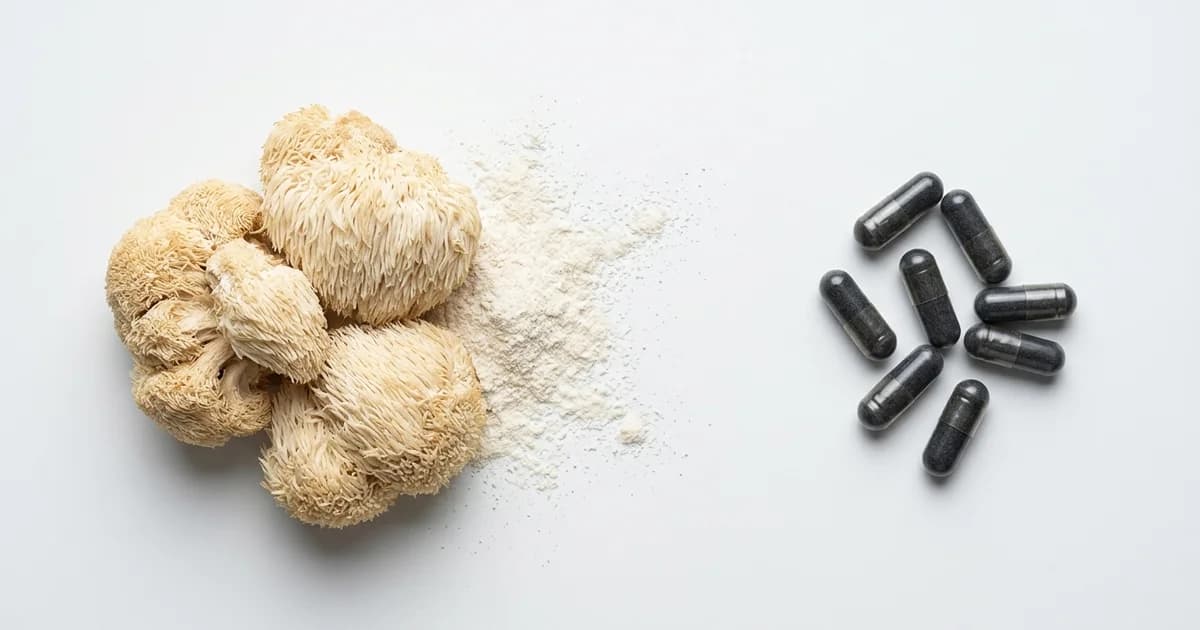
If you're going to try one mushroom for cognitive performance, lion's mane (Hericium erinaceus) is the obvious starting point. It's the only functional mushroom with multiple human clinical trials specifically measuring cognitive outcomes, making it the top candidate among mushroom supplements for focus.
The mechanism is genuinely interesting. Lion's mane contains two families of compounds, hericenones (found in the fruiting body) and erinacines (found in the mycelium), that can cross the blood-brain barrier and promote nerve growth factor (NGF) synthesis. NGF is a protein your brain needs to maintain, grow, and organize neurons. It's not a stimulant. It's closer to fertilizer for your nervous system.
What the Clinical Trials Show
The most cited trial is the Mori et al. (2009) study, a double-blind, placebo-controlled trial on 50- to 80-year-old adults with mild cognitive impairment. Participants took 3 grams of lion's mane daily for 16 weeks. The result: cognitive function scores improved consistently throughout the supplementation period compared to placebo. But here's the catch. Four weeks after they stopped taking it, the gains disappeared.
More recent work has looked at younger, healthy adults. A 2023 double-blind pilot study published on PubMed found that a single dose of lion's mane improved reaction time on the Stroop task (a standard measure of cognitive processing speed) within 60 minutes. After 28 days of supplementation, there was also a trend toward reduced subjective stress, though that finding didn't quite reach statistical significance. For people evaluating mushroom supplements for focus, this acute-effect data is encouraging.
A 2025 study published in Frontiers in Nutrition further investigated acute effects of a standardized lion's mane extract on cognition and mood in healthy younger adults. The researchers noted that mood benefits may be more pronounced in individuals already experiencing mood difficulties, rather than in healthy populations.
The Honest Assessment
Lion's mane is promising. The NGF mechanism is well-established in cell and animal models, and the handful of human trials point in the right direction. But "promising" is not the same as "proven." The trials are small (typically 30-80 participants), and the effects on healthy young adults, the people most likely buying mushroom supplements for focus, are modest. You're not going to take lion's mane and suddenly feel like you drank three espressos. The effects are subtle, cumulative, and may take weeks to notice.
Effective doses in clinical research range from 1 to 3 grams per day of actual mushroom material. The Alzheimer's Drug Discovery Foundation notes that clinical trials have tested up to 3 grams per day derived from the fruiting body, but dosage has not been established for any specific indication. Many commercial mushroom supplements for focus contain far less than what was used in these trials, and different brands use wildly different preparations (fruiting body, mycelium, various extraction methods), making direct comparisons difficult.
Cordyceps: The Energy Mushroom (Sort Of)
Cordyceps (Cordyceps militaris or Cordyceps sinensis) is marketed heavily for energy and athletic performance. The logic for focus goes like this: better oxygen utilization equals more energy to the brain equals sharper thinking. It's not a terrible theory. But the evidence is mostly indirect, and anyone shopping for mushroom supplements for focus should know the limits.
Research on animal models has shown that Cordyceps militaris can improve memory impairments in rats, with mechanisms tied to neuroprotection against ischemic damage. That's interesting for neuroscience, but it doesn't tell you much about whether a cordyceps capsule will help you power through a spreadsheet on a Tuesday afternoon.
The human data on cordyceps and cognition specifically is thin. Most human trials focus on physical endurance and VO2 max in older adults, not cognitive performance in healthy younger people. As Medichecks notes, cordyceps could support focus by boosting physical and mental energy, but most of the evidence remains in animal studies.
Studies showing benefits in older or clinical populations typically used doses of 1,000 to 3,000 mg daily for 12 weeks or more, according to Secret Nature's review of the research. That's a long commitment for uncertain cognitive returns.
Bottom line: Cordyceps might give you a slight energy lift. If you're fatigued and that fatigue is hurting your concentration, it could help indirectly. But there's no strong human evidence that cordyceps sharpens cognition the way lion's mane does, so it ranks lower among mushroom supplements for focus.
Reishi: Better for Calm Than for Focus
Reishi (Ganoderma lucidum) is often lumped into mushroom supplements for focus blends, but that's a stretch. Reishi is an adaptogen. Its primary studied effects are on immune modulation, stress response, and sleep quality. Not focus.
According to Healthline, reishi is known for its adaptogenic properties and its ability to help the body respond to stress. LongevityBotanicals reports that early research using blends containing reishi plus ashwagandha showed reduced perceived stress in healthy adults, though this doesn't isolate reishi's contribution.
Could lower stress improve focus? Absolutely. Chronic stress wrecks your ability to concentrate. But calling reishi a "focus supplement" is like calling a good night's sleep a nootropic. Technically true, practically misleading.
A 2025 randomized, double-blind, placebo-controlled trial published in PMC tested a proprietary mushroom blend (including reishi, lion's mane, maitake, and cordyceps) for its effects on stress, fatigue, and sleep. The results showed adaptogenic benefits, but the blend format makes it impossible to credit reishi alone.
Where reishi fits: As a nighttime or evening supplement to support stress recovery and sleep. Not as a daytime focus tool. If you're specifically seeking mushroom supplements for focus, reishi shouldn't be your first pick.
Mushroom Supplements for Focus: The Quality Problem Nobody Talks About
Here's where the mushroom supplements for focus industry gets messy. A 2023 market analysis covered by NutraIngredients called for more rigorous quality control across the sector, noting that simply relying on a supplier's Certificate of Analysis may not be enough.
The core issue is the fruiting body vs. mycelium-on-grain debate. Here's why it matters:
| Factor | Fruiting Body Extract | Mycelium on Grain |
|---|---|---|
| Active Compounds | Higher concentration of beta-glucans, hericenones (lion's mane) | Lower concentration, diluted by grain substrate |
| Starch Content | Low | Often 35-40% starch from grain filler |
| Cost | More expensive to produce | Cheaper and faster |
| Label Transparency | Usually specifies "fruiting body" | May just say "mushroom powder" |
As North Spore explains, mycelium-on-grain products involve growing the fungal mycelium on grain, then grinding the entire thing (mycelium plus grain) into powder. The result is a supplement that's largely grain starch with a fraction of actual fungal biomass. Select Ingredients notes that this high starch content, often 35 to 40%, dilutes the level of active mushroom compounds considerably. For anyone serious about mushroom supplements for focus, this distinction matters more than brand name or price.
What to Look for on the Label
Before buying any mushroom supplement for focus, check for these three things:
- "Fruiting body" on the label. If it just says "mycelium" or "full spectrum," you're likely getting a lot of grain filler.
- Beta-glucan content listed. This is the primary bioactive polysaccharide in medicinal mushrooms. Good products will list a specific percentage (aim for 20%+ for extracts).
- Third-party testing. Look for a COA (Certificate of Analysis) from an independent lab, not just the manufacturer's own testing.
The Bigger Picture: Why Mushroom Supplements for Focus Aren't Enough on Their Own
Let's be direct. Even the best mushroom supplement for focus is not a complete cognitive solution.
Lion's mane works on a structural level, supporting nerve growth factor production over weeks and months. It doesn't give you an immediate cognitive boost the way caffeine does. Cordyceps may nudge your energy levels. Reishi may help you sleep better. None of them deliver the acute, in-the-moment focus that most people are actually looking for when they search for mushroom supplements for focus online.
Real cognitive performance comes from stacking the right inputs. You need something for immediate alertness (like caffeine), something to smooth out the jitters (like L-theanine), and ideally compounds that extend the effect without the crash (like theacrine or methylliberine). Mushroom supplements for focus can play a supporting role in that stack, but they're the long game, not the quick win.
The research supports a practical framework: use clinically backed focus ingredients (caffeine, L-theanine) for daily focus, and consider mushroom supplements for focus like lion's mane as a longer-term addition if you're willing to commit to consistent daily use for at least a month.
This is the gap that most mushroom supplement brands don't address. They sell you the long-term potential without solving the immediate problem.
The Nootropic Stack, Simplified
If you want focus that works right now and doesn't require six different bottles on your desk, Roon takes a different approach. Instead of relying on a single ingredient with weeks-long onset times, Roon's nootropic pouches combine 80 mg of caffeine, L-theanine, theacrine, and methylliberine in a zero-nicotine sublingual pouch. The stack is designed for 6 to 8 hours of sustained focus without the jitters, crash, or tolerance buildup that comes with higher-caffeine alternatives.
It's not a mushroom supplement for focus. It's the part of the equation that mushrooms can't cover: reliable, immediate, smooth cognitive performance you can actually feel. Try it at takeroon.com.