How to Focus Better in School (Without Burning Out)
Roon Team
How to Focus Better in School (Without Burning Out)
You're sitting in class, staring at the whiteboard, and your brain has already left the building. Learning how to focus better in school starts with recognizing this exact moment: the professor is three slides deep into a lecture on macroeconomics, but you're mentally replaying a conversation from last night. Sound familiar?
Figuring out how to focus better in school isn't about willpower. It's about understanding what your brain actually needs to pay attention, and then building a system around that. The students who seem effortlessly locked in during lectures aren't genetically gifted. They've just figured out a few things you haven't. Yet.
This guide covers the specific, evidence-backed strategies that help you focus better in class, retain more of what you learn, and stop white-knuckling your way through every study session.
Key Takeaways
- Your phone is the single biggest threat to your focus. Remove it from sight during class and study sessions.
- Sleep quality predicts academic performance more reliably than hours spent studying.
- Structured breaks beat marathon sessions. The Pomodoro Technique and similar methods keep your brain fresh.
- What you put in your body matters. Caffeine, hydration, and amino acids like L-Theanine all influence how well you concentrate.
Why You Can't Focus in Class (It's Probably Not Your Fault)
Before you can learn how to focus better in school, it helps to understand why focus breaks down in the first place.
Research from the University of Albany found that young adults exposed to mobile phone distractions performed worse on learning outcomes compared to students without distractions. That tracks with what most students already feel intuitively: your phone is destroying your ability to pay attention.
And it's not just personal device use. An OECD report found that 59% of students across OECD countries said their attention was diverted by other students using phones, tablets, or laptops in at least some math lessons. You're fighting your own impulses and everyone else's screens, which makes learning how to focus better in class even harder.
Then there's the attention span question. Researchers at the University of California, Irvine tracked attention over time and found the average screen-based attention span dropped from two and a half minutes in 2004 to just 75 seconds by 2012. Your environment is literally training your brain to context-switch constantly.
The good news? Focus is a skill. You can train it.
How to Focus Better in School: 8 Strategies That Actually Work
1. Put Your Phone in Another Room
Not on silent. Not face-down on your desk. In another room, or at minimum, in a bag you can't easily reach.
The University of Albany analysis confirmed what you probably suspect: students in the phone distraction group scored lower than those without phones present. The mere presence of your phone, even if you don't touch it, splits your attention. Your brain is spending energy resisting the urge to check it. If you're serious about how to focus better in school, this is step one.
If your class requires a laptop, use a browser extension like Cold Turkey or Freedom to block social media and messaging apps during lecture hours.
2. Fix Your Sleep Before Anything Else
This one isn't sexy, but it's the single most effective change you can make when figuring out how to focus better in school.
According to the American Academy of Sleep Medicine, students with symptoms of sleep disorders are more likely to receive poor grades in classes like math, reading, and writing. A separate analysis published in Preventive Medicine found that sleep-deprived college students are more likely to fall asleep during lectures or skip class entirely.
The fix isn't complicated. Go to bed at the same time every night. Stop screen use 30 minutes before sleep. Keep your room cool and dark. If you're averaging less than seven hours, that's where your focus problem starts.
3. Use the Pomodoro Technique (or a Variation)
The Pomodoro Technique, 25 minutes of focused work followed by a 5-minute break, has solid research behind it. Students who want to know how to focus better in school should consider structured time blocks as a core strategy.
A 2023 study published in the British Journal of Educational Psychology compared Pomodoro-style systematic breaks to self-regulated breaks. Students who self-regulated their breaks had longer study sessions but reported higher fatigue, more distractedness, and lower concentration. The structured group stayed sharper.
A scoping review in BMC Medical Education found positive correlations between Pomodoro Technique use and focus (r = 0.72), student performance (r = 0.65), and learning engagement (r = 0.68). The technique also showed a negative correlation with fatigue and distraction.
You don't have to follow the exact 25/5 split. Some people work better with 50/10. The principle is what matters: work in defined blocks, then rest deliberately.
4. Move Your Body Before You Study
Exercise doesn't just help your body. It primes your brain, and that makes it a key part of how to focus better in school.
According to Untapped Learning, physical activity enhances focus and attention span for 2 to 3 hours after a workout. That's a meaningful window. A 20-minute jog or a quick gym session before your morning lectures could carry you through your first two classes with better concentration. That same movement effect carries over to retention, which we cover alongside other study tactics in our guide to building better study habits and memory.
Toronto Metropolitan University notes that moving your body increases blood flow to the brain, improving concentration, memory, and problem-solving skills. You don't need an intense session. A brisk walk counts.
The timing matters. If you have a 9 AM lecture, a short workout at 7:30 gives you that cognitive boost right when you need it.
5. Front-Load Your Hardest Work
Your brain's ability to concentrate follows a curve. It's strongest in the morning for most people and degrades as the day goes on, especially after meals.
If you have any control over your schedule, put your most demanding classes and study sessions in the morning. Save lighter tasks (email, organizing notes, reviewing flashcards) for the afternoon slump. This kind of schedule design is central to how to focus better in school over the long term.
When you can't control your schedule, you can still control your preparation. Review your hardest material before the lecture so you're reinforcing concepts rather than encountering them cold.
6. Eat for Focus, Not Just Fuel
A bagel and a large coffee might feel like breakfast, but it's a blood sugar spike followed by a crash. That crash hits right around the 90-minute mark of your morning, usually in the middle of a class.
Better options:
- Protein and fat in the morning: eggs, Greek yogurt, nuts. These stabilize blood sugar and provide sustained energy.
- Complex carbs over simple ones: oatmeal over a muffin, whole grain toast over white bread.
- Stay hydrated: even mild dehydration impairs working memory and attention. Keep a water bottle at your desk and actually drink from it.
The goal is steady energy, not peaks and valleys. Nutrition is an underrated part of how to focus better in school that most students overlook entirely.
7. Take Notes by Hand
Typing notes is faster. But faster isn't better when the goal is learning.
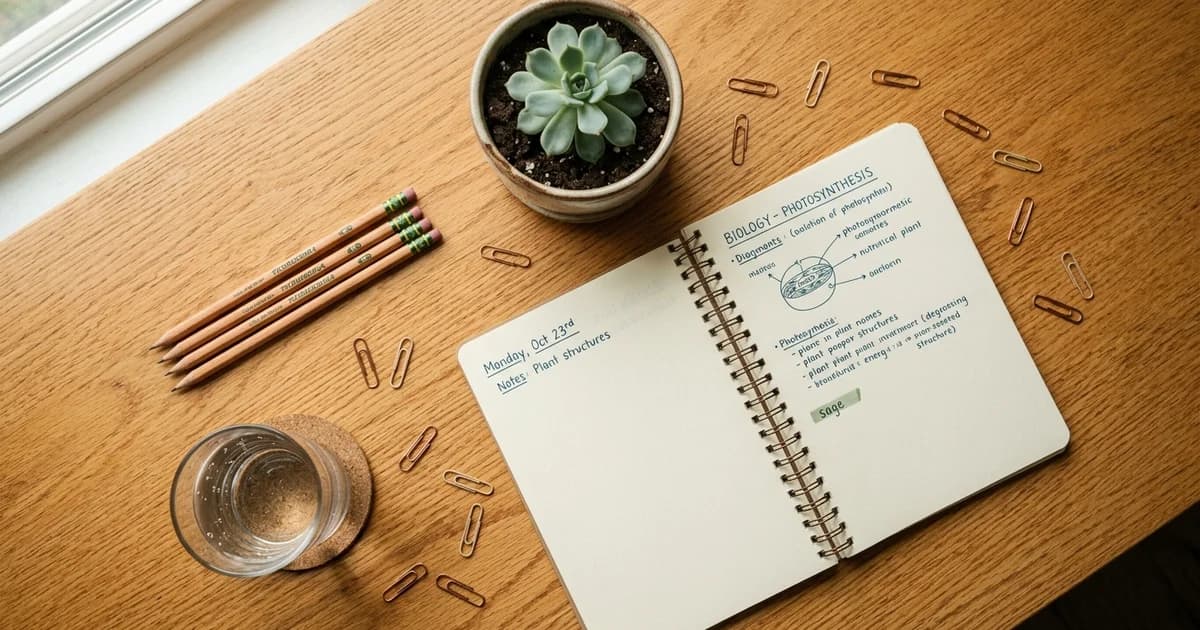
When you write by hand, you're forced to process and summarize information in real time because you can't transcribe everything verbatim. This act of compression forces deeper encoding. You're thinking about the material as you write it, rather than acting as a court stenographer. For students trying to learn how to focus better in class, handwriting creates a natural anchor for attention.
If your class moves too fast for handwriting, try a hybrid approach: type during the lecture, then rewrite the key concepts by hand within 24 hours. The rewriting process is where the learning happens.
8. Control Your Environment
This sounds obvious, but most students don't do it.
- Sit in the front three rows. Fewer visual distractions. More social pressure to pay attention. Easier to hear.
- Use noise-canceling headphones in the library with white noise or instrumental music. Lyrics pull your attention.
- Study in the same place consistently. Your brain builds location-based associations. When you always study at a specific desk, sitting down there becomes a cue to focus.
Small environmental changes stack. Each one removes a friction point between you and sustained attention, and together they form a practical system for how to focus better in school.
How to Focus Better in Class When You're Already Behind
If you're reading this mid-semester with a GPA that's slipping, the strategies above still apply. But here's the triage version for how to focus better in class right now:
- Start with sleep. One week of consistent 7-to-8-hour nights will produce noticeable changes in your ability to concentrate.
- Remove your phone from class immediately. This single change will reclaim more attention than any study hack.
- Use active recall instead of re-reading, since learning how to focus when reading assigned material is a skill worth building separately. Close your notes and try to write down everything you remember. The struggle is the learning.
- Talk to your professors. Office hours exist for a reason. Showing up signals that you care, and professors often tell you exactly what to prioritize.
You don't need to overhaul everything at once. Pick two strategies from this guide and commit to them for two weeks. Then add another. That's how to focus better in school without burning out in the process.
The Chemistry of Focus
Every strategy above works on the behavioral side. But there's also a chemical side to attention, and understanding it is part of learning how to focus better in school at a deeper level.
Your brain relies on specific neurotransmitters, primarily dopamine and norepinephrine, to maintain focus. Caffeine works because it blocks adenosine, the compound that makes you feel sleepy. But caffeine alone can make you jittery and anxious, which is the opposite of focused.
That's where L-Theanine comes in. A study indexed on PubMed found that the combination of L-Theanine and caffeine improved accuracy during task switching and increased self-reported alertness while reducing tiredness. A systematic review in Cureus confirmed that this combination decreased mind-wandering and improved concentration by reducing task-related reactivity in the brain's default mode network.
The ratio matters. Too much caffeine without L-Theanine gives you the jitters. The right balance gives you clean, sustained attention without the crash.
Optimize Your Day
Knowing how to focus better in school is one thing. Having the tools to do it consistently is another.
If you're looking for a way to support your focus that doesn't involve pounding energy drinks or relying on sheer willpower, Roon was built for exactly this. It's a zero-nicotine sublingual pouch that combines 80 mg of caffeine with L-Theanine, Theacrine, and Methylliberine, four compounds that work together to promote 6 to 8 hours of sustained focus without jitters, crashes, or tolerance buildup.
No sugar. No artificial energy spike. Just a cleaner way to stay locked in when it counts.