How Many Hours to Study for SIE? A Realistic Prep Timeline
Roon Team
How Many Hours to Study for SIE? A Realistic Prep Timeline
You typed "how many hours to study for SIE" because you want a number, not a motivational speech. Here it is: most candidates need between 40 and 80 hours of total study time, spread over four to six weeks. But that range is wide for a reason. Your background in finance, the quality of your study materials, and how well you actually retain information during each session all change the equation.
The SIE (Securities Industry Essentials) exam is the entry gate to a career in financial services. It's not the hardest FINRA exam you'll face, but it's the first, and underestimating it is the fastest way to waste $80 and a month of your life.
Key Takeaways:
- Plan for 40 to 80 hours of focused study, depending on your finance background.
- Spread that time over 4 to 6 weeks for best retention.
- Nearly half the exam (44%) covers products and their risks, so weight your study time accordingly.
- The first-time pass rate sits around 74%, meaning roughly 1 in 4 candidates fail on their first attempt.
What the SIE Exam Actually Covers
Before you can figure out how many hours to study for SIE prep, you need to understand what you're studying for.
The SIE is a 75-question, multiple-choice exam administered by FINRA. You get 1 hour and 45 minutes to complete it, and you need a score of 70% or higher to pass. There are actually 85 questions on the test, but 10 are unscored experimental items that FINRA uses for future exam development.
The exam breaks down into four sections, and the weight distribution matters more than most people realize:
| Section | Topic | % of Exam | # of Scored Questions |
|---|---|---|---|
| 1 | Knowledge of Capital Markets | 16% | 12 |
| 2 | Understanding Products and Their Risks | 44% | 33 |
| 3 | Understanding Trading, Customer Accounts, and Prohibited Activities | 31% | 23 |
| 4 | Overview of Regulatory Framework | 9% | 7 |
That table should dictate your study plan. Section 2 alone accounts for nearly half your score. If you spend equal time on all four sections, you're doing it wrong. Knowing how many hours to study for SIE is only useful if you allocate those hours wisely.
How Many Hours to Study for SIE Exam Success: The Real Range
Ask five different prep companies how many hours to study for SIE exam success, and you'll get five different answers.
Kaplan Financial recommends 140 to 180 hours over two to three months, including 60 to 80 hours of reading time. That's the high end, and it's aimed at candidates with zero financial background who want maximum preparation.
On the other end, Achievable claims their adaptive course takes about 20 to 30 hours. Most other test prep providers land somewhere in the middle, recommending around 50 hours of course time with at least a month of preparation.
OpenExamPrep puts the sweet spot at 40 to 60 hours over 4 to 6 weeks, which aligns with what most candidates who pass on their first try actually report.
So which number is right for how many hours to study for SIE? It depends on you.
If You Have a Finance Background
You studied economics, finance, or accounting in college. You know what a municipal bond is. You can explain the difference between a market order and a limit order without Googling it.
Plan for 40 to 50 hours over 4 weeks. You already have the conceptual framework. Your study time will focus on FINRA-specific regulations, prohibited practices, and the exact terminology the exam uses (which can differ from what you learned in school). For candidates like you, how many hours to study for SIE skews toward the lower end of the range.
If You're Starting from Scratch
You've never worked in finance. Terms like "variable annuity" and "Regulation T" mean nothing to you yet.
Plan for 60 to 80 hours over 6 weeks. Some candidates with no background may need even more, which is where Kaplan's 140+ hour recommendation starts to make sense. The first 20 to 30 hours will feel slow because you're building vocabulary and conceptual understanding from the ground up. It speeds up after that. For beginners, how many hours to study for SIE exam prep really depends on how quickly you absorb new financial concepts.
If You're a Career Changer with Some Exposure
Maybe you've traded stocks in a personal account, read financial news regularly, or worked in a finance-adjacent role like compliance or operations.
Plan for 50 to 60 hours over 4 to 5 weeks. You'll move faster than a true beginner but will still hit knowledge gaps in areas like options, municipal securities, and the regulatory framework. How many hours to study for SIE in your case falls right in the middle of the typical range.
A Week-by-Week Study Schedule That Actually Works
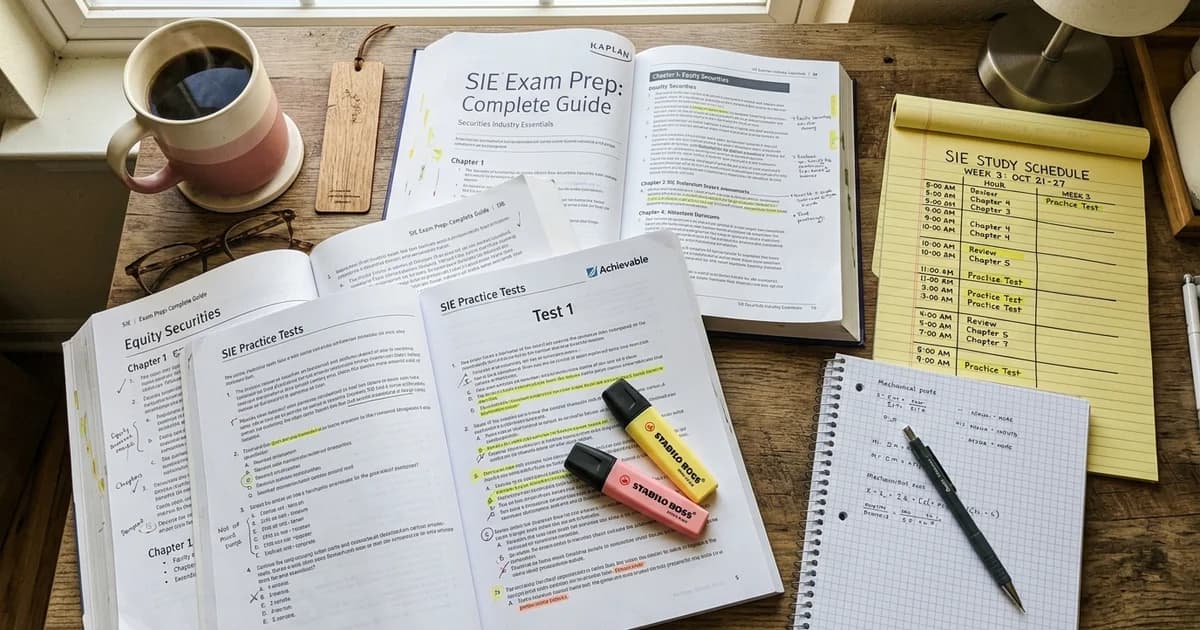
Knowing how many hours to study for SIE is step one. Blocking out "50 hours" on your calendar isn't a plan. Here's how to structure those hours so they produce results.
Weeks 1-2: Build the Foundation (15-20 hours)
Focus on Section 1 (Capital Markets) and start Section 2 (Products and Risks). Read through your prep material once without trying to memorize everything. The goal is exposure, not mastery.
- Spend 1.5 to 2 hours per day, five days a week.
- After each reading session, do 20 to 30 practice questions on the material you just covered.
- Keep a running list of terms you don't understand.
Weeks 3-4: Go Deep on Products (15-20 hours)
Section 2 is 44% of your exam. This is where you earn or lose your passing score. Equities, debt securities, packaged securities, options, municipal bonds, and variable products all live here.
- Continue the daily 1.5 to 2 hour blocks.
- Shift the ratio: spend 60% of your time on practice questions and 40% on review.
- Take your first full-length practice exam at the end of Week 4.
Weeks 5-6: Trading, Regulations, and Review (15-20 hours)
Cover Sections 3 and 4, then shift entirely to review mode. Section 3 (Trading and Customer Accounts) is 31% of the exam and includes suitability rules, account types, and prohibited activities. Section 4 (Regulatory Framework) is only 9%, so don't over-invest here.
- Take at least two more full-length practice exams under timed conditions.
- Review every wrong answer. Don't just read the correct answer; understand why the other three choices were wrong.
- If your practice scores are consistently below 75%, consider rescheduling your exam date. There's no penalty for pushing it back, and failing costs you another $80 and a 30-day waiting period.
Why Your Study Hours Don't All Count Equally
How many hours to study for SIE matters less than how you spend those hours. Sitting in front of a textbook for two hours and actually learning for two hours are different things. The quality of each study session matters as much as the total number.
Active Recall Beats Passive Reading
Re-reading chapters feels productive. It isn't. Research on learning consistently shows that testing yourself on material produces stronger memory formation than reviewing it passively. This is why practice questions should make up at least half your total study time.
FINRA offers a free practice test on their website. Use it early to identify weak areas, not just as a final check before exam day.
Study in Focused Blocks
Your brain doesn't do sustained, high-quality learning for four straight hours. It just doesn't. The Pomodoro technique (25 to 50 minutes of focused work, then a short break) exists because it matches how attention actually works.
A focused 90-minute session where you're fully locked in will beat a distracted three-hour marathon where you're checking your phone every ten minutes. Every time. This is why the question of how many hours to study for SIE is really a question about focused hours, not clock hours.
Manage Your Energy, Not Just Your Time
This is the part most SIE study guides skip. You can have the perfect schedule, the best prep course, and six weeks of runway, but if you're running on four hours of sleep and three energy drinks, your retention will be terrible.
Your brain consolidates new information during sleep. Caffeine helps alertness in moderate doses, but the jittery spikes and crashes from high-caffeine energy drinks actually impair the kind of sustained concentration that exam prep demands. A study published on PubMed found that a combination of L-theanine and 40mg of caffeine helped participants focus attention during demanding cognitive tasks, outperforming caffeine alone. The L-theanine smooths out the stimulant effect, promoting alert calm instead of wired anxiety.
The 74% Pass Rate: What It Really Tells You
The SIE exam has a first-time pass rate of about 74%, with an overall pass rate (including retakes) around 82%. Those numbers sound encouraging until you realize that the people taking this exam are typically motivated candidates who've already invested in prep courses and study time.
If 26% of prepared, motivated test-takers still fail on their first attempt, the exam deserves your respect. The most common reasons people fail:
- Underestimating Section 2. Products and risks is dense. Options alone can take a week to understand properly.
- Not doing enough practice questions. Reading is not studying. Testing is studying.
- Cramming instead of spacing. Two weeks of 6-hour days produces worse results than six weeks of 1.5-hour days, even though the total hours are similar. Spaced repetition wins.
Understanding how many hours to study for SIE exam prep is only half the battle. You also need to respect the spacing of those hours.
How Many Hours to Study for SIE: Study Smarter, Not Just Harder
The difference between candidates who pass the SIE on their first try and those who don't usually isn't raw intelligence or even total hours logged. It's the quality of focus during those hours.
That's the variable most people ignore when asking how many hours to study for SIE. You can optimize your schedule, buy the best prep course, and block out six perfect weeks on your calendar. But if your brain is foggy, overstimulated, or crashing from whatever you used to "power through" the last session, those hours are diluted.
This is exactly why Roon exists. It's a zero-nicotine sublingual pouch built around a specific cognitive stack: 80mg of caffeine paired with L-theanine, theacrine, and methylliberine. The combination supports 6 to 8 hours of sustained, clean focus without the jitters, crashes, or tolerance buildup that come with energy drinks or high-dose caffeine pills. No prescription needed, no nicotine, just a formula built around natural focus enhancers designed to help you stay locked in when the material gets dense.
Study smarter without a prescription. Check out Roon and see what focused study actually feels like.