How Many Hours to Study for the Series 7? A Realistic Breakdown
Roon Team
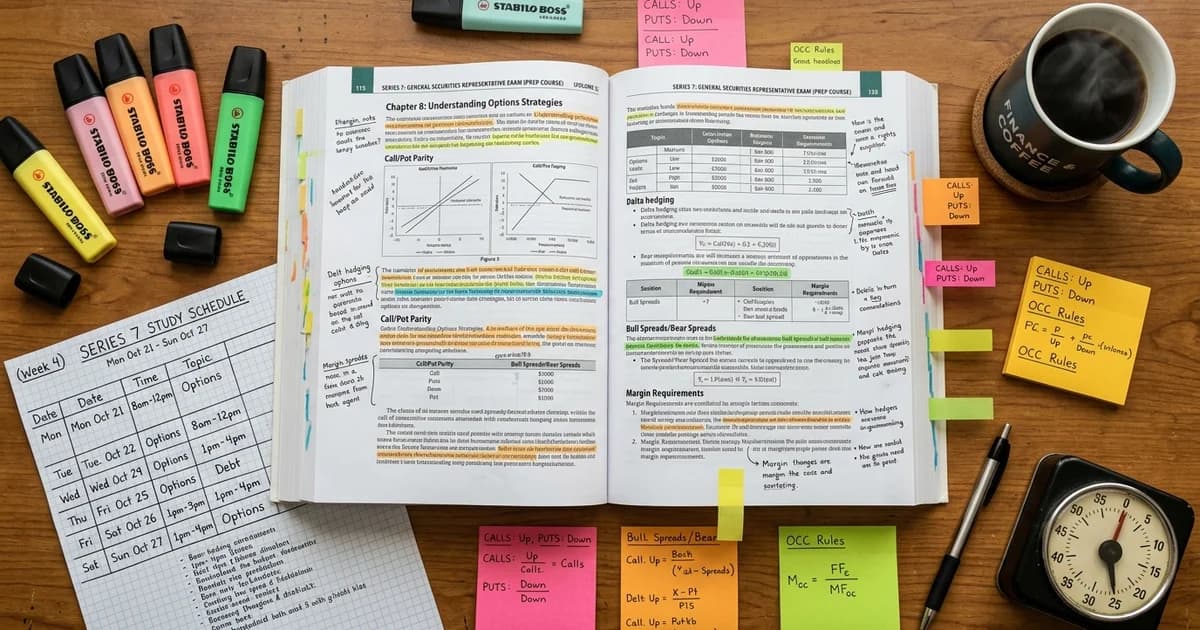
How Many Hours to Study for the Series 7? A Realistic Breakdown
You need between 80 and 150 hours to study for the Series 7 exam, a range that follows the same logic as study hour ranges for major exams like the GRE. That range is wide for a reason: how many hours to study for the Series 7 depends almost entirely on your existing finance knowledge, the quality of your study materials, and whether you can actually stay focused during those hours.
The Series 7, formally known as the General Securities Representative Exam, is one of the most demanding licensing exams in the financial industry. About 35% of test-takers fail it. If you're staring down a registration date and wondering how many hours to study for the Series 7 given your specific situation, this guide will give you an honest, week-by-week framework.
Key Takeaways:
- Candidates with a finance background should budget 80 to 100 hours of study time. Those without one should plan for 150 hours.
- The exam is 125 scored multiple-choice questions in 3 hours and 45 minutes, requiring a 72% passing score.
- Function 3 (providing investment information and recommendations) makes up roughly 73% of the exam and deserves the bulk of your attention.
- The quality of your study hours matters more than the quantity, a principle that holds true whether you explore quality beats quantity in exam prep for the Series 7 or the MCAT. Four focused hours beat eight distracted ones.
What the Series 7 Exam Actually Covers
Before you can determine how many hours to study for the Series 7, you need to understand what you're studying for.
The FINRA Series 7 exam consists of 135 multiple-choice questions. Of those, 125 are scored and 10 are unscored experimental questions mixed in at random. You get 3 hours and 45 minutes to complete it, and you need at least a 72% (roughly 90 correct answers out of 125) to pass.
The exam is organized around four job functions of a general securities representative:
| Function | Topic | Approximate % of Exam |
|---|---|---|
| 1 | Seeks business for the broker-dealer from customers and potential customers | ~9% |
| 2 | Opens accounts after obtaining and evaluating customers' financial profile and investment objectives | ~11% |
| 3 | Provides customers with information about investments, makes suitable recommendations, transfers assets, and maintains appropriate records | ~73% |
| 4 | Obtains and verifies customers' purchase and sales instructions and agreements; processes, completes, and confirms transactions | ~7% |
That third function is the monster. It covers everything from equity and debt securities to options, municipal bonds, variable annuities, direct participation programs, and tax implications. If you're going to over-study anything, over-study Function 3. Understanding its weight will directly influence how many hours to study for the Series 7 and where to spend them.
How Many Hours to Study for the Series 7 Based on Your Background
Not everyone starts from the same place. The question of how many hours to study for the Series 7 has a different answer depending on where you're coming from.
Finance Background (80 to 100 Hours)
If you majored in finance, economics, or accounting, or if you've been working in the industry for a year or more, the concepts on the Series 7 won't be entirely foreign. You already know what a municipal bond is. You understand the basics of margin accounts.
Kaplan Financial Education recommends 80 to 100 hours for candidates with this kind of background. Plan for about 4 to 6 weeks of dedicated study, spending 2 to 3 hours per day on weekdays and longer sessions on weekends.
Your risk here isn't a lack of knowledge. It's overconfidence. People with finance backgrounds sometimes skim material they think they already understand, then get tripped up by the specific regulatory details FINRA tests. Don't skip the SIE-level material just because you think it's basic. Even experienced professionals who underestimate how many hours to study for the Series 7 can find themselves retaking the exam.
No Finance Background (120 to 150 Hours)
If your degree is in English or you're making a career change from an unrelated field, budget more time. Kaplan suggests roughly 150 hours for candidates without a finance foundation.
That's 8 to 10 weeks at 2 to 3 hours per day. You'll need extra time to build foundational knowledge before you can tackle the application-based questions the exam loves to throw at you. For career changers, how many hours to study for the Series 7 is less about raw intelligence and more about giving yourself enough runway to absorb unfamiliar material.
Somewhere in Between (100 to 120 Hours)
Maybe you passed the SIE recently and the material is still fresh. Maybe you've been an assistant at a brokerage for six months. You know some of it, but not all of it. Split the difference. 100 to 120 hours, spread across 6 to 8 weeks, is a solid target. Assess your comfort level with options and municipal bonds early on; those topics will tell you how many hours to study for the Series 7 in your specific case.
A Sample Weekly Study Plan
Here's what a 6-week, 100-hour study plan could look like. Adjust the timeline based on your background and your own estimate of how many hours to study for the Series 7.
Weeks 1 and 2: Content Foundation (30 Hours)
Read through your study materials cover to cover. Don't try to memorize everything on the first pass. Focus on understanding the why behind each concept, not just the what.
Spend extra time on:
- Equity securities (common stock, preferred stock, rights, warrants)
- Debt securities (corporate bonds, government securities, yield calculations)
- Options (this is where most candidates struggle the hardest)
Weeks 3 and 4: Deep Study and Practice Questions (35 Hours)
Now go deeper. Reread the sections you found confusing. Start doing practice questions, but use them as a diagnostic tool, not a memorization shortcut.
A.D. Banker recommends spending most of your time reading the content rather than grinding practice tests. The reasoning: comprehension beats memorization on an exam that tests application. This is also the phase where you'll get a clearer sense of how many hours to study for the Series 7 remain on your calendar.
Focus heavily on:
- Municipal securities (taxation, suitability, underwriting)
- Variable annuities and insurance-based products
- Margin accounts and Regulation T
- Suitability rules and customer recommendations
Weeks 5 and 6: Practice Exams and Review (35 Hours)
This is where you shift to full-length practice exams. Take them under timed conditions. 3 hours and 45 minutes, no breaks, no phone.
Wall Street Prep suggests that at least 20 to 30 hours of your total study time should go toward practice exams and questions. After each practice test, review every question you got wrong. Don't just read the correct answer. Understand why you got it wrong and which concept you need to revisit.
If you're consistently scoring above 80% on practice exams, you're in good shape. If you're hovering around 72 to 75%, keep studying. The real exam will feel harder than practice tests because of the pressure.
Why the Quality of Your Study Hours Matters More Than the Quantity
Here's the part most Series 7 study guides skip: not all study hours are created equal. Knowing how many hours to study for the Series 7 is only half the equation. The other half is making those hours count.
Sitting at your desk for three hours while checking your phone every ten minutes does not count as three hours of studying. You know this. Everyone knows this. But very few people actually do anything about it.
Cognitive science has a concept called attention residue. Every time you switch tasks (even briefly glancing at a text message), your brain leaves a residue of attention on the previous task. It takes an average of 15 to 25 minutes to fully re-engage with deep work after an interruption.
If you're studying for 3 hours but getting interrupted 6 times, you might be getting less than 90 minutes of actual cognitive work done. That distortion is why some candidates log 150 hours and still fail, while others pass comfortably with 80.
How to Get More Out of Every Study Session
Use time blocks. Set a timer for 50 minutes of focused study, then take a 10-minute break. During those 50 minutes, your phone is in another room. Not on silent. In another room.
Study the hard stuff first. Your willpower and focus are highest at the beginning of a session. Don't start with the easy review material. Start with options pricing or municipal bond taxation, the topics that make your brain hurt.
Test yourself constantly. Passive reading feels productive but produces weak recall. Active recall (closing the book and trying to explain a concept from memory) is how you actually retain information.
Don't study for more than 4 hours in a single session. Research on learning consistently shows diminishing returns after about 3 to 4 hours of concentrated study. Two focused 2-hour sessions with a real break in between will outperform one grinding 5-hour marathon.
Common Mistakes That Add Hours to Your Study Time
Some habits silently inflate how many hours to study for the Series 7 without improving your score. Watch out for these.
Highlighting everything. Highlighting is the illusion of learning. If your textbook looks like a coloring book, you're not studying. You're decorating.
Spending too long on one topic. Options are hard. Everybody knows options are hard. But if you've spent 25 hours on options and still can't get above 60% on options practice questions, you might be better off solidifying your knowledge in other areas and picking up those points instead. Remember, you only need 72%.
Ignoring the SIE overlap. The Series 7 builds on the SIE. If you passed the SIE six months ago and haven't looked at the material since, plan to spend extra time refreshing those fundamentals. This is a common reason candidates underestimate how many hours to study for the Series 7.
Studying without a plan. "I'll just study until I feel ready" is not a plan. Set a date, build a calendar, and track your hours, much like candidates mapping out CPA exam study hours do. Candidates who follow a structured study plan consistently outperform those who wing it.
The 65% Pass Rate Problem
The estimated Series 7 pass rate sits around 65%, according to ExamFX (FINRA doesn't officially release pass rate data). That means roughly 1 in 3 candidates fail.
Most of those failures aren't from a lack of intelligence, a pattern familiar to anyone who has looked into how many hours for the LSAT or other high-stakes licensing exams. They come from underestimating the exam, studying inefficiently, or running out of steam in the final weeks of preparation. The Series 7 is a test of endurance as much as it is a test of knowledge. Many who fail simply misjudged how many hours to study for the Series 7 or failed to use those hours well.
The candidates who pass tend to share a few traits: they followed a schedule, they focused on comprehension over memorization, and they kept their energy and focus sharp during the weeks that mattered most.
Staying Sharp During 100+ Hours of Studying
Now that you know how many hours to study for the Series 7, the next challenge is sustaining your focus across all of them. Studying for this exam is a cognitive marathon. You're asking your brain to absorb and retain dense financial information over the course of 6 to 10 weeks. That takes sustained mental energy.
Most candidates reach for coffee. It works, for about 45 minutes. Then comes the spike, the jitters, the crash, and the second cup that somehow makes you more anxious but not more focused.
There's a better model for sustained cognitive performance. A study published in PubMed found that a combination of L-theanine and 40 mg of caffeine improved focus during demanding cognitive tasks without the typical caffeine side effects. The L-theanine smooths out the stimulation, promoting calm alertness instead of wired restlessness.
That's the same principle behind Roon, a sublingual cognitive performance pouch that combines caffeine (80 mg), L-theanine, theacrine, and methylliberine. The combination is designed to deliver 6 to 8 hours of clean focus without jitters, crashes, or tolerance buildup. No prescription. No nicotine. Just a studied stack of ingredients that supports the kind of sustained attention a 3-hour study session actually demands.
If you've figured out how many hours to study for the Series 7, the next step is making every one of those hours count. Study smarter without a prescription.