How Many Hours to Study for the LSAT
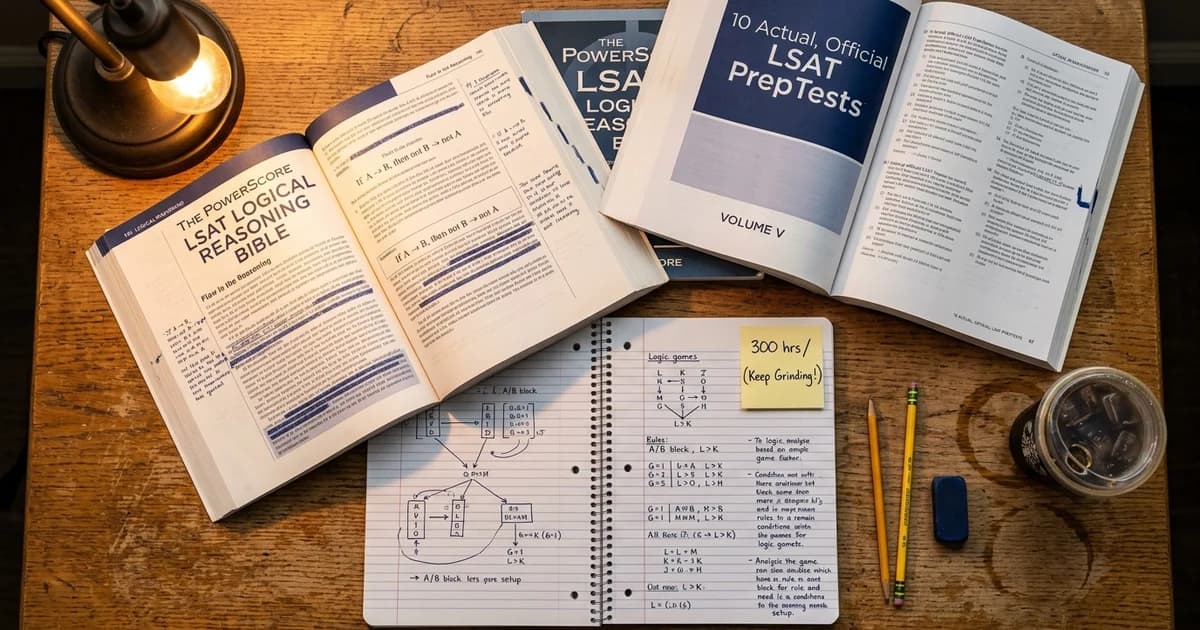
How Many Hours to Study for the LSAT (And How to Make Every One Count)
The honest answer to how many hours to study for the LSAT is somewhere between 150 and 300. That's a wide range, and it's wide on purpose. Your starting score, your target score, and how efficiently you use each study session all determine where you land in that window.
Most prep companies quote this range, and the data backs it up. The Princeton Review recommends 250 to 300 hours over several months. Kaplan suggests 150 to 300 hours, typically spread across two to three months at 20 to 25 hours per week. The real question isn't just how many hours to study for the LSAT in total. It's how you distribute them, and what you do with each one.
Key Takeaways
- Most students need 150 to 300 total hours of LSAT prep, depending on their starting score and target.
- 20 to 25 hours per week over three months is a standard, sustainable schedule.
- Quality beats quantity. Two focused hours outperform five distracted ones.
- Cognitive fatigue is real. Your brain's ability to perform complex reasoning tasks drops after extended sessions without breaks.
What the Prep Experts Say About How Many Hours to Study for the LSAT
The consensus across major LSAT prep providers is remarkably consistent.
Princeton Review data shows most students spend about 200 total hours preparing, which translates to roughly 20 hours per week over three months. Juris Education suggests that students studying for three months typically dedicate 15 to 25 hours per week, spread across four to six days.
Here's a rough breakdown of what that looks like in practice:
| Study Timeline | Hours Per Week | Total Hours | Best For |
|---|---|---|---|
| 2 months (intensive) | 25-35 | 200-280 | Full-time studiers with no job |
| 3 months (standard) | 15-25 | 180-300 | Students or working professionals |
| 4-6 months (extended) | 10-15 | 160-360 | Those balancing heavy workloads |
The three-month plan is the most popular for a reason, and intensive exam study schedules follow similar logic across high-stakes tests like the MCAT. It gives you enough time to learn the fundamentals, drill each section, and take multiple full-length practice tests without burning out.
How Many Hours a Day to Study for the LSAT
This is where most people get it wrong. They assume more hours per day equals faster improvement. It doesn't.
Resolution Test Prep recommends 2 to 4 hours a day, with one or two days off each week. That pace is sustainable and still produces solid progress. Going beyond four hours in a single session leads to diminishing returns, especially on a test that demands the kind of deep logical reasoning the LSAT requires.
A 2024 study published in Frontiers in Psychology found that mental fatigue rises during prolonged cognitive activity, and that even a 20-minute break only temporarily reduces the subjective experience of fatigue. Your brain isn't a muscle you can just grind harder. It's a system that needs recovery between high-demand efforts.
So if you're wondering how many hours a day to study for LSAT success, the answer is: fewer than you think, but with total concentration.
A Sample Daily Study Block
A high-quality three-hour LSAT study session might look like this:
- First 60 minutes: Drill a specific question type (e.g., logical reasoning assumption questions). Work untimed first, then timed.
- 15-minute break: Walk, stretch, eat something. No screens.
- Next 60 minutes: Timed practice section. Simulate real test conditions.
- 15-minute break.
- Final 30 minutes: Blind review. Go back through every question you weren't 100% confident on and analyze your reasoning.
That's about three hours of real work. It will do more for your score than a six-hour marathon where you're half-focused by hour four.
How Many Hours a Week to Study for the LSAT
For most people, 20 hours per week is the sweet spot. That's enough volume to make consistent progress without turning your entire life into LSAT prep.
Here's how to structure a 20-hour week:
- 4 weekdays at 3 hours each (12 hours)
- 1 weekend day at 5 hours, including a full timed practice test (5 hours)
- 1 weekend day at 3 hours for review and light drilling (3 hours)
- 1 full rest day. Non-negotiable.
If you can only manage 10 to 15 hours a week, extend your timeline to four or five months. Knowing how many hours to study for the LSAT matters less than staying consistent over time, a principle that applies equally to GRE study hour planning.
If you're studying full-time, one student reported dedicating 35 to 40 hours per week over two months and treating it like a job. That's aggressive, but it works if you have the bandwidth and the discipline to maintain quality across those hours.
The Score You Want Determines How Many Hours to Study for the LSAT
Not every LSAT goal requires the same investment. Someone aiming for a 155 from a 148 diagnostic needs a very different plan than someone trying to crack 170, much like decisions around total MCAT prep hours hinge on your target score and starting point.
According to U.S. News, the median LSAT score for incoming students at ranked law schools in fall 2024 was 158. The median across all test takers for the 2021-2024 testing years was 153. The top 14 law schools typically require scores of 170 or higher.
Here's a general guide:
| Goal | Typical Starting Score | Estimated Hours Needed |
|---|---|---|
| Score in the mid-150s | 145-148 | 150-200 |
| Score in the low 160s | 150-155 | 200-250 |
| Score 165+ | 155-158 | 250-300+ |
| Score 170+ | 160+ | 300-400+ |
These are rough estimates. Some people improve faster than others. But the pattern is clear: the higher you want to climb, the more deliberate practice hours you need. And the gains get harder to come by as you approach the top of the scale. Going from 150 to 160 is a very different challenge than going from 165 to 170.
Why the Quality of Your LSAT Study Hours Matters More Than the Quantity
You can log 300 hours of LSAT prep and still underperform if those hours are low quality. Passive review, unfocused reading, and practicing without analyzing your mistakes don't move the needle.
The LSAT tests three core skills: logical reasoning, reading comprehension, and analytical thinking. Each of these requires deep, focused cognitive work. You're not memorizing facts. You're training your brain to recognize patterns, evaluate arguments, and make decisions under time pressure.
That kind of work is exhausting. And research confirms it. A study in Frontiers in Psychology found that subjective mental fatigue and sleepiness both increase during prolonged cognitive tasks, with only partial recovery during short breaks. This means that your fifth hour of studying in a single session is almost certainly less productive than your second.
The students who see the biggest score jumps aren't the ones who study the longest. They're the ones who study with full attention, review their errors methodically, and stop before their focus degrades.
The Study Drug Temptation (And Why It Backfires)
When you're figuring out how many hours to study for LSAT prep on top of school or work, the temptation to reach for a shortcut is real. Prescription stimulants like Adderall have become common on college campuses, with some estimates suggesting as many as 20% of college students misuse them.
But the research on non-prescribed stimulant use paints a grim picture. A 2024 study from Binghamton University found that taking "study drugs" without a diagnosis can lead to other drug use and a decline in mental health. The National Center for Health Research notes that common side effects include insomnia, elevated heart rate, and impaired judgment, all of which directly undermine the kind of sustained, clear-headed focus that LSAT prep demands.
The drugs people take to study better can actually make them worse at the exact cognitive tasks the LSAT tests, which is why non-prescription focus alternatives have drawn so much attention.
A Smarter Approach to Sustained Focus
What actually works for long LSAT study sessions isn't a prescription. It's managing your neurochemistry with precision.
The combination of L-theanine and caffeine is one of the most well-studied cognitive performance stacks in the literature. A study published on PubMed found that 97 mg of L-theanine combined with 40 mg of caffeine helped participants focus attention during demanding cognitive tasks. A systematic review in PMC confirmed that the combination improves short-term sustained attention and overall cognition.
Add theacrine and methylliberine to the mix, and the effects become even more interesting. Research published in PMC found that a combination of caffeine, theacrine, and methylliberine improved cognitive performance and reaction time without negatively affecting mood.
This is the exact stack inside Roon, a zero-nicotine sublingual pouch built for sustained cognitive performance. It delivers 80 mg of caffeine alongside L-theanine, theacrine, and methylliberine, designed to give you 6 to 8 hours of clean focus without the jitters, crash, or tolerance buildup that comes with stimulants or endless cups of coffee.
Study Smarter Without a Prescription
The LSAT rewards precision, stamina, and clear thinking. Once you know how many hours to study for the LSAT, every one of those hours needs to count.
That means building a realistic schedule, protecting your rest days, and using tools that support your focus without compromising your health. Roon was designed for exactly this kind of sustained cognitive work. No prescription. No crash. Just the focus you need to make your study hours actually matter.