Gen Z Attention Span: What the Science Actually Says
Gen Z Attention Span: What the Science Actually Says (and What It Gets Wrong)
You've seen the stat. Gen Z has an eight-second attention span, shorter than a goldfish. The gen z attention span claim has been repeated by marketers, educators, and your uncle at Thanksgiving dinner so many times that most people accept it as fact.
It isn't. The gen z attention span debate is built on a foundation of bad data, misquoted research, and a fundamental misunderstanding of how human attention works. But that doesn't mean there's nothing going on. Something has changed about the way younger brains engage with information. The real story is more interesting, and more useful, than a clickbait comparison to a fish.
Key Takeaways:
- The "8-second attention span" claim has been widely debunked and was never supported by the Microsoft study it's attributed to.
- Gen Z doesn't have a broken attention span. They have a filtered one, trained by years of high-volume content exposure.
- Average time on any single screen has dropped to roughly 47 seconds, down from 2.5 minutes in 2004, across all age groups.
- The real problem isn't attention capacity. It's the neurochemical environment created by constant digital stimulation.
The Goldfish Myth: Where the Gen Z Attention Span Stat Came From
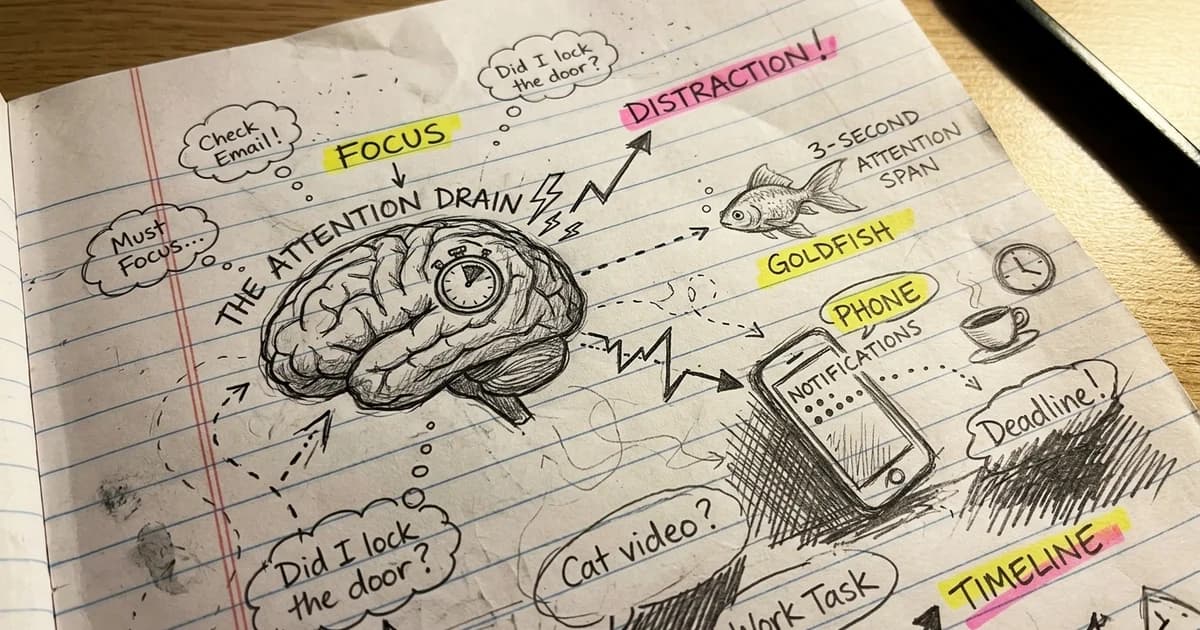
The claim that the average attention span of gen z is eight seconds traces back to a 2015 Microsoft Canada report. The report went viral. TIME Magazine ran with the headline comparing humans to goldfish. And the stat became gospel for anyone discussing gen z attention span.
Here's the problem: the Microsoft research never actually produced that number. As multiple investigations have shown, the "8-second" figure was pulled from a website called Statistic Brain, which cited sources that didn't support the claim. One source was an analytics report about 25 people who quickly left websites they didn't like. That's not attention span research. That's bounce rate data.
The goldfish attention span comparison? Also fabricated. There is no peer-reviewed study measuring goldfish attention spans at nine seconds. The whole thing is a house of cards.
Yet the gen z attention span stat persists because it feels true. And that feeling is worth examining.
What's Actually Happening to the Gen Z Attention Span
Dismiss the goldfish myth, and you still have to deal with reality: something about attention has shifted, and Gen Z sits at the center of it.
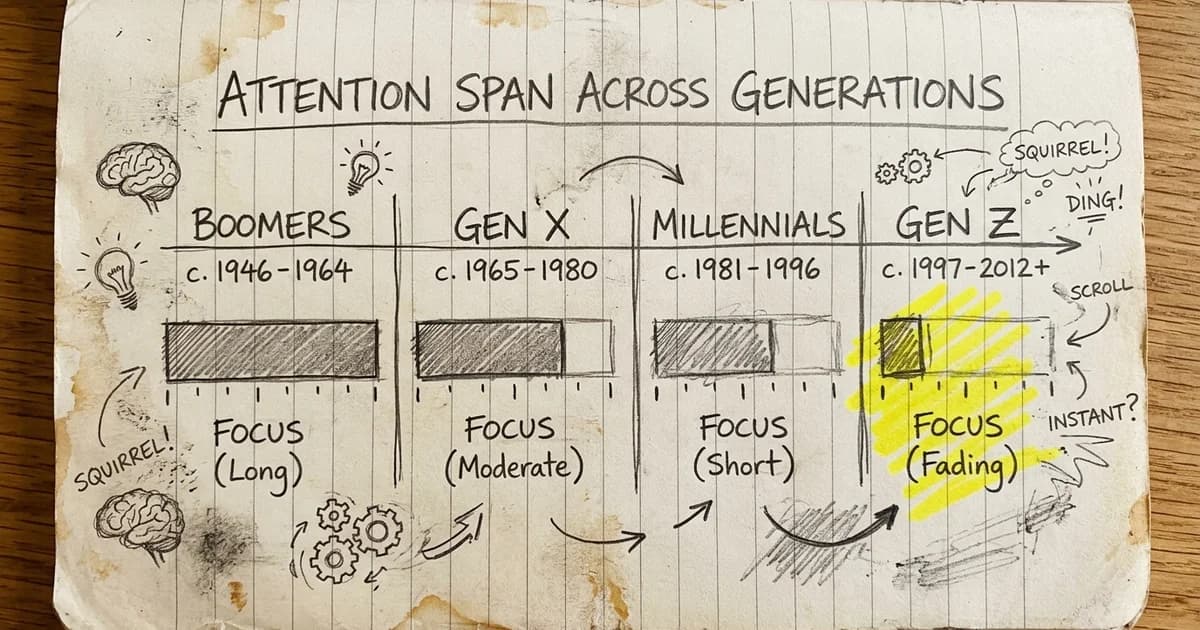
Dr. Gloria Mark, a professor of informatics at UC Irvine, has been tracking screen-based attention for nearly two decades. Her research found that the average time a person spends on any single screen before switching dropped to about 47 seconds, down from two and a half minutes in 2004. That's not a Gen Z stat. That's everyone. But Gen Z grew up inside this acceleration, which means they never knew the two-and-a-half-minute version.
The average gen z attention span isn't "broken." It's been shaped by an environment that rewards rapid filtering. Consider the numbers: Gen Z spends roughly 9 hours per day on screens, the highest of any generation. That's 9 hours of notifications, algorithmic feeds, autoplay videos, and infinite scroll. The brain adapts to whatever you train it on.
This isn't a deficit. It's a trade-off. Gen Z can scan, evaluate, and discard content faster than any previous generation. They decide within seconds whether something is worth their time. The flip side is that sustained, deep focus on a single task, the kind that produces real learning or creative work, becomes harder to access. That's the real gen z attention span story.
The Neuroscience Behind Gen Z Attention Span Concerns
To understand why the attention span of gen z operates differently, you need to look at what's happening under the hood.
Dopamine and the Scroll
Every notification, every like, every new video in a feed triggers a small release of dopamine, the neurotransmitter tied to reward and motivation. Research published in PMC shows that frequent social media engagement alters dopamine pathways in ways that mirror dependency patterns seen with addictive substances. The brain starts expecting constant novelty. When it doesn't get it (say, during a 45-minute lecture or a long-form article), it rebels. You feel restless. Bored. Foggy. This dopamine loop is central to the gen z attention span problem.
This is not a character flaw. It's neurochemistry responding to environmental inputs.
Adenosine and Mental Fatigue
There's a second system at play that gets less attention: adenosine. Throughout the day, adenosine accumulates in the brain as a byproduct of neural activity. The more cognitively active you are, the faster it builds. Adenosine binds to receptors that promote drowsiness and reduce alertness, which is why you feel mentally drained after hours of screen time even if you haven't moved from the couch.
For Gen Z, with their 9-hour daily screen averages, adenosine buildup is a constant background hum. It compounds the dopamine problem. Your reward system wants novelty, and your fatigue system is telling you to shut down. The result? Brain fog that makes sustained focus feel like pushing through wet concrete, further shrinking the average attention span of gen z.
The GABA Connection
Then there's GABA (gamma-aminobutyric acid), the brain's primary inhibitory neurotransmitter. GABA helps regulate neural excitability. It's what keeps your brain from being in a constant state of overstimulation. Chronic digital overload can disrupt GABA signaling, which means the brain struggles to calm itself down enough to focus on one thing at a time.
Three systems. Three problems. All feeding into the same outcome: the subjective experience of a diminished gen z attention span that makes sustained focus feel nearly impossible.
It's Not Just Gen Z (But Gen Z Feels It Most)
Here's the part that gets lost in the generational finger-pointing: declining attention on screens is a universal trend. Dr. Mark's research covers all age groups. The 47-second average isn't a Gen Z number. It's a human number in 2024.
But Gen Z feels the effects more acutely for two reasons.
First, developmental timing. The prefrontal cortex, the brain region responsible for executive function, impulse control, and sustained attention, doesn't fully mature until around age 25. Gen Z is navigating the most attention-hostile information environment in human history with hardware that's still being installed. That biological reality makes the gen z attention span challenge uniquely difficult.
Second, volume of exposure. A survey reported by Statista found Gen Z respondents spending over six hours a day on their phones alone, not counting laptops or TVs. That's more screen interaction per day than any other generation. More exposure means more dopamine cycling, more adenosine buildup, and more strain on the GABA system.
The average gen z attention span narrative isn't entirely wrong, and the next generation focus challenges suggest the pattern is only continuing. The span isn't short because Gen Z is lazy or broken. It's short because the neurochemical deck is stacked against sustained focus, and no one handed them a counterstrategy.
What Actually Works: Reclaiming the Gen Z Attention Span
Knowing the mechanisms is useful only if it leads to better strategies. Here's what the research supports for improving the attention span of gen z.
1. Stop Fighting Your Attention. Work With It.
Dr. Mark's work suggests that instead of trying to force marathon focus sessions, you should work in alignment with your natural attention rhythms. That means shorter, more intentional blocks of deep work (20-30 minutes) followed by genuine breaks, not phone breaks. This approach respects the gen z attention span rather than fighting against it.
2. Reduce the Dopamine Noise
Not all dopamine is created equal. The low-effort dopamine hits from social media feeds train your brain to expect rewards without effort. Counteract this by front-loading harder tasks in your day when your dopamine baseline is highest, typically within the first few hours after waking.
3. Address the Neurochemistry Directly
Caffeine blocks adenosine receptors, which is why coffee helps with alertness. But caffeine alone often comes with jitters and a crash, especially at the doses most people consume. The combination of caffeine with L-theanine changes the equation. A study published on PubMed found that 40mg of caffeine combined with 97mg of L-theanine improved focus during demanding cognitive tasks while promoting calm alertness rather than anxious energy.
Adding theacrine and methylliberine to that stack extends the effect. A randomized crossover study published in Cureus found that the combination of caffeine, theacrine, and methylliberine improved cognitive performance and reaction time without negatively affecting mood. Research published in the Journal of the International Society of Sports Nutrition found that combined caffeine, methylliberine, and theacrine showed similar efficacy to double the dose of caffeine alone on vigilance tasks, with better cardiovascular outcomes. For anyone looking to address the gen z attention span at a neurochemical level, this combination is worth considering.
4. Build Attention Like a Muscle
Attention isn't fixed. It responds to training. Even 10 minutes of daily meditation has been shown to improve sustained attention over time. The goal isn't to white-knuckle your way through distractions. It's to gradually expand your capacity for focus by giving your brain structured practice.
Gen Z Attention Span: The Bottom Line
The gen z attention span conversation needs an upgrade. The "8-second goldfish" framing is scientifically baseless. The real picture is more nuanced: a generation raised on high-speed digital inputs, navigating a neurochemical environment that actively works against deep focus, with brains that are still developing the architecture for sustained attention.
That's not a hopeless situation. It's a solvable one. The fix starts with understanding the three systems involved (dopamine, adenosine, and GABA) and then addressing them with precision instead of guesswork. Improving the average attention span of gen z is less about willpower and more about working with your brain's chemistry.
This is exactly what Roon was built for. Its sublingual pouch delivers a targeted nootropic stack of caffeine (80mg), L-theanine, theacrine, and methylliberine, the same compounds shown in clinical research to support sustained attention and cognitive performance. No nicotine. No jitters. No crash. Just 6-8 hours of clean, sustained focus that works with your neurochemistry instead of against it.
Cut through the fog. Try Roon today.