Focus Gaming Blue Blocking Glasses
Roon Team
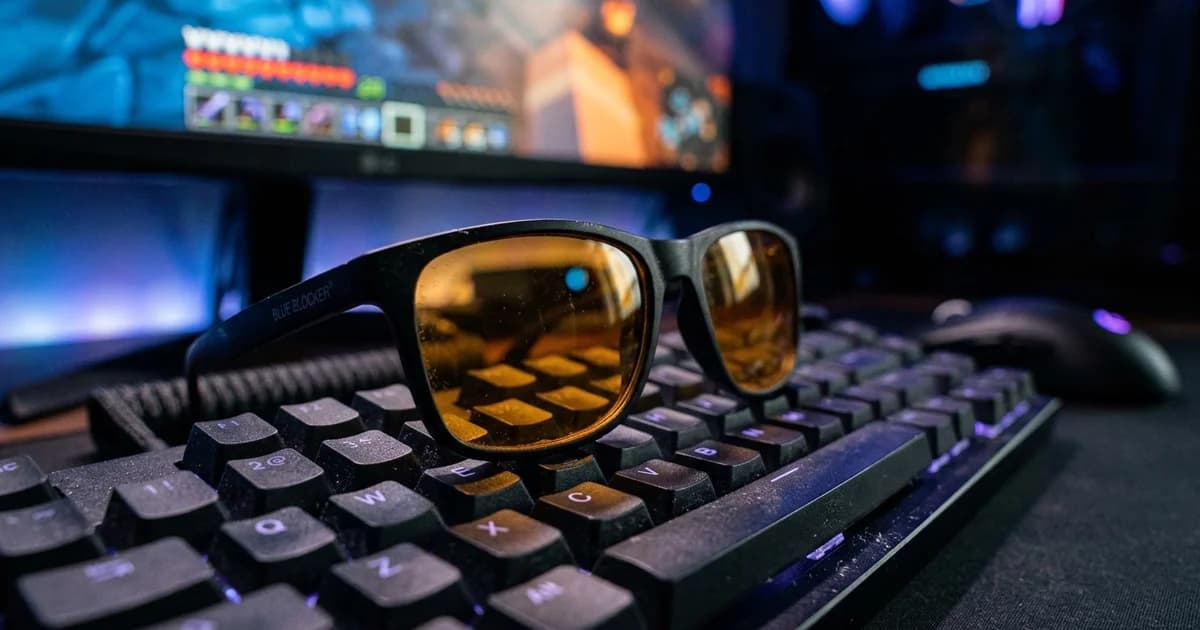
Focus Gaming Blue Blocking Glasses: What You Need to Know Before You Buy
You dropped $80 on a pair of focus gaming blue blocking glasses. The marketing promised sharper vision, faster reflexes, and marathon sessions without eye fatigue. Three weeks later, your K/D ratio hasn't moved. Your eyes still burn after hour four. And you're starting to wonder if those amber-tinted lenses are doing anything besides making your monitor look like a sepia Instagram filter.
You're not alone in that suspicion. And the science is starting to back you up.
Focus gaming blue blocking glasses have become standard gear in the gaming world, sitting right next to mechanical keyboards and 360Hz monitors on every "essential setup" list. But the gap between what these glasses promise and what they actually deliver is worth examining, especially if your real goal is sustained cognitive performance during competitive play.
Key Takeaways:
- A 2023 Cochrane review of 17 randomized controlled trials found blue light filtering lenses probably make no difference to eye strain or sleep quality.
- Digital eye strain affects roughly 66% of regular screen users, but the cause is likely reduced blinking, not blue light itself.
- Focus gaming blue blocking glasses can reduce glare and improve visual comfort, but they don't improve reaction time or cognitive function.
- If competitive performance is the goal, what you put in your body matters more than what you put on your face.
What Focus Gaming Blue Blocking Glasses Actually Do
Focus gaming blue blocking glasses with blue light filtering lenses work by blocking a portion of high-energy visible (HEV) light in the 400-450nm wavelength range. This is the blue end of the visible spectrum, and it's emitted in concentrated doses by LED screens, monitors, and overhead lighting.
The theory sounds reasonable: blue light overstimulates photoreceptors, contributes to eye fatigue, disrupts melatonin production, and degrades your focus over long sessions. Block the blue light, protect your eyes, game longer.
Most focus gaming blue blocking glasses on the market follow this logic. GUNNAR, one of the original brands, uses proprietary lens tints that bend light to reduce eye muscle strain while filtering HEV wavelengths. Gamer Advantage markets their REZME lens technology as "clinically proven" to improve sleep and reduce eye strain. Budget options flood Amazon at every price point from $12 to $120.
The products themselves are real. The question is whether the mechanism that focus gaming blue blocking glasses target, blue light, is actually the problem.
The Science Says: Probably Not
In August 2023, the Cochrane Library published a systematic review of 17 randomized controlled trials examining blue light filtering spectacle lenses. Cochrane reviews are considered the gold standard of evidence-based medicine. They don't sell products. They just analyze data.
The conclusion was blunt: blue light filtering spectacles "probably make no difference to eye strain caused by computer use or to sleep quality." The review's lead author stated that the results do not support prescribing blue light filtering lenses to the general population. This finding applies directly to focus gaming blue blocking glasses marketed to competitive players.
The American Academy of Ophthalmology has taken a similar position. Their guidance states there is no scientific evidence that the light coming from computer screens is damaging to the eyes, and the Academy does not recommend any special eyewear for computer use.
So if focus gaming blue blocking glasses aren't solving the problem during a six-hour Valorant session, what is actually wrecking your eyes?
The Real Cause of Gaming Eye Strain
Digital eye strain, also called computer vision syndrome (CVS), affects a staggering number of screen users. A meta-analysis covering 103 studies and 66,577 participants found a pooled global prevalence of 66%. Among esports athletes specifically, a case-control study on Thai esports players reported CVS prevalence rates between 72% and 89%.
The primary culprit isn't blue light. It's blinking, or rather, the lack of it.
When you're locked into a competitive match, your blink rate drops dramatically. Normal blinking happens about 15-20 times per minute. During focused screen use, that rate can fall by more than half. Fewer blinks means less tear film coverage, which leads to dryness, irritation, blurred vision, and that familiar burning sensation.
Research in optometry journals has pointed to incomplete blink quality, not just reduced frequency, as a key driver of symptoms. Your eyes aren't being damaged by wavelengths. They're drying out because you're staring without blinking. No pair of focus gaming blue blocking glasses can fix that.
This is why the 20-20-20 rule (every 20 minutes, look at something 20 feet away for 20 seconds) works better than any lens tint. It forces your eyes to reset, refocus, and rehydrate.
What Focus Gaming Blue Blocking Glasses Can (and Can't) Do
This doesn't mean focus gaming blue blocking glasses are completely useless. Here's an honest breakdown:
| Claimed Benefit | Evidence Level | Reality |
|---|---|---|
| Reduces blue light exposure | Moderate | Yes, lenses do filter some HEV light |
| Reduces eye strain | Low | Cochrane review found no meaningful benefit |
| Improves sleep quality | Low | Inconsistent findings across trials |
| Reduces glare | Moderate | Anti-reflective coatings can help with reflections |
| Improves reaction time | None | No clinical evidence supports this claim |
| Improves focus/cognition | None | Blue light filtering has no demonstrated cognitive benefit |
The anti-reflective coating on many focus gaming blue blocking glasses can genuinely reduce screen glare, which is a real source of visual distraction. LensDirect put it plainly: blue light glasses "do not improve reaction time, visual acuity, or in-game skill on their own."
If you find a pair comfortable and the slight tint reduces your subjective sense of strain during late-night sessions, that's fine. Comfort has value. Just don't expect measurable performance gains from focus gaming blue blocking glasses alone.
What Actually Moves the Needle on Gaming Performance
Competitive gamers obsess over hardware specs: polling rates, response times, refresh rates. But the most important processing unit in your setup is your brain, and it runs on neurochemistry, not nanometers of filtered light. This is where focus gaming blue blocking glasses fall short of their marketing promises.
Three factors dominate cognitive performance during extended gaming sessions:
1. Sustained Alertness Without Overstimulation
Your brain needs to stay sharp for hours without tipping into jittery overstimulation. Pure caffeine, the go-to for most gamers, creates a spike-and-crash pattern that works against sustained performance. The half-life of caffeine is roughly five hours, but the subjective alertness it provides often fades much sooner, leaving you worse off than baseline.
The combination of caffeine with L-theanine changes this equation. A study published in Nutritional Neuroscience found that combining moderate doses of L-theanine and caffeine improved accuracy during task switching and increased self-reported alertness while reducing tiredness. L-theanine smooths out caffeine's rough edges by promoting alpha brain wave activity, the same brain state associated with calm, focused attention.
2. Reaction Time Under Fatigue
Reaction time degrades as cognitive fatigue sets in. This is where most gamers lose their edge, not in the first match, but in the fifth or sixth. Sleep-deprived individuals show reaction times roughly 20% slower and up to 40% more errors in problem-solving tasks compared to well-rested controls, according to research compiled by BluLites. No amount of focus gaming blue blocking glasses will compensate for a fatigued brain.
A 2023 study on elite curling athletes found that the combined intake of caffeine and L-theanine produced the best accuracy rates and cognitive performance scores compared to either ingredient alone or placebo. The combination didn't just maintain baseline performance. It improved it.
3. Avoiding Tolerance Buildup
Regular caffeine users know the problem: the same dose stops working after a few weeks. You need more to get the same effect, and the crashes get worse. Compounds like theacrine and methylliberine, which share structural similarities with caffeine but act on slightly different receptor pathways, show promising evidence for sustained energy without the same tolerance curve.
The Uncomfortable Truth About Focus Gaming Blue Blocking Glasses
The gaming accessories market is built on a simple formula: take a real problem (eye strain, fatigue, slow reactions), attach it to a product category (glasses, energy drinks, supplements), and fill the gap with marketing.
Focus gaming blue blocking glasses target a real symptom, eye discomfort, but misidentify the cause. Energy drinks deliver real stimulation but come loaded with sugar, artificial ingredients, and a crash that tanks your performance in the back half of a session.
The question worth asking isn't "which pair of focus gaming blue blocking glasses should I buy?" It's "what is actually limiting my performance, and what does the evidence say about fixing it?"
For most competitive gamers, the answer comes down to three things: adequate sleep, proper hydration, and sustained cognitive fuel that doesn't spike and crash.
Skip the Focus Gaming Blue Blocking Glasses. Sharpen the Machine That Matters.
If you're serious about competitive performance, the data points in one direction. Focus gaming blue blocking glasses address a problem that probably isn't the problem. Your eyes hurt because you don't blink enough, and your focus drops because your brain runs out of fuel, not because your monitor emits wavelengths in the 440nm range.
Roon was built around this reality. It's a zero-nicotine sublingual pouch that combines 80 mg of caffeine with L-theanine, theacrine, and methylliberine, four compounds that work together to deliver 6-8 hours of sustained focus without jitters, without a crash, and without the tolerance buildup that makes most stimulants useless after a few weeks. In clinical testing, the combination showed an 11.5% improvement in reaction time, the kind of measurable edge that no pair of focus gaming blue blocking glasses can match.
You can keep optimizing your peripherals. Or you can optimize the only system that actually determines whether you win or lose.