Cyclone Pods vs Roon: Adaptogen-Mushroom Pouches vs the Clinical Focus Stack
Roon Team
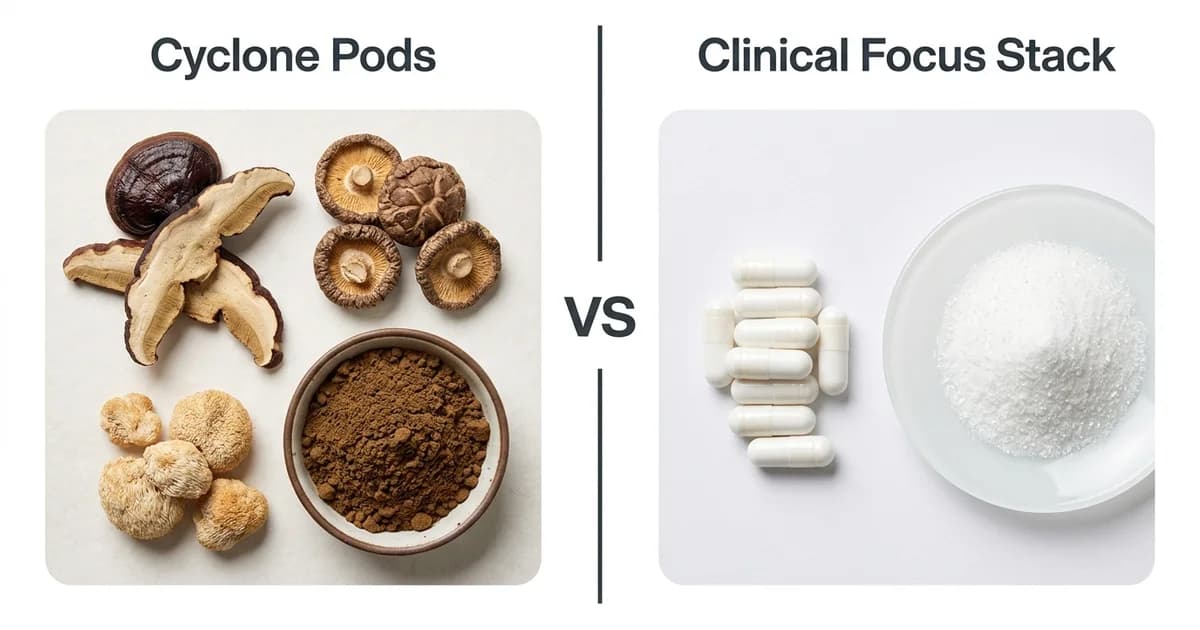
Cyclone Pods vs Roon: Adaptogen-Mushroom Pouches vs the Clinical Focus Stack
This cyclone pods review exists to answer one question: do mushroom pouches actually deliver the focus they promise, or are you paying for ingredients at doses too small to do much?
Cyclone Pods Focus Pouches lead with functional mushrooms and adaptogens. Roon takes the opposite approach, building around four compounds dosed to feel something within minutes. Both are zero-nicotine. Both go between your lip and gum. After that, they part ways fast.
Here is the honest breakdown, including where each one falls short.
Key Takeaways
- Cyclone Pods Focus Pouches pack six adaptogens and mushrooms plus 50 mg of caffeine from guarana for $9.99 per 20-count tin.
- Mushroom pouches rely on lion's mane, cordyceps, and ashwagandha, ingredients with real research behind them, but at doses far below what clinical trials used.
- Roon runs a tighter four-ingredient stack (80 mg caffeine, 60 mg L-theanine, 25 mg Dynamine, 5 mg TeaCrine) built for fast onset and a long, flat focus curve.
- The core trade-off: broad adaptogen blends versus a smaller stack dosed to actually be felt.
What Are Cyclone Pods and Mushroom Pouches?
Cyclone Pods is a zero-nicotine brand that makes vapes and, more relevant here, Focus Pouches. You park one under your upper lip, and the active ingredients absorb through the thin tissue in your cheek and gum into the bloodstream. The format borrows directly from nicotine pouches, minus the nicotine.
The category these belong to is mushroom pouches: oral pouches built around functional fungi like lion's mane, cordyceps, and reishi, usually paired with adaptogens and a modest hit of caffeine. The pitch is calm, steady focus instead of a sharp stimulant spike.
It's a reasonable idea. The question is whether the dose inside a single pouch matches the dose that made these ingredients famous.
Cyclone Pods Focus Pouches: The Full Breakdown
Cyclone Pods Focus Pouches are built around a six-ingredient adaptogen and mushroom blend rather than a single stimulant. Each pouch contains ashwagandha, lion's mane, reishi, cordyceps, bacopa monnieri, and guarana, with roughly 50 mg of caffeine sourced from that guarana. According to Cyclone Pods, the tins run $9.99 for 20 pouches across four flavors.
What Cyclone gets right
The ingredient list is genuinely broad. Most focus pouches lean on an Alpha-GPC and L-tyrosine template, and Cyclone went a different direction with a stack of mushrooms and herbs that each have published research behind them.
The price is fair. At about $0.50 per pouch, it sits in the normal range for the category, and the zero-nicotine, zero-tobacco positioning is exactly what someone leaving nicotine pouches is looking for.
The caffeine load is gentle. At 50 mg, roughly half a cup of coffee, it won't wreck most people's afternoons or sleep.
Where Cyclone runs into trouble
The dosing problem is hard to get around. The research everyone cites for lion's mane used large daily amounts over weeks. One trial improved cognitive scores using 3 grams of lion's mane daily for 16 weeks, and another study referenced by the Alzheimer's Drug Discovery Foundation used 2.4 grams daily for 12 weeks. A pouch contains a small fraction of a single gram.
Ashwagandha has the same issue. The clinical effect on cortisol and stress shows up at 250 mg or more per day, taken consistently for two weeks or longer. One pouch, used occasionally, is unlikely to reach that threshold.
There's also a timing mismatch. Adaptogens and mushrooms are slow, cumulative ingredients. They are built for weeks of daily use, not for a focus boost in the next ten minutes. Guarana caffeine releases more gradually too, so the kick is softer and slower than anhydrous caffeine. That's fine if steady is what you want, but it isn't an acute focus tool.
Cyclone Pods vs Roon: Side-by-Side Comparison
Here's how the two stack up, with the honest version of each product's strengths.
| Feature | Cyclone Pods Focus | Roon |
|---|---|---|
| Core approach | Six adaptogens + mushrooms | Four-ingredient clinical focus stack |
| Active ingredients | Ashwagandha, lion's mane, reishi, cordyceps, bacopa, guarana | Caffeine, L-theanine, Dynamine, TeaCrine |
| Caffeine | ~50 mg (from guarana) | 80 mg |
| Calming pairing | Adaptogens (slow, cumulative) | 60 mg L-theanine (acute) |
| Onset | Gradual | 5 to 10 minutes |
| Duration claim | Steady, 2 to 4 hours | 6 to 8 hours, no crash |
| Nicotine / tobacco | Zero | Zero |
| Best for | Daily adaptogen support, gentle energy | Acute, sustained focus on demand |
| Price | $9.99 / 20 ct (~$0.50/pouch) | Premium tier, 15 ct |
Neither product is doing the same job. Cyclone is a daily wellness pouch with mild energy. Roon is a focus tool you reach for before deep work.
What's Missing Across Mushroom Pouches
The gap in nearly every mushroom-focused pouch is the same: the ingredients are real, but the doses are too small and too slow to deliver acute focus. Here is the concrete list of what these products leave on the table.
Effective ingredient doses. Lion's mane and ashwagandha work in clinical studies at gram-level and several-hundred-milligram daily amounts. A single pouch can't physically hold that much, so the cognitive payoff stays mostly theoretical for someone using one pouch when they need to lock in.
A fast-onset stimulant. Guarana-based caffeine releases slowly. That's pleasant, but it means no sharp ramp into focus. If you need to be dialed in for a meeting in eight minutes, slow release works against you.
A true calm-focus pairing. Adaptogens take weeks to influence stress response. They don't smooth out caffeine in real time. The ingredient that actually does that, acutely, is L-theanine, and most mushroom pouches either skip it or underdose it.
Crash and tolerance management. A modest caffeine dose with no companion compounds tends to fade flat, and daily caffeine alone builds tolerance. Nothing in the standard mushroom blend specifically addresses the comedown or the slow creep of needing more.
So the category forces a trade-off. You get breadth of ingredients you can't fully feel, in exchange for the acute, reliable focus most people are actually buying a pouch to get.
Where the Clinical Focus Stack Fills the Gap
Roon was built around the gaps above, not around a mushroom trend. Instead of spreading micro-doses across six ingredients, it uses four compounds at amounts meant to be felt, fast.
The pairing that mushroom pouches miss is the foundation here. Research found that L-theanine combined with caffeine improves attention on demanding tasks, with the theanine taking the edge off the stimulant so you get focus without the wired feeling. Roon runs 80 mg caffeine against 60 mg L-theanine to hit that calm-but-sharp zone.
Then it addresses duration and tolerance. A study in egamers found that caffeine combined with TeaCrine (theacrine) and Dynamine (methylliberine) improved cognitive performance and reaction time without raising anxiety or headaches. Theacrine is known for a longer half-life than caffeine and a lower tolerance profile, while methylliberine works fast and may extend caffeine's effect, per a breakdown from Nootropics Depot.
That's the difference in plain terms. Cyclone bets on slow, cumulative adaptogens. Roon bets on a small set of compounds with acute, measured effects, sublingually, so onset lands in 5 to 10 minutes.
The Bottom Line on Each
If you want a daily, low-stimulant pouch with a broad adaptogen profile and you're committed to using it consistently for weeks, Cyclone Pods Focus is a fair pick at a fair price. The mushrooms won't transform a single afternoon, but the format is clean and the caffeine is gentle.
If your actual goal is sharp focus that arrives in minutes and holds through a long work block, the math favors a tighter, properly dosed stimulant-and-theanine stack over a spread of sub-clinical mushroom doses.
Match the tool to the job. A wellness pouch and a focus tool are not the same product, even when they look identical in your hand.
Frequently Asked Questions
Do mushroom pouches actually work for focus?
They can support general wellness over time, but acute focus is a stretch. The lion's mane and ashwagandha research used gram-level and several-hundred-milligram daily doses over many weeks. A single pouch holds a small fraction of that, so the same-day cognitive effect is mostly driven by the caffeine, not the mushrooms.
How much caffeine is in Cyclone Pods Focus Pouches?
About 50 mg per pouch, sourced from guarana, which is roughly half a cup of coffee. Because guarana releases caffeine more gradually than anhydrous caffeine, the energy feels softer and slower to arrive. That suits people who want gentle energy and dislike a sharp stimulant spike.
Are Cyclone Pods and Roon nicotine-free?
Yes, both are completely free of nicotine and tobacco. They use the same physical format as nicotine pouches, sitting between your lip and gum, which makes either one a reasonable swap for someone moving away from nicotine. The active ingredients are entirely different, though.
Why does Roon use only four ingredients instead of six?
The choice is about dose, not variety. Fitting six ingredients into one pouch means each gets a tiny amount. Roon uses four compounds at levels supported by acute research, so each one is present in an amount you can actually feel rather than a token sprinkle.
Which lasts longer, Cyclone or Roon?
Roon is built for a 6 to 8 hour focus window without a hard crash, partly because theacrine has a longer half-life than caffeine. Cyclone's energy curve is described as steady over roughly 2 to 4 hours. The mushrooms and adaptogens act on a much slower timeline measured in weeks of daily use.
Will I build a tolerance to these pouches?
Daily caffeine alone tends to build tolerance over time, which applies to any caffeinated pouch. Theacrine is notable for showing little tolerance buildup in studies, which is one reason it appears alongside caffeine in stacks aimed at sustained, repeatable use. Cycling your intake is still smart regardless of the product.
Is Cyclone Pods or Roon better value?
Cyclone is cheaper per pouch at about $0.50, and if you want a daily adaptogen habit, that price is hard to beat. Roon sits in a premium tier built around acute focus performance rather than cost per pouch. The better value depends entirely on whether you want daily wellness support or on-demand focus.
Built for the Acute-Focus Gap, Not the Mushroom Trend
Mushroom pouches ask you to trust ingredients you can't fully feel from a single dose. That's the gap this comparison keeps circling back to. Roon was designed to fill it directly, with four compounds dosed to do something in the next ten minutes rather than the next ten weeks.
The stack is simple on purpose: 80 mg caffeine and 60 mg L-theanine for calm, sharp focus, plus 25 mg Dynamine and 5 mg TeaCrine to stretch that focus across 6 to 8 hours without the jitters, the crash, or the slow tolerance creep. It absorbs sublingually, so onset lands in 5 to 10 minutes.
Roon is not a substitute for sleep, real meals, or a long-term adaptogen routine if cortisol support is your actual goal. It does one job well: dependable focus on demand. If that's what you've been hoping a mushroom pouch would do, try Roon and feel the difference in dosing.
Written by Roon Team