CBD vs L-Theanine for Calm: Endocannabinoid Wind-Down vs Alert Calm-Focus
Roon Team
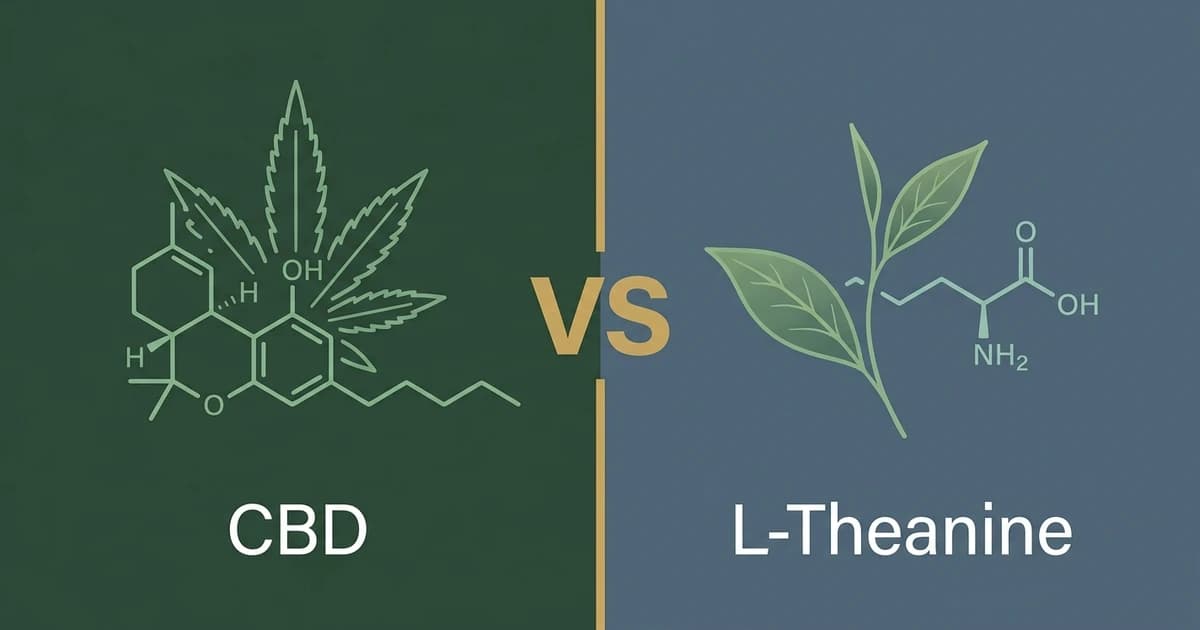
CBD vs L-Theanine for Calm: Endocannabinoid Wind-Down vs Alert Calm-Focus
Both promise calm. They get you there through completely different doors. The cbd vs l-theanine question usually comes down to one thing most people miss: do you want to wind down, or do you want to stay sharp while the edge comes off?
CBD works on your endocannabinoid system, the network that helps regulate stress, mood, and sleep. L-theanine, an amino acid from green tea, nudges your brain toward an alert, relaxed state without sedation. One pulls you toward the couch. The other keeps you at the desk.
Here is the honest breakdown of how each works, what the science actually shows, and which one fits the result you're after.
Key Takeaways
- L-theanine produces "alert calm," relaxation with no drowsiness, and pairs with caffeine to sharpen focus.
- CBD works through the endocannabinoid system and leans toward wind-down, stress relief, and sleep support, often with mild sedation.
- For anxiety, CBD has the more direct clinical evidence at therapeutic doses. For daytime focus, L-theanine wins.
- They are not interchangeable. The right pick depends on whether you need to perform or to power down.
CBD vs L-Theanine: The Core Difference
L-theanine gives you calm without losing your edge. CBD gives you calm that often comes with a soft landing toward rest. That single distinction settles most of the debate.
L-theanine is a non-protein amino acid found almost exclusively in tea leaves. It crosses the blood-brain barrier and shifts brain activity toward alpha waves, the electrical pattern linked to wakeful relaxation, the same state you reach in light meditation. You feel settled, but you stay switched on.
CBD, or cannabidiol, is a non-intoxicating compound from the hemp plant. It interacts with the endocannabinoid system, a regulatory network that touches stress response, mood, pain signaling, and sleep cycles. The effect tends to be a downshift rather than a sharpening.
Here's the practical translation. L-theanine is a tool you reach for at 9 a.m. before a deep-work block. CBD is something many people reserve for the evening.
How L-Theanine Works: The Alpha-Wave Route
L-theanine raises alpha-wave activity in the brain, which is why it produces relaxation without making you tired. This is the mechanism behind "alert calm-focus."
The amino acid influences GABA, dopamine, and serotonin while dampening the overstimulating effects of glutamate. The result is a quieter mental baseline that doesn't trade away alertness. You think more clearly because the noise drops, not because the system slows down.
Where it gets interesting is the pairing with caffeine. The theanine cbd focus comparison almost always favors theanine here, because theanine has no equivalent partnership in the CBD world.
A meta-analysis on PMC found that combining caffeine and L-theanine improved attention-switching accuracy and visual attention accuracy in the first two hours after a dose, with a moderate effect on alertness one hour in. A separate proof-of-concept neuroimaging trial on PubMed Central reported that the L-theanine and caffeine combination improved overall cognitive performance and reduced activity in the brain network tied to mind-wandering.
In plain terms: theanine takes the jitter out of caffeine and tightens your attention. That's the calm that helps you work, not the calm that helps you sleep.
How CBD Works: The Endocannabinoid Wind-Down
CBD acts on the endocannabinoid system to support stress regulation, and the clinical evidence is strongest for anxiety at therapeutic doses. This is the wind-down route.
Your endocannabinoid system runs on internal signaling molecules that help keep mood, stress, and sleep in balance. CBD modulates this system rather than overriding it, which is why the experience feels more like a release of tension than a stimulant effect.
The dosing story matters here. A phase 2 clinical trial published in Nature's Communications Medicine found that a full-spectrum, high-CBD product produced meaningful improvement in anxiety symptoms, with patients reaching at least a 15% reduction. On the dosing question, coverage from NORML pointed out that response came at roughly 30 mg per day in this full-spectrum trial, far below the ~300 mg per day used in earlier CBD-isolate studies.
The catch for daytime use is sedation. CBD can relax you past the point of peak performance, and many products lean into that for sleep support. If your goal is to stay sharp, that's a feature working against you.
CBD vs Theanine for Anxiety: Which Has the Edge?
For clinical anxiety, CBD has the more direct human-trial evidence at therapeutic doses. For everyday stress and performance pressure, L-theanine is the cleaner daytime choice.
This is the heart of the cbd vs theanine for anxiety question, and the answer is not a single winner. They serve different versions of "anxious."
If you're dealing with the wired, can't-focus, racing-thoughts type of stress during a workday, L-theanine's alert-calm profile fits without slowing you down. If you're managing persistent, sleep-disrupting anxiety in the evening, CBD's wind-down effect is the better match.
Neither is a treatment. Both are supplements, and neither replaces care from a clinician if anxiety is interfering with your life.
CBD vs L-Theanine: Side-by-Side Comparison
The cbd theanine difference is easiest to see laid out directly. Here's how the two compare, with Roon included as the L-theanine-forward focus option.
| Factor | L-Theanine | CBD | Roon (focus pouch) |
|---|---|---|---|
| Primary effect | Alert calm-focus | Wind-down, stress relief | Sharp, sustained focus |
| Mechanism | Raises alpha waves; modulates GABA/glutamate | Acts on endocannabinoid system | L-theanine + caffeine + methylliberine + theacrine |
| Best time of day | Daytime, work blocks | Evening, pre-sleep | Daytime, work or training |
| Sedation risk | Very low | Moderate | None by design |
| Strongest evidence for | Attention, alert calm | Anxiety at therapeutic doses | Onset and sustained focus |
| Pairs with caffeine | Yes, classic combo | Not a focus pairing | Built-in (80 mg caffeine) |
| Onset | 30 to 60 minutes | Varies by format | 5 to 10 minutes (sublingual) |
The takeaway: if the goal is performance, theanine is the spine of a focus stack. If the goal is rest, CBD has the wind-down advantage. Best natural calm supplement is the wrong frame, because "calm" means two different things depending on the time of day.
L-Theanine or CBD: How to Choose
Choose L-theanine for daytime focus and alert calm. Choose CBD for evening wind-down and stress that disrupts rest. The l-theanine or cbd decision is really a question about timing and intent.
Ask yourself three questions:
- Do I need to perform right now, or recover? Perform points to theanine. Recover points to CBD.
- Am I pairing this with caffeine? Theanine is the natural partner. CBD is not.
- Is sedation a problem or a goal? If you can't afford to feel slowed down, theanine. If you want to slow down, CBD.
You can use both, just at different ends of the day. Theanine to sharpen the morning, CBD to soften the night. They aren't competitors so much as tools for opposite jobs.
The Verdict on Calm
CBD and L-theanine both deliver calm, but they are not the same product wearing different labels. L-theanine raises alpha-wave activity to give you relaxation that keeps your mind alert, which is why it pairs so well with caffeine for focus. CBD works through the endocannabinoid system and leans toward wind-down, with its strongest human evidence pointing to anxiety relief at therapeutic doses.
Match the tool to the moment. If you need to be sharp, reach for the alert-calm route. If you need to power down, the endocannabinoid wind-down makes more sense. The mistake is expecting one molecule to do both jobs.
Frequently Asked Questions
Is L-theanine or CBD better for focus?
L-theanine is the better choice for focus. It raises alpha-wave activity to produce alert calm and pairs with caffeine to sharpen attention. Research on the caffeine and L-theanine combination shows improved attention accuracy and reduced mind-wandering. CBD, by contrast, works through the endocannabinoid system and tends toward sedation, which makes it a poor fit for performance-driven daytime focus.
Can I take CBD and L-theanine together?
Yes, and many people do, but usually at different times of day. L-theanine fits the morning and workday for alert calm-focus, while CBD suits the evening for wind-down. Taking both during the day can blunt the alertness L-theanine provides, since CBD can sedate. There are no widely reported interactions, but check with a clinician if you take medication.
Which is better for anxiety, CBD or L-theanine?
For clinical anxiety, CBD has more direct human-trial evidence at therapeutic doses, with one phase 2 trial showing meaningful symptom reduction. For everyday performance stress and racing thoughts during the day, L-theanine's alert-calm profile is the cleaner option because it doesn't slow you down. Neither is a treatment, and anxiety that disrupts daily life warrants professional care.
Does L-theanine make you sleepy like CBD can?
No. L-theanine produces relaxation without drowsiness because it raises alpha-wave activity rather than sedating the nervous system. That's the defining feature of alert calm. CBD, depending on dose and format, can produce noticeable sedation, which is why it's often used for sleep support rather than daytime focus.
How much L-theanine should I take for calm focus?
Common daily intakes range from roughly 100 to 200 mg, and L-theanine is frequently paired with caffeine in a ratio near 2:1 or 1:1 for focus. The pairing matters more than the raw dose, since caffeine supplies the alertness and theanine smooths out the jitter. Start low and adjust based on how you respond.
What is the main difference between CBD and L-theanine?
The core difference is direction. L-theanine creates calm that keeps you alert by boosting alpha waves, making it a daytime focus tool. CBD creates calm that leans toward rest by acting on the endocannabinoid system, making it an evening wind-down tool. One sharpens, the other softens.
Why Roon Sits in the Alert-Calm Lane, Not the Wind-Down Lane
If you read this far, the lane separation is clear: L-theanine is for staying sharp, CBD is for powering down. Roon is built squarely in the alert-calm lane. It contains no CBD, and that's intentional.
Each Roon pouch delivers 60 mg of L-theanine alongside 80 mg of caffeine, 25 mg of methylliberine, and 5 mg of theacrine. The theanine is there for exactly the reason this article describes: to take the edge off the caffeine and produce focus that feels calm instead of wired. The sublingual format means a 5 to 10 minute onset and a 6 to 8 hour window with no jitters, no crash, and no tolerance buildup.
To be clear about what Roon is not: it isn't a wind-down product, a sleep aid, or a substitute for CBD if you're after evening relaxation or managing anxiety with a clinician. If you want to wind down, look at our CBD deep-dive. If you want to understand the focus mechanism, read more on L-theanine and alpha waves. When you need to be sharp, that's where Roon fits. Try it for the days you can't afford to slow down.
Written by Roon Team