NooCube Review 2026: Full Ingredient List, Doses and Price
Roon Team
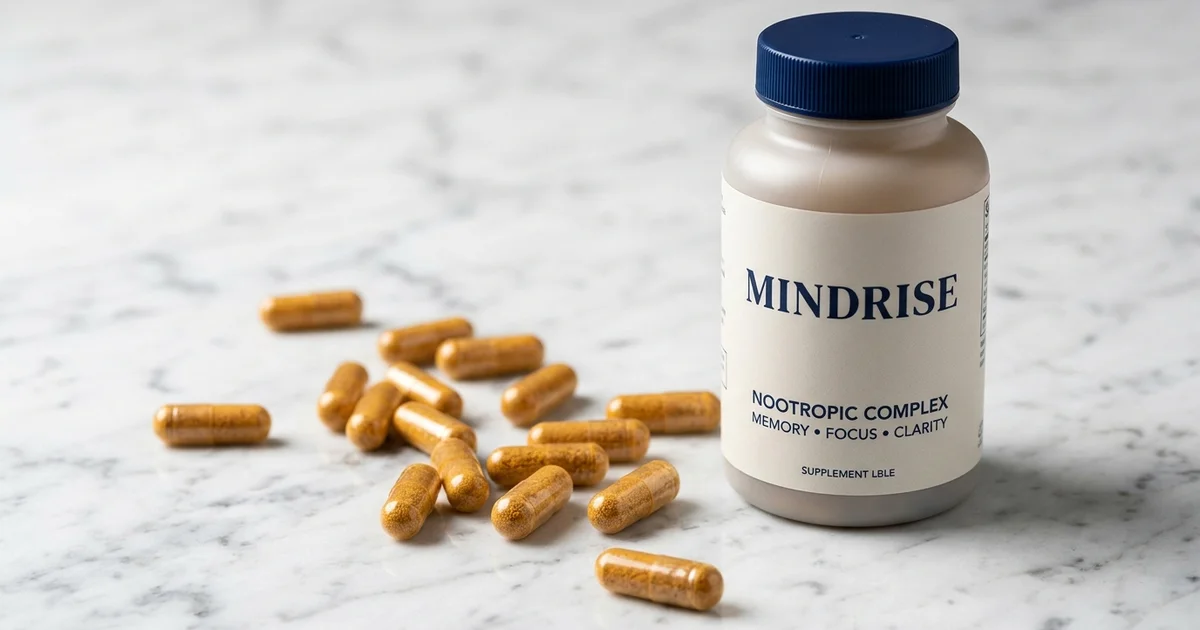
NooCube Review: A Neuroscientist Breaks Down This Budget Nootropic Stack
NooCube has been one of the most marketed nootropic supplements online for years, and this NooCube review takes a hard look at what's behind the hype. It promises better focus, sharper memory, and improved mental clarity, all without caffeine. But does the formula actually hold up when you look past the marketing copy and dig into the science?
I spent weeks analyzing NooCube's ingredient list, comparing clinical dosages against what's actually in each capsule, and stacking it up against Mind Lab Pro, its closest competitor. This NooCube review covers everything I found.
Key Takeaways From This NooCube Review
- NooCube uses several well-researched nootropic compounds, but multiple ingredients appear underdosed compared to clinical studies.
- NooCube side effects are generally mild, though headaches affect roughly 5% of users.
- At $64.99 per bottle (one month supply), it sits in the mid-premium price range for nootropics, well below Qualia Mind at $139 a bottle.
- In the mind lab pro alternative matchup, both share a core limitation: capsule-based delivery with no stimulant component for acute focus.
NooCube Ingredients: What's Actually Inside
The NooCube ingredients list (now called "Brain Productivity 3.0") contains a mix of amino acids, herbal extracts, and vitamins. The recommended serving is two capsules per day. Here's the breakdown of the key active NooCube ingredients:
Bacopa Monnieri (250 mg)
Bacopa is the star of the formula. It's one of the most studied natural nootropics, with strong evidence supporting its effects on memory acquisition and retention, particularly in older adults. The catch? Most clinical studies on Bacopa use 300 mg or higher. NooCube's 250 mg is close but falls slightly short of the doses used in the research that made this ingredient famous.
Choline source: VitaCholine (about 100 mg)
Older NooCube reviews list Alpha-GPC at 50 mg, but the current Brain Productivity 3.0 formula replaced Alpha-GPC with VitaCholine, a branded choline bitartrate, at around 100 mg. Choline supports acetylcholine production, a neurotransmitter tied to learning and memory. The trade-off: choline bitartrate is a lower-bioavailability form than Alpha-GPC or citicoline, so even at 100 mg it is a modest contributor. If you are reading a NooCube review that still cites 50 mg of Alpha-GPC, it predates the reformulation.
L-Theanine (100 mg)
L-Theanine is well-documented for promoting calm focus without drowsiness. The 100 mg dose in NooCube is reasonable and falls within the range used in clinical research (100 to 200 mg). Among all the NooCube ingredients, this is one where the dosing actually checks out.
L-Tyrosine (250 mg)
NooCube contains 250 mg of L-Tyrosine, which is slightly below the clinically studied dose, but still within a potentially effective range. L-Tyrosine helps improve mental performance under stress and supports cognitive flexibility during multitasking. Most studies use 500 mg to 2,000 mg, so this is another ingredient where NooCube is playing it conservative.
Panax Ginseng (20 mg, 8:1 extract)
NooCube uses a concentrated 8:1 extract, which they claim makes 20 mg equivalent to 160 mg of raw powder. As explained in a 2024 review, the doses of Panax ginseng used to investigate acute effects on cognitive function typically range from 100 to 600 mg per day. With this in mind, Noocube's 20 mg may be too low to provide much benefit.
Other NooCube Ingredients
The formula also includes Huperzine A, Cat's Claw extract, Lutemax 2020 (a lutein blend for visual processing), and vitamins B6, B9, B12, C, D, and K. The vitamin inclusions are fine but unremarkable. You likely get enough of these from a basic multivitamin.
NooCube Side Effects: What Users Report
Based on both research and user reports, NooCube is generally well-tolerated, with side effects being rare and typically mild. The most commonly reported issue is occasional headaches, affecting approximately 5% of users.
Some reviewers have also noted mild gastrointestinal discomfort, which is likely tied to the choline content. It can lead to a gradual buildup of levels of acetylcholine, which may present problems like headaches, impaired mental focus, mood, and some confusion. They are not related to any severe safety problems, though.
The consensus across multiple review sites: NooCube side effects are genuinely mild compared to stimulant-based nootropics, and the product is safe for most healthy adults. This is one area where every NooCube review tends to agree.
NooCube vs Mind Lab Pro: Head-to-Head Comparison
This is the matchup most nootropic buyers want to see, and our Mind Lab Pro full stack review goes even deeper on that product alone. The NooCube vs Mind Lab Pro debate comes up constantly because both products market themselves as premium, stimulant-free cognitive supplements. Here's how they compare:
| Feature | NooCube | Mind Lab Pro |
|---|---|---|
| Price (1 bottle) | ~$64.99 | ~$69.00 |
| Servings per bottle | 30 (2 capsules/day) | 30 (2 capsules/day) |
| Caffeine | None | None |
| Key ingredients | Bacopa, VitaCholine, L-Theanine, L-Tyrosine, Lutemax 2020 | Citicoline, Lion's Mane, Bacopa, L-Theanine, Phosphatidylserine |
| Clinical studies on formula | None on the full formula | 3 studies on the combined product |
| Bulk pricing | ~$119.99 for 6 bottles | $207 for 4 bottles subscribed (list $276) |
| Delivery method | Capsule | Capsule |
| Money-back guarantee | 60 days | 30 days |
While the battle between NooCube and Mind Lab Pro is close, Mind Lab Pro wins mainly because of its 3 clinical studies backing its formula. That's a real differentiator. NooCube relies on the research behind individual ingredients, which is standard for the industry but less convincing than testing the actual finished product. In the NooCube vs Mind Lab Pro comparison, this is the single biggest distinction.
On price, NooCube has a clear edge, especially in bulk. You can get 6 bottles of NooCube (and free shipping) at $119.99, while the max for Mind Lab Pro is 4 bottles at $207 on its smart subscription, list price $276, with free shipping.
Mind Lab Pro uses Citicoline (as Cognizin) instead of Alpha GPC for its choline source, and includes Lion's Mane mushroom, which NooCube lacks entirely, a contrast also explored in the Mind Lab Pro vs Alpha Brain breakdown. NooCube focuses on a combination of amino acids, vitamins, and other essential nutrients. Neither relies on Alpha-GPC: Mind Lab Pro uses citicoline, and NooCube's current formula uses choline bitartrate.
Both products share Bacopa Monnieri, L-Theanine, and B vitamins. When weighing NooCube vs Mind Lab Pro, the real difference is philosophy: NooCube casts a wider net with more ingredients at lower doses, while Mind Lab Pro uses fewer ingredients at doses closer to clinical standards.
The Dosing Problem Nobody Talks About
Here's the pattern that emerges across this NooCube review: individually, most of the NooCube ingredients have solid research behind them. But the doses consistently land below what those studies actually used.
Bacopa at 250 mg instead of 300 mg. L-Tyrosine at 250 mg instead of 500 mg or more. Panax Ginseng at a dose that Innerbody's analysis flagged as potentially too low to provide benefit.
This is a common strategy in the supplement industry. Include a long list of proven ingredients so the label looks impressive, but keep each dose low enough to fit everything into two small capsules. The result is a formula that reads well on paper but may not deliver the effects you'd expect based on the published research. Any thorough NooCube review has to call this out.
What's Missing From Both NooCube and Mind Lab Pro
After comparing these two products for this NooCube review, a few gaps stand out that neither one addresses:
No acute focus mechanism. Both NooCube and Mind Lab Pro are caffeine-free, which they market as a feature. And for some users, that's exactly what they want. But if you need focus right now, for a meeting in 20 minutes or a deadline in an hour, neither product is designed for that. Their ingredients work through gradual mechanisms: acetylcholine support, long-term neuroplasticity, stress adaptation. These are background processes, not on-demand tools.
Capsule absorption is slow. Both products use standard oral capsules. That means your body has to break down the capsule, absorb the ingredients through the GI tract, and wait for them to cross the blood-brain barrier. This process takes 30 to 60 minutes at minimum. For a daily "baseline" supplement, that's fine. For acute cognitive demand, it's a limitation.
No tolerance management. Neither formula includes ingredients specifically chosen to prevent tolerance buildup. If you take the same stimulant pathway every day, your receptors adapt. This is basic pharmacology. Both products sidestep the issue by avoiding stimulants entirely, but that also means they sidestep the acute performance benefits that come with them.
Ingredient overlap with what you already take. Several NooCube ingredients are vitamins that most people already get from food or a multivitamin. That's filler, not formulation.
NooCube Review Final Verdict: A Different Approach Worth Considering
The gaps above point to a specific design problem: capsule-based nootropic alternatives are built for daily maintenance, not acute performance. They're the slow cooker of cognitive support. Sometimes you need something faster. This NooCube review makes that limitation clear.
Roon was built around this exact problem. Instead of a capsule you swallow and wait on, it's a sublingual pouch that delivers its active compounds through the tissue under your lip, bypassing the GI tract entirely. Absorption starts in minutes, not an hour.
The formula is different too. Roon combines 80 mg of caffeine (comparable to a cup of coffee) with L-Theanine for improved attention-switching accuracy and calm, focused alertness, plus two compounds you won't find in NooCube or Mind Lab Pro: Theacrine and Methylliberine. These are methylxanthines related to caffeine, but they work on slightly different receptor pathways. The practical result is 6 to 8 hours of sustained focus without the crash or the tolerance buildup that regular caffeine causes.
It's not trying to replace a daily nootropic stack. It's solving a different problem: the moment you actually need to perform. No capsules to swallow, no water needed, no 45-minute wait. You put it in, and you're on.
If this NooCube review has shown anything, it's that NooCube works as a daily multivitamin for the brain. Roon is the tool you reach for when the work actually starts.
What's in NooCube? The Full 2026 Ingredient List With Doses
NooCube's current Brain Productivity label lists 12 active ingredients in a two-capsule serving, and every one carries a printed milligram amount. There are no proprietary blends. Three things older reviews still get wrong: the formula contains no Alpha-GPC, no Huperzine A, and no oat straw, all removed in the v3.0 reformulation, and the only vitamins in it are B1, B12, and biotin, not vitamins C, D, and K.
| Ingredient (as printed on the label) | Amount per 2-capsule serving |
|---|---|
| Vitamin B1 (from thiamine HCl) | 1.1 mg |
| Vitamin B12 (as cyanocobalamin) | 2.5 mcg |
| Biotin (as D-biotin) | 50 mcg |
| Choline (from 250 mg choline bitartrate, VitaCholine) | 100 mg |
| Bacopa monnieri extract (standardized to 20% bacosides) | 250 mg |
| L-tyrosine | 250 mg |
| Cat's claw 4:1 concentrated extract (Uncaria tomentosa) | 175 mg |
| L-theanine | 100 mg |
| Panax ginseng 8:1 concentrated extract | 20 mg |
| Marigold flower extract (Lutemax 2020) | 20 mg |
| Trans-resveratrol (Polygonum cuspidatum) | 14.3 mg |
| Pterostilbene | 140 mcg |
Serving size is 2 capsules, 30 servings per 60-capsule bottle. Source: NooCube's published US label.
One line is worth reading twice. The choline entry reads "Choline (from 250mg Choline Bitartrate) 100 mg." The 250 mg is the weight of the bitartrate salt; the elemental choline you actually receive is 100 mg, which the NIH Office of Dietary Supplements puts at roughly 18% of the 550 mg daily adequate intake for adult men. Marketing copy elsewhere on the site describes it as "250 mg," which reads as more choline than the panel delivers.
Here is how four of those amounts compare against what human trials actually used:
| Ingredient | NooCube amount | Amount used in human trials | Source |
|---|---|---|---|
| Bacopa monnieri | 250 mg | 300 to 450 mg/day, every trial run for 12 weeks | Pase et al., systematic review of 6 RCTs |
| L-theanine | 100 mg | 200 to 400 mg/day taken on its own | Williams et al., 2020 review |
| L-tyrosine | 250 mg | 150 mg/kg, about 10 g for a 70 kg adult | Neri et al., extended-wakefulness trial |
| Panax ginseng | 20 mg of an 8:1 extract | 200 to 400 mg of G115 standardized extract | Reay et al., 2005 |
Sitting below a trial dose is not proof that a product does nothing. It does mean the published research does not directly describe what is in the capsule, and that is the honest reading for all four rows. The L-theanine line carries one useful caveat: 100 mg does have trial support, but paired with 50 mg of caffeine, and NooCube is caffeine-free.
Roon takes the same approach to labeling in a different category: all four amounts printed on the tin (80 mg caffeine, 60 mg L-theanine, 25 mg Dynamine, 5 mg TeaCrine) across 15 nicotine-free pouches. It is a caffeinated pouch rather than a caffeine-free daily capsule, so it answers a different question than NooCube does.
How Much Does NooCube Cost and Where Can You Buy It?
NooCube is sold direct at noocube.com and is not stocked in retail pharmacies. A single bottle is $64.99 for 30 servings, or about $2.17 a serving. The bundles are where the price actually moves: 3 bottles for $129.99 works out to roughly $1.44 a serving, and 5 bottles for $194.99 comes to about $1.30. Subscribe and Save takes another 15% off each tier.
| Package | One-time price | Subscribe and Save (15% off) | Servings | Cost per serving (one-time) |
|---|---|---|---|---|
| 1 bottle | $64.99 | $55.24 | 30 | $2.17 |
| 3 bottles (2 + 1 free) | $129.99 | $110.49 | 90 | $1.44 |
| 5 bottles (3 + 2 free) | $194.99 | $165.74 | 150 | $1.30 |
Two things to check before you buy. Free shipping applies over $79.99, so the single $64.99 bottle does not qualify for it and the effective one-bottle cost is higher than the sticker.
And the 60-day money-back guarantee is real but conditional. NooCube's own guarantee page asks you to return unopened bottles along with the used product within 60 days of receiving your order, and it refunds the product price "minus a small handling fee of 5% of your order," excluding shipping charges. That is more generous than most nootropic brands, which typically offer 30 days, but it is not a no-questions full refund.
One correction to older reviews, including earlier versions of this one: the 6-bottle bundle at $119.99 that circulates widely is no longer offered. The largest package NooCube sells today is 5 bottles at $194.99.
NooCube vs Alpha Brain: Which Should You Choose?
The deciding difference is the label. NooCube prints a milligram amount for every active ingredient. Onnit's Alpha Brain groups its actives into proprietary blends (the Onnit Flow Blend, Focus Blend, and Fuel Blend), so you can see each blend's total but not how much of any individual compound you are getting. On price, Alpha Brain is $79.95 for 90 capsules, a 45-day supply at 2 capsules a day, which is about $1.78 a serving against NooCube's $2.17 for a single bottle. Both are caffeine-free.
| NooCube | Alpha Brain | |
|---|---|---|
| Price | $64.99 per bottle | $79.95 per 90-count bottle |
| Servings | 30 (2 capsules) | 45 (2 capsules) |
| Cost per serving | $2.17 | $1.78 |
| Per-ingredient amounts published | Yes, full panel | No, proprietary blends |
| Caffeine | None | None |
| Choline source | VitaCholine choline bitartrate, 100 mg elemental | Alpha-GPC, amount not published |
| Huperzine A | Not in the formula | Yes, as Huperzia serrata, amount not published |
| Money-back guarantee | 60 days, minus a 5% handling fee | 30 days |
Sources: noocube.com and onnit.com/alphabrain.
The Huperzine A row cuts both ways. It is one of Alpha Brain's signature compounds and NooCube dropped it, but the evidence base for it is thin. The Cochrane review of Huperzine A for Alzheimer's disease found that "only one study was of adequate quality and size" and that there is "inadequate evidence to make any recommendation about its use." A companion Cochrane review of Huperzine A for mild cognitive impairment, which is closer to the healthy-adult use case, identified no eligible trials at all.
Neither product's choline choice is settled either. The only head-to-head human comparison of choline bitartrate against Alpha-GPC was a crossover study in six adults that found no difference in plasma choline between the forms. NooCube's marketing claim that VitaCholine is "more bioavailable" than Alpha-GPC is not supported by that data, and neither is the reverse claim you will read on Alpha Brain fan sites.
What Other NooCube Products Are There? NAD+ and Sleep Upgrade
NooCube currently sells two product lines on its official US storefront: Brain Productivity, the nootropic reviewed here, and NooCube NAD+, an NAD-precursor supplement built on nicotinamide riboside. NooCube Sleep Upgrade is written about extensively by affiliate review sites, but it does not appear in NooCube's own US or UK product catalog as of August 2026, so it cannot currently be bought direct. NooCube publishes no supplement facts panel for NAD+, so its nicotinamide riboside amount is not verifiable from the official page.
| Product | Status (Aug 2026) | What it is | Price ladder |
|---|---|---|---|
| Brain Productivity | Live | 12-ingredient caffeine-free nootropic, every amount published | $64.99 / $129.99 / $194.99 |
| NooCube NAD+ | Live | Nicotinamide riboside NAD precursor, amount not published | $64.99 / $129.99 / $194.99 |
| Sleep Upgrade | Not listed on noocube.com or noocube.co.uk | Sleep formula described by third-party reviewers only | Not available direct |
The pattern is worth naming, because dose transparency is the main thing Brain Productivity has going for it. Brain Productivity publishes every amount on its label. The newer NAD+ product does not. If the ingredient panel is what sold you on NooCube in the first place, the rest of the line does not yet meet that standard, and the sleep product is not something you can currently evaluate or buy from the brand at all.