L-Theanine and Magnesium for Sleep: What Actually Works
L-Theanine and Magnesium for Sleep: What Actually Works
You took magnesium. You took L-theanine. You still stared at the ceiling for 45 minutes. The internet told you these two supplements would fix your sleep, but nobody explained how they work, what doses matter, or why most people use them wrong.
L-theanine and magnesium for sleep is one of the most searched supplement combinations right now. And the science behind both ingredients is real. But the gap between "this compound does something interesting in a lab" and "this will help you fall asleep tonight" is wider than most blog posts admit.
Here's what the research actually says about l-theanine and magnesium for sleep, which forms matter, and where the hype falls apart.
Key Takeaways:
- L-theanine promotes relaxation without sedation by boosting alpha brain wave activity and calming neurotransmitters like GABA and serotonin.
- Magnesium supports sleep through a different pathway, acting on both GABA receptors and NMDA receptors to reduce neural excitability.
- The form of magnesium you choose matters more than the dose on the label.
- Taking magnesium and theanine for sleep can address both the mental and physical sides of restlessness, but neither is a sedative.
How L-Theanine Works in an L-Theanine and Magnesium for Sleep Stack
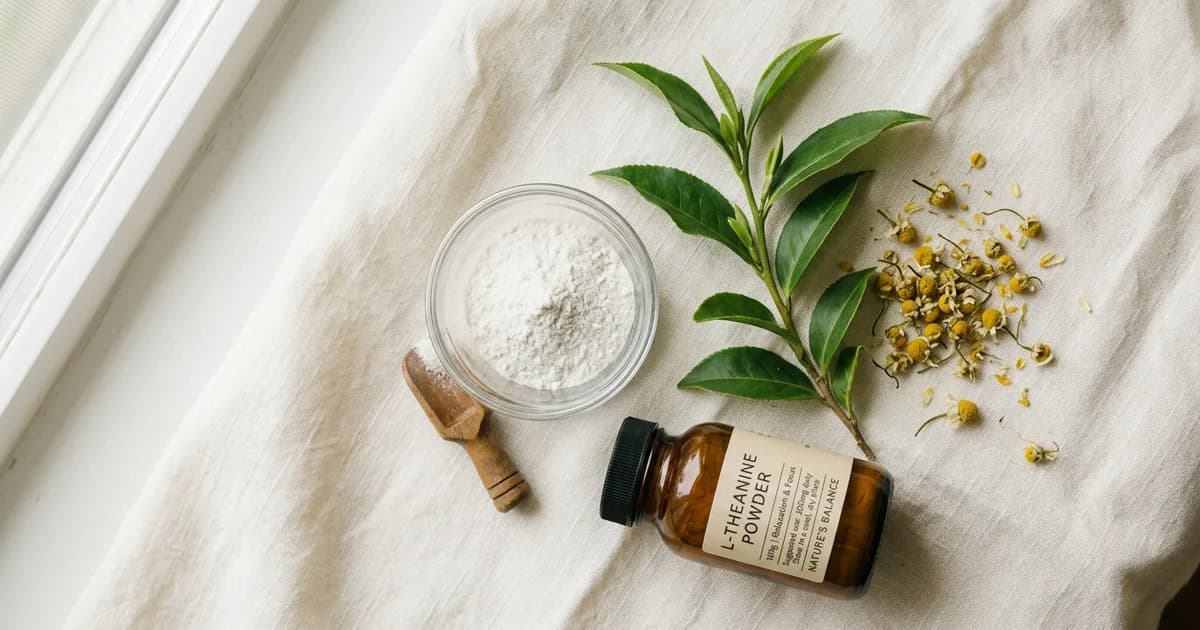
L-theanine is an amino acid found almost exclusively in tea leaves (Camellia sinensis). It crosses the blood-brain barrier and gets to work within about 30 to 60 minutes.
Its main trick: L-theanine promotes relaxation without drowsiness by increasing alpha brain waves and enhancing the production of calming neurotransmitters like GABA. Alpha waves are the brain state associated with calm, wakeful attention. Think meditation, not sedation.
The GABA and L-theanine interaction means L-theanine elevates levels of GABA, as well as serotonin and dopamine. That trio of neurotransmitters regulates mood, emotional stability, and the ability to wind down. This is why l-theanine and magnesium for sleep work differently than melatonin. L-theanine doesn't knock you out. It quiets the noise. Your brain becomes less reactive to the anxious thoughts that keep you awake.
What the Clinical Data Shows
A 2025 systematic review published in Nutritional Neuroscience looked across multiple supplementation trials and concluded that supplementation with 200-450 mg/day of L-theanine appears to be a safe and effective way to support healthy sleep in adults.
A meta-analysis on ScienceDirect pooled data from 10 studies and found that L-theanine improved subjective sleep onset latency and reduced daytime dysfunction. Translation: people fell asleep faster and felt less wrecked the next day.
One thing to flag. Most of these studies used doses of 200mg or higher. If your supplement contains 50mg of L-theanine buried in a proprietary blend, you're probably below the threshold where results start to show up. This matters whether you're taking L-theanine alone or combining l-theanine and magnesium for sleep.
L-Theanine Is Not a Sedative
This distinction matters for anyone exploring l-theanine and magnesium for sleep. L-theanine doesn't force sleep. It creates conditions where sleep comes more easily. L-theanine does not induce daytime drowsiness, which means you can take it in the evening without worrying about a hangover effect the next morning.
That's a real advantage over melatonin, antihistamines, or prescription sleep aids, all of which can leave you groggy for hours after waking.
How Magnesium Supports Sleep in an L-Theanine and Magnesium for Sleep Protocol
Magnesium is involved in over 300 enzymatic reactions in the body. One of its most relevant roles for sleep: regulating your nervous system's excitability.
Magnesium binds to GABA receptors and activates GABA to reduce excitability of the nervous system, which also explains how L-theanine and GABA compare when targeting the same calming pathway. It can also inhibit the N-methyl-D-aspartate (NMDA) receptor, promoting muscle relaxation via suppression of intracellular calcium concentration. In plain terms, magnesium acts like a brake pedal for an overactive nervous system. It calms both the brain and the body, which is why it pairs so well with L-theanine.
Here's the problem: it is currently estimated that 60% of adults do not achieve the average dietary intake and 45% of Americans are magnesium deficient, according to a review published in Nutrients. Modern diets heavy in processed food and depleted soil conditions have made magnesium insufficiency extremely common.
If your magnesium levels are low, your nervous system runs hotter than it should. You feel wired. Your muscles stay tense. Sleep suffers. This is exactly why magnesium and theanine for sleep is such a popular combination: one fills a nutritional gap while the other calms mental chatter.
The Evidence for Magnesium and Sleep
A meta-analysis on PubMed that pooled data from randomized controlled trials in older adults found that post-intervention sleep onset latency time was 17.36 minutes less after magnesium supplementation compared to placebo. Falling asleep 17 minutes faster is a meaningful difference if you're someone who routinely lies awake.
A 2025 randomized, placebo-controlled trial published in PMC tested magnesium bisglycinate in healthy adults reporting poor sleep. The magnesium bisglycinate group showed a greater reduction in ISI (Insomnia Severity Index) scores compared to the placebo group from baseline to Week 4.
But here's where it gets complicated. A systematic review on PubMed noted that observational studies suggested an association between magnesium status and sleep quality, while the RCTs reported an uncertain association between magnesium supplementation and sleep disorders. The evidence is promising but not bulletproof. Magnesium seems to help most when you're actually deficient, which, as we covered, a large percentage of people are. That's one reason l-theanine and magnesium for sleep works better for some people than others.
Which Form of Magnesium Matters
Not all magnesium supplements are the same. The form determines how well your body absorbs it and where it goes. Choosing the right form is essential if you want l-theanine and magnesium for sleep to actually deliver results.
| Form | Best For | Notes |
|---|---|---|
| Magnesium Glycinate | Sleep, relaxation | Gentle on the stomach and calming; may help with sleep, stress and anxiety |
| Magnesium L-Threonate | Brain health, cognition | A newer form that crosses the blood-brain barrier |
| Magnesium Citrate | General supplementation | Well absorbed but can cause GI issues at higher doses |
| Magnesium Oxide | Heartburn, constipation | Poorly absorbed; not ideal for sleep |
For sleep specifically, magnesium glycinate is the most commonly recommended form. It has high bioavailability and the glycine component itself has calming properties. Magnesium L-threonate is a strong second option if you're also looking for cognitive benefits, and if you're weighing L-Threonate vs L-Theanine for cognition, it's one of the few forms that effectively crosses the blood-brain barrier.
If you've been taking magnesium oxide from a grocery store shelf and wondering why your l-theanine and magnesium for sleep stack isn't working, the form is likely the issue.
Taking L-Theanine and Magnesium Together for Sleep
Combining magnesium and theanine for sleep makes sense on paper. They work through complementary mechanisms.
L-theanine helps quiet the "mental chatter" and supports focused relaxation. Magnesium supports the release of physical tension in the body. One calms the mind. The other calms the muscles. Together, l-theanine and magnesium for sleep address two of the most common reasons people can't fall asleep: a racing brain and a tense body.
There are no known negative interactions between the two. Both have strong safety profiles at standard supplemental doses, making l-theanine and magnesium for sleep a low-risk option worth trying.
Recommended Dosing
Based on the available research, here's a reasonable starting protocol for l-theanine and magnesium for sleep:
- L-Theanine: 200mg to 400mg, taken 30 to 60 minutes before bed
- Magnesium Glycinate: 200mg to 400mg elemental magnesium, taken with dinner or before bed
Start at the lower end. L-theanine is well tolerated even at high doses (studies have tested up to 900mg without serious adverse effects), but there's no reason to overshoot. With magnesium, higher doses can cause loose stools, especially with citrate forms.
What This Stack Won't Do
Let's be honest about the limits.
L-theanine and magnesium for sleep are not replacements for sleep hygiene. If you're scrolling your phone until midnight, drinking coffee at 4pm, and sleeping in a room that's 75 degrees, no supplement stack is going to override those signals.
They also won't treat clinical insomnia. If you've been struggling with sleep for months and nothing helps, that's a conversation for a doctor, not a supplement aisle.
What magnesium and theanine for sleep can do is lower the activation threshold for sleep. They make it easier for your body to do what it already knows how to do, if you give it the right conditions.
L-Theanine Beyond Sleep: The Focus Connection
Here's where L-theanine gets interesting beyond bedtime. The same properties that make l-theanine and magnesium for sleep effective at night, alpha wave promotion, GABA modulation, reduced neural noise, also make L-theanine a powerful ingredient for daytime focus when paired with caffeine.
A study published on PubMed found that 97 mg of L-theanine in combination with 40 mg of caffeine helps to focus attention during a demanding cognitive task. Another trial from Nutritional Neuroscience showed that the L-theanine and caffeine combination improved both speed and accuracy of performance of the attention-switching task at 60 min, and reduced susceptibility to distracting information in the memory task.
L-theanine smooths out caffeine's rough edges. You get the alertness without the jitters or the anxious spike. It's the reason green tea feels different from coffee, even when the caffeine content is similar.
This dual nature, calming at night, sharpening during the day, is what makes L-theanine one of the most versatile nootropic compounds available and a key reason l-theanine and magnesium for sleep has become such a popular nighttime protocol.
Build a Stack That Works Around the Clock
L-theanine and magnesium for sleep are solid choices backed by real research, especially at the right doses and in the right forms. But sleep is only half the equation. What you put into your body during the day determines how well you perform and how easily you wind down at night.
That's the thinking behind Roon. Roon's nootropic focus pouches are a zero-nicotine sublingual pouch built around a specific combination of Caffeine (80mg), L-Theanine, Theacrine, and Methylliberine. The formula is designed for 6 to 8 hours of sustained focus without the jitters, the crash, or the tolerance buildup that comes with most stimulants.
If you're already thinking about your supplement stack in terms of specific ingredients and clinical doses, whether it's l-theanine and magnesium for sleep at night or a clean focus formula during the day, you'll want to see exactly what's in it. Check out the full formula here.