Is Magnesium Bisglycinate Good for Sleep? What the Science Actually Says
Roon Team
Is Magnesium Bisglycinate Good for Sleep? What the Science Actually Says
You took magnesium oxide for a month and felt nothing. Maybe some GI distress. You're not alone, and the form of magnesium you choose matters more than most people realize. So is magnesium bisglycinate good for sleep, or is it just another supplement shelf-warmer? The short answer: it's one of the most promising forms available, and we now have a proper randomized controlled trial to back that up.
Here's what you need to know before you buy a bottle.
Key Takeaways
- Magnesium bisglycinate (also called magnesium glycinate) reduced insomnia severity in a 2025 placebo-controlled trial of 155 adults.
- The glycine component adds its own sleep benefits, acting on NMDA receptors and lowering core body temperature.
- Dosing matters: if you're wondering about magnesium glycinate how much to take for sleep, most evidence points to 200 to 400 mg of elemental magnesium taken 30 to 60 minutes before bed.
- Nearly half of Americans don't get enough magnesium from food, making supplementation a reasonable move for many people.
What Makes Magnesium Bisglycinate Different from Other Forms?
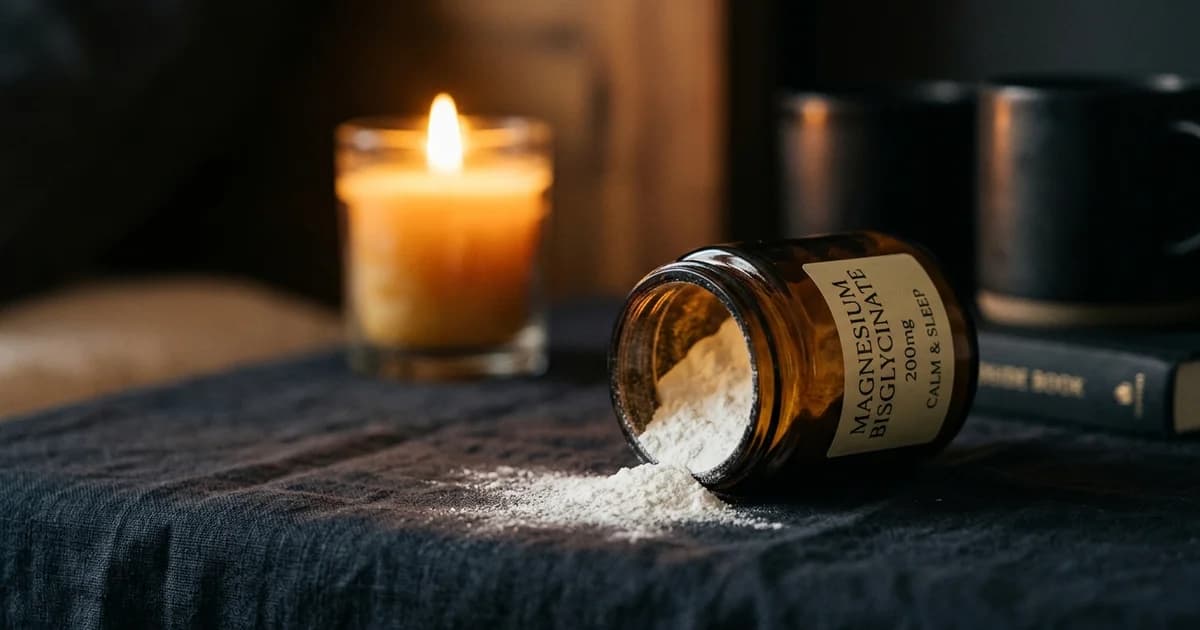
Understanding why is magnesium bisglycinate good for sleep starts with its molecular structure. Magnesium bisglycinate is a chelated form of magnesium, meaning the magnesium ion is bound to two molecules of glycine, an amino acid. This structure does two useful things.
First, it improves absorption. Chelated minerals pass through the intestinal wall more efficiently than inorganic salts like magnesium oxide. That's why oxide, despite containing more elemental magnesium per gram, is notorious for poor bioavailability and digestive side effects.
Second, the glycine itself is bioactive. Glycine is an inhibitory neurotransmitter that plays a role in sleep regulation, muscle relaxation, and nervous system calming. You're getting a two-for-one compound: the magnesium does its job, and the glycine does its own. This dual action is a key reason why is magnesium bisglycinate good for sleep compared to other forms.
Here's a quick comparison of common forms, which matters when comparing magnesium forms for sleep:
| Magnesium Form | Bioavailability | GI Tolerance | Sleep-Specific Research |
|---|---|---|---|
| Bisglycinate (Glycinate) | High | Excellent | Yes (2025 RCT) |
| Citrate | Moderate-High | Moderate | Limited |
| Oxide | Low | Poor (laxative effect) | Minimal |
| Threonate | Moderate | Good | Some (cognitive focus) |
| Taurate | Moderate | Good | Minimal |
If your primary goal is sleep, bisglycinate is the strongest pick based on current evidence.
The 2025 RCT: Is Magnesium Bisglycinate Good for Sleep According to Clinical Data?
For years, the "magnesium helps sleep" claim rested on observational data and small trials. That changed with a randomized, double-blind, placebo-controlled trial published on PubMed Central that enrolled 155 healthy adults who self-reported poor sleep quality.
Participants took either 250 mg of elemental magnesium (as bisglycinate) or a placebo capsule daily, 30 to 60 minutes before bed.
The results after four weeks: the magnesium bisglycinate group showed a statistically significant reduction in Insomnia Severity Index (ISI) scores compared to placebo. The magnesium group's ISI dropped by 3.9 points versus 2.3 points in the placebo group (p = 0.049). The effect size was small (Cohen's d = 0.2), which is honest reporting, not a reason to dismiss the finding. For anyone asking is magnesium bisglycinate good for sleep, this trial provides the strongest direct evidence to date.
One of the more interesting findings from the exploratory analysis: participants with lower baseline dietary magnesium intake saw greater improvements. This suggests that if you're already getting plenty of magnesium from food, supplementation might not move the needle as much. But if you're running a deficit (and statistically, you probably are), the effect could be more pronounced.
The trial also confirmed what users have reported anecdotally: bisglycinate is easy on the stomach. No significant adverse effects were reported compared to placebo.
How Magnesium Bisglycinate Supports Your Sleep
Magnesium bisglycinate doesn't knock you out like a sedative. It works through several quieter mechanisms that prime your body for sleep.
GABA Activation
Magnesium binds to GABA receptors in the brain. GABA is the primary inhibitory neurotransmitter, the one responsible for slowing neural activity and promoting calm. According to a review published in Dove Medical Press, magnesium acts as a GABA agonist while also blocking excitatory NMDA receptors. The net effect: less neural noise, easier transition into sleep. This GABA pathway is central to why is magnesium bisglycinate good for sleep at a neurochemical level.
Cortisol Reduction
That same review notes that magnesium supplementation can reduce serum cortisol levels. Cortisol is your stress hormone. Elevated cortisol at night is one of the most common reasons people lie awake staring at the ceiling. Magnesium bisglycinate helps dial it down.
Melatonin Support
Magnesium plays a role in the enzymatic pathways that produce melatonin, your body's primary sleep-signaling molecule. Low magnesium can mean low melatonin, which can mean a disrupted circadian rhythm. Supplementing with magnesium bisglycinate helps restore that chain.
Muscle Relaxation
This one is straightforward. Magnesium regulates calcium flow into muscle cells. Too little magnesium means excess calcium, which means muscle tension and cramps, two things that are terrible for sleep quality.
The Glycine Bonus
Here's where bisglycinate pulls ahead of other magnesium forms for sleep specifically. The glycine molecule isn't just a carrier. Research suggests that glycine supplementation at doses around 3 grams can enhance sleep quality and reduce daytime fatigue, likely by lowering core body temperature before sleep onset. You won't get 3 grams of glycine from a standard magnesium bisglycinate dose (250 mg of elemental magnesium delivers roughly 1.5 grams of glycine), but even sub-threshold amounts may contribute to the overall effect. It's a compounding benefit that other magnesium forms simply don't offer, and another reason is magnesium bisglycinate good for sleep compared to alternatives like citrate or oxide.
Magnesium Glycinate: How Much to Take for Sleep
Dosing is where most people get it wrong. They either take too little (a token 100 mg) or pick a form where the "400 mg" on the label refers to the total compound weight, not the elemental magnesium inside. Knowing magnesium glycinate how much to take for sleep can make the difference between results and wasted money.
Here's what the evidence supports:
- 200 to 400 mg of elemental magnesium daily is the range recommended by most clinical sources. Banner Health's clinical guidance puts the typical adult dosage at 200 to 400 mg daily.
- Mayo Clinic Press reports that Dr. Denise Millstine recommends 250 to 500 mg in a single dose at bedtime.
- The 2025 RCT used 250 mg of elemental magnesium, which is a solid middle-ground starting point for anyone researching magnesium glycinate how much to take for sleep.
Timing matters too. Take it 30 to 60 minutes before you plan to sleep. Consistency matters more than any single dose. The RCT measured outcomes at four weeks, not four days. Give it time.
A few practical notes:
- Check the label for "elemental magnesium." A capsule containing 1,000 mg of magnesium bisglycinate might only deliver ~140 mg of elemental magnesium. Do the math.
- The upper tolerable intake from supplements is 350 mg/day according to the NIH. Going above this isn't dangerous for most people, but it can cause loose stools.
- If you're on medication (especially blood pressure drugs, antibiotics, or diuretics), talk to your doctor first. Magnesium interacts with several drug classes.
Magnesium for Hot Flashes and Sleep: A Special Case
Women going through perimenopause and menopause often deal with a brutal one-two punch: hot flashes that wake them up, and disrupted sleep that wrecks the next day. Magnesium for hot flashes and sleep is a common search, and the interest is justified, though the evidence is nuanced.
A double-blind, placebo-controlled trial published in PMC tested magnesium oxide specifically for menopausal hot flashes and found no statistically significant reduction compared to placebo. But that study used magnesium oxide, the least bioavailable form. The question of is magnesium bisglycinate good for sleep in menopausal women specifically hasn't been tested in a dedicated trial, but the general mechanisms still apply.
The sleep angle is more promising. A review on OAText notes that magnesium has been found to improve sleep disturbances in elderly patients and reduce daytime sleepiness in women. The connection between low magnesium and menopause-related sleep disruption is plausible: estrogen decline affects magnesium retention, which affects GABA activity, which affects sleep.
The bottom line for menopausal women: using magnesium for hot flashes and sleep won't eliminate hot flashes on its own, but bisglycinate may help with the sleep disruption that accompanies them. The muscle-relaxing, cortisol-lowering, and GABA-activating properties all apply regardless of what's causing the wakefulness. For women exploring magnesium for hot flashes and sleep, bisglycinate remains the best-tolerated form to try.
Who Benefits Most from Magnesium Bisglycinate for Sleep?
Not everyone needs to supplement. But certain groups are more likely to be running low, and for them the answer to is magnesium bisglycinate good for sleep is a clearer yes:
- People under chronic stress. Stress burns through magnesium reserves. It's a vicious cycle: low magnesium increases stress reactivity, which depletes magnesium further.
- Adults over 50. Absorption efficiency declines with age, and dietary intake tends to drop.
- Anyone eating a highly processed diet. Refined grains lose most of their magnesium during processing. According to PubMed research, almost half (48%) of the U.S. population consumed less than the required amount of magnesium from food.
- Women in perimenopause or menopause. Hormonal shifts affect mineral retention.
- Athletes and heavy exercisers. Magnesium is lost through sweat.
If you fall into one or more of these categories and you're struggling with sleep, magnesium bisglycinate is a reasonable first step. Pair it with the right dose (see the section on magnesium glycinate how much to take for sleep above) and give it at least four weeks.
What Magnesium Bisglycinate Won't Do for Sleep
Let's be clear about the limits. Magnesium bisglycinate is not a sleeping pill. It won't override poor sleep habits, late-night screen exposure, or a caffeine habit that runs past 3 PM.
It also won't fix clinical insomnia caused by sleep apnea, chronic pain, or psychiatric conditions. If you've been struggling with serious sleep problems for months, see a doctor before reaching for any supplement.
What bisglycinate does well is fill a nutritional gap that, when present, makes sleep harder than it needs to be. Think of it as removing a bottleneck, not adding a turbocharger. So is magnesium bisglycinate good for sleep? Yes, especially if you're deficient, but it works best as part of a broader sleep strategy.
The Sleep-Performance Connection
Sleep quality and cognitive performance are not separate conversations. They're the same conversation.
Poor sleep degrades working memory, reaction time, and decision-making. One bad night can drop your cognitive output by 20 to 30 percent. String a few together and you're operating with a serious handicap, whether you feel it or not.
Getting your sleep right is the foundation, and if you prefer alternatives to capsules, liquid magnesium drops for sleep are another format worth understanding. Magnesium bisglycinate for sleep, proper sleep hygiene, consistent timing, cool room, no screens before bed. These are the basics that make everything else work.
And once you've handled the night, you still need to show up sharp during the day. That's where Roon fits in. It's a zero-nicotine sublingual pouch built around caffeine (80 mg), L-Theanine, theacrine, and methylliberine, designed for 6 to 8 hours of sustained focus without jitters, crashes, or tolerance buildup. Sleep well at night, perform well during the day. The two aren't competing priorities. They're the same system.