How to Improve My Reaction Time: A Science-Backed Guide for Gamers and Athletes
Roon Team
How to Improve My Reaction Time: A Science-Backed Guide for Gamers and Athletes
Your opponent peeks the corner. You see them. Your brain fires a signal down your arm. Your finger twitches on the mouse. But by the time the click registers, you're already dead. If you've ever asked yourself "how to improve my reaction time," you already know the problem. Milliseconds separate the kill from the killcam.
The average human visual reaction time sits around 250 milliseconds. Professional esports players regularly clock in at 150 to 160ms. That gap isn't just genetics. It's trainable. And the methods that close it are backed by neuroscience, not Reddit folklore.
Here's what actually works when figuring out how to improve my reaction time.
Key Takeaways
- Reaction time is a skill, not a fixed trait. Training can shave 10 to 50ms off your baseline.
- Sleep is non-negotiable. One bad night can slow your reactions by 15% or more.
- Physical exercise directly speeds up neural processing, even if you never touch a weight in-game.
- The right combination of stimulants and amino acids can measurably improve reaction time and reflexes without the downsides of caffeine alone.
What Actually Determines Your Reaction Time?
Reaction time isn't one thing. It's a chain: stimulus detection, signal processing, decision-making, and motor output. A slow link anywhere in that chain drags the whole thing down.
Your visual cortex identifies the stimulus. Your prefrontal cortex decides what to do about it. Your motor cortex fires the command. And your muscles execute. The entire sequence happens in roughly a quarter of a second for most people.
Three factors control how fast that chain fires:
- Neural efficiency: How quickly signals travel between brain regions.
- Cognitive load: How many competing processes are eating up bandwidth.
- Physiological state: Sleep quality, hydration, stimulant intake, stress levels.
You can train all three. Let's break them down.
How to Improve Reaction Time and Reflexes Through Training
Targeted Cognitive Drills
Your brain adapts to what you repeatedly ask it to do. Learning how to improve my reaction time works because drills strengthen the specific neural pathways between your visual processing centers and motor cortex.
According to Outside Online, doing focused reaction drills for just five minutes, five times a week can produce noticeable improvements within two weeks. The key is consistency. Stop training, and those gains fade.
Effective drills include:
- Ball drop tests: Have someone hold a ruler or ball at shoulder height and release it without warning. Catch it as fast as possible.
- Aim trainers: Tools like Aim Lab or Kovaak's force your brain to process randomized visual targets and respond with precision. They're standard practice for competitive FPS players researching how to improve your reaction time in gaming.
- Stroop tests and dual-task challenges: These force your brain to manage conflicting information, which builds the kind of processing speed that transfers to real scenarios.
The goal isn't just raw speed. It's reducing the gap between seeing and doing.
Physical Exercise (Yes, Really)
This is where most gamers tune out. Don't.
A systematic review published in Communications Psychology found that a single session of physical exercise improves reaction time on cognitive tasks, with cycling and high-intensity interval training showing the strongest effects. This isn't about building muscle. It's about increasing cerebral blood flow and upregulating neurotransmitter activity.
Research from PubMed confirmed that moderate-intensity aerobic exercise enhanced reaction time on executive function tasks without sacrificing accuracy. You get faster and you stay precise.
You don't need to become a gym rat. Three to four sessions per week of 20 to 30 minutes of moderate cardio will move the needle. Agility drills, like ladder runs and cone work recommended by the NSCA, add a reactive component that directly trains your neuromuscular response.
Hand-Eye Coordination Work
This one bridges the gap between physical and cognitive training. Catching a tennis ball off a wall. Juggling. Playing table tennis. These activities force your brain to predict trajectories, adjust motor plans in real time, and execute under time pressure.
BlazePod's research summary notes that regular physical activity enhancing hand-eye coordination translates directly into faster in-game reactions. The neural circuitry you build catching a ball is the same circuitry that fires when you flick to a target in Valorant.
How to Improve Your Reaction Time in Gaming: The Digital Angle
Training outside the game matters. But knowing how to improve my reaction time inside the game matters too.
Deliberate Practice Over Ranked Grinding
Playing ranked for six hours straight doesn't improve reaction time. It fatigues it. Deliberate practice means isolating the specific skill you want to improve and drilling it with full attention for shorter periods.
For FPS players wondering how to improve your reaction time in gaming, that means:
- Deathmatch with intent: Focus only on crosshair placement and first-shot speed. Ignore your K/D ratio.
- Custom scenarios in aim trainers: Set up drills that mimic the specific reaction challenges of your game. Tracking for Apex. Flicking for CS2. Switching for Overwatch.
- VOD review: Watch your deaths. Identify whether you died because of slow reactions, bad positioning, or poor decision-making. Most players blame reaction time when the real problem is anticipation.
According to Dot Esports, consistent practice schedules matter more than marathon sessions. Short, focused blocks of 15 to 30 minutes produce better adaptation than hours of unfocused play.
Reduce Your Input Lag
Before you train your brain, make sure your hardware isn't the bottleneck.
| Factor | Impact on Perceived Reaction Time |
|---|---|
| Monitor refresh rate (60Hz vs 240Hz) | Up to 12ms difference in frame delivery |
| Mouse polling rate (125Hz vs 1000Hz) | Up to 7ms difference in input registration |
| Display response time (5ms vs 1ms) | 4ms difference |
| Network latency (50ms vs 10ms) | 40ms difference |
A player on a 240Hz monitor with a 1000Hz mouse is seeing and sending information tens of milliseconds faster than someone on a 60Hz setup. That's not skill. That's physics. Eliminate hardware lag first, then train the wetware.
How to Improve My Reaction Time Through Recovery: Sleep, Stress, and Nutrition
Sleep Is Your Biggest Performance Variable
A 2025 study published in Frontiers in Neuroscience found that sleep deprivation leads to increased reaction time and reduced alertness. Another study from PMC measured choice reaction time in sleep-deprived subjects at 281ms compared to a baseline of 244ms. That's a 15% degradation from one night of poor sleep.
No amount of training compensates for bad sleep. Seven to nine hours. Every night. Non-negotiable if you want to improve reaction time and reflexes.
Hydration and Blood Sugar
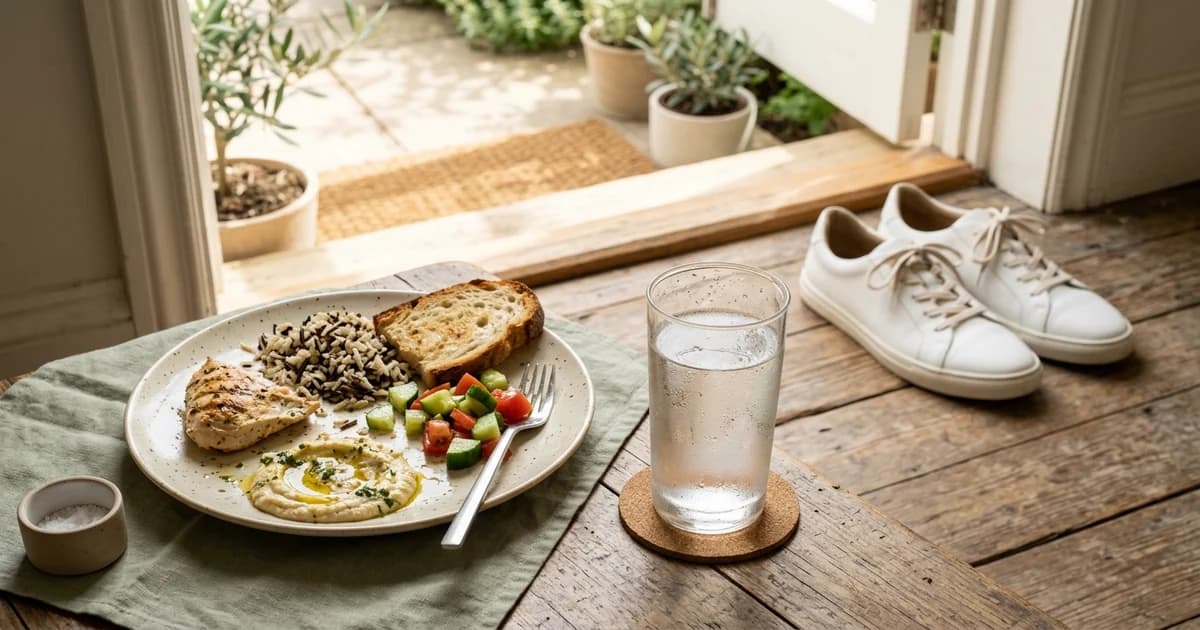
Dehydration of just 1 to 2% of body weight impairs cognitive function. Your brain is roughly 75% water, and even mild dehydration reduces the speed of neural signaling. Keep a water bottle at your desk. Drink before you feel thirsty.
Blood sugar crashes are equally destructive. If you're gaming on an empty stomach or after a high-sugar energy drink spike, your reaction time will suffer during the inevitable crash. Steady, moderate-glycemic meals keep your brain fueled without the rollercoaster.
The Neurochemistry Behind How to Improve My Reaction Time
Here's where most reaction time advice stops. But the neurochemical environment of your brain is arguably the most controllable variable in the entire chain.
Caffeine: Effective but Incomplete
Caffeine blocks adenosine receptors, reducing drowsiness and increasing neural firing rates. It works. But caffeine alone comes with jitter, tolerance buildup, and an inevitable crash that leaves you slower than baseline.
The Caffeine + L-Theanine Stack
A study published on PubMed tested a combination of 97mg L-Theanine and 40mg caffeine and found it improved accuracy during task switching and increased subjective alertness. L-Theanine, an amino acid found in tea, promotes alpha brain wave activity, which is associated with calm, focused attention. Combined with caffeine, it smooths out the stimulant curve: faster reactions without the anxious edge.
A double-blind study on elite curling athletes found that combined caffeine and L-Theanine intake produced the best reaction times during cognitive reaction tasks compared to either compound alone or placebo. Anyone asking how to improve reaction time and reflexes should consider this stack.
Adding Theacrine and Methylliberine
The stack gets more interesting when you add Theacrine (TeaCrine) and Methylliberine (Dynamine) to the mix. A randomized crossover study on PubMed tested 50 young male egamers and found that a combination of caffeine, Theacrine, and Methylliberine increased cognitive performance and reaction speed without negatively affecting mood. A double-blind trial on tactical personnel showed similar reaction time benefits between high-dose caffeine alone and a lower-dose caffeine combined with Methylliberine and Theacrine, suggesting the combination achieves comparable cognitive speed with less total stimulant load.
That's the principle behind the most effective nootropic stacks: don't just hit the gas. Smooth out the ride so you can sustain the speed.
Gain the Edge
You can train your reflexes. You can optimize your sleep. You can upgrade your monitor. All of those things help you improve my reaction time, and you should do them.
But the fastest way to close the reaction time gap is to address every link in the chain at once, including the neurochemical one. Roon is a zero-nicotine sublingual pouch built on exactly the stack the research supports: 80mg caffeine, L-Theanine, Theacrine, and Methylliberine. In testing, it delivered 11.5% faster reaction times with 6 to 8 hours of sustained focus, no jitters, and no crash.
You don't need another energy drink. You need a cleaner signal between your brain and your hands. Try Roon and feel the difference where it counts.