Attention Span Book
Attention Span Book: What Gloria Mark's Research Actually Says About Your Brain
You spend an average of 47 seconds on a screen before your attention drifts somewhere else. Not 47 minutes. Seconds. That number comes from Dr. Gloria Mark, a Chancellor's Professor of Informatics at UC Irvine, and it sits at the center of her attention span book, Attention Span: A Groundbreaking Way to Restore Balance, Happiness and Productivity. If you've felt your ability to concentrate eroding over the past decade, this attention span book confirms you're not imagining it.
But here's what most summaries of the attention span book get wrong: the problem isn't just technology. It's you. Mark's data shows that we interrupt ourselves more often than we're interrupted by external sources. That reframes the entire conversation about focus, distraction, and what it actually takes to think clearly in 2025.
Key Takeaways:
- Our average attention on a single screen dropped from 2.5 minutes in 2004 to 47 seconds by 2016.
- Self-interruption is more common than being interrupted by someone else.
- Constant task-switching raises stress levels, measurable through heart rate variability.
- Mindless activity (like simple games) can actually help you recover mental energy, if used strategically.
The Core Finding in This Attention Span Book: 47 Seconds and Falling
Mark didn't arrive at that 47-second figure through a survey or self-report. She and her team observed real people in real workplaces over nearly two decades, using screen-logging software and stopwatches in what she calls "living laboratories". The methodology matters because people are terrible at estimating their own attention spans. We think we focus for much longer than we actually do.
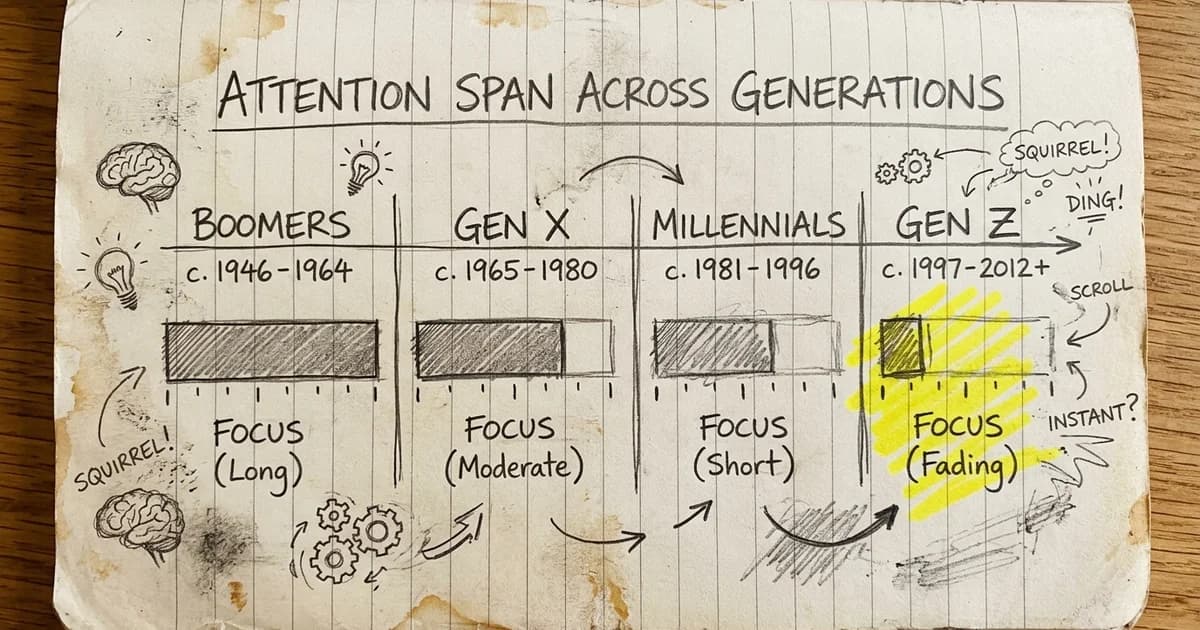
The trend line is steep. According to an interview with the American Psychological Association, Mark found the average attention span on any screen was 2.5 minutes in 2004. By 2012, it had dropped to 75 seconds. By 2016, it was down to 47 seconds, with a median of just 40 seconds, meaning half of all observations were even shorter.
That's not a gradual decline. That's a collapse. And it happened in just over a decade.
To put it differently: in the time it took smartphones to go from novelty to necessity, the average person's ability to sustain attention on a single task shrank by more than 80%. Mark's attention span book doesn't just describe a trend. It quantifies a fundamental shift in how human brains interact with digital environments.
The Attention Span Book's Biggest Surprise: You're Doing This to Yourself
The instinct is to blame notifications, Slack pings, and open-plan offices. Mark's research tells a different story. As described on the book's Amazon listing, her data reveals that "we interrupt ourselves more than we're interrupted by others."
Think about the last time you were working on something difficult. Did your phone buzz, or did you just... pick it up? That impulse to check email, open a new tab, or glance at social media is a self-generated interruption. And once you break your own focus, Mark's research shows it takes roughly 25 minutes to fully return your attention to the original task.
This is the detail that separates the attention span book from the standard "phones are bad" narrative. The enemy isn't just the technology. It's the habits your brain has built around that technology. Any reader of this attention span book will recognize the pattern in their own behavior almost immediately.
Four Myths Mark Dismantles
One of the strongest sections of the attention span book is Mark's systematic takedown of common assumptions about attention and productivity. She outlines four myths on her website that structure much of the book's argument.
Myth 1: You Should Always Be Focused
Mark compares sustained attention to lifting weights. You can't hold a barbell overhead indefinitely, and you can't maintain deep focus for hours without rest. The guilt people feel about losing focus is often misplaced. Your brain needs periods of lower engagement to recover its capacity for concentration.
This is a liberating reframe. Instead of treating every moment of distraction as a personal failure, the attention span book suggests viewing your attention as a rhythm, one that naturally alternates between high-effort and low-effort states throughout the day. The goal isn't constant focus. It's knowing when to push and when to let your mind coast.
Myth 2: Mindless Screen Time Is Always Wasted Time
Playing a simple phone game or scrolling through low-effort content isn't automatically destructive. Mark's research found that people report being happiest during rote, low-challenge digital activities. According to a University of California interview with Mark, these activities have "a calming influence on people" and can help replenish spent mental resources. The catch: this only works when it's intentional and time-limited, not a three-hour doom scroll.
Myth 3: Notifications Are the Main Problem
External notifications get blamed for our fractured attention, but this attention span book argues it's more complicated. The deeper issue is the internal trigger, the conditioned impulse to seek stimulation when a task gets difficult or boring. Turning off notifications helps, but it doesn't address the root behavioral pattern.
Myth 4: Multitasking Makes You More Productive
This one has been debunked before, but Mark adds physiological data. As she described in an interview on Annie Duke's Substack, her team used heart rate monitors alongside screen-tracking software. The correlation was clear: "the faster the switching, the higher the stress is as measured by heart rate variability." Multitasking doesn't just reduce output quality. It physically stresses your body.
The Stress Connection: What This Attention Span Book Reveals About Your Body
This is where the attention span book goes beyond productivity advice and into health territory. Mark's team didn't just track what people clicked on. They strapped heart rate monitors to participants and measured physiological stress alongside digital behavior.
In one study, described in a podcast with neuroscientist Dr. Phil Stieg, Mark's team had workers turn off email for an entire work week. The results: participants focused for longer stretches on each screen, and their measured stress levels dropped. The connection between attention fragmentation and elevated stress isn't theoretical. It shows up in heart rate data.
The stress hormone cortisol rises during rapid task-switching. Blood pressure increases. People report feeling burned out, exhausted, and mentally depleted. As noted in a discussion on Singularity University's platform, Mark explained that "blood pressure has been shown to rise" and "the secretion of the stress hormone, cortisol increases" during sustained multitasking.
This creates a feedback loop. Fragmented attention causes stress. Stress makes it harder to focus. Harder focus leads to more self-interruption. And the cycle continues.
If you've ever ended a workday feeling exhausted despite not producing much, this is probably why. Your brain spent the day in a state of constant low-grade switching, never settling into deep work long enough to produce results, but burning through energy and cortisol as if it had. The subjective experience is brain fog, fatigue, and the nagging sense that you can't think straight. It's exactly the kind of problem this attention span book documents so well.
What the Attention Span Book Gets Right (and Where It Leaves You Wanting More)
Mark's strength is her data. Two decades of observational research in real workplaces gives her findings a weight that lab-only studies can't match. The 47-second statistic alone has reshaped how organizations think about knowledge work, open offices, and digital tool design.
The attention span book also introduces the concept of "kinetic attention," as noted by Storyboard18's review, which describes a more balanced understanding of how we naturally oscillate between deep focus and lighter cognitive states. This framing is useful. It removes the moral judgment from distraction and treats attention as a resource that fluctuates throughout the day.
Where the attention span book is less satisfying is in its solutions. Mark offers solid behavioral advice: be intentional about breaks, use "meta-awareness" to notice when you've drifted, schedule focused blocks, and reduce environmental triggers. These are good strategies. But they require a level of discipline that, by definition, is hard to access when your attention is already depleted.
The book diagnoses the problem with precision. The prescription is reasonable but incomplete. Behavioral strategies work best when your neurochemistry is already cooperating with you, not fighting against you.
The Neurochemistry Beneath the Behavior
Mark's attention span book documents what happens at the behavioral level. But beneath every self-interruption, every impulse to check your phone, there's a neurochemical event.
Adenosine builds up in your brain throughout the day, creating the sensation of mental fatigue and fog. It accumulates as a byproduct of neural activity, and the more cognitively demanding your day, the faster it piles up. This is the molecule that makes your eyelids heavy at 2 PM, even when you slept well.
Dopamine circuits drive the reward-seeking behavior that pulls you toward your phone mid-task. Every time you check a notification and find something mildly interesting, you get a small dopamine hit that reinforces the switching habit. Your brain literally learns to prefer distraction over sustained effort. The attention span book captures this pattern perfectly, even if it doesn't address the chemistry behind it.
GABA, your brain's primary inhibitory neurotransmitter, regulates whether you can sustain calm, controlled focus or whether your mind races from thought to thought. When GABA signaling is weak, the prefrontal cortex loses its ability to suppress irrelevant stimuli, and everything becomes a potential distraction.
The behavioral fixes this attention span book recommends are sound. But they work better when the underlying chemistry supports them. That's the gap between knowing you should focus and actually being able to.
Cut Through the Fog
If the research in the attention span book resonates with you, and you're looking for something that works at the neurochemical level, Roon was built for exactly this. It's a zero-nicotine sublingual pouch with a stack of Caffeine (80mg), L-Theanine, Theacrine, and Methylliberine that targets the adenosine, GABA, and dopamine pathways behind brain fog and scattered focus. No jitters. No crash. No tolerance buildup. Just 6 to 8 hours of clean, sustained attention, the kind Mark's attention span book shows we're all struggling to maintain.
Try Roon and give your brain the chemistry it needs to actually follow through on the focus strategies that work.